Moving Company Website Cost and the Survey That Prices Every Move
Removal firms put $119 into twelve months of site hosting, or settle a $19 bill each month instead, and also buy a domain. Topics: how people pick a mover, move pages, surveys and quotes, packing, cover for belongings, moving day, warning signs, search and the yearly bill.
- No coding required
- Live in minutes
- Blog, SEO and chatbot tools included
Removal companies hand AI Web Maker $119 for a year of website hosting, or $19 on any month they choose to pay separately, and the domain is bought alongside. Not a cent goes to AI Web Maker while the van photos and move pages take shape in the preview. One household move, even a short local one, usually earns several times that yearly sum. Trust is the hard part of this trade, because a family is handing over everything it owns to strangers, and stories of quotes that double on the day make people wary. Easyhaul Movers, a removals firm invented for the moving company website example AI Web Maker built, meets that wariness with pages on quotes, stairs and lifts. A moving company website has to show real vehicles and crews, explain exactly how the price is worked out and set calm expectations for a stressful day. What follows looks at how people shortlist movers, the move pages, surveys and pricing, packing, cover for belongings, moving day, warning signs, search and the year's hosting bill.
This article is part of our complete guide: Home Services Website Builder.
Families, renters and offices: how a mover gets shortlisted
People rarely hire the first mover they find, because the stakes feel high and the price differences can be large. Families moving house compare several quotes, often weeks ahead, and look closely at reviews and photos of real crews. Renters moving from a flat want a quick, fair price for a smaller load and clear answers about stairs and parking. Older people downsizing value patience, packing help and a firm that will take time over furniture with sentimental value. Businesses moving offices care about weekend work, minimal downtime and careful handling of computers and files. Removal firms whose pages answer each group in its own terms land on far more shortlists.
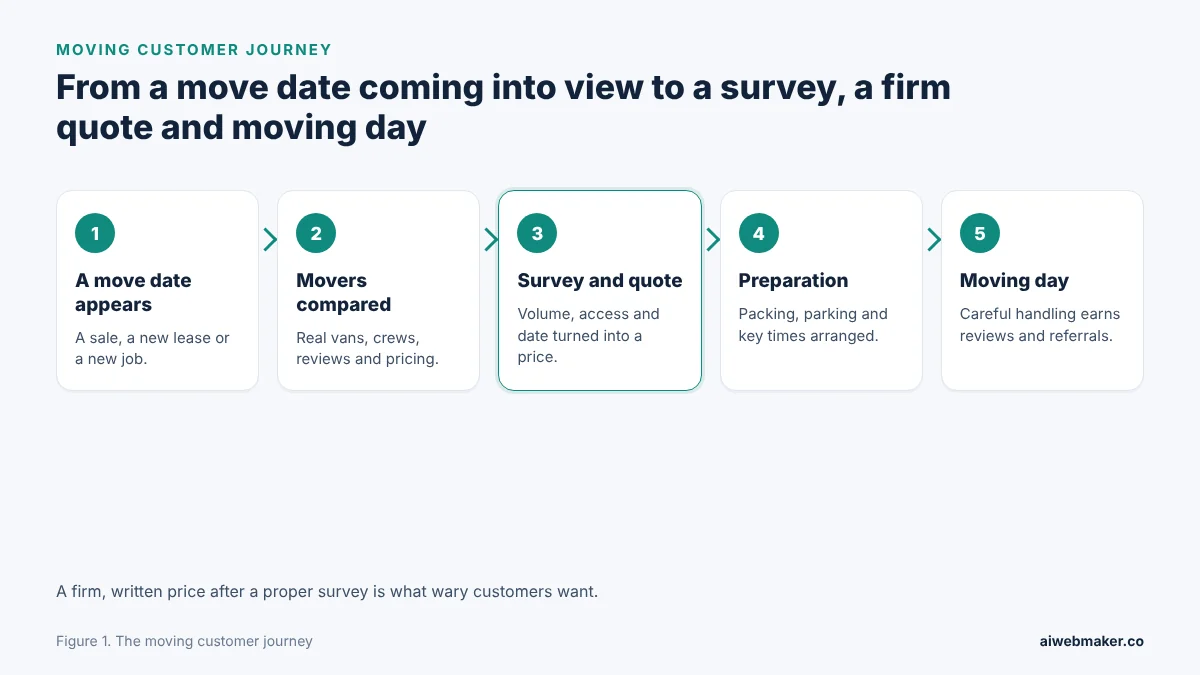
Out of these five stages, the survey and quote step decides most moves, because that is where a vague estimate becomes a firm price the customer can trust. The journey begins when a move date comes into view, often after a sale, a new lease or a job change. Comparing movers comes next, with reviews, vehicles and clear pricing doing most of the work. A survey, whether in person, by video or from a detailed list, turns the contents of a home into a volume and a price. Moving day itself, and how carefully belongings arrive, decides whether the company earns reviews and referrals. A website that makes the survey easy to arrange removes the biggest barrier between interest and a booked move.
Local, long distance, office and freight: the move pages
Each type of move raises its own questions, so a moving company website works best with a page for each service it offers. A local house move needs clear answers about crews, vans and how the day runs. Long distance and international moves raise questions about timings, overnight storage and, for crossing borders, customs paperwork. Office moves turn on weekend work and the safe handling of equipment, while single items such as pianos or antiques need specialist care. Packing, storage and regular freight loads can each have a short page of their own. A table helps decide what each page must answer first.
| Move type | Main worry | What the page should say |
|---|---|---|
| Local house move | Price and timing on the day | Crew sizes, vans, typical durations |
| Long distance move | Delivery date and overnight safety | Timings, secure storage, tracking updates by phone |
| International move | Paperwork and shipping times | Customs help, partner networks, timelines |
| Office move | Downtime and equipment | Weekend work, labelling, IT handling |
| Single and specialist items | Damage to valuable pieces | Equipment, training, extra cover |
| Packing and storage | Time and fragile items | Materials, full or partial packing, storage terms |
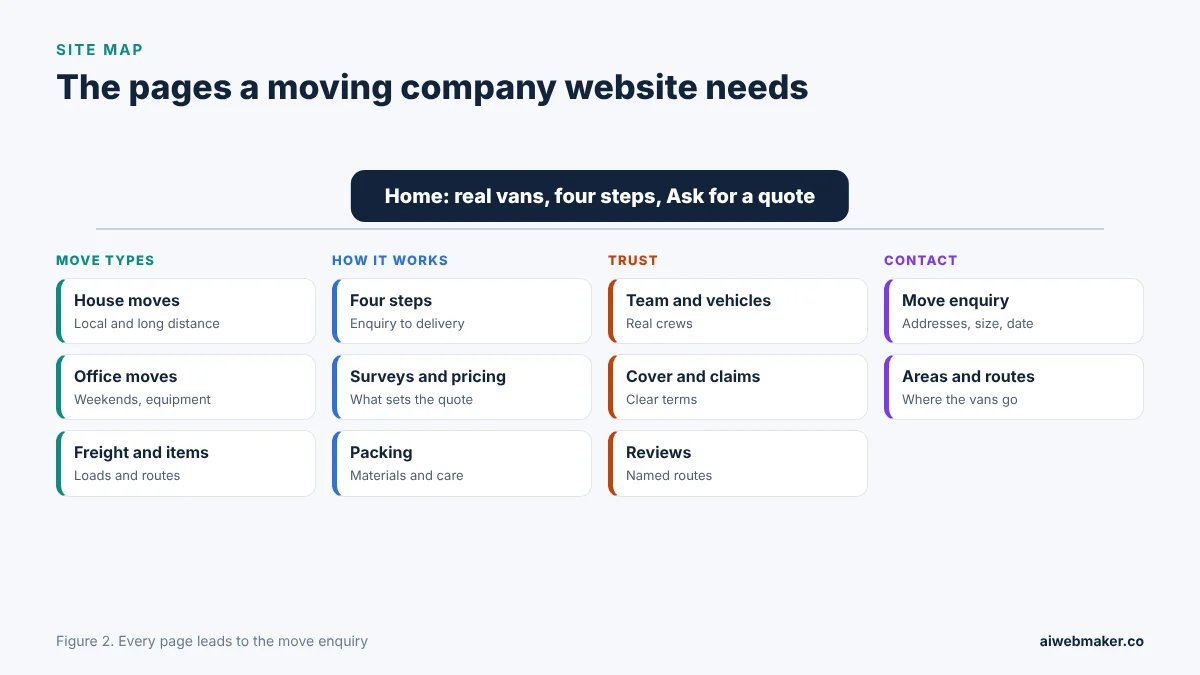
Arranged around the enquiry, the moving company's pages fall into move types, how it works, trust and contact. Move type pages cover house moves, long distance work, offices and freight. How it works pages explain surveys, pricing and moving day. Trust pages show the team, the vehicles, insurance and reviews. Our sample business, Easyhaul Movers, uses a moving or freight enquiry form on its contact page, linked from its services page and from a dedicated page that sets out four simple steps, while its home page traces the path from enquiry to delivery. The services page describes the types of items and loads it handles and the areas and routes it serves, and the about page gives the team and vehicles their own heading beside the company's story; the moving company website example with a moving and freight enquiry form was built in 53 seconds.
Surveys, volume and what really sets the price
A moving quote is only as accurate as the survey behind it, so the website should explain how the company measures a move before it names a figure. In person surveys suit large homes, while video surveys and detailed room by room lists work well for flats and straightforward moves. Volume is the main driver, followed by distance, access, the date and any packing or specialist items. Rules on quotes vary between countries, and in the United States, for example, movers carrying household goods across state lines must be registered with the federal motor carrier regulator. A written quote that lists what is included and what could change it protects both sides. Customers who understand these factors compare quotes fairly instead of chasing the lowest number.
| Price factor | Why it changes the quote |
|---|---|
| Volume of belongings | Decides the van size, crew and hours |
| Distance | Fuel, driving time and possible overnight stops |
| Access | Stairs, lifts, long carries and narrow streets |
| Parking | Permits or suspended bays near each home |
| Date and day | Month ends, Fridays and holidays are busiest |
| Packing and dismantling | Extra materials and crew time |
| Specialist items | Pianos, safes, artwork and heavy appliances |
Packing, protection and fragile items
Careful packing prevents most moving damage, and a page devoted to it tells customers the company treats their belongings as its own. Furniture should be wrapped in blankets or covers, with corners protected and drawers secured. Mattresses need covers, mirrors and glass need rigid cartons or crates, and electronics travel best in their original boxes or well padded cartons. Appliances may need disconnecting before the move, and gas appliances in particular should be handled by a qualified engineer under local rules. Customers who pack themselves should get advice on box weights and labelling by room. A clear packing page reduces breakages, claims and stressful conversations at the new address.
| Item | How a careful mover handles it |
|---|---|
| Wooden furniture | Blankets, corner guards, drawers secured |
| Mattresses and sofas | Fitted covers against dirt and tears |
| Mirrors, glass and artwork | Rigid cartons or made to measure crates |
| Televisions and computers | Original boxes or padded cartons |
| Washing machines and fridges | Disconnected and secured for transport |
| Books and heavy items | Small boxes to keep weights manageable |
Cover for belongings, and what happens if something breaks
Cover for belongings is one of the first questions customers ask, and the honest answer depends on the company's insurance and the rules where it operates. Some movers include basic liability cover with a limit per item or per load, while fuller protection may cost extra. Customers should be told to declare high value items before the move, since limits often apply to jewellery, artwork and antiques. The website should explain how to report damage, how quickly claims must be made and whether items should be checked as they are unloaded. Typical arrangements differ a great deal from one country to another, which is why the company's own terms belong on the page rather than general promises. Clear terms prevent disputes and show a firm that expects to stand behind its work.
Access, parking and the moving day timeline
Moving day runs smoothly when access is planned in advance, and the website can show customers exactly what they need to arrange. Parking permits or suspended bays may be needed outside both homes, depending on local rules. Flats with lifts may require a booking with the building manager, and long carries or narrow stairs should be mentioned at the survey. Key handovers can be delayed when a sale completes late, so the page should explain what happens to the van and crew while everyone waits. The AI website builder for moving companies with move and freight enquiry pages drafts the services, how it works, about and contact pages after the company describes its moves and routes in a short note. A timeline on the website turns a stressful day into a sequence the customer can follow.
| Moving day stage | What happens |
|---|---|
| Arrival | Crew introduces itself and walks the rooms with the customer |
| Protection | Floors, doorways and banisters covered |
| Loading | Heavy and essential items placed in a planned order |
| Travel | Customer told the expected arrival time |
| Unloading | Boxes placed by room labels, furniture positioned |
| Finishing | Beds rebuilt, packaging collected, final walk round |
Warning signs of a rogue mover
Customers who have heard horror stories about movers will look for reasons to trust or distrust any company, and a website can address those fears directly. Rogue operators often quote very low without a survey, ask for large cash payments upfront and give no physical address. Some raise the price once belongings are loaded, which is why written quotes and clear terms matter so much. A real company shows its address, its vehicles, its team, its insurance and, where it applies, its registration or trade association membership. Explaining these signs helps customers judge every quote, including the company's own. Honest advice of this kind sets a professional mover apart from the operators that give the trade a bad name.
Searches that start a house move
People planning a move type phrases such as movers near me, removal company, long distance movers, office relocation or packing service, often with their town or the two cities involved. Naming each move type page after its search phrase means a query for office relocation lands on the office page rather than the home page. Real van photos, accurate hours and the site address on a map listing pull in a good share of local searches. Reviews that mention careful handling, punctual crews and a final price that matched the quote are the strongest reassurance a mover can earn. Articles such as a moving checklist, a guide to packing a kitchen or tips for moving with pets attract people weeks before they choose a company. A site that helps during the planning stage is the one people trust on the day.
Removal firm hosting set against one household move
For a moving company's site, the charges that come back each year are hosting and the domain, and each moving guide drafted with AI credits adds roughly $0.65. A firm with steady bookings pays least by taking the yearly option. A new operator with one van may prefer to keep payments monthly through the first busy season. Adding routes, new vehicles or extra services never raises the hosting price. The table compares yearly and monthly totals for a removal firm, with the $189 tier added purely for scale.
| Item | Yearly | Monthly |
|---|---|---|
| Hosting the moving company pages | $119 | $228 over twelve months |
| Domain | Depends on the ending | Depends on the ending |
| Higher plan, for comparison | $189 a year | Not needed |
| Twelve moving and packing articles at about $0.65 | About $7.80 | About $7.80 |
| Routes, vehicles and service changes | No charge | No charge |
| Year before the domain | About $126.80 | About $235.80 |
Website gaps that cost a mover the survey visit
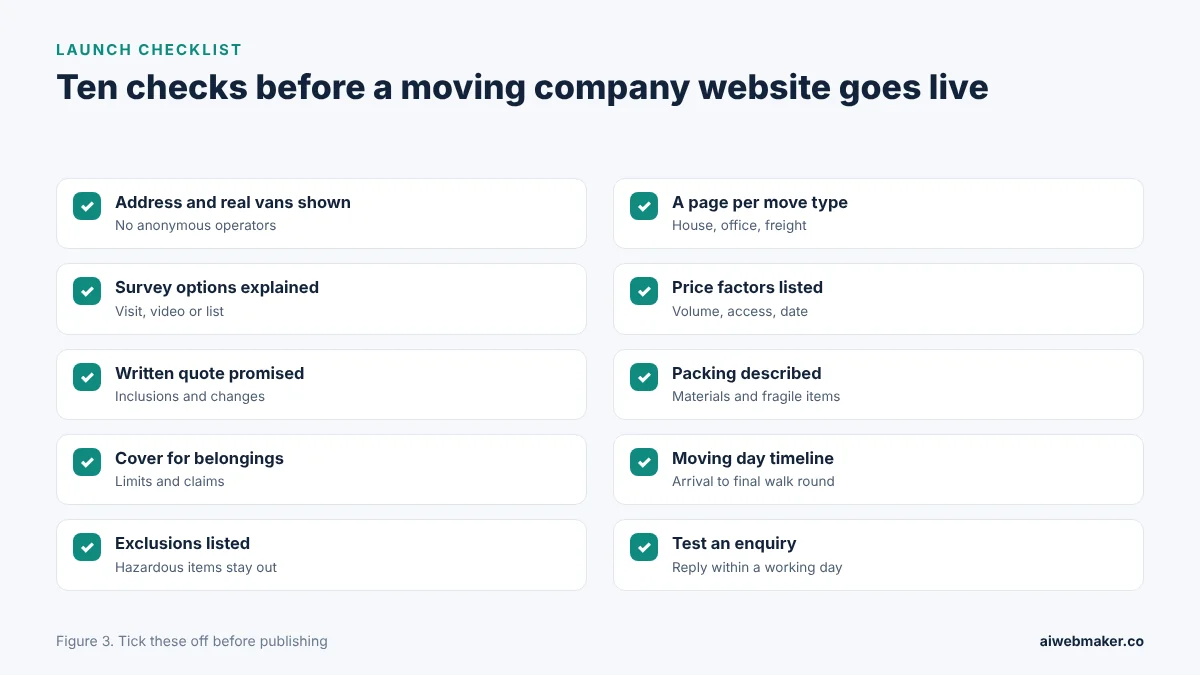
A cautious customer closes a moving website when there is no address, no photos of real vans and no sign of who will actually turn up. When the site never explains what drives a moving quote, every figure looks like a starting bid. No word on cover for belongings leaves families worried about the one item they cannot replace. A survey that seems hard to arrange pushes people towards whichever company replies first. Silence on packing, parking and moving day details makes the whole move feel uncertain. Each of these gaps is closed by one of the ten checks gathered in the mover's checklist below.
Frequently asked questions
How far ahead should a house move be booked?
A house move is best booked as soon as the date is reasonably certain, because popular days fill quickly. Month ends, Fridays and school holidays are usually the busiest times. Flexible customers can often find better availability midweek or mid month. The survey can happen before the date is fixed, so the quote is ready when contracts are signed. A note on the website about busy periods helps customers plan well ahead.
Is a video survey as accurate as a home visit?
A video survey can be very accurate for most homes, provided the customer shows every room, cupboard, loft and garage during the call. Larger or more complex moves may still benefit from an in person visit. Items stored out of sight are the most common cause of a quote being wrong. The company can confirm anything unclear before issuing the written price. Explaining both options on the website lets customers choose the one that suits them.
Will the movers take apart and rebuild furniture?
Many movers dismantle and rebuild beds, wardrobes and tables as part of the service, but the website should state whether this is included or charged separately. Flat pack furniture can be fragile when taken apart, so customers should mention it during the survey. Screws and fittings should be bagged and labelled with each item. Fitted furniture or wall units may need a carpenter rather than a removal crew. Clear terms prevent surprises when the crew arrives.
What should stay out of the moving van?
Hazardous items such as gas bottles, fuel, paint, chemicals and aerosols usually cannot travel in a removal van, and the website should list them clearly. Valuables, important documents, medicines and keys are best carried by the customer. Plants, food and pets need their own plans, especially on long journeys. Rules on dangerous goods vary between countries, so the company's own list is the best guide. A clear exclusions list keeps crews safe and prevents arguments on the doorstep.
One house move and the year is paid
A single local house move typically covers the $119 removal firm hosting bill several times over. The monthly $19 is less than one hour of a two person crew's time. Every family or office that books after reading the survey, packing and cover pages adds a job the website helped secure. Real vans, clear pricing factors and honest terms persuade wary customers more than any slogan about care. Firms that add new reviews and vehicle photos keep that trust current. A diary of surveyed, well priced moves is how a moving company knows the site is earning its place.
Build your website in Minutes and get the AI Tools that work
Start Building Your Website →