Mold Remediation Website Cost and Pages That Trace the Water First
Mould removal firms stay hosted all year for $119, or pay $19 in each monthly cycle, then buy the domain at its going rate. Covered: customers, service pages, causes, containment, health wording, landlords and reports, inspections, search and the budget.
- No coding required
- Live in minutes
- Blog, SEO and chatbot tools included
A mould removal company spends $119 to stay hosted on AI Web Maker all year, or $19 per monthly cycle, and buys its domain at the going rate. No AI Web Maker charge arises while the cause tables, treatment cards and inspection page are drafted, then reread in the preview before launch. One contained clean of a single bedroom normally earns more than the hosting year. The real test for this trade is credibility, because householders have seen mould wiped away only to return a month later, and landlords have paid for treatments that never touched the cause. A firm that explains where the water comes from, how removal is contained and what it will fix wins the careful customers. The sections that follow look at customers, service pages, causes, containment, health wording, landlords and reports, inspections, search and a yearly budget.
This article is part of our complete guide: Home Services Website Builder.
Black spots, musty smells and worried landlords: who books a mould inspection
Mould enquiries usually start with something seen or smelt, and the person searching is often anxious. A parent notices black spots spreading across a child's bedroom ceiling every winter. A tenant finds mould behind a wardrobe and wants an independent view before talking to the landlord. Landlords and letting agents want a written report that explains the cause and the fix. Homeowners recovering from a leak or a flood want the building dried properly before mould takes hold. Each of them wants to know why it grew, whether it will return and what the work will involve for the people living there.
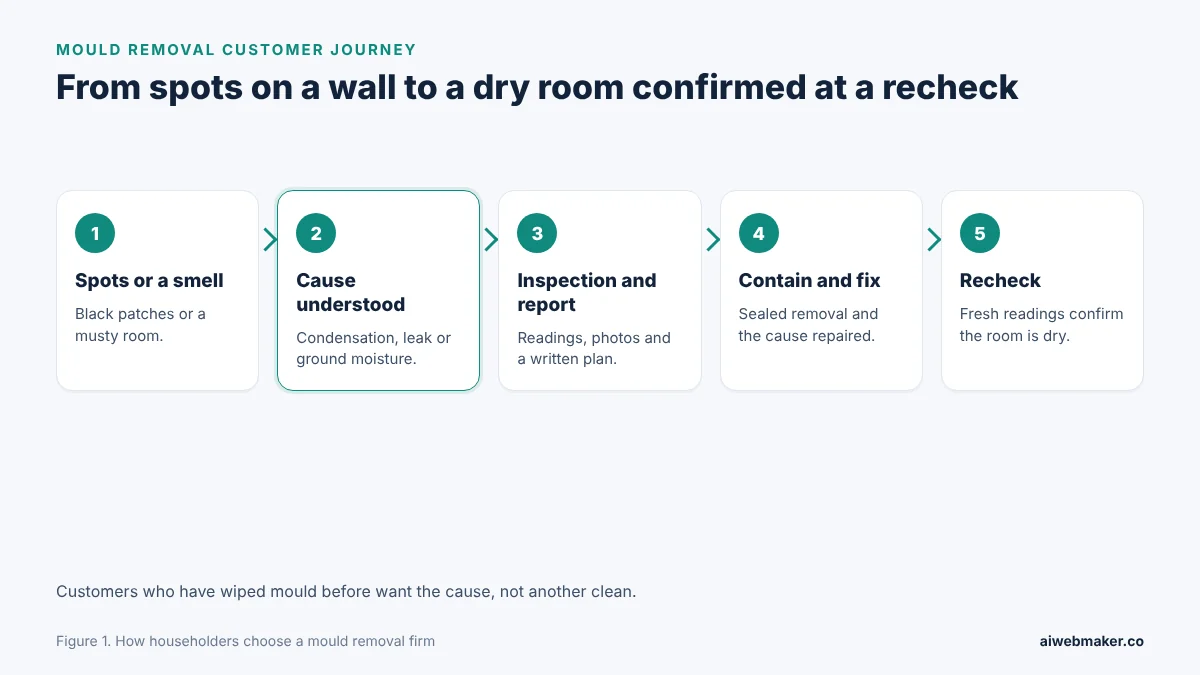
Seen as a path, the job moves from worry to proof in five stages, and the second one shapes the rest. Something visible or a smell starts the search. The highlighted stage is understanding the cause, because customers who have already wiped mould away several times want to know why it keeps coming back. An inspection with moisture readings and a written report follows. Contained removal and the repair of the cause come next, finished by a recheck that confirms the room has stayed dry. A site that explains causes clearly earns the inspection that makes everything else possible.
Causes, inspection and treatments: pages a mould removal company needs
A mould removal site should be organised around the water rather than the mould, because the cause decides the treatment. A section reading common patterns of mould and their likely sources helps visitors recognise their own situation. The inspection page explains the readings taken and the report produced. Treatment cards describe contained cleaning, removal of damaged materials, ventilation, repairs, drying out and finishing. Pages on living at home during the work and on landlord reports answer the practical questions that follow.
| Page or section | What the customer asks | What it should explain |
|---|---|---|
| Why the mould grew | Is it condensation or a leak? | Common patterns and their moisture sources |
| Inspection | What will be checked? | Moisture readings, humidity, thermal camera |
| Contained cleaning | Will spores spread? | Sealing the area, filtered air, safe cleaning |
| Removing damaged materials | Does plaster need to go? | When porous materials are cut out |
| Ventilation and repairs | Will it come back? | Fans, vents, leaks and cold spots fixed |
| Living at home | Can the family stay? | Sealed rooms, timing, clean up |
| Reports and landlords | Who pays and what is recorded? | Written findings, photos, recheck |
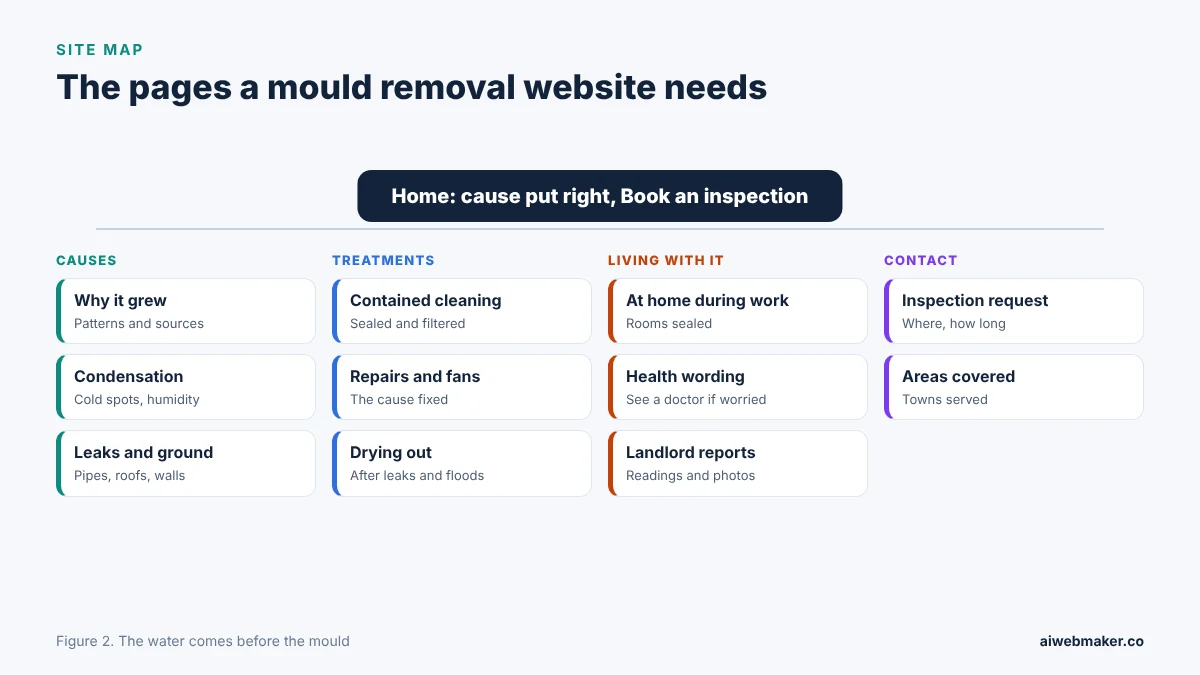
Four groups emerge on the map: causes, treatments, living with the work and contact. Cause pages cover condensation, leaks and the inspection that tells them apart. Treatment pages carry containment and removal, ventilation and repairs, and drying out. The sample business here, Dryhaven Mould Removal, opens with a table of why the mould grew and an inspection that finds the water first. Its treatment cards cover contained mould cleaning, removing damaged materials, ventilation and extraction, leak and source repairs, drying out after a leak, and finishing and protection. The mold remediation website example that traces the water before cleaning continues with a five step sequence, notes on living at home during the work, recent jobs, questions and an inspection request.
Reading the pattern: what mould on a wall says about its water source
Where mould appears tells an experienced inspector a great deal about where the moisture comes from, and sharing that knowledge builds trust. Black spots in the top corners of bedrooms that worsen each winter usually point to condensation and cold spots. A dark patch under a window may come from condensation running off the glass or from a failed seal. Mould behind furniture pushed against an outside wall suggests cold, still air. A musty smell under a sink often means a slow plumbing leak. Mould low on ground floor walls with a tide mark may indicate moisture from the ground or a bridged damp proof course, which needs careful diagnosis.
| Where it appears | Likely moisture source | What the inspection checks |
|---|---|---|
| Top corners of bedrooms | Condensation at cold spots | Humidity, surface temperature, insulation |
| Under a window | Condensation or a failed seal | Window seals, trickle vents |
| Behind wardrobes on outside walls | Cold, still air | Wall temperature, airflow |
| Under a sink or bath | Slow plumbing leak | Pipe joints, seals, readings |
| Ceilings below a roof | Roof leak or loft condensation | Roof covering, loft ventilation |
| Low walls with a tide mark | Ground moisture or bridged damp course | Wall readings at heights, ground levels |
Containment, removal and why bleach is not the answer
Removing mould safely is about stopping spores from spreading to clean rooms as much as cleaning the visible growth. The affected area is sealed with sheeting, and filtered air machines keep the air moving outwards through a filter. Surfaces are vacuumed with high efficiency filters and wiped with suitable cleaners rather than brushed or sanded dry. Porous materials such as plasterboard, carpet underlay or insulation that are badly affected are usually cut out and bagged. Bleach may lighten the colour on hard surfaces, but it does not fix the moisture and can leave growth inside porous materials. Industry guidance, such as the remediation standard widely used in the United States, describes these steps, and explaining them shows a firm that works to a method.
| Method | When it is used | Why it matters |
|---|---|---|
| Sealed containment | Any significant area of growth | Keeps spores out of clean rooms |
| Filtered air machines | During removal | Draws air through high efficiency filters |
| Filtered vacuuming and wiping | Hard surfaces | Removes growth without spreading it |
| Cutting out porous materials | Badly affected plaster or carpet | Growth inside cannot be cleaned |
| Drying with dehumidifiers | After leaks and floods | Stops regrowth before finishing |
Health questions and what a mould firm must never claim
Health is the reason many people book an inspection, so the website has to handle the subject with great care. A firm can say that damp and mould are linked to breathing problems and that some people are more vulnerable, such as those with asthma, allergies or weakened immune systems, young children and older adults. It should advise anyone worried about symptoms to speak to their doctor, rather than offering any diagnosis itself. Claims that a treatment cures illness, or that a certain type of mould is toxic without testing and expert advice, have no place on the site. Advertising rules on health claims differ by country, and cautious wording keeps a firm on the right side of them. Plain, honest signposting reassures families without frightening them.
Tenants, landlords and the written report
Rented homes raise the question of who arranges and pays for mould work, and the answer depends on the tenancy, the cause and the law where the property stands. Many countries place a duty on landlords to deal with serious damp and mould hazards, though the detail varies widely, and some have tightened those rules recently. A written report that records the readings, the photos, the likely cause and the recommended fix helps both sides. The firm can offer to work for either party but should be clear about whom it represents. Tenants should be told to report problems to the landlord in writing, while landlords should be told to act promptly. Neutral, accurate reports earn repeat work from letting agents and housing providers.
Booking an inspection, and the builder that sets up a mould firm's pages
The inspection request should gather where the mould is, the type of home, how long it has been there and what the occupants have noticed. Describing the visit itself, its usual length and the day the written report lands removes most of the uncertainty. Lab samples, when needed, are best shown as a separate line so customers see why they are charged. The AI website builder for mould removal firms and their inspection requests produces the cause table, treatment cards and request page after the firm summarises its services, and polishing them in the preview is never billed. Payment terms should be stated plainly and settled directly between the customer and the firm. A calm, specific booking page converts worried visitors into inspections.
How people search for help with damp and mould
People type black mould in bedroom, damp inspection, condensation help, mould removal or mold remediation near me, usually with their town, and landlords add words such as report or survey. Spelling splits by region, mould in British usage and mold in American usage, so both can appear naturally on the site. A heading for each cause and each treatment gives search engines a clear match. The map listing deserves photos of contained rooms and fitted fans, the towns served and correct opening times. Reviews should never name tenants or addresses, and replies should keep the same discretion. Seasonal articles on condensation as the heating comes on, or on drying out after a leak, bring readers before the problem spreads.
Twelve months of mould firm pages, costed
Hosting and a domain are what a mould removal company pays for each year, with twelve damp and mould articles drafted on AI credits costing around $7.80 in total. Firms with steady landlord work pay least by choosing the $119 yearly route. A new operator may prefer to pay $19 every month during its first damp season. Changing prices, adding treatments or posting new jobs adds no charge. Each payment route has its own column below, and the $189 tier is a marker, nothing more.
| Item | Yearly | Monthly |
|---|---|---|
| Hosting the mould removal pages | $119 | $228 over twelve months |
| Domain | Depends on the ending | Depends on the ending |
| Higher plan, for comparison | $189 a year | Not needed |
| Twelve damp and mould articles at about $0.65 | About $7.80 | About $7.80 |
| Price, treatment and job updates | No charge | No charge |
| Year before the domain | About $126.80 | About $235.80 |
Warning signs that send a worried householder elsewhere
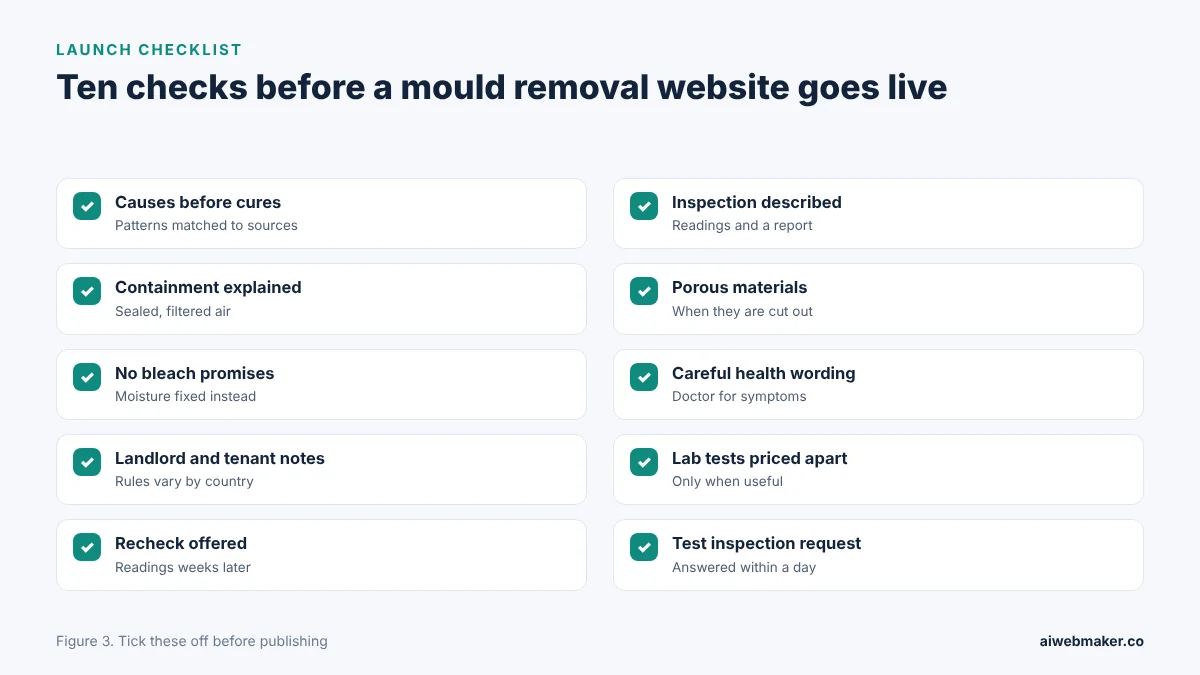
Worried householders leave a mould removal website when it promises to kill mould forever without saying anything about the moisture behind it. A single price for any job, with no inspection, suggests the same spray will be used everywhere. Frightening health claims make people suspicious rather than reassured. No mention of containment raises fears that spores will spread through the house. Silence on reports and landlords loses the tenants and agents who need written evidence. These worries each meet their answer in the ten checks pictured beneath this paragraph.
Frequently asked questions
Will cleaning alone stop the mould from coming back?
Cleaning alone rarely stops mould returning, because the growth will come back wherever the moisture remains. Lasting results come from fixing the cause, such as improving ventilation, warming cold spots or repairing a leak, and then drying the building. The website should say clearly that removal and the cause are treated together. A recheck after a few weeks, with fresh moisture readings, confirms whether the fix is working. Honest wording about recurrence earns more trust than any guarantee.
Is lab testing needed when the mould is plain to see?
Visible mould usually does not need lab testing, because the treatment depends on the moisture source rather than the species. Testing can help when hidden growth is suspected, when results are needed for a legal dispute or when a doctor has asked about specific exposure. Air and surface samples have limits, and results need expert interpretation. The website can explain when testing is useful and show it as a separate charge. Clear guidance stops customers paying for tests that would not change the plan.
Do families need to move out while the crew works?
Most households can stay at home during mould removal, because the work area is sealed off and air is filtered while the crew works. Larger jobs, or homes with very vulnerable occupants, may need a different plan, and the firm should discuss this before starting. Rooms being treated are closed until cleaning and drying are complete. The website can describe the daily routine, the noise of dehumidifiers and how long each room is out of use. Practical detail reduces anxiety for families who cannot easily move out.
Who arranges the work in a rented home?
In a rented home, the landlord is often responsible for dealing with damp and mould, but the rules depend on the country, the tenancy and what caused the problem. Tenants should report mould to the landlord in writing as soon as they notice it. Landlords benefit from an independent inspection and report that identifies the cause and the fix. The firm should state clearly which party it is working for on each job. Clear roles prevent disputes and speed up repairs.
One treated bedroom set against a year of hosting
A contained clean and repair in one bedroom usually earns well over $119, which is the entire hosting bill for a mould removal company's year online. Paying $19 a month instead is easily absorbed by a single inspection fee. Each landlord who returns with another property and each family that recommends the firm adds work the pages helped start. Clear cause tables, careful health wording and honest talk about recurrence carry more weight with anxious customers than dramatic before and after shots. Firms that publish rechecked rooms, still dry weeks later, prove the method rather than just the clean. Inspection requests that already describe where the mould is and when it appears show the pages are teaching visitors what matters.
Build your website in Minutes and get the AI Tools that work
Start Building Your Website →