Locksmith Website Cost and Honest Pricing That Beats Fake Listings
A locksmith's hosting bill comes to $119 annually, or $19 paid monthly, and a domain is chosen too. Inside: how customers choose, service pages, entry methods, identity checks, pricing before arrival, lock standards, fake listings, search and the yearly sum.
- No coding required
- Live in minutes
- Blog, SEO and chatbot tools included
A locksmith pays $119 for a year of AI Web Maker hosting, or $19 on a monthly bill, and buys a short, memorable domain alongside. Nothing is invoiced while the locksmith tunes the service list, the price notes and the team photos inside the AI Web Maker preview. One night time lockout, or a single lock upgrade, out earns that annual hosting charge. The real difficulty is trust, because people searching in a panic at night are easy targets for misleading listings that quote a low price on the phone and present a much larger bill at the door. For the opposite approach, study the locksmith business website design on a made up locksmith's AI Web Maker site, where each job from a lockout to a lock change is explained in plain terms. An honest locksmith website has to prove that a real, local person will arrive, explain the price before anyone travels and show the care taken over security and identity. What follows looks at how customers choose, the service pages, entry methods, identity checks, pricing, lock standards, standing apart from fake listings, search and the hosting sum for twelve months.
This article is part of our complete guide: Home Services Website Builder.
Locked out tonight or upgrading next week: two kinds of locksmith customer
Locksmith customers arrive in two states, and a good website serves both without making either wait. The locked out caller is cold, stressed and often on a phone with a low battery, so the number, an honest arrival estimate and a clear price structure must appear within seconds. The planning customer has just moved house, lost a key, suffered a break in or been told by an insurer that the locks are not good enough. That second customer reads carefully, compares firms and looks for advice on standards, brands and costs. Landlords, letting agents and businesses add regular work such as lock changes between tenants and master key systems. A site that gives the urgent caller a fast route and the planner a thorough one wins both kinds of job.
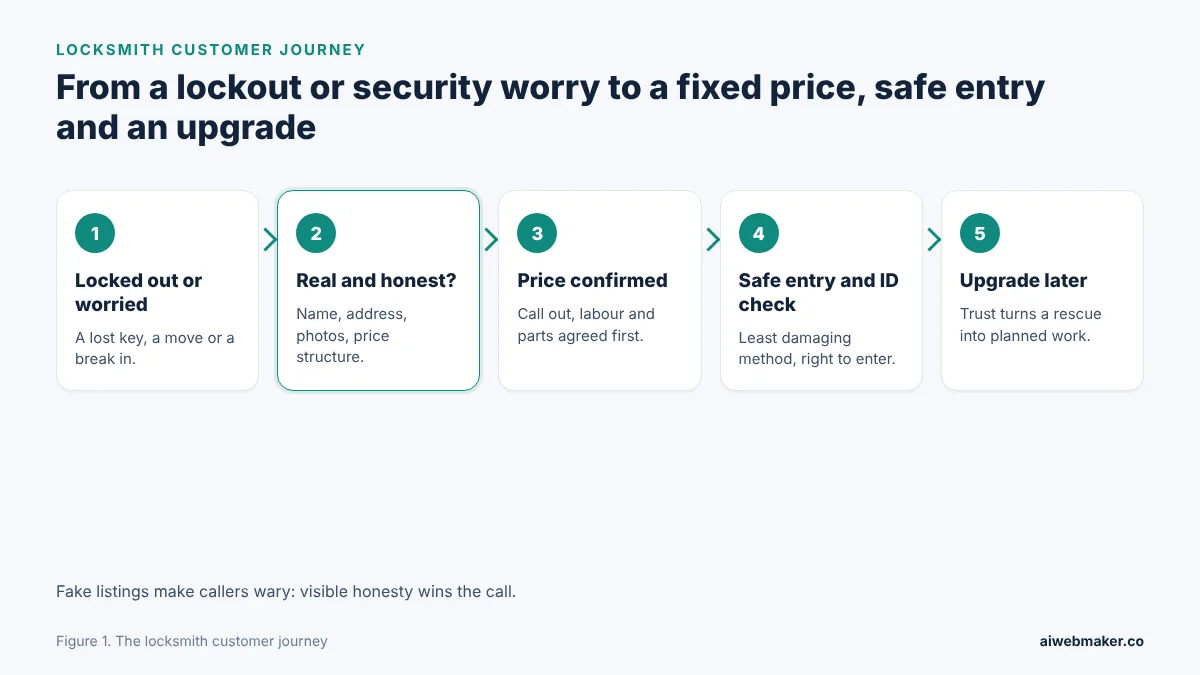
The second of these five stages is where most locksmith jobs are won, because a stressed customer decides in moments whether a firm is real and honest. A lockout, a lost key or a break in starts the search. Signs of a genuine local business, such as a real name, address, photos and a stated price structure, decide who gets the call. The locksmith then confirms the price, checks the customer's right to enter and chooses the least damaging way in. Many lockout customers return later for an upgrade once they trust the firm, which is where the steadier income lies. A locksmith website should treat every stage as a chance to prove honesty.
Lockouts, lock changes, upgrades and key cutting: the service pages
Each locksmith service answers a different worry, which argues for separate pages instead of one long list. Emergency lockouts belong first, with the number and arrival estimate visible at once. Lock changes and rekeying suit people who have moved home or lost keys, while repairs fix sticking or broken mechanisms. Security upgrades, key cutting and commercial work such as master key systems bring planned, steadier income. Some locksmiths also handle safes or vehicles, which deserve their own pages where offered. The table below shows what each service page should say.
| Service | When customers need it | What the page should say |
|---|---|---|
| Emergency lockout | Locked out, key lost or snapped | Number, arrival estimate, price structure |
| Lock change | New home, lost keys, after a break in | Lock types fitted, time on site |
| Rekeying | Old keys must stop working | How it differs from replacing the lock |
| Lock repair | Sticking, stiff or broken locks | Common faults and repair options |
| Security upgrade | Insurer requirements, peace of mind | Standards, brands, advice visit |
| Key cutting | Spares, restricted keys | Key types handled, proof of ownership |
| Commercial work | Offices, shops, rentals | Master key systems, access control |
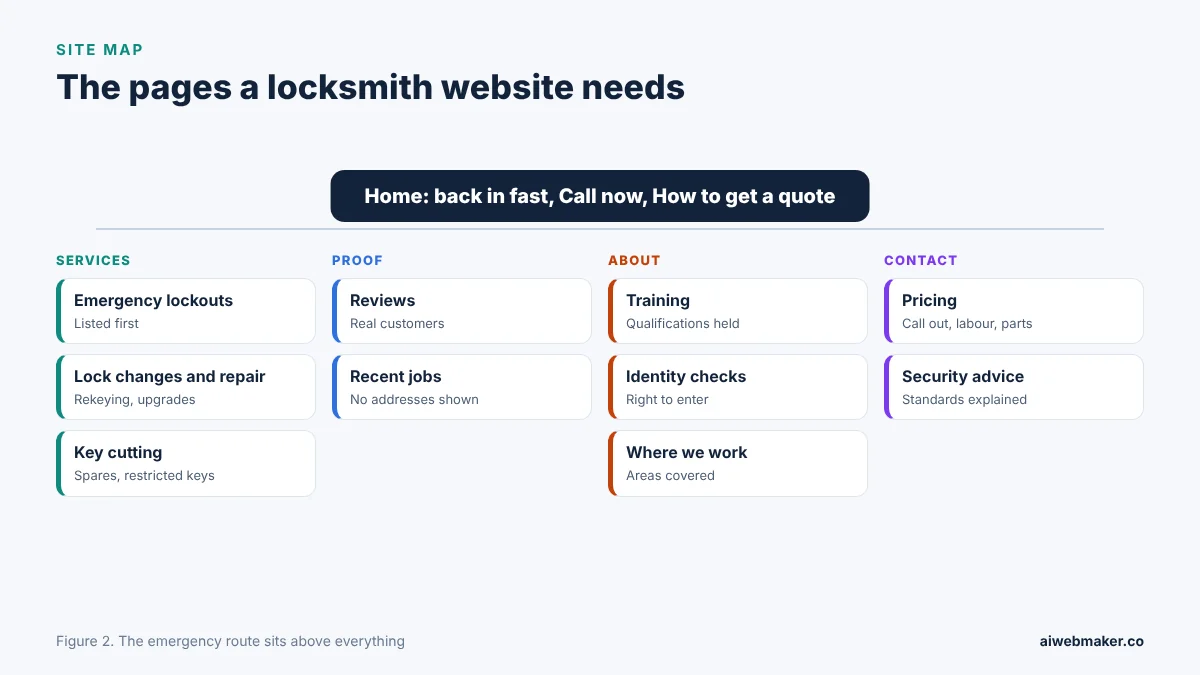
Sketched as a structure, the locksmith site rests on services, proof, about and contact, with the emergency number above everything. The services group starts with lockouts and moves to planned work. Proof pages hold reviews and recent completed jobs described without addresses. About pages explain training, identity checks and where the firm works. Our sample firm, Keyturn Locksmiths, greets visitors with a home page headline about getting people back in, lists emergency lockout assistance first on its services page and follows it with lock repair, replacement and upgrades, key cutting and lock changes, and security checks and advice, ending with a part on how to get a quote. Its reviews page pairs feedback marked in the sample as example reviews with a list of recent completed jobs, and the about page covers its story, how it works, qualifications and training, and where it works; the locksmith website example with emergency lockout help and recent jobs took 56 seconds to build.
Non destructive entry, and when drilling is justified
Skilled locksmiths open most doors without damaging the lock, and explaining this on the website reassures customers who fear a broken door and a large repair bill. Non destructive methods include picking, bypass tools and tools that work through letterboxes or gaps around the door. Drilling or destroying a lock should be a last resort, used when the lock is faulty, high security or impossible to open any other way. The customer should be told before any destructive method is used, along with the cost of a replacement lock. Many lockouts end with a simple opening and no new parts at all. Honest explanations of entry methods separate skilled locksmiths from operators who drill first and charge for a new lock every time.
| Entry method | When it is used | What it means for the customer |
|---|---|---|
| Picking | Standard cylinder and lever locks | Lock usually keeps working afterwards |
| Bypass tools | Latches and some mechanisms | Quick entry, no damage in most cases |
| Letterbox and gap tools | Doors with handles inside | Entry without touching the lock |
| Drilling | Faulty or high security locks | Lock replaced, cost agreed beforehand |
Proof of identity before any door is opened
A responsible locksmith checks that the person asking for entry has the right to be there, and the site ought to state that policy in plain words. Customers can be asked for photo identification and proof of address, such as a utility bill or tenancy agreement, once the door is open and before the locksmith leaves. Tenants may need the landlord's agreement for lock changes, and disputes between partners or relatives are usually referred to the proper authorities rather than settled with a drill. For vehicles, proof of ownership or registration is commonly requested. These checks protect the customer as much as anyone, since nobody wants a locksmith who would open their home for a stranger. Stating the identity policy on the website shows customers the firm takes security seriously.
Pricing before arrival: call out, labour and parts
Surprise bills are the most common complaint about locksmiths, so the pricing page should explain each part of the charge before the customer agrees to a visit. A call out or attendance fee usually covers travel and the first part of the job. Labour depends on the method and time taken, while parts, such as a new cylinder or lock, vary with the security grade chosen. Out of hours surcharges for nights, weekends and holidays belong in plain view. The AI website builder for locksmiths with service and quote pages drafts the services, about, reviews and contact pages once the locksmith sums up the firm in a few sentences. A promise to confirm the total before any work starts is the most persuasive line a locksmith can publish.
| Charge | What it covers | What the page should say |
|---|---|---|
| Call out or attendance | Travel and the first minutes on site | The fee and the area it applies to |
| Labour | Opening, fitting or repairing | How time is counted |
| Parts | New cylinders, locks, keys | Grades offered and their price range |
| Out of hours | Nights, weekends, holidays | When surcharges apply |
| Confirmation | The full price before work | A firm promise, in writing where possible |
Lock standards, insurers and security advice
Lock standards help customers choose the right upgrade, and naming them shows that the locksmith knows the details insurers and police care about. Standards differ between countries, so the website should explain the ones that apply locally and avoid suggesting any lock is impossible to defeat. In the United Kingdom, for example, many insurers ask for mortice deadlocks meeting BS 3621, and anti snap cylinders are tested under schemes such as TS 007. In the United States, door hardware is often graded under ANSI and BHMA standards, with Grade 1 the most robust. Across Europe, cylinders are classified under EN 1303. A short table of standards, with honest notes on what each signals, turns a confusing topic into a reason to book a security visit.
| Standard or rating | Where it is common | What it signals |
|---|---|---|
| BS 3621 | United Kingdom | Mortice locks often required by insurers |
| TS 007 star ratings | United Kingdom | Cylinders tested against snapping and attack |
| ANSI and BHMA grades | United States | Grade 1 the most robust for heavy use |
| EN 1303 | Europe | Cylinder classification for security and durability |
Standing apart from fake local listings
Many customers have heard of call centres posing as local locksmiths, taking a booking at a low quoted price and passing the job to whoever is nearby. A genuine firm can stand apart by showing a real business name, a physical address where appropriate, photos of the actual locksmiths and vans and a phone number that matches every listing. Licensing for locksmiths varies widely, with some places, including several states in the United States, requiring a licence while many countries have none at all. Where a licence, background check or trade association membership exists, naming it gives customers something to verify. Avoiding pressure language and unrealistic arrival promises signals honesty too. In a trade where trust has been abused, plain truthfulness is the strongest marketing a locksmith can have.
What a locked out caller types into a phone
Locked out callers type short, urgent phrases such as locksmith near me, emergency locksmith, locked out of house or lock change, often followed by their area. Planning customers search for lock upgrades, rekeying, anti snap locks or master key systems. When each service page carries the exact phrase it answers in its heading, both search engines and stressed visitors find it faster. A map listing with a real address where appropriate, consistent business details, genuine photos and recent reviews helps customers separate a local firm from a call centre. Articles on choosing a front door lock, what to do after losing keys or what insurers usually ask for bring planners to the site months before they need work. Steady, honest information makes the firm the name people save in their phone.
The locksmith's yearly website outlay
For a locksmith, only hosting and the domain recur each year, and a security article written through AI credits adds around $0.65. A locksmith with steady work pays least on the annual bill. A newly qualified locksmith working alone may prefer monthly payments while building a customer base. Updating prices, adding lock brands or posting recent jobs adds nothing to the cost. For locksmiths, the table lays the yearly and monthly routes side by side, with the $189 tier shown as a reference rather than a suggestion.
| Item | Yearly | Monthly |
|---|---|---|
| Hosting the locksmith pages | $119 | $228 over twelve months |
| Domain | Depends on the ending | Depends on the ending |
| Higher plan, for comparison | $189 a year | Not needed |
| Twelve home security articles at about $0.65 | About $7.80 | About $7.80 |
| Prices, services and recent jobs | No charge | No charge |
| Year before the domain | About $126.80 | About $235.80 |
Red flags that make a caller dial someone else
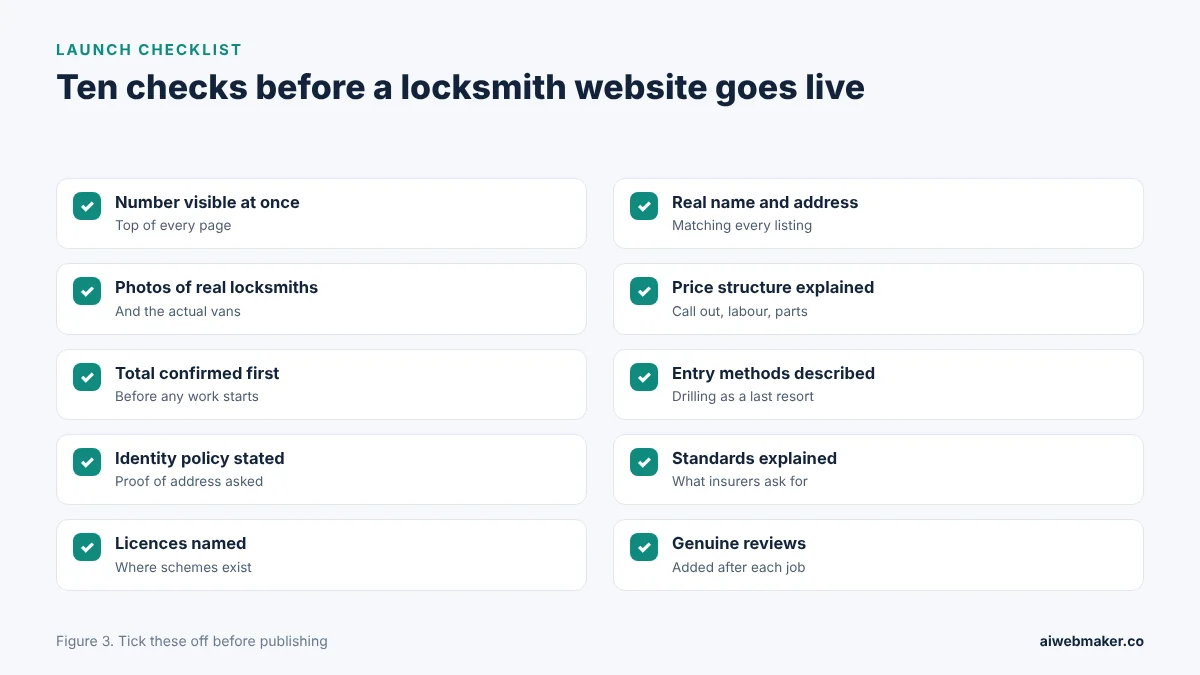
A caller dials someone else when a locksmith website shows no business name, no address and no photos of real people. A suspiciously low headline price with no explanation of call out, labour and parts looks like the start of a trap. No mention of identity checks makes careful homeowners wonder who else the firm would let in. Stock photos of padlocks instead of real vans and locksmiths suggest a call centre rather than a local firm. A slow, cluttered page with the phone number buried below long text loses the caller standing on a cold doorstep. The locksmith checklist shown next lists ten fixes that remove these red flags.
Frequently asked questions
Can a locksmith open any lock without damaging it?
A skilled locksmith can open most common locks without damage, but some high security or faulty locks need drilling or replacement. Picking and bypass methods work on many standard cylinders and latches. Older or damaged locks sometimes fail during opening, which is another reason to agree costs first. The customer should always be told before any destructive method is used. Honest expectations prevent disputes at the door.
What proof do customers need before a locksmith lets them in?
Customers should expect to show photo identification and proof that they live at or own the property, such as a bill or tenancy agreement. The check usually happens once the door is open, before the locksmith leaves. Tenants changing locks may need the landlord's permission under their agreement. Vehicle owners are commonly asked for registration documents. These checks protect every homeowner, including the one who calls.
Is rekeying cheaper than replacing a lock?
Rekeying is often cheaper than replacing a lock, because the existing lock body stays in place while the internal parts are changed so old keys stop working. It suits good quality locks after a move or the loss of a key. Replacement makes more sense when the lock is worn, damaged or below the standard an insurer requires. The locksmith can advise which option fits each door. A clear comparison on the website helps customers choose sensibly.
Should locks be changed after moving into a new home?
Changing or rekeying locks after moving in is widely recommended, because there is no way to know how many keys previous owners, tenants or contractors still hold. The job is quick for most doors and gives complete control over who has access. It is also a good moment to check whether the locks meet the standard an insurer expects. Landlords often change locks between tenancies for the same reason. A short page on this topic brings steady, planned work.
A lockout or two and the year is settled
A single lockout, or a pair of lock changes, usually brings a locksmith more than the $119 needed to keep the site hosted for a year. One night call covers many months of the $19 plan. Every customer who returns for an upgrade after a calm, honestly priced lockout adds work that was won by trust rather than advertising. A real name, clear pricing, visible identity checks and plain advice on standards set an honest locksmith apart from fake listings. Firms that add genuine reviews after each job keep that proof growing. A phone that rings with repeat customers and their neighbours is the clearest return on a locksmith's website.
Build your website in Minutes and get the AI Tools that work
Start Building Your Website →