Lawn Care Website Cost and the Street by Street Route Behind It
A lawn care crew keeps its site live on $119 of yearly hosting, switching to $19 a month if cash is short in winter, with a domain bought on top. Inside: how homeowners choose, pages to build, pricing, route density, mowing standards, the lawn calendar, treatment safety, search and the yearly total.
- No coding required
- Live in minutes
- Blog, SEO and chatbot tools included
Lawn care crews budget $119 to keep their site hosted by AI Web Maker through the year, or pay $19 a month while the round grows. The domain sits on top as an extra line. Writing the pages and swapping in photos of striped lawns happens inside the AI Web Maker preview, where nothing is billed. Two or three regular gardens on one street normally cover that annual fee before the spring growth has properly begun. Greenline Lawn Care is an invented crew, but the lawn care business website AI Web Maker generated for Greenline shows how mowing plans and seasonal feeds can keep the same gardens booked all season. The deeper challenge is that lawn care profit depends on routes, because time spent driving between scattered gardens is time nobody pays for. A website therefore has to attract the right customers in the right streets, and turn one off tidy ups into regular rounds that last the whole season. What follows walks through how homeowners choose a crew, the service pages, pricing, route density, mowing standards, the lawn calendar, treatments and safety, search and the cost of the year.
This article is part of our complete guide: Home Services Website Builder.
Homeowners, landlords and estates: who hands over the mower?
Those who hand over their mower come in a few distinct types, and each judges a lawn care crew by different standards. Busy families want reliable regular cuts and a lawn that looks cared for without weekend effort. Older homeowners often give up mowing when the work becomes physically hard, and they value a familiar crew who closes the gate behind them. Landlords and letting agents want tidy front gardens between tenancies, while housing estates and businesses look for contracts covering many lawns at once. Keen gardeners care less about cutting and more about feeding, moss control and repairing bare patches. A lawn care website that speaks to each group, with clear areas and honest prices, fills a route faster than any leaflet.
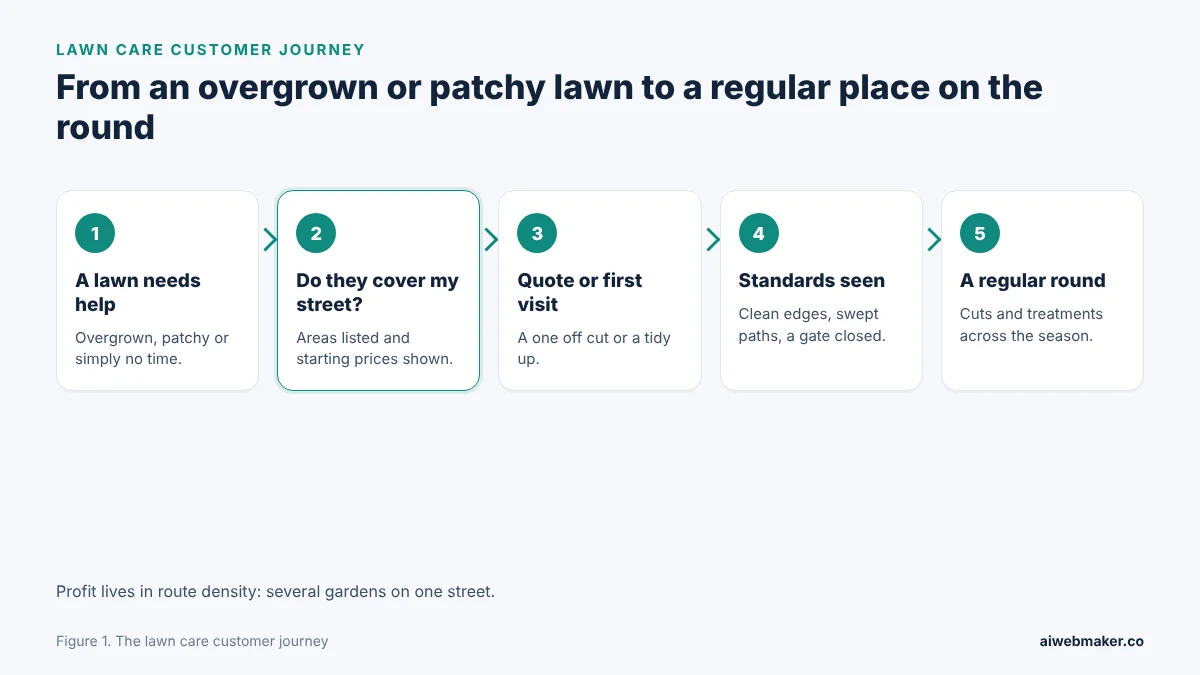
Among these five stages, the second decides more than the rest, because a homeowner first needs to know the crew actually works on their street. The journey starts with an overgrown lawn, a patchy one or simply a lack of time. A clear list of areas and starting prices settles whether an enquiry is worth sending. A first visit, often a one off cut or tidy up, then shows the crew's standards in the customer's own garden. The step from that first visit to a regular round is where most of the yearly value sits. Every page should nudge customers along this path, from areas and prices to a standing place on the round.
Mowing, feeding, scarifying: the lawn pages to build
A lawn care site needs a page or clear section for each service, because a homeowner searching for moss removal reads differently from one who just wants the grass cut. Mowing and edging is the core of most rounds and deserves the clearest description. Feeding and weed control attract keen gardeners and anyone unhappy with yellow patches or dandelions. Scarifying, aeration and overseeding are seasonal jobs that repair tired lawns and add valuable work in spring and autumn. Leaf clearing and simple hedge trimming fill gaps at the edges of the season. The table below suggests what each page should promise.
| Service | When customers want it | What the page should say |
|---|---|---|
| Mowing and edging | Throughout the growing season | Visit frequency, clippings, edges and paths |
| Feeding and weed control | Spring to autumn | What is applied, when, and safety notes |
| Moss control and scarifying | Spring or autumn | Why lawns look worse before they recover |
| Aeration | Compacted or waterlogged lawns | Hollow or solid tines, best timing |
| Overseeding and repairs | After scarifying or damage | Seed choice, watering, time to establish |
| Leaf clearing | Autumn | Collection and disposal of leaves |
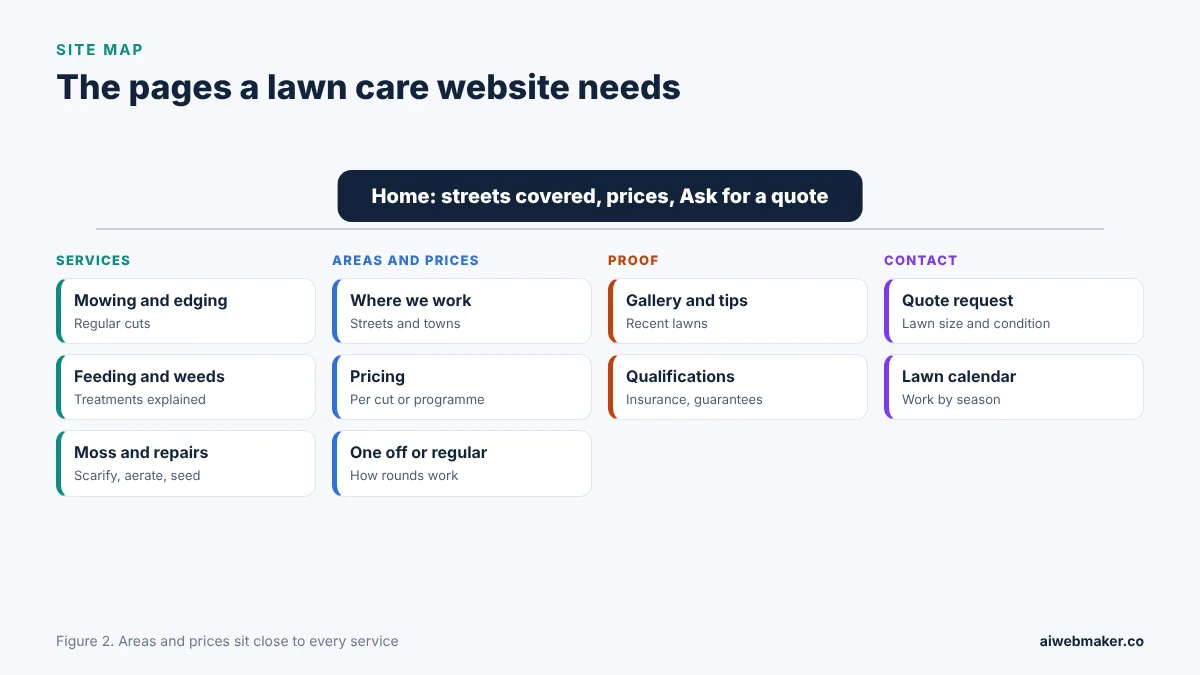
Sorted into four branches, the lawn care site covers services, areas and prices, proof and contact, with a quote request on the home page. Service pages describe mowing, feeding, moss control and repairs. The areas branch lists the streets or towns on the round and explains how pricing works. Proof pages carry a gallery of recent lawns, seasonal tips, qualifications and insurance. Our sample business, Greenline Lawn Care, keeps its core services, its pricing, a part headed one off visits or regular care, a weed control heading and a section on where it works together on the services page. Its about page covers qualifications, insurance and guarantees, the gallery of recent lawns shares a page with lawn tips, and a handful of products sits alongside the services; the lawn care website example with service areas and regular rounds was built in 50 seconds.
Pricing per cut, per round or per season
Lawn care pricing usually starts from the size and condition of the lawn, and the website should say how that size is judged. A price per cut suits customers who want regular mowing, often with a lower rate for weekly or fortnightly visits than for occasional ones. Seasonal treatment programmes are commonly priced as a set number of visits across the year, which helps customers budget. Overgrown lawns and first visits often cost more, because long grass takes longer and may need more than one pass. Extras such as edging new borders, clearing leaves or removing clippings should be priced or described separately. A pricing section that shows starting figures and the factors behind them earns more serious enquiries.
| Pricing model | Suits | What to state |
|---|---|---|
| Per cut | Regular mowing customers | Lawn size bands, visit frequency, clippings |
| Treatment programme | Feeding, weed and moss control | Number of visits and what each includes |
| One off tidy up | Overgrown or neglected lawns | Why it costs more than a routine cut |
| Seasonal repair work | Scarifying, aeration, overseeding | Price by area and the recovery time |
| Extras | Leaves, borders, hedges | Separate prices or a quote on request |
Route density and the areas a crew covers
Route density is the quiet engine of a profitable lawn care business, because three gardens on one street earn far more per hour than three gardens in three towns. The website should list the streets, districts or towns covered and, where it helps, the day the crew usually works there. Customers outside the area learn quickly that another crew would suit them better, which saves both sides wasted calls. A note that neighbours on the same street are welcome to join the round can bring several gardens from one happy customer. The AI website builder that lawn care crews use for their services and areas pages drafts the services, about, gallery and contact pages after the owner describes the round in a few sentences. A tight route, built street by street, is the difference between a busy week and a profitable one.
Mowing standards that show on every lawn
Good mowing practice is visible from the pavement, so putting it into words online tells customers the crew takes care over details they notice later. Most turf guidance advises removing no more than about a third of the grass height in one cut, which keeps the lawn stronger through dry spells. Sharp blades cut cleanly, while blunt ones tear the grass and leave brown tips. Cutting height usually rises in hot or dry weather to protect the roots. Edges, paths and clippings left on borders are what customers remember, so the finishing routine deserves a line of its own. These standards, written plainly, separate a careful crew from one that simply mows fast.
| Practice | Why it matters |
|---|---|
| Remove about a third of the height per cut | Keeps the grass strong and green |
| Sharp blades | Clean cuts, fewer brown tips |
| Higher cut in heat or drought | Protects roots and reduces stress |
| Varying the mowing direction | Reduces ruts and grass leaning one way |
| Neat edges and swept paths | The finish customers notice first |
A lawn calendar through the year
A lawn calendar helps customers understand why visits change through the year, and it sells seasonal treatments without any pressure. In temperate climates, growth starts in spring, peaks in early summer, slows in drought and picks up again in autumn before winter dormancy. Warmer regions and the southern hemisphere follow different months, so the calendar should match the crew's own climate. Feeding, moss control and repairs each have windows when the grass can recover, and outside those windows they do little good. Showing the calendar on the website lets customers book the right work at the right time. A crew that explains the seasons sounds like the expert homeowners want looking after their lawn.
| Season in a temperate climate | Mowing | Typical treatments |
|---|---|---|
| Early spring | First light cuts at a higher setting | Moss control, first feed |
| Late spring | Weekly or fortnightly cuts | Weed control, scarifying if needed |
| Summer | Higher cuts, less often in drought | Light feed, watering advice |
| Autumn | Cuts slow down | Scarifying, aeration, overseeding, autumn feed |
| Winter | Little or no mowing | Leaf clearing, planning the next season |
Treatments, products and keeping children and pets safe
Lawn treatments should be described honestly, including what is applied, why and what homeowners need to do afterwards. Rules on garden products differ between countries, and in some places certain treatments may only be applied by trained or certified operators, so the crew should name any qualification it holds. The product label sets how long children and pets should stay off a treated lawn, and the website can remind customers to follow the crew's instructions on the day. Spot treating weeds rather than spraying the whole lawn, and offering organic or lower chemical options where they work, reassures careful families. Water restrictions in dry seasons may also limit what can be done after feeding or seeding. Clear, careful wording protects customers and the business alike.
Phrases typed by people staring at a patchy lawn
Homeowners after help with grass usually type lawn mowing service, lawn care near me, moss removal or weed control for lawns, often with a district added. Giving every service its own page, named in the words people use, lets search engines send the moss searcher to the moss page. On the map listing, the areas covered, real photos of finished lawns and a route through to the site belong together. Reviews mentioning reliable visits, neat edges and a lawn that improved over the season carry more weight than general praise. Seasonal tips, such as when to stop cutting in autumn or how to help a lawn through a heatwave, pull in readers long before the mowing season starts. Steady, practical advice turns a lawn care site into a local reference that keeps the phone ringing.
A season's website bill for a lawn care crew
Two charges come round for a lawn care crew every year, hosting and the domain, and seasonal tips drafted with AI credits cost cents rather than dollars. A crew with a full round keeps the cost lowest by paying once for the year. A crew building its first round may lean towards monthly payments until the customer list fills. Adding streets, changing prices or posting new lawn photos never changes the bill. Both routes appear below, where the $189 tier serves only as a benchmark for lawn crews.
| Item | Yearly | Monthly |
|---|---|---|
| Hosting the lawn care pages | $119 | $228 over twelve months |
| Domain | Depends on the ending | Depends on the ending |
| Higher plan, for comparison | $189 a year | Not needed |
| Twelve seasonal lawn articles at about $0.65 | About $7.80 | About $7.80 |
| Areas, prices and lawn photos | No charge | No charge |
| Year before the domain | About $126.80 | About $235.80 |
Bare patches in the website that lose the round
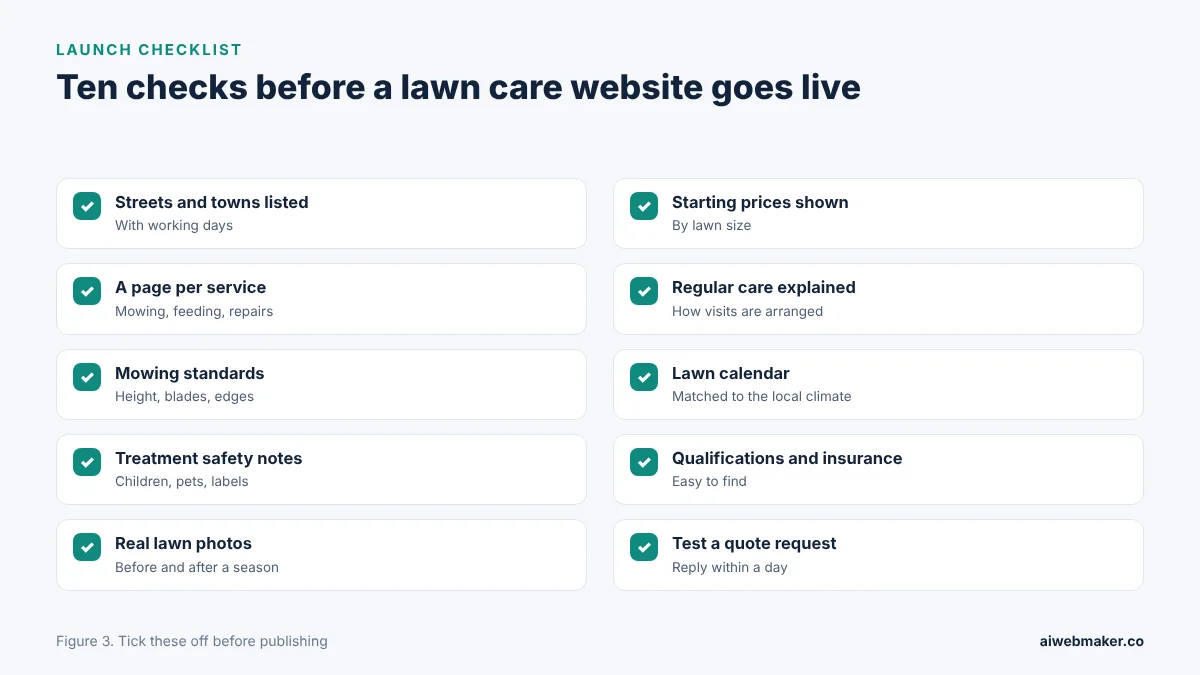
Homeowners leave a lawn care site when they cannot tell whether the crew works on their street. Missing prices, even as starting figures, make them assume regular care is beyond their budget. A gallery of stock lawns rather than real gardens suggests the crew has little to show. Vague treatment descriptions worry parents and pet owners, who want to know what goes on the grass. No explanation of how regular visits are arranged, paused or ended makes the commitment feel risky. The ten fixes in the following lawn care checklist close those bare patches before the first mower starts.
Frequently asked questions
How short should a lawn be cut?
The right height depends on the grass type, the season and how the lawn is used, so the crew should advise rather than cut every lawn to the same setting. A common rule is to remove no more than about a third of the height at each cut. Lawns are usually cut a little longer in hot, dry weather and in shade. Very short cuts look neat for a few days but weaken the grass and invite moss and weeds. Explaining this on the website helps customers understand why their lawn is not scalped.
Can a treated lawn be used by children and pets straight away?
Children and pets should stay off a treated lawn for as long as the product label and the crew advise, which varies between products. Some treatments need to dry or be watered in before the lawn is used again. Rules on lawn products also differ between countries, so the crew's own instructions are the best guide. Customers should mention pets, ponds and vegetable beds before the first treatment. A clear note on the website prevents worry and careless mistakes.
When is the best time to scarify or aerate a lawn?
Scarifying and aeration work best when the grass is growing actively and the weather allows it to recover, which in temperate climates usually means autumn or spring. Doing either in a drought or a frost can leave the lawn weak for weeks. Scarified lawns often look worse at first, and the website should warn customers about that. Overseeding afterwards helps fill the gaps. Honest timing advice saves customers from disappointment and the crew from complaints.
Does the homeowner need to be at home for each visit?
Most regular lawn care visits do not need the homeowner present, provided the crew can reach the lawn safely. Gates should be left unlocked or a code shared, and dogs kept indoors during the visit. Toys, hoses and garden furniture are best cleared from the grass beforehand. Customers should mention any hidden hazards, such as sprinkler heads or uneven ground. A short access note on the website makes every visit smoother.
A few regular gardens on one street fund the year
Three regular lawns on the same street tend to earn back the $119 lawn care hosting fee before the first feed of the year is due. The $19 monthly alternative is smaller than the price of a single routine cut. Every neighbour who joins the round after seeing a well kept lawn next door adds income with almost no extra driving. Clear areas, honest prices and a calendar that explains the seasons answer the questions homeowners ask before handing over the mower. Crews that post fresh lawn photos through the season keep that proof current. A tight route of regular customers, street after street, is the payoff a lawn care website is built for.
Build your website in Minutes and get the AI Tools that work
Start Building Your Website →