Handyman Website Cost and the Job List That Fills a Whole Visit
For a handyman, the website's hosting is $119 per year or a $19 monthly bill, with a domain bought too. Covered: who hires a handyman, the pages to build, pricing and minimum charges, job lists, licensed trade limits, landlords, search and the yearly sum.
- No coding required
- Live in minutes
- Blog, SEO and chatbot tools included
Twelve months of handyman hosting on AI Web Maker costs $119, or $19 each month for those paying as work comes in, with a domain on top. The drafting stage costs nothing on AI Web Maker, so the job list on each page can be matched to the tools in the van and checked in the preview before launch. A handy reference while matching that list is the handyman business website, whose invented handyman gets a full sample site in AI Web Maker with the job list placed first. A single morning of shelves, curtain poles and a sticking door usually earns more than the whole yearly fee. Handyman work has an awkward quirk, which is that every job is small, and many homeowners leave a dripping tap or a loose handrail for months because they doubt anyone will come for something so minor. A handyman website has to show that small jobs are welcome, explain how they are priced and encourage customers to gather several tasks into one visit. What follows covers who hires a handyman, the pages to build, pricing, the job list, the limits of the trade, tidy working, maintenance rounds, search and the year's cost.
This article is part of our complete guide: Home Services Website Builder.
Who calls a handyman, and what tips them into booking?
Handyman customers are a varied group, but most share a list of jobs they cannot or will not tackle themselves. Busy professionals collect small repairs for an empty weekend that never comes. Older homeowners often need help with anything involving ladders, heavy lifting or fiddly fittings. Landlords and letting agents need a reliable pair of hands between tenants, and people who have just moved in want furniture assembled, televisions mounted and blinds fitted. Sellers often call before viewings to clear a list of snags that buyers would notice. What tips each of them into booking is the same mix of proof: a clear list of jobs done, an honest pricing method, punctual arrival and tidy work.
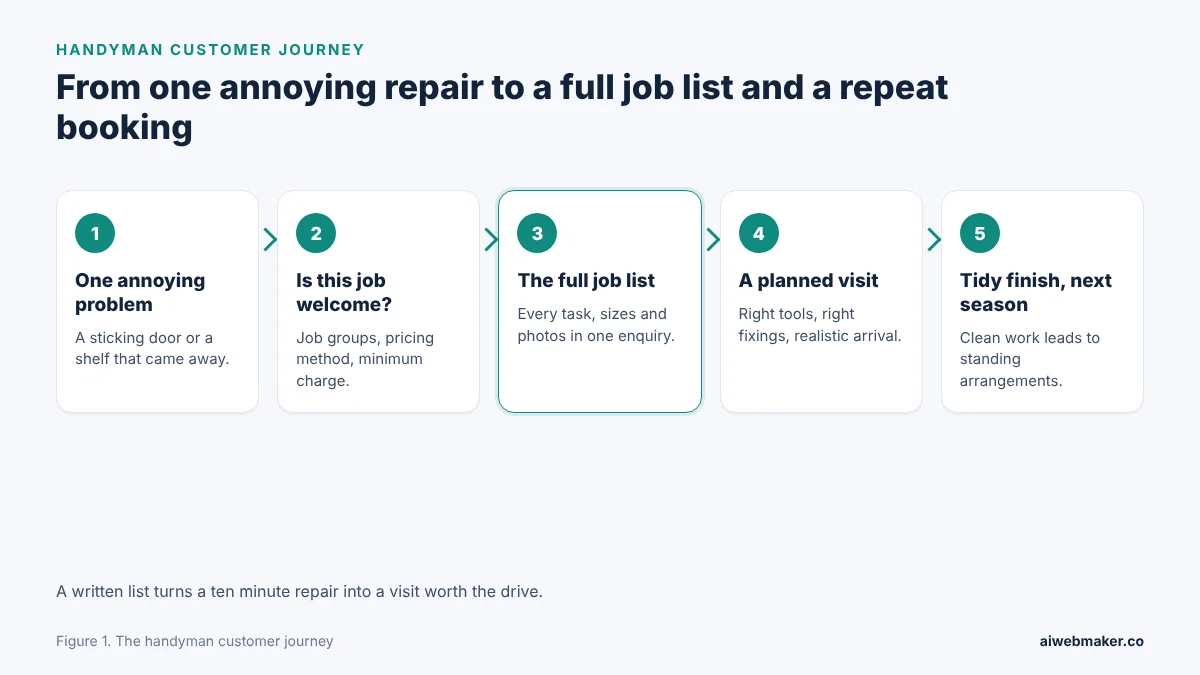
Of the five stages, the third stands out, because writing down every task is what turns a small job into a worthwhile visit. A list begins with one annoying problem, often a door that will not close or a shelf that has come away. The customer then checks whether this handyman takes on that kind of job and how the price is set. Writing the full job list, ideally with photos, turns a single repair into half a day of work. The visit itself, with punctual arrival and a clean finish, decides whether the customer calls again next season. A handyman website that guides people towards that third step earns fuller days and fewer wasted journeys.
Grouping odd jobs into pages a homeowner can scan
Odd jobs are easier to find when they are grouped into a few clear categories, each with its own page or section. Assembly and mounting covers flat pack furniture, televisions, mirrors, curtain poles and shelves. Doors and windows covers sticking doors, loose hinges, broken handles and draught strips. Small plumbing fixes, where local rules allow them, include dripping taps, toilet seats and resealing baths. Outdoor jobs such as gutter clearing, fence panels and shed repairs suit a separate page, as do regular maintenance visits. A short table of groups, typical jobs and what each page should say helps keep the site organised.
| Job group | Typical jobs | What the page should say |
|---|---|---|
| Assembly and mounting | Flat pack, televisions, shelves, curtain poles | Wall types handled, fixings used |
| Doors and windows | Sticking doors, hinges, handles, draught strips | Common fixes and typical time on site |
| Small plumbing fixes | Dripping taps, toilet seats, resealing | What is included, what goes to a plumber |
| Walls and touch ups | Filling holes, patch painting | Drying times, colour matching |
| Outdoor jobs | Gutters, fence panels, sheds, decking repairs | Weather limits and ladder work |
| Maintenance visits | Seasonal checks for homes and rentals | What a visit covers and how often |
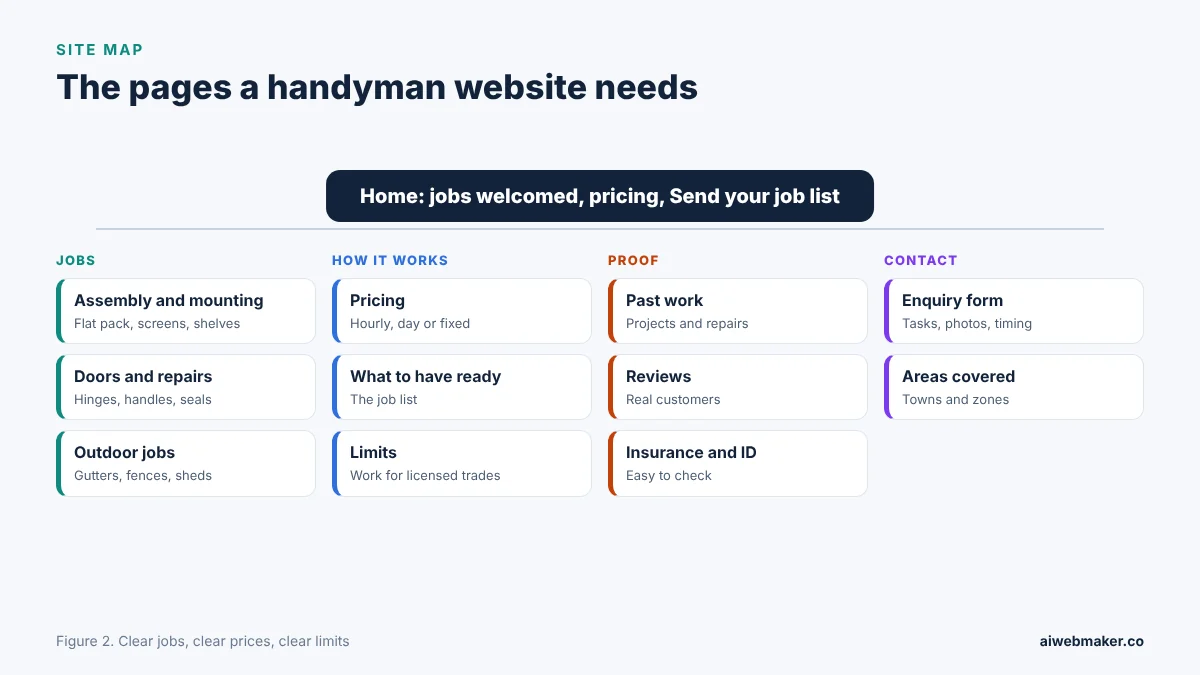
Organised by what a visitor needs at each moment, the handyman site splits into jobs, how it works, proof and contact. Job pages describe the groups in the table, each with photos of finished work. The how it works pages explain pricing, the job list and the limits of the service. Proof pages carry past work, reviews and insurance, while contact pages hold the enquiry form and the areas covered. Our sample business, Fixwell Home Services, has four pages: services, past work, a how it works page and a contact form, with the how it works page covering the route from enquiry to finished job, what to have ready when enquiring, how quotes work and how the home is kept tidy. Its work page groups completed projects, repairs and maintenance before customer comments that the sample labels as example reviews; the handyman site example where homeowners send a list of odd jobs took 48 seconds to build.
Hourly, half day or fixed price: how handymen charge
Handymen usually charge by the hour, by the half or full day, or by a fixed price per task, and each model suits different work. Hourly rates suit repairs whose length is hard to predict, and most come with a minimum charge that covers travel and setting up. Half day and full day rates reward customers who gather a long list, and they suit landlords preparing a property between tenants. Fixed prices work well for common, repeatable tasks such as mounting a television or assembling a wardrobe. Materials need their own line, stating whether the customer buys them, the handyman supplies them at cost or a handling charge applies. Whatever the model, a pricing page that explains it plainly prevents surprise at the door and arguments at the end of the visit.
| Pricing model | Suits | What the page should state |
|---|---|---|
| Hourly with a minimum | Repairs of uncertain length | The minimum, what it covers, how time is counted |
| Half day or full day | Long job lists, rentals between tenants | How many tasks fit, breaks, materials runs |
| Fixed price per task | Mounting, assembly, common repairs | What is included and what would change it |
| Materials | Every job | Who buys them, receipts, any handling charge |
| Travel and parking | Busy or distant areas | Zones covered and any parking costs |
The job list: getting the most from each visit
A written job list is the handyman's best tool, because it turns a single small repair into a visit worth the drive. The website can invite customers to list every task, give rough sizes or quantities, mention the wall type where something will be fixed and have photos ready in case the handyman asks for them. Customers should say who is buying materials, and give the brand or model of anything they have already bought, such as a blind or a light fitting. Parking, stairs and any pets in the home are worth noting too. The AI website builder for handyman services with job lists and enquiry pages drafts the services, past work, how it works and contact pages once the owner describes the jobs taken on in a short paragraph. A customer who arrives at the enquiry with a full list gets a more accurate price and a better planned day.
Where handyman work stops and a licensed trade begins
Every handyman should state which jobs fall outside the service, because some work legally or safely belongs to licensed trades and the rules vary between countries. Gas work is the clearest example, and in the United Kingdom it must be done by an engineer on the Gas Safe Register. Many countries restrict new electrical circuits and changes to fuse boards to qualified electricians, even where swapping a light fitting is allowed. Some states in the United States require a contractor licence once a job passes a set value, so a handyman there must know the local limit. Structural changes, suspected asbestos and work on load bearing walls call for specialists and sometimes official approval. Saying this openly shows customers a handyman they can trust with everything else.
| Type of work | Why it may need a specialist | What the page can say |
|---|---|---|
| Gas appliances and pipes | Safety and registration rules | Referred to a registered gas engineer |
| New circuits and fuse boards | Electrical rules and certification | Referred to a qualified electrician |
| Structural changes | Engineering and approvals | Referred to a builder or engineer |
| Suspected asbestos | Health risk when disturbed | Left untouched until tested by specialists |
| Large jobs above local limits | Contractor licensing in some places | Quoted only where the rules allow |
Tidiness, punctuality and working in occupied homes
A handyman works inside people's homes, often while they are there, so manners matter almost as much as skill. The website can describe dust sheets, shoe covers, vacuuming at the end of each job and taking away offcuts and packaging. Arrival windows should be realistic, with a promise to call if a previous job runs over. Older or vulnerable customers appreciate knowing that the handyman carries identification, never pressures anyone into extra work and is happy for a relative to be present. Where background check schemes exist, stating that the handyman holds a current check reassures families arranging help for a parent. A tidy, punctual visit is the most reliable way to turn a first job into a standing arrangement.
Regular maintenance for landlords and older homeowners
Regular maintenance visits smooth out the quiet weeks in a handyman's diary and save customers from small problems turning into large ones. Landlords value a handyman who checks seals, gutters and fittings between tenancies and reports anything that needs a specialist. Older homeowners often prefer a familiar face who calls round each season with a ladder and a list. A seasonal table, adjusted to the local climate, shows customers what a visit might include. Over time, these standing arrangements become the steadiest income in the business.
| Season in a temperate climate | Typical maintenance tasks |
|---|---|
| Spring | Fence repairs, sealant checks, outdoor furniture fixes |
| Summer | Exterior touch ups, decking repairs, window easing |
| Autumn | Gutter clearing, draught proofing, outside taps protected |
| Winter | Indoor repairs, door adjustments, alarm battery tests |
The words people type when a shelf will not stay up
People needing small jobs done type phrases such as handyman near me, television mounting or flat pack assembly, often adding their area. Naming each job group after the words people actually type means a search for television mounting lands on the page that shows mounted screens. A map listing with accurate hours, photos of real jobs and a link to the website catches many people searching on a phone. Reviews that mention punctual arrival, tidy work and fair pricing matter more than any claim the handyman makes about himself or herself. Short articles on preparing a job list or getting a home ready for winter attract readers who later become customers. A handyman who answers everyday questions online becomes the local name people remember when the list grows long.
Twelve months of hosting beside a handyman's diary
A handyman's website brings two yearly costs, the hosting and the domain, and each article drafted with AI credits costs well under a dollar. A handyman with a steady diary spends the least by settling twelve months in one go. Someone just leaving employment to work alone may find the monthly bill gentler on cash flow. New job photos, changed rates or extra service areas never raise the price. The two billing routes are compared next, with the $189 tier added for reference only.
| Item | Yearly | Monthly |
|---|---|---|
| Hosting the handyman pages | $119 | $228 over twelve months |
| Domain | Depends on the ending | Depends on the ending |
| Higher plan, for comparison | $189 a year | Not needed |
| Twelve home maintenance articles at about $0.65 | About $7.80 | About $7.80 |
| Job photos, rates and areas | No charge | No charge |
| Year before the domain | About $126.80 | About $235.80 |
Doubts that leave the job list unsent
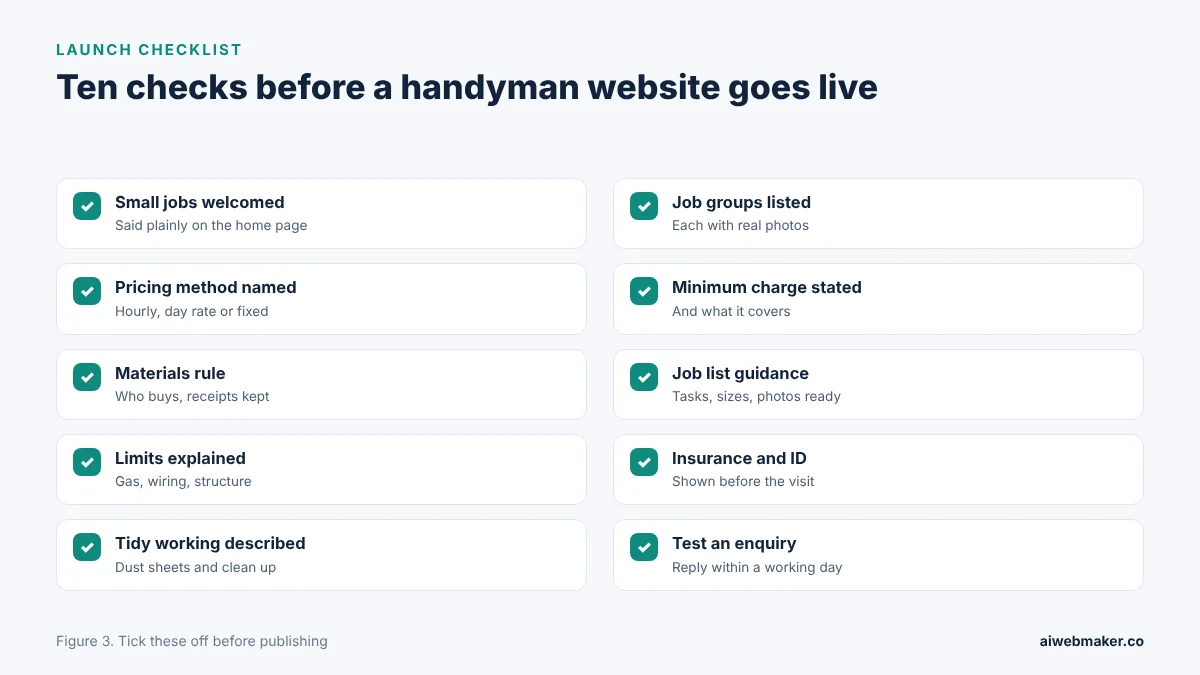
Customers close a handyman website without asking when they cannot tell whether their small job is welcome. A missing minimum charge or pricing method makes them fear a large bill for ten minutes of work. No photos of real jobs, or only stock images, suggest a business with little to show. Silence on insurance and identification worries anyone letting a stranger into the house, especially older customers. A vague promise to do everything, with no mention of jobs referred elsewhere, sounds less honest than a clear list of limits. The handyman checklist that follows turns each of these doubts into a quick fix before launch.
Frequently asked questions
Is there a minimum charge for one small handyman job?
Most handymen set a minimum charge, often equal to an hour or a short call out, because travel and setting up take time whatever the size of the task. The website should state the minimum clearly and say what it covers. Customers can get more value by adding other small jobs to the same visit. Some handymen offer a fixed price for common single tasks instead of the minimum. Being open about this from the start avoids the most common complaint in the trade.
Who supplies the materials for a handyman visit?
Materials can be supplied by either side, and the website should explain the handyman's preferred approach. Some customers like to choose their own fittings, such as blinds, handles or light fittings, and simply need them installed. Others prefer the handyman to buy fixings and sundries, which often go on the bill at cost or with a small handling charge. Receipts for larger items help keep the arrangement transparent. A clear rule on materials keeps the final bill predictable.
Can one visit cover jobs in several rooms?
One visit can cover jobs across several rooms, and that is usually the best value for the customer. A half day or full day booking suits a long list, with tasks ordered so the handyman is not fetching tools from the van repeatedly. The customer should mention every job in the enquiry so the right fixings and materials arrive with the handyman. Jobs that need drying time, such as filling and painting, may be split across two visits. A well planned list makes the most of every hour on site.
What happens if something is damaged during a handyman job?
If something is damaged during a job, a properly insured handyman can put it right or claim on liability insurance, which is why insurance details belong on the website. The page can name the type of cover held, without overstating what it includes. Customers should mention fragile walls, antique furniture or hidden pipes and cables before work starts. A careful handyman checks for cables and pipes before drilling, using a detector where appropriate. Clear cover and careful habits reassure customers before anyone picks up a drill.
A few half days against the year's hosting
A single busy half day of odd jobs tends to out earn the $119 hosting bill for a handyman's whole year. The $19 monthly route is lighter still, matched by a single short call out. Every landlord who books a seasonal round after reading the maintenance page adds work that returns year after year. A clear job list, an honest pricing method and a plain statement of limits answer the doubts that keep small repairs waiting. Handymen who photograph each finished task build a gallery that grows more convincing every month. Diaries filled with long job lists rather than single tap washers show the website doing its share.
Build your website in Minutes and get the AI Tools that work
Start Building Your Website →