Garden Design Website Cost When Clients Pay for Paper First
Garden studios are charged $119 per annum for hosting, or $19 on any monthly bill, and a domain is chosen besides. Covered: who hires a designer, the pages, fee models, the drawing set, build partners, seasons, permissions, search and the budget.
- No coding required
- Live in minutes
- Blog, SEO and chatbot tools included
Garden studios are billed $119 to stay hosted through a whole year, or $19 on a rolling monthly basis, and they choose and pay for a domain alongside. Inside the AI Web Maker preview, shaping and testing each page costs the studio nothing. One concept design fee would fund that hosting for roughly a decade. The harder sell is that clients pay for paper before a single plant arrives, so the site has to make drawings feel worth the money. Visitors want to see what the sheets look like, what each stage costs and who will actually build the garden. Fee models, the drawing set, build partners, planting seasons, permissions and the yearly budget follow, after a look at who hires a designer and the pages they expect.
This article is part of our complete guide: Home Services Website Builder.
Who hires a garden designer before calling a landscaper?
Clients who hire a designer first usually have a problem that a landscaper's quote alone cannot solve. Owners of new build plots on bare clay want a whole garden planned before any turf goes down. Families with long, narrow town gardens or steep slopes need levels and structure worked out on paper. Others have inherited tired borders and want a planting plan without a full redesign. A smaller group holds a large build budget and wants comparable quotes from several landscapers, which only a full drawing set allows. Each of them judges a designer by drawings, fees and finished gardens before anything else.
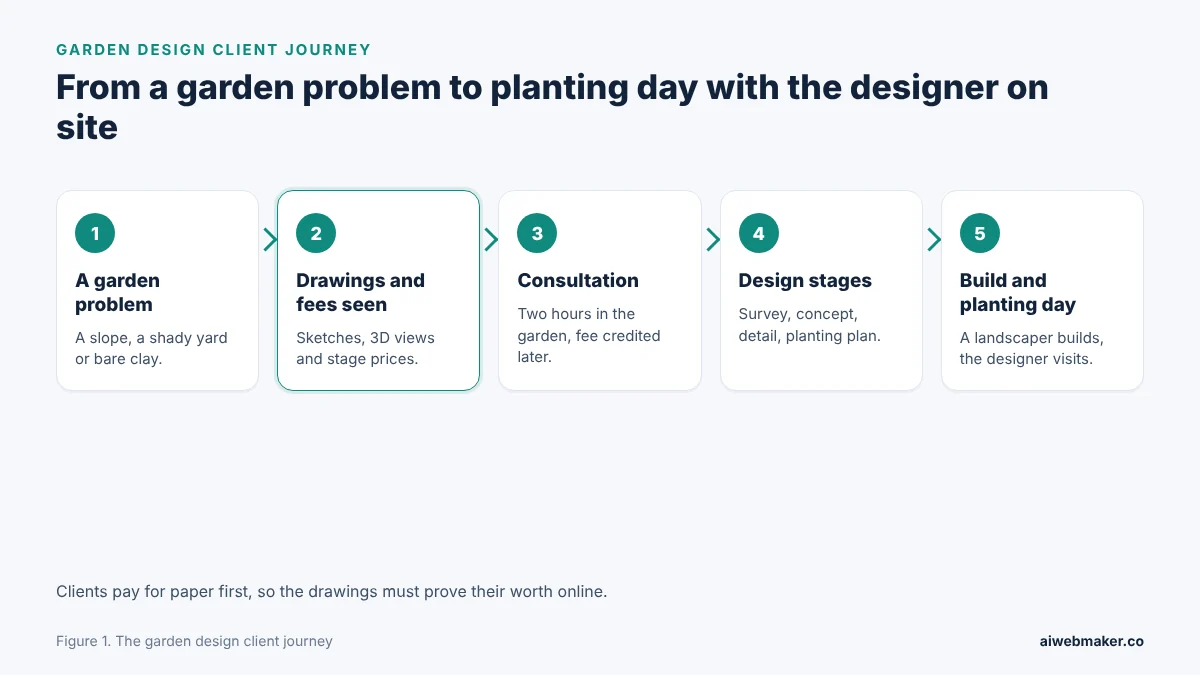
In this journey the website does its hardest work at the second step, before anyone has met the designer. A visitor who has just measured a gloomy courtyard wants to see what a concept sketch, a planting plan and a 3D view actually look like. Stage fees shown beside those drawings let the visitor judge whether the paper is worth paying for. The consultation then turns curiosity into a paid relationship, especially when its fee comes off a later design. Planting day, with the designer placing every pot, is the moment clients photograph and share.
Pages that let a visitor judge drawings before paying for them
A garden design website needs fewer pages than a landscaping firm, because it sells one service in clear stages rather than dozens of jobs. A stages page explains the sequence from consultation to planting plan, with typical weeks and a sign off at each step. A drawings page shows real sheets, from concept sketches over a survey to a finished planting plan. Fees sit on their own page, kept firmly apart from the cost of the build. A page on who builds the garden answers the question that separates a designer from a landscaper.
| Page | Visitor's question | What it should show |
|---|---|---|
| Home | Does this studio suit my garden? | A planting plan, the area served, a consultation button |
| Stages | What happens, and when? | Five stages, typical weeks, a sign off at each |
| Drawings | What does the paper look like? | Concept sketch, planting plan, 3D view, sections |
| Fees | What does design cost? | Consultation, concept and full design, apart from the build |
| Who builds | Who digs, and who checks? | Build partners, outside firms welcome, site visits |
| Enquire | Where does a project start? | Garden size, slope, build budget, preferred season |
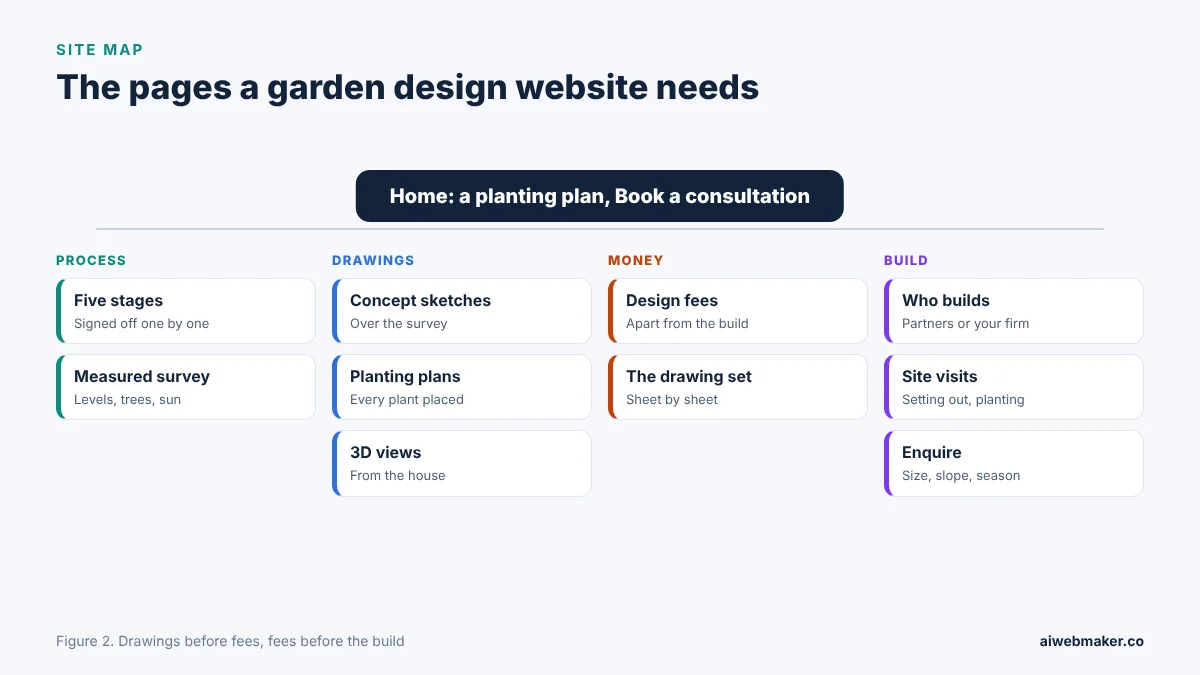
Four branches grow from the home page here, each answering one doubt a cautious client brings. Process pages carry the stages and the survey, drawing pages carry sketches and 3D views, money pages carry fees and the sheet list, and build pages carry partners and site visits. Our sample studio, Sage and Stone Garden Design, prices a garden consultation from $180, a concept design at $1,200 and a full design at $3,200 for gardens up to about 250 square metres. It sets out five stages, each signed off by the client, and takes the consultation fee off a design booked within three months. The garden design website example with a drawing set and stage fees was written by hand to show a layout, and no real studio stands behind it. Its order, drawings before fees and fees before the build, is the part worth copying.
Fee models for a studio that sells drawings rather than digging
Garden studios charge for design in at least four distinct ways, and visitors deserve to know which one applies before they pick up the phone. Fixed fees per stage are the clearest, because the client knows what the consultation, the concept and the detailed design each cost. Some studios price by garden area, which suits level plots but needs a note on steep or unusual sites. Hourly rates fit small advisory jobs, such as choosing plants for an existing border. Others charge a share of the build budget, which tracks the scale of the work but can look like an incentive to spend. Whatever the model, payment timing belongs on the page as well, for example half of each stage fee before that stage begins.
| Fee model | How it is worked out | Where it fits | What to state |
|---|---|---|---|
| Fixed fee per stage | A set price for each stage | Most home gardens | What each stage delivers |
| By garden area | A rate per square metre | Level plots of ordinary shape | Limits for slopes and listed gardens |
| Hourly rate | Time spent, billed after | Advice visits and border plans | Minimum visit and travel time |
| Share of the build budget | A percentage of the build cost | Large gardens with long builds | How the build figure is fixed |
The drawing set, sheet by sheet, is what the client buys
Clients value a design far more when the website lists every sheet they will receive and who works from it. A measured survey records boundaries, levels, drains and existing trees, and every later sheet is drawn over it. The concept plan sets out spaces, paths and views, while a setting out plan dimensions each edge so a landscaper can mark it on site. Levels, sections and a materials schedule let builders price stone and timber like for like, and a planting plan places each plant with a code and a count. The AI website builder for garden designers who sell drawings and planting plans drafts a page for this set, along with the stages and fees, after the studio describes its service in a few sentences. Seen sheet by sheet, the fee stops looking like the price of a few pretty pictures.
| Sheet | What it records | Who uses it |
|---|---|---|
| Measured survey | Boundaries, levels, trees, drains | Everyone, as the base |
| Concept plan | Spaces, paths and views | The client, choosing a direction |
| Setting out plan | Each edge measured from fixed points | The landscaper, marking out |
| Levels and sections | Heights of terraces, steps and walls | The landscaper and any engineer |
| Materials schedule | Stone, gravel and timber by area | Builders pricing like for like |
| Planting plan | Each plant placed, counted and sized | The planting team and the nursery |
| Lighting layout | Fittings, cable runs, switches | The electrician |
Who builds the garden, and who checks the build
The question that separates a designer from a landscaper is who digs, and the website should answer it without hedging. Some studios work with a few build partners they have watched on site for years, while others hand the drawings to any capable firm the client prefers. Sending one drawing set to two or three firms gives the client comparable prices, which is among the strongest reasons to pay for design. If the studio takes commission from build partners, saying so plainly protects trust, and saying it takes none is a strong signal where true. Site visits during the build, such as at setting out and on planting day, should be listed with any fee they carry. Clients who know who answers for each stage hire with far fewer doubts.
Seasons, planting windows and building a garden in phases
Garden design follows the calendar more closely than most services, and a website that explains timing fills the quiet months. In temperate regions many studios draw through autumn and winter, so hard landscaping can start in early spring with planting close behind. Bare root trees and hedging usually go in during the dormant season, while tender plants wait until frosts have passed. Climates differ widely, from dry Mediterranean summers to tropical wet seasons, so the page should describe the studio's own region rather than a general rule. Phasing helps clients spread cost, with terraces and paths built first and the planting a season later. A short timing note on the stages page turns a vague wish into a booked consultation.
Permissions, protected trees and boundary rules
Garden work needs permission more often than clients expect, so the website should flag common cases while saying that rules are set locally. Raised terraces near a boundary, tall walls or fences, work close to protected trees and changes in conservation areas are typical triggers. In England, for example, individual trees can be protected by preservation orders, and tree work in conservation areas usually needs notice to the council first. In parts of the United States, homeowner association rules or local permits for taller retaining walls may apply instead. A studio should promise to flag anything that might apply at the concept stage, without offering legal advice. That one promise reassures clients who fear an expensive surprise halfway through the build.
Phrases people type when a garden needs a plan, not just a gardener
People looking for a designer often type a problem rather than a profession. Searches such as garden designer near me, small garden design, sloping garden ideas, planting plan service or garden design for a new build show that mix. Each problem deserves its own heading, so a page section on sloping gardens can answer the search that names a slope. On the map listing, photos of drawings placed beside the gardens they became help nearby owners spot the studio. Reviews that describe a solved problem, such as a shady courtyard brought to life, count for more than stars alone. Articles on choosing plants for clay soil or on what a concept plan contains catch owners while their garden is still a muddy idea.
A studio's hosting bill beside one concept fee
Hosting is a minor overhead next to the fee for a single concept design. Settled annually the hosting is cheapest, and a newly launched designer can instead spread it at $19 each month. Articles on planting, soil and seasons cost about $0.65 each in AI credits. New drawings, revised fees or a wider travel area add nothing to the bill. Below, each route is summed, and the dearer $189 tier is noted purely as a yardstick.
| Item | Yearly | Monthly |
|---|---|---|
| Hosting the stages, drawings and fees pages | $119 | $228 over twelve months |
| Domain | Depends on the ending | Depends on the ending |
| Higher plan, for comparison | $189 a year | Not needed |
| Twelve planting and soil articles at about $0.65 | About $7.80 | About $7.80 |
| New drawings, fees and travel areas | No charge | No charge |
| Year before the domain | About $126.80 | About $235.80 |
Why garden owners close a designer's site without enquiring
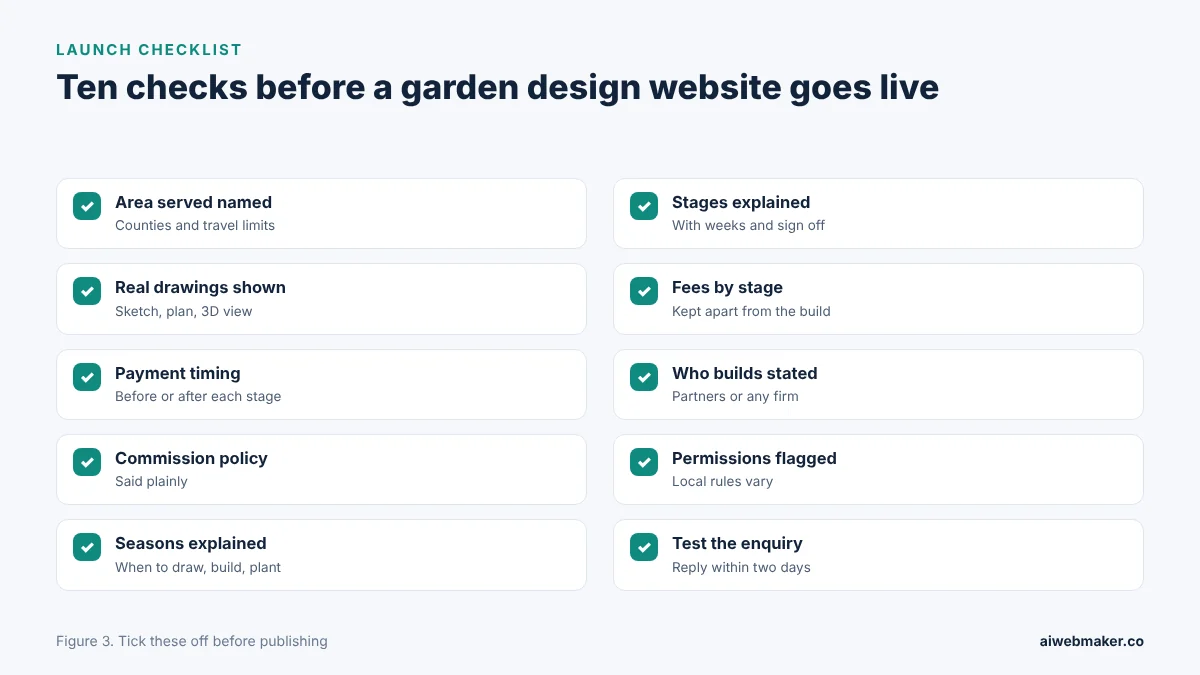
Garden owners close a designer's site quickly when it shows finished gardens but no drawings, leaving them unsure what the fee buys. Fees tangled up with build costs, or no fees at all, make the service feel unaffordable before a word is exchanged. Silence on who builds leaves visitors guessing whether they must find a landscaper alone. Garden photos years old, with no planting plans behind them, suggest a studio that has stopped working. A contact page that never asks about the size or slope of the plot reads as though it was written for any trade. Every one of those faults has a remedy among the ten ticks drawn for garden studios below.
Frequently asked questions
Who owns the drawings once the design fee is paid?
Ownership of garden drawings depends on the studio's terms and on copyright law where it works, so the website should state the position clearly. Many designers keep the copyright but license the client to build that garden from the drawings. The Sage and Stone sample goes further and says the drawings belong to the client once the fee is paid. Either approach is fine when it is written down before work begins. Clear terms let clients send drawings to any landscaper without worry.
Can a planting plan be bought without a full redesign?
A planting plan for existing borders is a popular smaller service, and it deserves its own line on the fees page. It usually includes a visit to check the soil, the light and which plants are worth keeping. The sample studio offers it from $650, which shows how a modest job can sit beside full designs. Clients with a sound layout but tired planting are often the most grateful buyers. Listing it widens the studio's reach beyond owners planning a full rebuild.
How should a designer talk about the build budget?
A designer should give a range for the build at the consultation rather than a firm price, because size, levels and materials move cost far more than style. The website can say so openly and explain that detailed drawings let landscapers quote firmly. Suggesting a contingency for hidden drains or poor soil shows experience. Keeping design fees and build costs in separate tables avoids confusion. Honest talk about money attracts clients whose budgets suit the work.
Is a 3D view worth paying for?
A 3D view helps many clients picture levels, heights and planting that they cannot read from a flat plan. Families often agree on a design sooner once they can see the garden from the kitchen door. The website should say whether 3D views come within a stage fee or cost extra. Showing one example view, labelled as a visualisation, sets fair expectations. A clear answer stops the question from stalling a decision.
How few consultations pay for the studio's year online
One garden consultation at the sample's $180 more than covers a year of hosting at $119. A concept design pays for it ten times over, and a full design covers many years. What turns visitors into those consultations is visible paper: real sketches, planting plans and fees set out by stage. Clear answers on who builds, when to plant and which permissions might apply remove the doubts that delay a booking. Studios that add each new drawing set to the site give visitors fresh proof every season. Counted in consultations, the year online is the smallest line in the studio's accounts.
Build your website in Minutes and get the AI Tools that work
Start Building Your Website →