Flooring Company Website Cost and the Subfloor Truths Behind a Quote
Flooring firms budget $119 a year for hosting, or a monthly $19, and pick a domain alongside. Topics: how buyers choose, material pages, comparisons, the measure visit, subfloors, pricing, homes and commercial spaces, search and the annual total.
- No coding required
- Live in minutes
- Blog, SEO and chatbot tools included
Floors are a long sale, yet the website behind them is cheap: $119 buys twelve months on AI Web Maker, $19 covers a single month, and a domain is paid for besides. Room by room pages and project photos take shape in the preview at no charge, so the fitter can polish every description before paying anything. The flooring business website shows those descriptions finished, since AI Web Maker gave its invented fitter a complete sample site running from subfloors to skirting. One fitted kitchen or living room floor usually covers the hosting for several years. The real challenge is that a new floor is a considered purchase, often browsed for weeks, and the quality that matters most lies underneath, in subfloor preparation, moisture checks and careful fitting that no showroom photo reveals. A flooring website has to hold a buyer's attention through those weeks of comparing materials, then explain why a properly prepared floor costs what it does. Below are how buyers decide, the pages to build, honest material comparisons, the measure visit, subfloors, pricing, homes and commercial spaces, search and the year's total.
This article is part of our complete guide: Home Services Website Builder.
Browsing for weeks: how flooring buyers make up their minds
Flooring buyers rarely decide quickly, because a floor is expensive, hard to change and visible every day. Homeowners renovating a kitchen or living room browse photos, compare materials and order samples before they ask anyone to measure. Families with children and pets worry about scratches, spills and cleaning. Landlords want hard wearing floors that survive tenants and can be fitted between lets. Shops, offices and restaurants care about durability, slip resistance and fitting outside trading hours. A flooring website that serves each of these buyers keeps them returning until they are ready to book a measure.
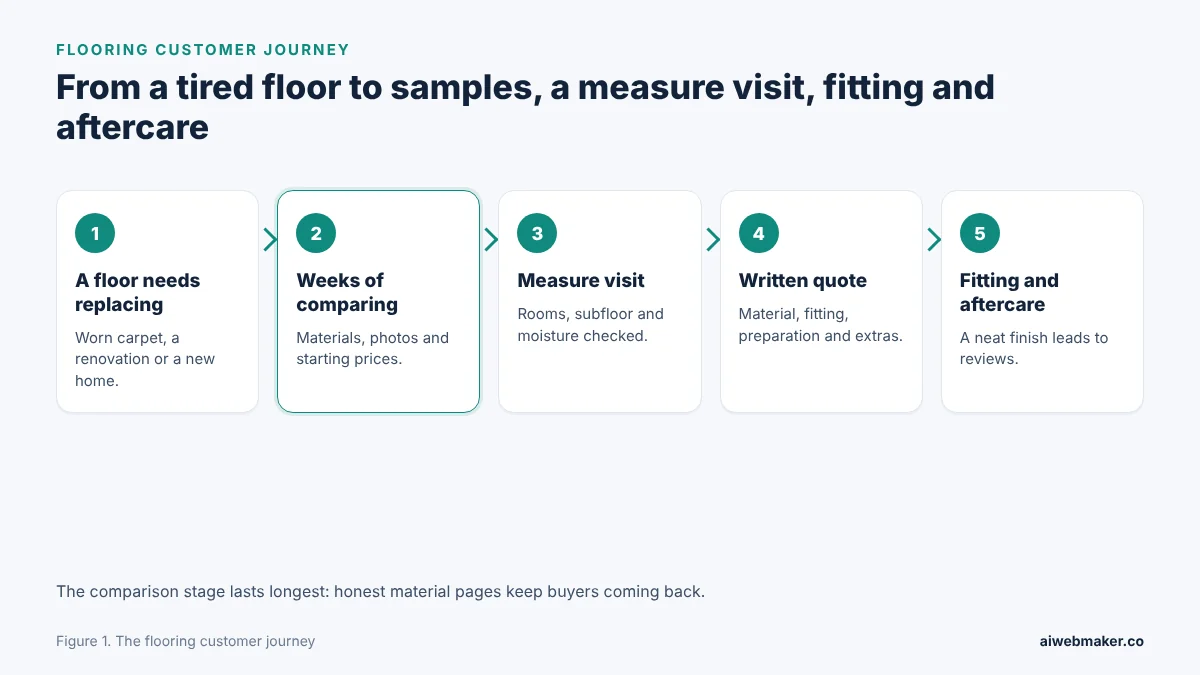
Among these five stages, comparing materials takes the longest, and a website that helps with that comparison is the one a buyer returns to. The journey starts with a worn carpet, a renovation or a new home. Weeks of comparison follow, with photos of finished rooms, honest pros and cons and starting prices shaping a shortlist. The measure visit then checks the room, the subfloor and the moisture before a written quote is given. Fitting day, and how the floor performs in the months after, decides whether the customer writes a review and recommends the firm. Each page of a flooring site should either help that comparison or move the buyer towards a measure.
Wood, laminate, vinyl, tile and carpet: the pages to build
Buyers often know the material they want before they search, so a flooring site needs a page for each material it supplies and fits. Each material page should show finished rooms, colours and textures, along with where the material suits and where it does not. Fitting services such as stairs, underfloor heating and old floor removal need their own explanations. A measure visit page and a projects gallery turn interest into enquiries. Commercial work and aftercare can each have a short section. What each of those pages needs is laid out in the next table.
| Page | What the buyer wants | What to include |
|---|---|---|
| Wood flooring | Warmth and character | Solid or engineered, finishes, rooms suited |
| Laminate | Value and durability | Wear ratings, water resistance, underlay |
| Vinyl planks and tiles | Water resistance and comfort | Click or glued, kitchens and bathrooms |
| Tiles | Hard wearing, easy to clean | Porcelain or ceramic, grout, heating |
| Carpet | Softness and quiet | Pile types, underlay, stairs |
| Measure visit | What happens before a quote | Measuring, moisture checks, samples |
| Projects | Proof of finished work | Before and after pairs, room types |
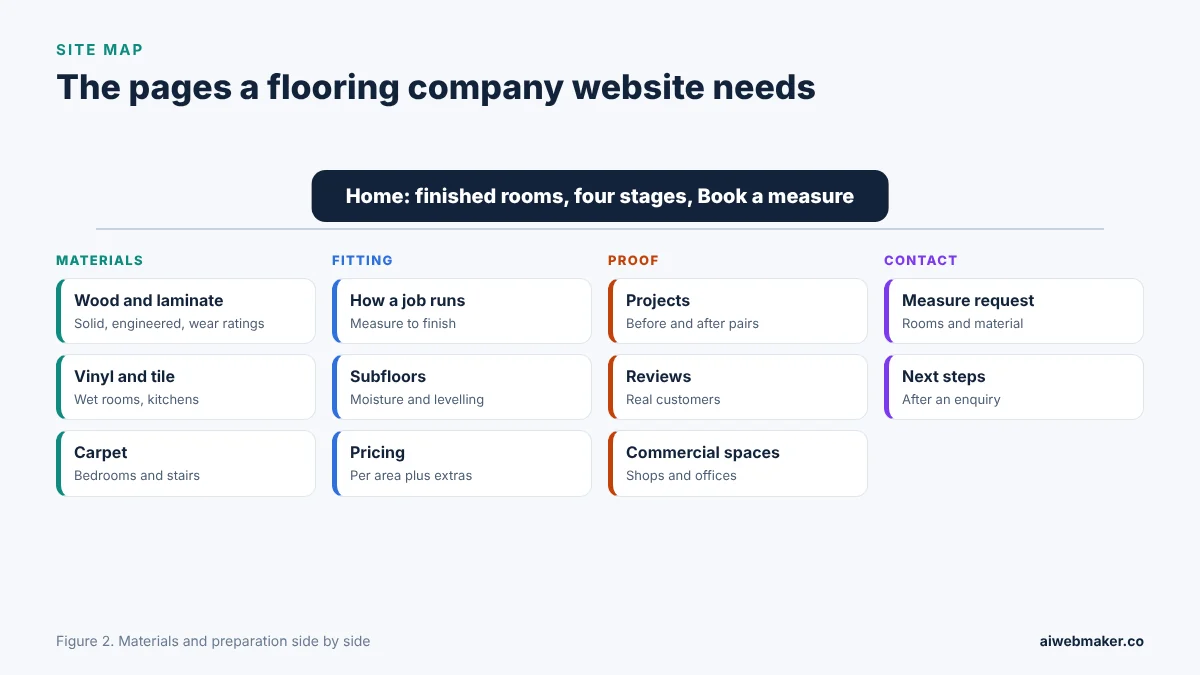
Mapped into a structure, a flooring site falls into materials, fitting, proof and contact, with the measure request on the home page. Material pages carry each floor type with photos and honest notes. Fitting pages explain preparation, the measure visit and how a typical job runs. Proof pages show finished floors and reviews. Our sample company, Plankwise Flooring, lists the types of flooring it supplies and installs on its services page, with separate parts for homes and commercial spaces and a description of how a typical job runs, while its home page traces four stages from the first quote to the finished floor. Its projects page combines finished floors, before and after pairs and a block of example reviews, and the contact page spells out the next steps after an enquiry; the flooring company website example with finished floors and before and after pairs was built in 55 seconds.
Comparing materials honestly
An honest material comparison is the most useful page a flooring company can publish, because buyers struggle to weigh looks, durability, comfort and price. Solid wood can be sanded and refinished many times but reacts to moisture and temperature. Engineered wood has a real wood top layer on a stable core, which makes it better suited to underfloor heating and some kitchens. Laminate offers good value and scratch resistance, with wear ratings that indicate how much traffic it can take. Luxury vinyl copes well with water and feels warmer underfoot, while porcelain and ceramic tiles are hard wearing and suit wet rooms. Carpet remains the softest and quietest choice for bedrooms and stairs.
| Material | Strengths | Points to watch | Rooms it suits |
|---|---|---|---|
| Solid wood | Character, can be refinished | Moves with moisture and heat | Living rooms, bedrooms, hallways |
| Engineered wood | Real wood look, more stable | Top layer limits refinishing | Living areas, some kitchens |
| Laminate | Value, scratch resistance | Most dislike standing water | Hallways, living rooms, rentals |
| Luxury vinyl | Water resistant, warm, quiet | Can dent under heavy points | Kitchens, bathrooms, rentals |
| Porcelain and ceramic tile | Very hard wearing | Cold and hard without heating | Kitchens, bathrooms, entrances |
| Carpet | Soft, quiet, warm | Stains and wear in busy areas | Bedrooms, stairs, lounges |
The measure visit and how area is calculated
A measure visit turns a buyer's choice into an accurate quote, and the website should explain what happens during it. The fitter measures each room, notes alcoves, doorways and thresholds and checks how the floor will run from room to room. An allowance for cutting and waste is added, commonly around five to ten percent, and more for patterns such as herringbone or diagonal layouts. The subfloor and its moisture are checked at the same visit, since they decide how much preparation is needed. The AI website builder for flooring companies with material and measure pages writes first drafts of the services, projects, about and contact pages from the fitter's own summary of the floors it lays. A clear account of the measure visit makes the next step feel easy rather than a sales pitch.
Subfloor preparation, moisture and acclimatisation
Subfloor preparation decides how long a new floor lasts, which is why careful fitters spend time on work the customer will never see. Concrete floors are tested for moisture, since damp can ruin wood, laminate and adhesives, and a membrane may be needed. Uneven floors are levelled with compound, and loose or squeaking boards are fixed before anything new goes down. Wood flooring often needs time in the room to adjust to its temperature and humidity, following the manufacturer's guidance. Older floors can hide tiles or adhesives containing asbestos, so they should not be sanded or broken up until tested, and rules on removal vary between countries. A page that explains these checks shows why the cheapest quote may skip the work that matters most.
| Check | Why it matters | What the fitter may do |
|---|---|---|
| Moisture | Damp damages wood, laminate and adhesives | Test the subfloor, fit a membrane |
| Level | Dips and humps cause gaps and wear | Apply levelling compound |
| Rigidity | Loose boards squeak and move | Screw down or overboard |
| Old floor coverings | Some may contain asbestos | Test before lifting, use specialists |
| Underfloor heating | Some materials have limits | Check compatibility and temperatures |
| Acclimatisation | Wood moves as it settles | Leave boards in the room as advised |
Pricing per square metre, and what sits outside it
Flooring quotes are usually built on area, in square metres or square feet, but the headline figure rarely covers everything. Buyers compare quotes far better when each line is explained. Material and fitting may be priced together or separately. Underlay, preparation, removal of the old floor, door trimming, thresholds and skirting or beading are often listed as extras. Stairs are commonly priced per step because of the cutting and fixing involved. A pricing page that shows starting figures for common materials, with the extras explained, brings in buyers whose budget matches the work. Transparent pricing also protects the firm from being undercut by quotes that quietly leave out preparation.
| Item | Usually priced as | What to explain |
|---|---|---|
| Material | Per square metre or foot | Range, grade and wastage allowance |
| Fitting | Per square metre or foot | Pattern and room shape effects |
| Underlay | Per square metre or foot | Type chosen for the material |
| Preparation | Per area or per job | Levelling, membranes, board repairs |
| Old floor removal | Per room or per job | Disposal included or extra |
| Stairs | Per step | Nosings and trims |
| Trims and doors | Per item | Thresholds, beading, door trimming |
Homes, rentals and commercial spaces
Each of these three settings asks for different floors and different fitting arrangements, so the site needs a few lines for every one. Homeowners care most about look, comfort and how the floor copes with children, pets and kitchens. Landlords want hard wearing, easily cleaned floors that can be fitted between tenancies with minimal empty days. Shops, offices and restaurants look for durability ratings, slip resistance and fitting at night or over weekends so trading continues. Laminate wear ratings, commercial grade vinyl and porcelain tiles are common choices for busy spaces. Showing a few commercial projects, with permission, tells business owners the firm has done this before.
Search phrases that lead to a measure visit
Flooring buyers type phrases such as flooring company near me, engineered wood flooring, luxury vinyl fitting, laminate installation or carpet fitters, with the town tacked on the end. A page for each material, headed with the phrase people use, connects each search to the right answer. Photos of finished rooms and correct showroom hours on the map listing give nearby buyers a reason to click through. Reviews that mention neat edges, careful preparation and a tidy finish carry more weight than general praise. Articles comparing laminate and vinyl, explaining acclimatisation or caring for wood floors draw buyers during their weeks of research. A flooring company that teaches buyers how to choose becomes the one they ask to measure up.
The flooring firm's hosting ledger for the year
Just two lines recur for a flooring company's website, the hosting and the domain, and any buying guide drafted through AI credits costs around $0.65. A firm with steady work keeps the year cheapest on annual billing. A fitter starting out alone may prefer the monthly bill while the order book grows. New projects, updated prices or extra materials never raise the hosting cost. The flooring figures sit in the table below, with the higher $189 tier listed beside them as a benchmark.
| Item | Yearly | Monthly |
|---|---|---|
| Hosting the flooring pages | $119 | $228 over twelve months |
| Domain | Depends on the ending | Depends on the ending |
| Higher plan, for comparison | $189 a year | Not needed |
| Twelve flooring buying guides at about $0.65 | About $7.80 | About $7.80 |
| Projects, prices and materials | No charge | No charge |
| Year before the domain | About $126.80 | About $235.80 |
What makes a floor buyer keep browsing elsewhere
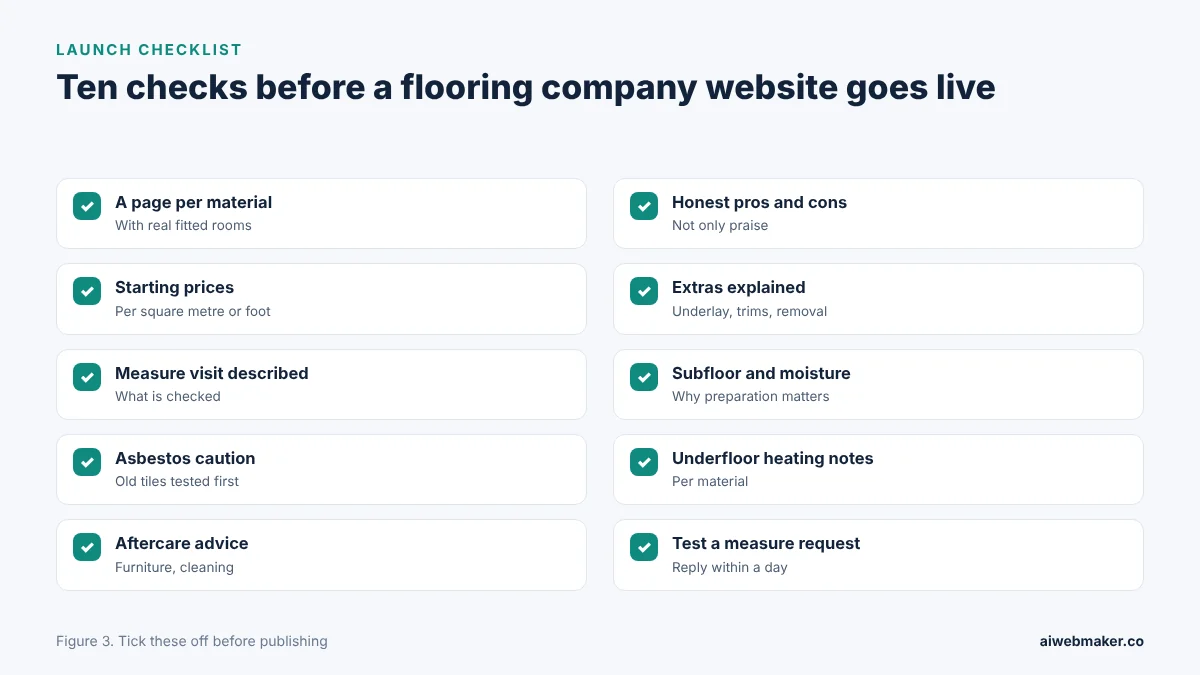
A floor buyer keeps browsing elsewhere when a flooring website shows no photos of real fitted rooms. Material pages that only praise every option, without honest drawbacks, make the advice feel like a sales pitch. Missing starting prices leave buyers unable to tell whether the firm suits their budget. No mention of subfloor preparation or moisture checks suggests the firm skips the work that decides how long a floor lasts. A measure visit that is not explained feels like a commitment buyers are not ready to make. Ten checks for a flooring site, pictured below, address each of these reasons to leave.
Frequently asked questions
How long should wood flooring acclimatise before fitting?
Wood flooring should acclimatise for as long as the manufacturer recommends, which is often a few days in the room where it will be fitted. The boards adjust to the room's temperature and humidity, reducing movement after fitting. Some engineered products need less time, and some manufacturers advise against opening the packs early. The heating should run at normal levels during this time. Explaining this on the website sets realistic timings for the job.
Can new flooring go over the old floor?
New flooring can sometimes go over an old floor, but only if the existing surface is sound, level, dry and suitable for the new material. Floating floors are more forgiving than glued ones. Carpet, soft vinyl and uneven tiles are usually removed first. Raising the floor height may also mean trimming doors and adjusting thresholds. The measure visit is the right moment to decide, and the website can explain the factors involved.
Is underfloor heating suitable for wood and vinyl floors?
Many engineered wood, vinyl and laminate products can be used over underfloor heating, but each has temperature limits set by its manufacturer. Tiles and stone conduct heat well and are a common pairing. Solid wood is more likely to move with heat changes and is often less suitable. The heating should usually be switched off or lowered during fitting and brought back gradually afterwards. A clear compatibility note on each material page saves buyers from costly mistakes.
How soon can furniture go back after fitting?
Furniture can often go back on floating wood, laminate and click vinyl floors soon after fitting, while glued floors and tiles need time for adhesives and grout to set. The fitter should give clear timings for each job. Felt pads under furniture legs help protect new surfaces from scratches. Heavy items should be lifted rather than dragged into place. A short aftercare page helps customers keep their new floor looking its best.
A single kitchen floor against twelve months online
One fitted room usually earns a flooring company more than the $119 that hosts its website for the year. A single doormat sized trim job would almost cover a month at $19. Every buyer who books a measure after weeks of reading the material and preparation pages arrives better informed and readier to proceed. Honest comparisons, visible preparation and clear pricing persuade careful buyers more than any showroom slogan. Firms that add before and after pairs after each fitting keep that proof growing. A diary of measure visits from people who already know what they want is the return a flooring website is built to deliver.
Build your website in Minutes and get the AI Tools that work
Start Building Your Website →