Excavation Contractor Website Cost, Day Rates and Cables Found First
An excavation firm covers hosting with $119 each year or a $19 charge every calendar month, and the domain ending it picks carries its own price. Read on for builders and homeowners, machine cards, pricing and muck away, buried services, trench safety and spoil, quote requests, search and a cost table.
- No coding required
- Live in minutes
- Blog, SEO and chatbot tools included
An excavation firm on AI Web Maker covers hosting with $119 each year or a $19 charge every calendar month, and the domain ending it picks carries its own price. No bill is raised for drafting machine cards, dig pages and a quote request on AI Web Maker, or for trying them out on a small screen in the preview. Half a day of operated hire on one small job usually covers the whole year. What takes real effort is convincing a builder or homeowner who has never met the crew that the right machine will arrive, fit through the gap and dig without striking a cable. Clients compare contractors like rate cards, so vague promises lose to firms that publish sizes, rates and a method. The pages below cover the clients, machine sizes and access, day rates and muck away, buried services, trench safety and spoil, site visits, search and a yearly budget.
This article is part of our complete guide: Home Services Website Builder.
Builders, homeowners and farmers: who hires an excavation contractor
Excavation work comes from a wider mix of clients than most trades, and each arrives with a different first question. Main contractors need footings and drainage dug to a programme and want to know whether the firm can start on the day promised. Homeowners planning an extension, a pool or a new driveway want to know whether a machine will fit through the side gate and how much mess it will leave. Landscapers book a micro excavator for a day of shaping, while farmers want field drains, ponds or a track cleared. Developers clearing a plot ask about bigger machines, tipper lorries and how spoil leaves the site. All of them judge a contractor on the same three points: which machine, what it costs and whether the crew knows what lies underground.
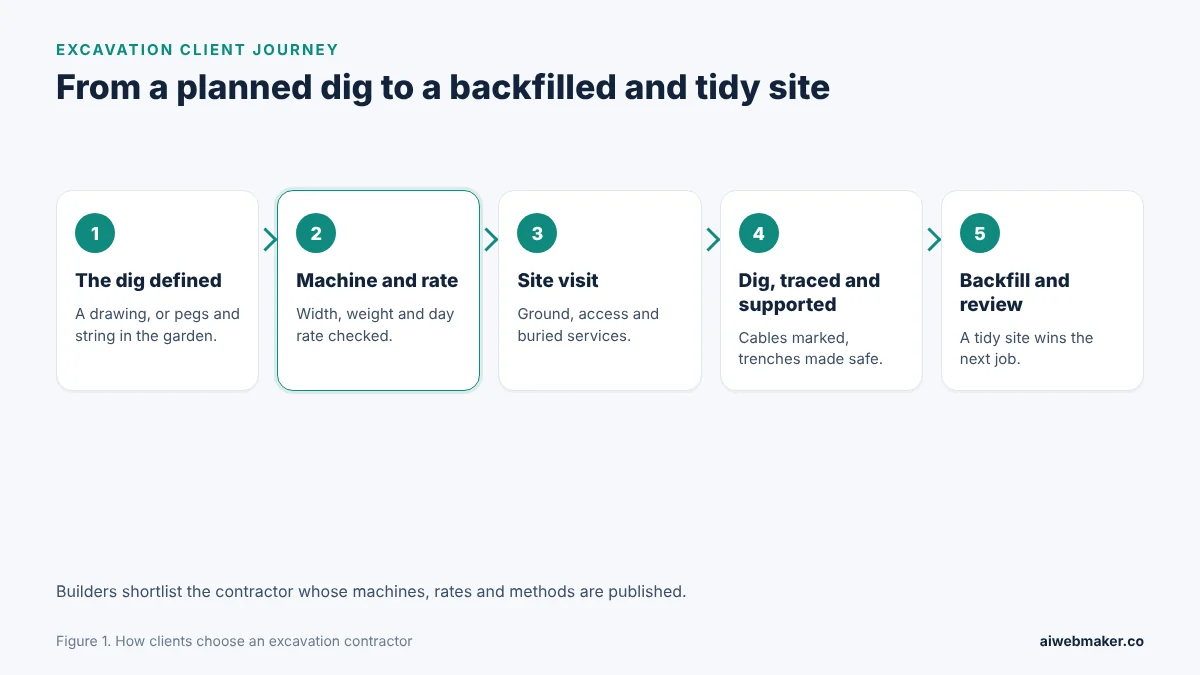
The journey runs from a drawing or an idea to a trench filled in and a site left tidy. A client first defines the dig, often with a plan from an architect or simply a line of pegs in the garden. The highlighted step is checking the machine and the rate, because access width and the day rate decide whether a contractor makes the shortlist. A site visit follows, where the contractor checks the ground, the access and the likely route of buried services. The dig itself, with services traced and trenches supported, earns the review that wins the next job. Each stage depends on the client finding clear facts on the website before picking up the phone.
Machine cards, dig pages and the rest of an excavation contractor's site
An excavation site works best as a published rate card backed by evidence that the crew digs safely. Machine pages list each excavator with its weight, width and day rate. Dig pages describe foundations, drainage, clearance and the other jobs in builders' words. A section on buried services, a guide matching machines to jobs and a gallery of real sites build trust. The quote request closes the route, with a note on how the site visit works.
| Page or section | What the client checks | What it should show |
|---|---|---|
| Machines and day rates | Size, width, operator included | Weight, narrowest width, daily price |
| Digging services | Is my job covered? | Foundations, trenches, clearance, dig outs, pools |
| Buried services | Will they hit a cable? | Records, scanning, marking, hand digging |
| Machine for the job | What will they send? | Typical jobs matched to machines and days on site |
| How a dig runs | What happens in order? | Visit, quote, tracing, dig, backfill |
| Recent sites | Do they do this work? | Real trenches and plots, with stages shown |
| Quote request | How do we start? | What, where, access and spoil |
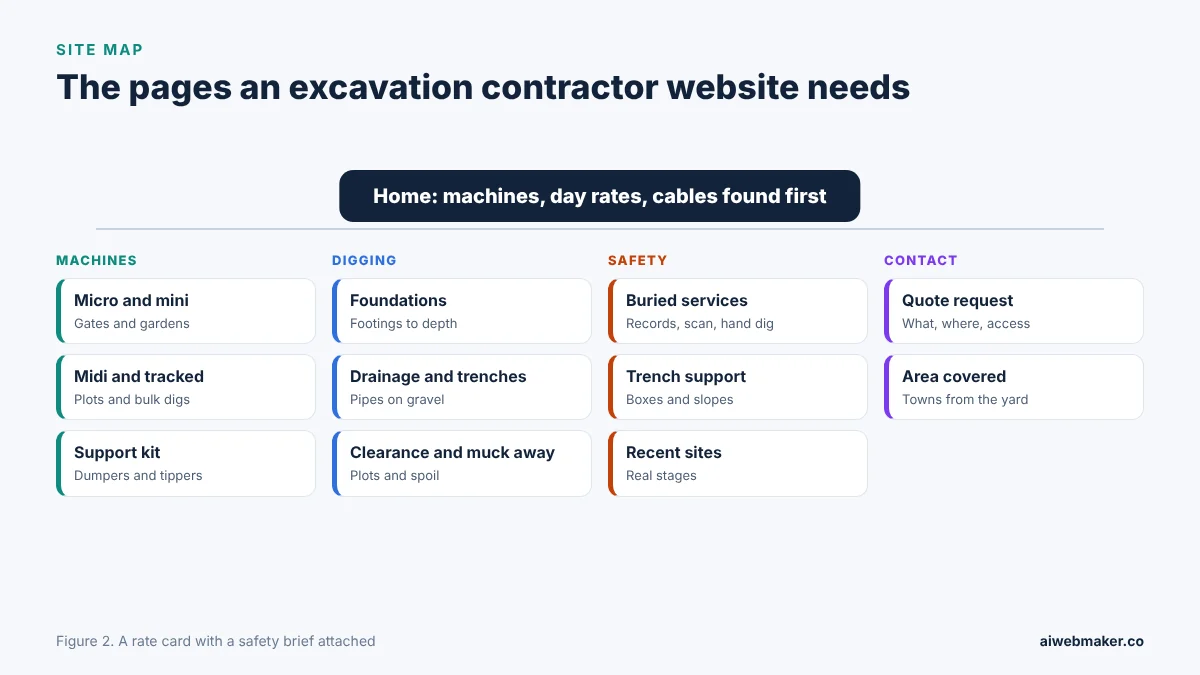
Arranged around the client's three questions, the contractor's pages split into machines, digging work, safety and contact. The machine group carries the smallest and largest excavators and the support kit such as dumpers and tippers. The digging group covers foundations, drainage and clearance, while the safety group explains service tracing and trench support. Our sample firm, Groundbreak Excavation, puts this on one page with a micro excavator of 1.5 tonnes, a mini excavator of 3 tonnes, a midi excavator of 8 tonnes and a tracked excavator of 14 tonnes, each carrying a day rate. Its digging cards cover foundations, drainage and service trenches, site clearance, driveway and patio dig outs, basements and pools, and muck away. The excavation contractor website example that traces cables before digging adds a buried services section, a machine for the job table, a five step dig sequence and a gallery of recent sites.
Machine sizes, access widths and what each excavator can reach
Choosing the machine is the decision clients understand least, so the website should make it for them in plain terms. A micro excavator can often pass through a garden gate or a house's side passage, but it digs slowly and not very deep. A mini excavator handles most extension footings and drain runs, provided the access is wider. Midi machines and full size tracked excavators move far more soil each hour but need vehicle access, firm ground and delivery on a plant trailer. Each machine card should state the narrowest width with tracks retracted, the weight and what jobs it usually does. Clients who see these facts can rule out a machine that would never reach the back garden.
| Machine | Typical access | Usually suited to | Points to state |
|---|---|---|---|
| Micro, around 1.5 tonnes | Garden gates and narrow passages | Small footings, drain runs, landscaping | Slow on bulk digs, limited depth |
| Mini, around 3 tonnes | A wider side access or driveway | Extension footings, service trenches | Ground protection on lawns |
| Midi, around 8 tonnes | Vehicle access to the site | Pools, basements, larger plots | Delivered on a trailer |
| Tracked, around 14 tonnes | Open sites with firm ground | Clearance, bulk digs, loading tippers | Low loader delivery, ground bearing |
Day rates, fixed prices and muck away on an excavation quote
Excavation pricing confuses clients because the machine is only one line among several. Most contractors charge the excavator and operator by the day or half day, and the website should say whether the operator, fuel and travel are included. Delivery and collection of larger machines is usually a separate charge. Muck away is often the biggest surprise, because soil takes up more room once it has been dug and tip fees vary by region and by the type of material. Set prices for routine digs, for example the footings of a single storey extension, help homeowners budget, provided the conditions behind them are written down. A quote that lists each line separately prevents arguments when the final invoice arrives.
| Cost line | How it is usually charged | Worth stating on the page |
|---|---|---|
| Machine and operator | By the day or half day | What is included, minimum hire |
| Delivery and collection | Per trip | Which machines need a trailer |
| Muck away | Per load or by volume | Tip fees vary by area and material |
| Dumper or second operator | Per day, when needed | Shown as its own line |
| Trench support | Per day or per job | Used on deeper or unstable trenches |
| Pumping water | Per day | Only if groundwater appears |
Finding buried services before the bucket goes in
Striking a cable, a gas main or a water pipe is the risk every client fears, so the website should describe exactly how the crew avoids it. The process usually starts with utility records, which show the approximate route of known services. Many countries run a one call service that tells contractors what lies under a site, for example 811 in the United States, and the page can say the firm uses the local equivalent. On site, an operator sweeps the ground with a cable locator and a signal generator, then marks each line with paint. Digging near those marks is done by hand, with trial holes to confirm depth. The page should also admit the limits, because locators can miss plastic pipes and disconnected cables, and that honesty is exactly what experienced builders look for.
Trench safety, neighbours and where the spoil ends up
Deep trenches can collapse without warning, which is why clients want to read how the crew supports or slopes each one. Trench protection rules differ by country; American federal workplace standards, as one example, call for a protective system in most trenches five feet deep or more. Steel trench boxes, shoring or sides cut back at a safe angle each suit different ground, and the page can name the methods the firm uses. Digging close to a neighbour's foundations may need formal notice, as under the party wall rules in England and Wales, so clients should be told to check local requirements. Spoil needs a plan too, whether it is reused on site, taken to a tip or kept separate when contaminated. A paragraph on each of these subjects shows a contractor who thinks beyond the bucket.
Site visits, quote requests and a builder that drafts the contractor's pages
The quote request should gather enough to price the job without turning into a survey form. A useful request mentions what needs digging, the town, the narrowest access, where the soil should go and when the work is needed. The page should explain that a site visit follows for anything beyond simple jobs, because ground, slopes and services cannot be judged from a message. The AI website builder for excavation contractors with machine cards and quote pages drafts the machine cards, dig pages and request page after the contractor names its fleet and its work, and every draft can be reviewed in the preview at no cost. Rates, photos and wording can then be adjusted to match the yard. A clear request route turns casual browsers into site visits worth making.
Phrases builders and homeowners type when they need a digger
Clients look for excavation contractor near me, mini digger hire with operator, foundation digging, drainage trench, site clearance or muck away, nearly always with a town or region. In some countries the trade is called groundworks, and in others excavating or earthworks, so the main headings can carry the local words. Each machine card and dig page should carry the phrase a client would actually type. The map listing should show the yard address, the area covered and photos of machines at work. Reviews from builders who mention punctual starts and clean trenches carry real weight with other builders. Articles on whether a digger will fit through a gate or what happens to soil from an extension dig answer questions clients ask on every visit.
The year's website bill for an excavation firm
The recurring cost of an excavation firm's site is hosting plus the domain, and a dozen groundworks articles bought on AI credits add roughly $7.80. A firm with steady contracts saves most on the $119 yearly bill. A new outfit with one machine might prefer $19 each month at first. Changing rates, adding a machine or posting new sites costs nothing extra. Both billing routes follow in two columns, with the $189 tier placed there to compare against.
| Item | Yearly | Monthly |
|---|---|---|
| Hosting the excavation pages | $119 | $228 over twelve months |
| Domain | Depends on the ending | Depends on the ending |
| Higher plan, for comparison | $189 a year | Not needed |
| Twelve groundworks articles at about $0.65 | About $7.80 | About $7.80 |
| Rate, machine and gallery updates | No charge | No charge |
| Year before the domain | About $126.80 | About $235.80 |
Omissions that make a builder ring the next contractor
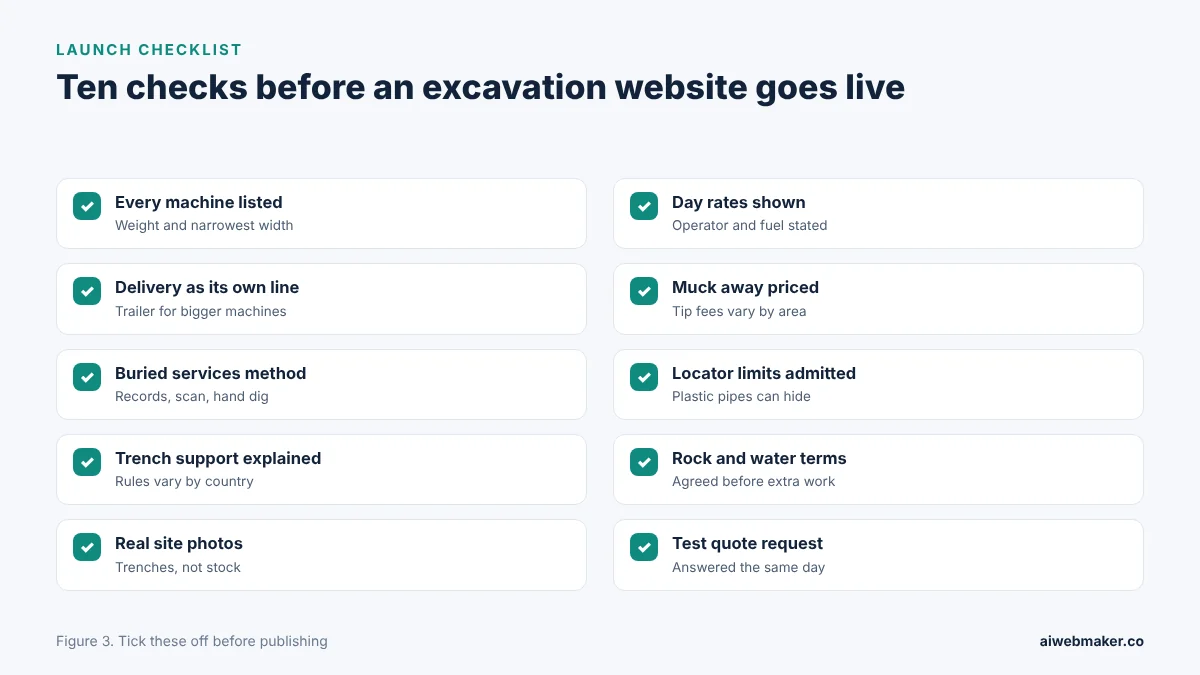
Builders move on quickly when an excavation website gives no machine sizes, because they cannot tell whether the digger will reach the job. Missing day rates suggest the price changes with the customer. Silence about buried services worries anyone who has seen a cable struck on site. Muck away left out of the pricing makes every quote look incomplete. Stock photos of yellow machines prove nothing, while real trenches with string lines and support boxes prove a great deal. Ten checks that answer these doubts are set out in the next graphic.
Frequently asked questions
Is operated hire the same as hiring the machine alone?
Operated hire supplies the excavator with a trained driver, while hiring the machine alone leaves the client responsible for operating it. Many excavation contractors only work with their own operators, because insurance and safety depend on who sits in the cab. The website should state which option the firm offers and what each includes. Clients who choose a machine alone need to know about competence, insurance and the rules that apply where they live. Clear wording prevents a homeowner from booking something they cannot legally or safely use.
Who pays if the dig strikes an unmarked pipe?
Responsibility for damage to an unmarked pipe depends on the contract, the records available and the law in the country concerned. A contractor who checked records, scanned the ground and dug by hand near the marks can show that it took care. The website should explain this process and state that the firm holds liability insurance, without promising how any claim would be settled. Clients should agree in writing how unexpected services will be handled before work starts. Honest wording on this question builds more trust than any guarantee.
What happens when the dig hits rock or groundwater?
Rock and groundwater are the two most common reasons a dig takes longer than planned, so the quote should say how each is handled. Rock may need a hydraulic breaker on the machine, which adds time and cost. Groundwater may need a pump and, in deeper trenches, extra support. The page can explain that these are charged at the stated day rate and agreed with the client before continuing. Clear terms turn an unwelcome surprise into a calm conversation.
Can a mini excavator work on a lawn without ruining it?
A mini excavator will leave marks on a lawn, but ground protection mats or boards reduce the damage considerably. The website can show photos of boards laid along the route and explain that tracks are kept to one path where possible. Clients should know that some reseeding or returfing may be needed afterwards and whether the contractor includes it. Wet weather makes lawns far more vulnerable, which may affect the start date. Setting expectations early prevents disappointment when the machine leaves.
A single footings job against twelve months online
A single small footings dig normally brings in more than $119, the price of an excavation contractor's pages staying online for a year. Spread across monthly bills, $19 is less than an hour of operated machine time. Every builder who returns for the next extension, and every homeowner who passes the name to a neighbour, adds work the site helped start. Published machine sizes, honest rates and a clear account of how cables are found persuade careful clients better than any slogan. A contractor who keeps the gallery fresh with real trenches shows that the yard is busy and the crew is careful. Calls that begin with a machine size and a date already chosen show that clients are reading the pages properly.
Build your website in Minutes and get the AI Tools that work
Start Building Your Website →