Emergency Electrician Website Cost, Call Out Rates Read Aloud First
A phone answered at three in the morning is costly to run, but the website behind it is not: $119 hosts it for a year, a lone month costs $19, and the domain ending sets its own price. Ahead: callers, pages, time bands, making safe, who to call first, business accounts, search and the budget.
- No coding required
- Live in minutes
- Blog, SEO and chatbot tools included
A phone answered at three in the morning is costly to run, but the website behind it is not. Twelve months of hosting are billed at $119, a single month at $19, and the domain is bought according to its ending. Building the call out pages and testing them in preview produces no invoice from AI Web Maker. One night visit to a scorched socket is worth more than the entire hosting year. The harder task is reaching a stranger standing in a dark hallway, who is frightened, unsure what is safe to touch and worried about an unknown bill. Ahead come the callers, the pages, time bands and rates, making safe, who to call first, business accounts, search and the yearly budget.
This article is part of our complete guide: Home Services Website Builder.
Dark hallways, dead chillers and tenants: who rings an emergency electrician
Most people who ring an emergency electrician have never needed one before and are reading the website by phone torch. A household has lost power to one circuit or the whole home, or a socket has scorched and smells of burning. A shop owner has found a dead bank of chilled cabinets before opening, with stock warming by the minute. Tenants call when a landlord cannot be reached, and landlords or letting agents call on behalf of homes they manage. After storms and leaks, people ring because water has come through a light fitting. Each caller wants three answers at once: what is safe to do now, how soon someone can come and what it will cost.
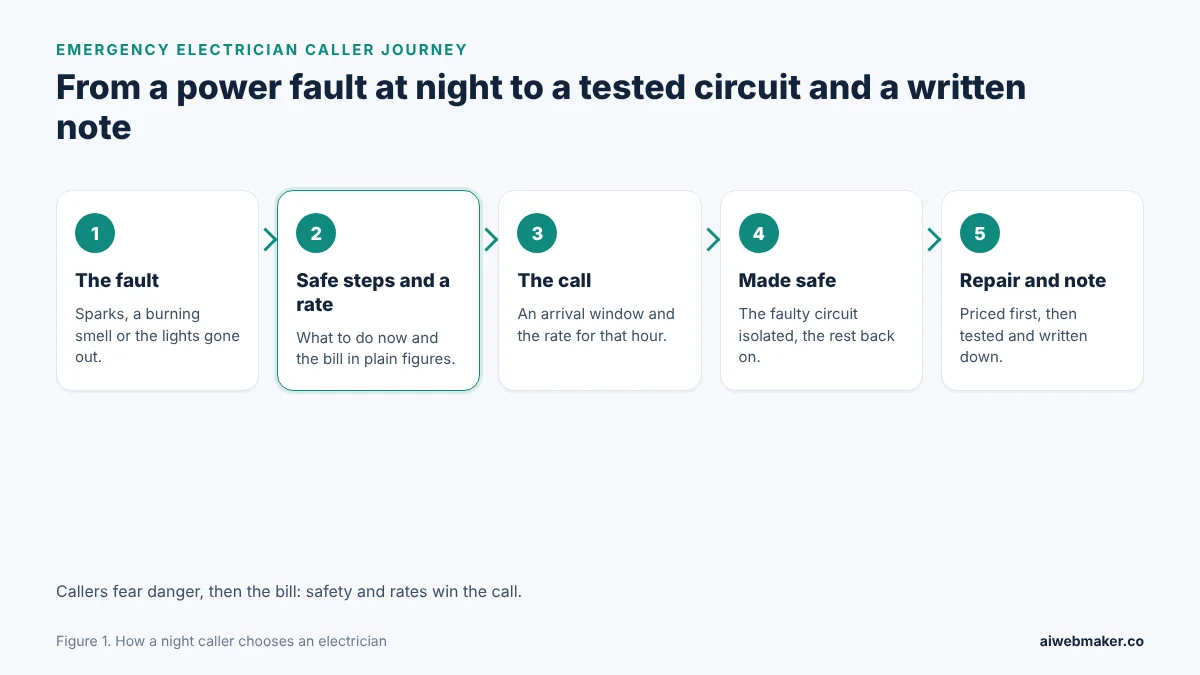
Panic shapes the first two cards of this journey, and the website has to calm it before it sells anything. The opening card is the fault itself, such as a tripped board, sparks or water near a fitting. The highlighted card is the moment the caller reads what is safe to do and sees a rate in plain figures, because an unknown bill is the second fear after the danger. The call follows, with an arrival window and the rate for that hour read out. The final cards cover making the fault safe, pricing the permanent repair and leaving a short written note, which is what turns a frightening night into a review and a saved number.
Safety first, rates second: the pages an out of hours electrician publishes
An emergency electrician's pages should run in the order a frightened caller needs them, starting with safety rather than credentials. A short safety strip at the very top tells people when to switch off at the main switch and when to stay away. Call out rates by time of day come next, followed by the faults the vans are equipped to fix. A section for businesses and landlords explains accounts, keyholders and site details kept on file. A call back route handles faults that can wait a few hours, which keeps the night line clear for real danger. Contact details repeat the phone number large enough to tap with a shaking hand.
| Page or section | What the caller needs | What it should state |
|---|---|---|
| Safety strip | What to do this minute | Main switch only if dry and reachable, never touch damaged wiring |
| What you are seeing | Reassurance and next steps | Symptoms, safe actions, what the electrician does |
| Call out rates | The bill before the visit | Rate by time band, what it covers, extra time |
| Faults fixed | Whether the van can help | Power loss, tripping, burnt sockets, water damage, boards |
| Businesses and landlords | Faster visits to known sites | Accounts, keyholders, written handovers |
| Call back request | Help for faults that can wait | When a visit is needed and a short description |
| Contact | The number, again | Hours answered, area covered, travel beyond it |
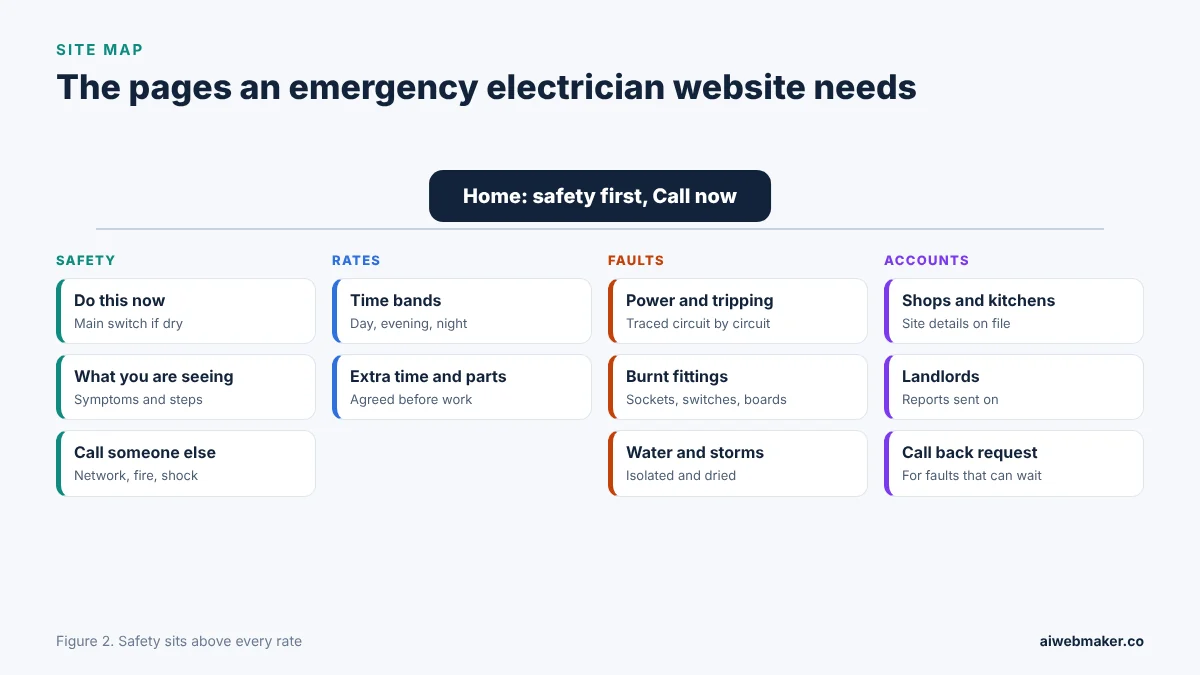
Sorted by urgency, the emergency electrician pages fall into four groups: safety, rates, faults and accounts. Safety pages tell callers what to do before help arrives and when to ring the emergency services instead. Rate pages explain each time band and what it includes. Live Wire Emergency Electrical, the sample business, opens with a do this now bar, then a table of what callers notice, what is safe to do and what the electrician does. The emergency electrician website example with call out rates by the hour shows daytime, evening and Saturday, and night, Sunday and holiday rates before listing power cuts to one home, an RCD or breaker that keeps tripping, burnt sockets or switches, lights flickering or dead, water and storm damage and failed or burnt fuse boards. It ends with five steps from the call to the power back on, a block for shops and kitchens, recent nights on the job, questions and a call back request.
Call out rates by the hour: time bands, the first half hour and extra blocks
Call out pricing is the part of an emergency electrician's page that decides whether a nervous caller rings or keeps searching. Most firms charge a call out rate that covers travel and a first period on site, then charge further time in fixed blocks. That rate usually rises across time bands, with evenings and Saturdays above weekday daytime and nights, Sundays and public holidays above both. Parts should be priced before they are fitted, and the page can promise that no extra work starts without agreement. A clear note that the rate is read out on the phone before the van sets off removes most of the fear. Stating rates as examples in a stated currency, with the reasons they vary, keeps the page honest wherever the business trades.
| Rate element | What it usually covers | What the page should say |
|---|---|---|
| Daytime call out | Travel and the first period on site | Hours of the band and the time included |
| Evening and Saturday | The same, at a higher band | When the band starts and ends |
| Night, Sunday and holidays | The highest band | Which days count as holidays |
| Extra time | Fixed blocks after the first period | Block length and its price |
| Parts | Breakers, sockets, cable and fittings | Priced and agreed before fitting |
| Travel beyond the area | Longer drives | Told on the call, before anyone sets off |
Make safe tonight, repair by daylight
The most useful idea an emergency electrician can explain is the difference between making a fault safe and repairing it properly. At night the priority is to isolate the faulty circuit, test what remains and bring the rest of the home or shop back on. A permanent repair may need a part the van does not carry, more time than the caller wants to pay for at night rates, or daylight to work safely. Offering to finish the job at the daytime rate gives the caller a fair choice rather than a large night bill. Callers who decline the full repair should know they pay only the call out and the time already used. Written notes after each visit, saying what was found and done, matter for landlords, insurers and the next electrician.
| Fault | Made safe on the night | Often finished later |
|---|---|---|
| Burnt socket or switch | Circuit made dead, fitting replaced if stocked | Cable checked further back if heat damaged |
| Breaker or RCD that keeps tripping | Faulty appliance or circuit isolated | Repair of the faulty fitting or cable |
| Water through a light | Wet circuits isolated, dry ones restored | Reconnection once everything has dried and tested |
| Burnt or failed fuse board | Board made safe and tagged | Replacement priced and fitted in daylight |
| Storm damaged cable | Area isolated and made safe | Permanent repair and a report for the insurer |
Network faults, shocks and fires: who to call before the electrician
A responsible emergency electrician's page sends some callers elsewhere, and doing so builds more trust than it costs. When neighbours and street lights are dark too, the fault is usually on the network side, and the local network operator is the right call. Fire, smoke or anyone who has had an electric shock means calling the local emergency number first. People should not touch someone who may still be in contact with a live source, and should switch off the power only if they can do so safely. Qualification and registration rules for electricians differ between countries, which is why the page can promise only that each electrician holds what local rules require, with details given on request. Honest routing of these calls shows the firm puts safety ahead of a booking.
| Situation | Who to call first | Why |
|---|---|---|
| The whole street is dark | The local network operator | The fault is outside the home |
| Fire or heavy smoke | The local emergency number | Life safety comes before any repair |
| Someone has had a shock | The local emergency number | Medical help is needed first |
| Only one home is dark | The emergency electrician | Board, breakers or a circuit fault |
| A breaker trips once | A call back in working hours | Often an appliance, rarely urgent |
Business accounts for shops, kitchens and landlords
Businesses lose money by the hour when the power goes, so an emergency electrician should speak to them on their own terms. An account that keeps the site plan, board locations and keyholder list on file lets the electrician walk in already knowing the building. Out of hours access agreed in advance saves the time spent finding someone with a key. Landlords and letting agents want a report sent to them when a tenant calls, and agreement that anything beyond making safe waits for their go ahead. One invoice per visit with job notes attached keeps accounts departments content. The AI website builder for electricians who take call outs day and night drafts the safety strip, rate bands, fault pages and an account section once the business describes its hours and area in a few lines, and the wording can be adjusted until every rate reads exactly as it is quoted on the phone.
What people type in the dark, and how the page meets it
People in trouble type short phrases such as electrician now, emergency electrician, 24 hour electrician or power cut help, nearly always followed by a town or district. Some search the symptom instead, such as RCD keeps tripping or burning smell from socket. Headings that use those plain words, with the districts covered written as text, answer both kinds of search. The map listing should only show round the clock hours if the phone truly is answered at night, because one unanswered call produces a damaging review. Reviews that mention arrival times and a rate given up front persuade the next caller more than any badge. Short articles on why a breaker trips or what to do when water reaches a light fitting bring in readers before they are in trouble.
The yearly sums behind a round the clock phone line
An out of hours electrician's website year is hosting plus a domain, with twelve safety articles drafted through AI credits costing about $7.80 between them. An established firm pays least by settling $119 once. A new firm taking its first night calls can keep outgoings low at $19 a month. Changing a rate band, a district or a fault description is never billed. The $189 tier is printed in the table purely to compare.
| Item | Yearly | Monthly |
|---|---|---|
| Hosting the call out pages | $119 | $228 over twelve months |
| Domain | Depends on the ending | Depends on the ending |
| Higher plan, for comparison | $189 a year | Not needed |
| Twelve electrical safety articles at about $0.65 | About $7.80 | About $7.80 |
| Rate, district and fault updates | No charge | No charge |
| Year before the domain | About $126.80 | About $235.80 |
Hidden rates and no safety advice: why a caller dials someone else
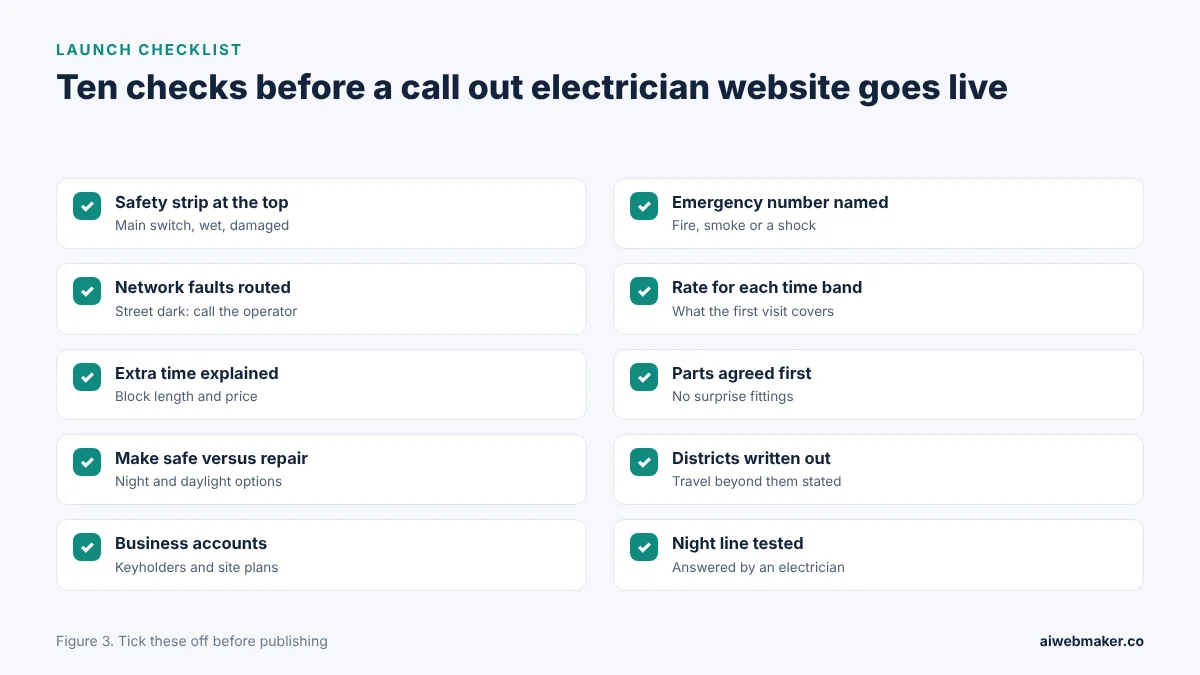
A frightened caller dials someone else when the page shows no rate at all, because an unknown night bill feels like a trap. No safety advice at the top makes the firm look more interested in the job than the person. Claims of round the clock cover with only an office number listed destroy trust within seconds. Missing districts leave callers unsure whether the van will even come. Stock photos of smiling electricians in daylight say nothing about night work. Ten practical remedies for those failings fill the launch list drawn here.
Frequently asked questions
Is it safe to keep resetting a breaker that trips?
A breaker or RCD that trips is protecting the home from a fault, so repeated resetting is not wise. Unplugging everything on that circuit and resetting it once is a reasonable step. If it trips again straight away, it should be left off and an electrician called. Repeated trips often come from one appliance or a damp outdoor fitting, which testing can find. A page that explains this calmly prevents both danger and unnecessary night call outs.
What does a call out charge usually cover?
A call out charge usually covers the drive to the property and a first period on site, often enough to find the fault and make it safe. Further time is normally charged in fixed blocks, and parts are priced separately. The rate depends on the time band in which the call is made. The page should state what is included and promise that extra work starts only with agreement. Clear terms prevent arguments on the doorstep at midnight.
Should a tenant call an electrician or the landlord first?
A tenant facing danger, such as sparks, burning smells or water near fittings, should make the home safe and call for help without waiting. Many tenancies expect the landlord to arrange repairs, so contacting the landlord or agent as soon as possible is still wise. An emergency electrician can make the fault safe and send a report to the landlord. Anything beyond making safe usually waits for the landlord's approval. Rules on who pays vary by country and by tenancy agreement.
Can a fuse board be replaced in the middle of the night?
A damaged fuse board is usually made safe at night and replaced later in daylight, once the owner has agreed the cost. Replacement takes time, needs the right parts and often requires testing and certification under local rules. Working in daylight is safer and cheaper for the customer than paying night rates for hours. The electrician can often restore some circuits while the board waits. A page that explains this sequence spares callers a shock on the invoice.
One scorched socket at midnight, and the website year is covered
A single night visit to a burnt socket or a tripping circuit brings in more than the $119 charged for a year of emergency electrician hosting. Billed monthly, $19 is smaller than one block of extra time at almost any rate. Every business account opened through the site adds call outs across the years, and every landlord who saves the number brings tenants with them. Safety advice first, rates read out before the van leaves and honest routing of network faults persuade more callers than any slogan. Firms that keep their rate bands and districts current avoid the arguments that cost reviews. A caller who rings already knowing the night rate shows that the page has done its calming work.
Build your website in Minutes and get the AI Tools that work
Start Building Your Website →