Electrician Website Cost and the Enquiry Pages That Bring Real Jobs
Twelve months of hosting for an electrician's website come to $119, or $19 a month, with a domain bought alongside. Inside: who calls an electrician, services, enquiries, emergency advice, licences, certificates, pricing, EV chargers, search and the yearly budget.
- No coding required
- Live in minutes
- Blog, SEO and chatbot tools included
Twelve months of hosting for an electrician's website come to $119, or $19 a month for owners saving cash for vans and stock, with a domain bought alongside. Pages are drafted, photos added and every screen checked in AI Web Maker without a bill until the site goes live. A finished example of such pages is the electrical company website, a complete sample AI Web Maker created around a fictional electrician, covering rewires and the paperwork that follows. A single consumer unit upgrade or small rewire covers that fee many times, so cost is never the obstacle. The obstacle is that electrical work is invisible, technical and potentially dangerous, so customers need strong reasons to trust a stranger with it. They want to know the electrician is qualified, will turn up, will charge fairly and will leave the paperwork that proves the work is safe. The sections ahead explain the services, enquiry route, safety guidance and credentials that earn that trust.
This article is part of our complete guide: Home Services Website Builder.
Who calls an electrician, and what do they need to know?
People call an electrician for urgent faults, planned improvements and legal obligations, and each group needs different information. A homeowner whose lights keep tripping wants a fast response and reassurance that the fault will be found. Someone renovating a kitchen or adding an extension wants new circuits, lighting and sockets planned properly. Landlords need periodic inspections and certificates to meet rental rules in many countries. Businesses need testing, maintenance and work done outside opening hours. Electric vehicle owners want a home charger installed safely. A website that recognises each of these needs turns more visitors into enquiries.
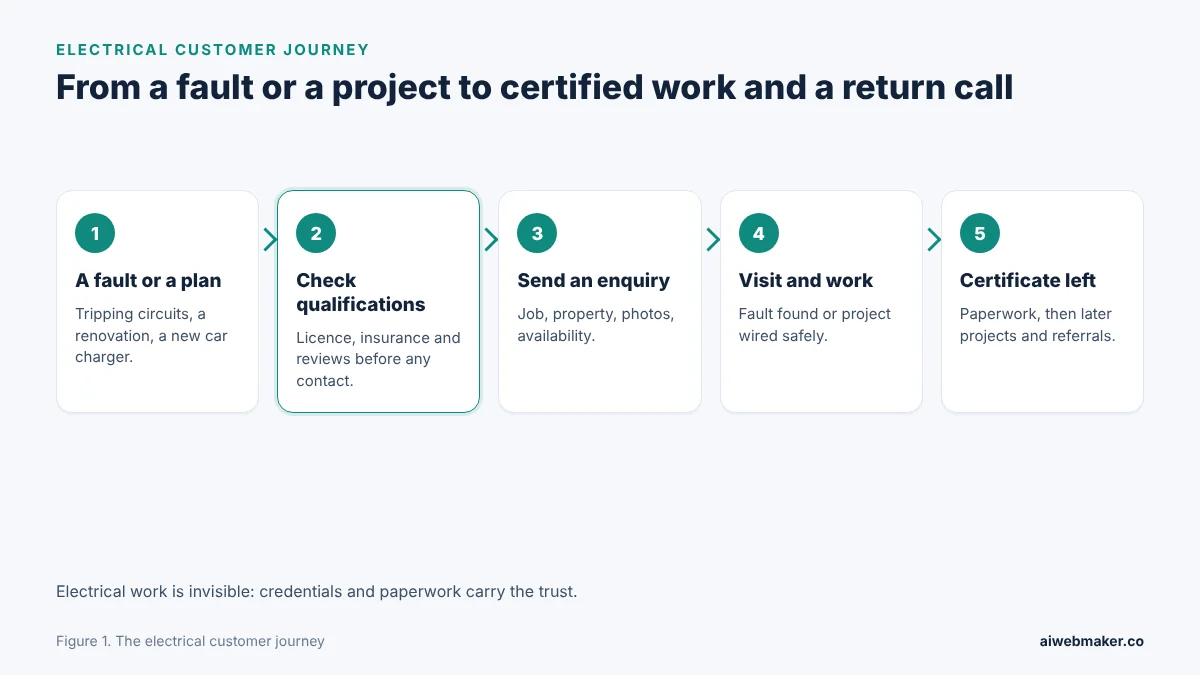
The journey drawn in this figure starts with either a fault that cannot wait or a project that needs planning. Both kinds of customer check qualifications and reviews before getting in touch, because electrical mistakes can be dangerous. An enquiry with the right details lets the electrician judge the job, the time and the likely price. The visit, the work and the certificate left behind decide whether the customer calls again. Satisfied customers return for later projects and recommend the electrician to neighbours. Each page of the site should move a visitor one step further.
How should electrical work be split across service pages?
Splitting the work by what customers call it pays off, because a homeowner looking for an EV charger installer rarely searches for electrical work in general. Fault finding and repairs cover tripping circuits, dead sockets and flickering lights. Rewires and consumer unit or panel upgrades are larger jobs for older homes. Lighting, sockets and kitchen or extension wiring cover planned improvements. Inspection and testing serve landlords, buyers and businesses. EV chargers, smoke alarms and outdoor power complete the range for many domestic electricians.
| Service | Typical trigger | What the page should state |
|---|---|---|
| Fault finding | Tripping, dead sockets, flickering | Response time, how faults are traced |
| Rewiring | Old wiring, renovation, buying a home | Disruption, timescale, room by room approach |
| Consumer unit or panel upgrade | Old fuse boards, extra circuits | Safety benefits, certification |
| Lighting and sockets | Renovations, extensions, new layouts | Design help, typical prices |
| Inspection and testing | Landlords, sales, businesses | Reports provided, how often needed |
| EV charger installation | A new electric car | Suitability check, location, any grants |
| Smoke and heat alarms | Safety rules, rentals | Types installed, interlinking |
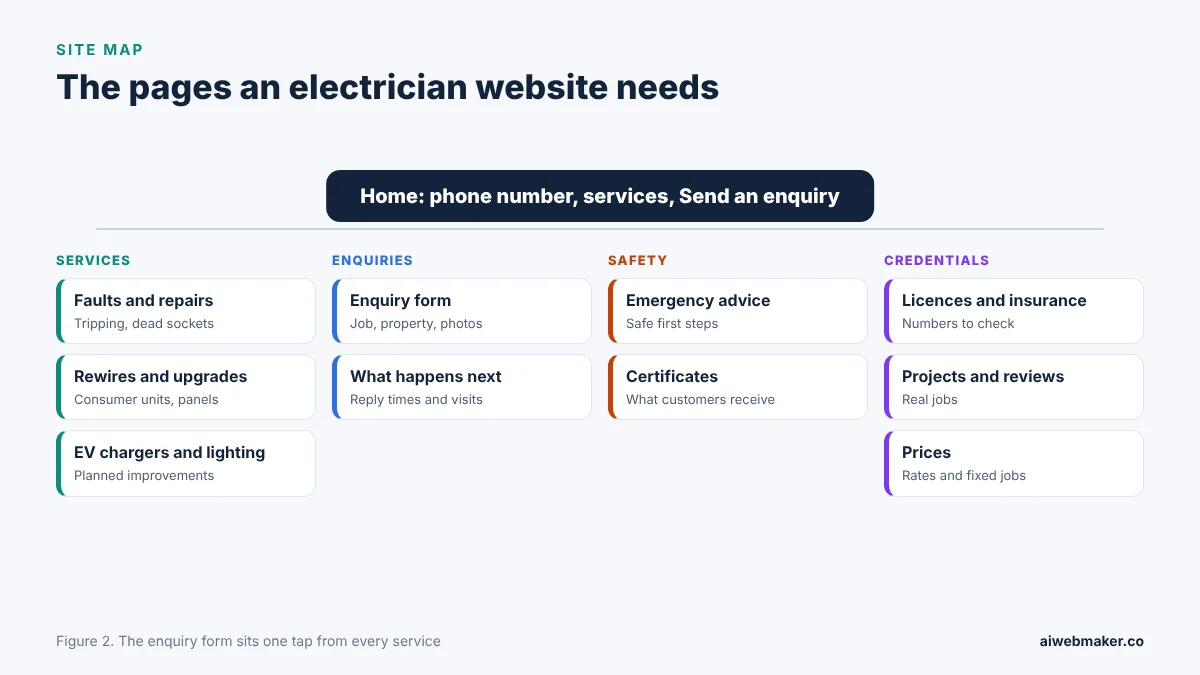
In site map form, an electrician's pages divide into services, enquiries, safety guidance and credentials. Service pages cover faults, rewires, upgrades, lighting, testing and EV chargers. The enquiry group holds the form and explains what happens after it arrives. Safety pages give clear advice for emergencies and explain why certificates matter. Credential pages show licences, registrations, insurance and reviews. Our sample contractor, Brightwire Electric, uses an enquiry form on its contact page and explains on its services page how a job starts, with a room by room family home rewire on the home page and a projects page with client comments; the electrician website example with an enquiry form and project pages was built in 50 seconds.
Why does an enquiry form suit electrical work better than instant booking?
An enquiry form suits electrical work because most jobs need a few details before anyone can name a price or a time. Moving a socket and replacing a consumer unit look similar in a calendar, yet one takes an hour and the other most of a day. A form can ask what the problem or project is, the age of the property, whether power is currently off and when the customer is available. Photos of the fuse board or the area to be worked on help the electrician prepare. The page should say how quickly enquiries are answered and what happens next. The AI website builder that electricians use for enquiry pages generates this form, the service pages and the project pages once the electrician lists the jobs the business takes on.
| Enquiry detail | Why it helps |
|---|---|
| Type of job | Separates repairs from projects |
| Age and type of property | Hints at wiring age and access |
| Is power off now | Flags urgent safety issues |
| Photos | Shows the fuse board or work area |
| Availability | Speeds up scheduling |
| Postcode or town | Confirms the area is covered |
What emergency advice should an electrician's website give?
An electrician's website should give short, safe emergency advice, because customers often find the site in a moment of alarm. A burning smell, smoke or sparks call for leaving the room, cutting the supply at the main switch only where that can be done safely, and phoning emergency services at any sign of fire. Anyone who sees a damaged electricity supply cable or meter should keep away and contact the network operator. Water near sockets or the fuse board means the power should be turned off at the main switch if that can be done safely, and nothing should be touched with wet hands. The page should never encourage DIY repairs to live electrics. Clear, calm advice builds trust and may prevent injuries.
| Situation | Safe first step |
|---|---|
| Burning smell, smoke or sparks | Leave the area; call emergency services if there is fire |
| Whole house power cut | Check whether neighbours are affected; contact the network operator if so |
| Circuit keeps tripping | Unplug appliances on that circuit, then call an electrician |
| Water near electrics | Switch off at the main switch only if safe; do not touch fittings |
| Damaged supply cable or meter | Keep away and call the network operator |
Which licences and certificates should an electrician show?
Licences, registrations and insurance belong prominently on the site, because customers cannot judge electrical skill by looking at finished work. Many countries and regions license electricians or require them to belong to recognised schemes that check their competence. Licence or registration numbers let customers verify the claim. Liability insurance protects customers if something goes wrong. The certificates or reports issued after work, such as installation certificates or periodic inspection reports, should be explained so customers know to expect them. Accurate, checkable credentials separate qualified electricians from untrained handymen.
How should an electrician explain prices?
An electrician should explain prices by stating the call out or hourly rate, giving fixed prices for common jobs and describing how larger projects are quoted. A fixed price for fitting a socket, a light or a smoke alarm lets customers decide quickly. Fault finding is harder to price in advance, so the page can explain how time is charged and when the customer will be consulted. Rewires and consumer unit upgrades depend on property size, access and the state of existing wiring, and a written quote should follow a survey. Out of hours rates should be stated clearly. Transparent pricing removes the fear of surprise bills.
| Price element | What the page should state |
|---|---|
| Call out or first hour | Amount, and what it includes |
| Hourly rate | Rate after the first hour |
| Fixed price jobs | Sockets, lights, alarms, small additions |
| Quoted work | Rewires, upgrades, extensions, after a survey |
| Out of hours | Evening, weekend and holiday rates |
| Materials | How parts are charged |
How should an EV charger page be written?
An EV charger page should explain suitability, location, installation steps and any grants, because electric vehicle owners are often unsure what their home needs. The electrician usually checks the supply, the consumer unit and the distance from the board to the parking space before quoting. Charger brands, smart features and tethered or untethered options can be described simply. Charger grants come and go and vary between countries, so linking to the official scheme beats quoting a figure that may be out of date. Photos of tidy installations on real driveways help owners picture the result. A clear page captures a growing group of customers who need exactly this service.
Why do page titles matter for an electrician's search visibility?
Page titles matter because they are often the first words a searcher sees, and Google's guidance on title links explains how it chooses and displays them. A clear title naming the service and the area, such as EV charger installation in a town, tells searchers they have found what they need. Phrases such as electrician near me, emergency electrician, rewire cost or fuse board upgrade reveal what people type. Each service page should match one of these phrases in its title, heading and opening lines. Urgent searches often end on the map listing, so its hours and emergency note must be right. Reviews that mention punctuality and tidy work strengthen every listing.
How much does an electrician's website cost each year?
An electrician's website costs hosting plus a domain each year, and safety articles drafted with credits add almost nothing. Annual billing keeps the cost lowest for an established business. Electricians who have just qualified and work alone may prefer monthly payments. Changing services, prices or areas never increases the total. Both routes appear below, together with the $189 tier.
| Expense | Yearly route | Monthly route |
|---|---|---|
| Hosting the electrician's pages | $119 | $228 over a year |
| Domain | Set by the ending chosen | Set by the ending chosen |
| Higher plan, for comparison | $189 a year | Not needed |
| Twelve safety articles at about $0.65 | About $7.80 | About $7.80 |
| Service, price and area changes | No charge | No charge |
| Year before the domain | About $126.80 | About $235.80 |
What makes customers pick a different electrician?
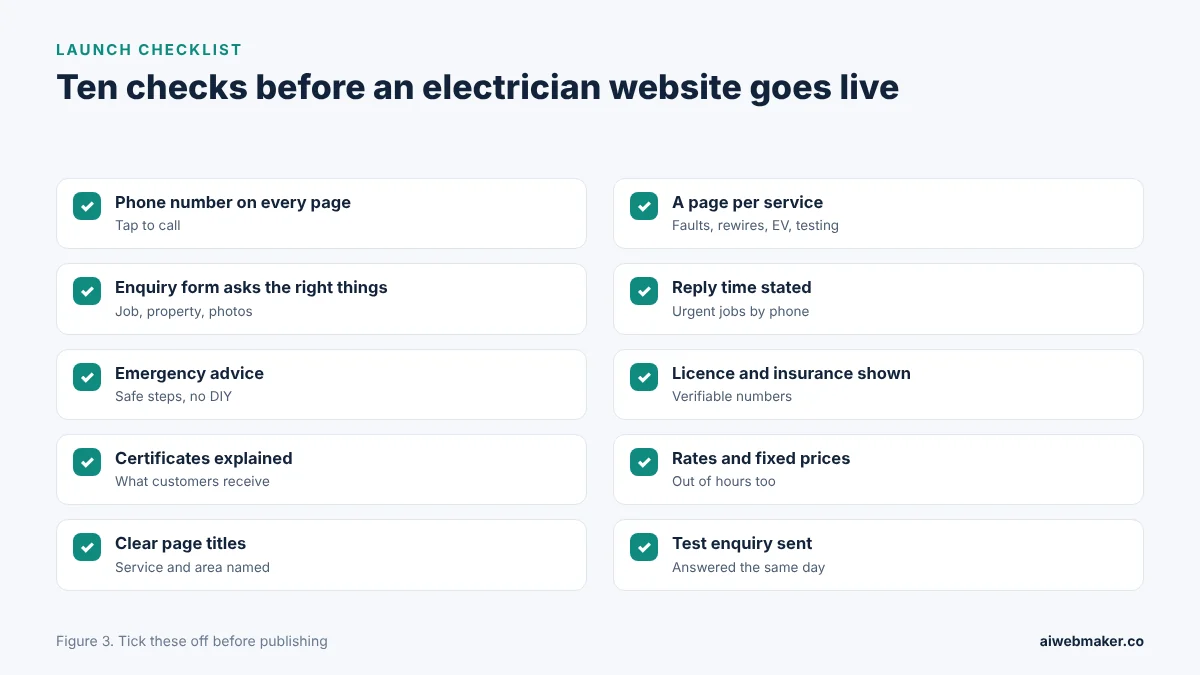
Customers pick a different electrician when no licence, registration or insurance appears anywhere on the site. A phone number hidden at the bottom of the page loses people with an urgent fault. Vague services leave them unsure whether this electrician fits EV chargers or tests rental properties. Silence on prices makes small jobs feel risky. An enquiry form that asks nothing useful leads to slow, inaccurate quotes. The figure below lists ten checks that remove these doubts.
Frequently asked questions
Can customers book an electrician online?
Customers can usually send an enquiry online, and the electrician then confirms a time once the job is understood. Instant booking can work for simple fixed price jobs, such as fitting a smoke alarm, but most electrical work needs details first. The website should explain how enquiries are handled and how quickly replies arrive. Urgent faults are best handled by phone. A clear process keeps both routes working smoothly.
How often do landlords need electrical inspections?
Requirements for electrical inspections of rental properties vary by country and region, and some places set fixed intervals between reports. The website can explain that the electrician carries out these inspections and provides the required report. Landlords should check the rules that apply to their properties. Clear guidance on the page helps landlords plan and book in good time. Regular inspection work is valuable repeat business for electricians.
Do listed prices help an electrician win small jobs?
Showing prices for common jobs and the hourly or call out rate helps customers decide quickly and reduces time spent on quotes. Larger projects, such as rewires, need a survey first, and the page can explain why. Out of hours rates should be clear. Transparent prices build trust before the first visit. They also discourage callers whose expectations could never be met.
What paperwork should customers receive after electrical work?
Customers should usually receive a certificate or report confirming that the work meets the relevant standards, depending on the type of job and local rules. Larger work, such as new circuits or a consumer unit replacement, often needs formal certification or notification. The website should explain what paperwork the electrician provides and why it matters when selling a home or claiming on insurance. Customers should keep these documents safe. Clear paperwork shows professionalism and protects everyone.
Does one rewire pay for the electrician's website?
A single rewire, or even one consumer unit upgrade, typically earns many times the $119 annual hosting charge. With monthly billing, part of one fixed price socket job covers the $19. Every customer who returns for a later project after a good first job adds income the website helped start. Clear services, a useful enquiry form and checkable credentials do most of the persuading. Keeping project photos and prices fresh means customers arrive already knowing what to expect. A week of well described jobs in the diary is the reward for a carefully built site.
Build your website in Minutes and get the AI Tools that work
Start Building Your Website →