Eco Landscaper Website Cost and the Proof Behind Every Green Claim
Rain garden and wildlife garden designers pay $119 to stay hosted for a whole year, or nineteen dollars in each separate month, and their domain is priced by its ending. The guide moves through callers, pages, green claims, rain features, native planting, staged prices, search and the budget.
- No coding required
- Live in minutes
- Blog, SEO and chatbot tools included
Wildlife and rain garden designers pay AI Web Maker $119 to stay hosted across a whole year, or $19 per month instead, while the domain they register is priced by its ending. No invoice is raised while the planting pages are drafted and looked over in preview. A single rain garden built from one downpipe brings in far more than the hosting for a whole year. The difficulty lies elsewhere, because buyers of eco gardens have read so many soft promises about nature and sustainability that green words alone now raise suspicion. A firm wins those buyers by showing method: a drainage test, a plant list tied to the region, a source written beside every material and an honest note about watering. This guide moves through the clients, the pages, provable claims, rain features, native planting, survey and stage prices, search and a budget for the year.
This article is part of our complete guide: Home Services Website Builder.
Flooded patios, silent gardens and tired lawns: who hires an eco landscaper
People who call an eco landscaper usually have a problem in mind rather than a style. Some have a patio that floods every winter because a downpipe empties straight onto paving. Others notice that birds, bees and frogs have vanished from a garden of lawn and fencing. Many are simply tired of mowing and watering a lawn that browns every summer, especially where water restrictions are common. A growing group wants a garden that copes with heavier storms and longer droughts in the same year. Each of them wants proof that the designer understands soil and water, plus an idea of what the work will cost before inviting anyone round.
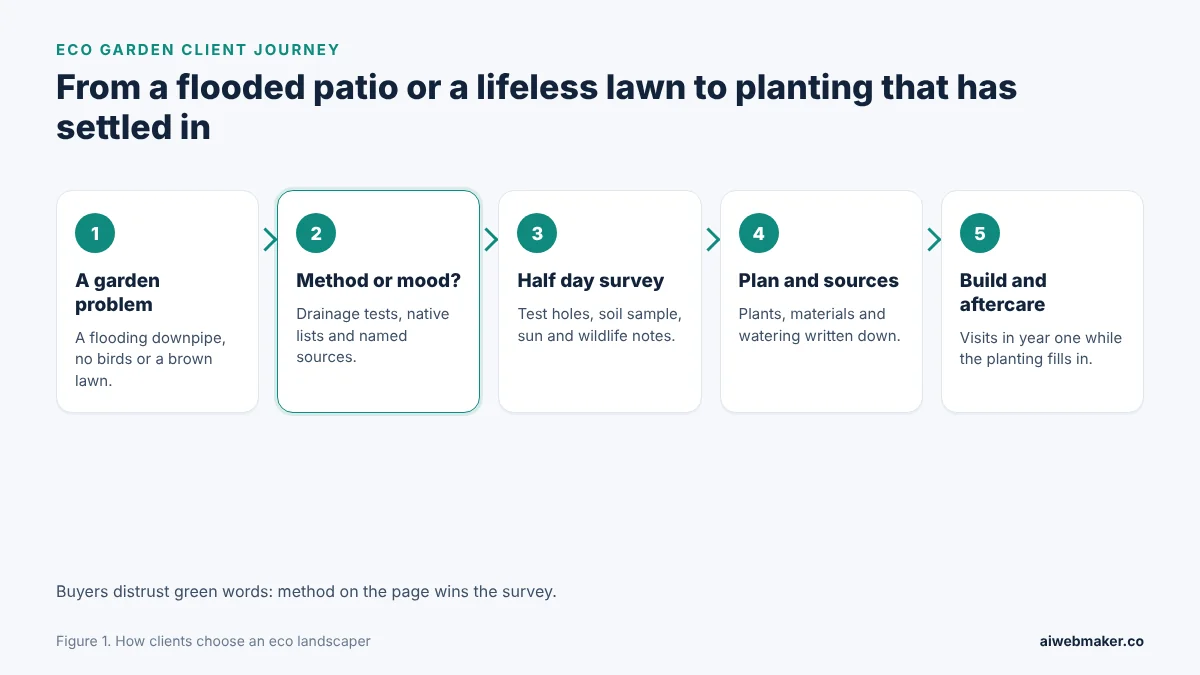
Reading the five cards in order, a client moves from a nagging garden problem to planting that has filled in a season or two later. The first card is the trigger, often a flooded patio or a lawn that browns each August. The highlighted second card matters most, because this is where the visitor decides whether the firm's green language is backed by method or by mood. A half day survey with drainage tests and a soil sample follows, then a written plan listing plants, materials and their sources. The last card covers the build and the aftercare visits, which decide whether the garden looks thin and neglected or settles into the layered planting the client paid for.
Survey, garden types and aftercare: the pages a green garden firm needs
An eco landscaper's pages should follow the order of the work, starting with the survey rather than the finished photos. Each kind of garden deserves a short section, because a rain garden and a meadow solve different problems. A page on water explains where the rain goes and how much watering will remain. Material sourcing earns its own section, since buyers increasingly ask where reclaimed brick and stone actually came from. Prices by stage, from the survey to aftercare, let a family see what it is committing to. The request route asks about the garden as it is today and the job the client wants it to do.
| Page or section | What the client wants to know | What it should state |
|---|---|---|
| Survey | What happens first | Test holes, soil sample, sun map, wildlife notes |
| Wildlife gardens | Whether it will look wild or cared for | Layers of native planting, log piles, a small pond |
| Rain gardens | Whether it will flood the house | Distance from walls, drainage tests, overflow route |
| Low water planting | How much watering is left | Watering while roots establish, then only in long dry spells |
| Lawn to meadow | How long until it flowers | Mowing changes or turf lifted and sown |
| Wildlife ponds and living roofs | Safety and weight | Sloping beach, no fish, structure checked first |
| Materials | Where things came from | Salvage yard, distance and previous use |
| Ways to work | Cost of each stage | Survey, design and build, aftercare |
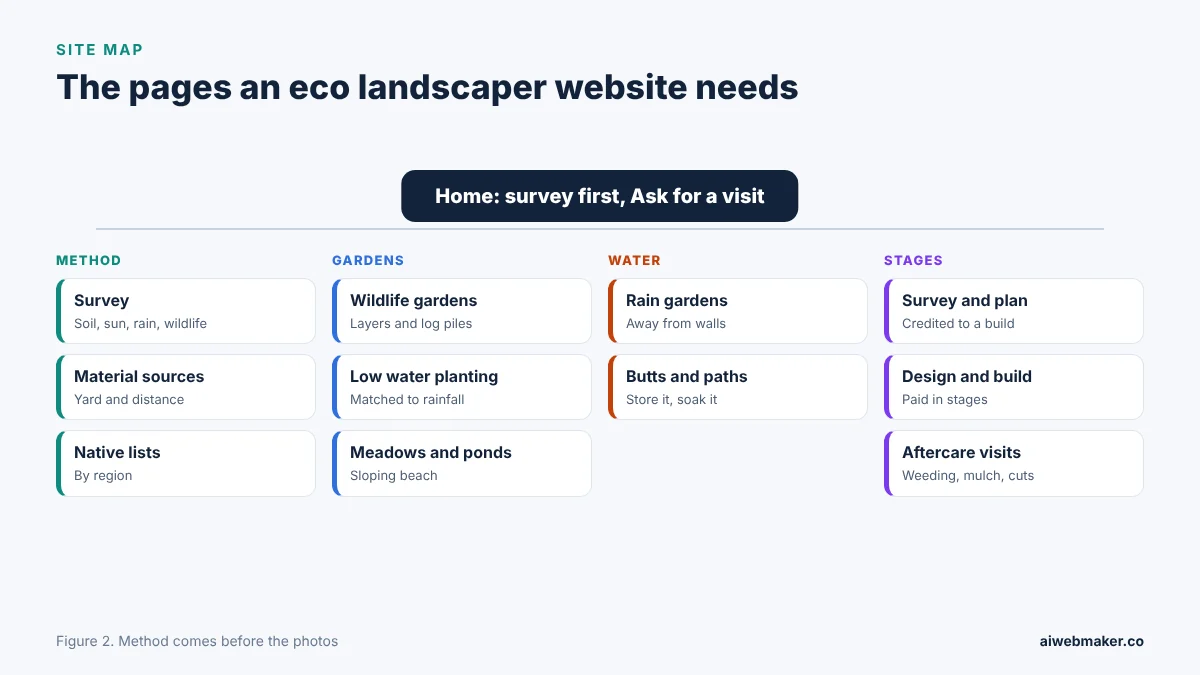
Grouped around the questions a careful client asks, the eco garden pages split into method, gardens, water and stages. Method pages hold the survey and the material sources, gardens pages hold the six kinds of planting, and the water branch explains rain features. Wildroot Eco Landscapes, the sample firm, starts with its survey of soil, sun, rain and the wildlife already living in the garden before it shows wildlife gardens, rain gardens, low water planting, lawn to meadow, wildlife ponds and living roofs. Its page then sets out where the rain goes, small details that bring wildlife in, and three ways to work: a survey and planting plan, design and build, and aftercare visits. The eco landscaper website example with rain gardens and native planting closes with a section on reclaimed materials, gardens photographed after planting, questions and a request for a garden visit.
Green claims an eco landscaper can actually prove
Every eco landscaper competes against vague promises, so the strongest pages replace adjectives with things a client could check. A claim that a garden is sustainable means little, while a list of the yards that supplied its brick means a great deal. A promise that a garden needs no water at all is almost always untrue, and careful firms say so before a dry summer proves it. Wildlife friendly becomes believable when the page names specific features, such as gaps under fences for small mammals or night scented flowers for moths. Advertising rules on environmental claims are tightening in several regions, including the European Union and the United Kingdom, and they vary by country, so precise wording also protects the firm. The table pairs common vague claims with versions that can be shown.
| Vague claim | Provable version |
|---|---|
| Sustainable materials | Each material listed with its salvage yard, distance and previous use |
| Needs no watering | Watered while roots establish, then only in long dry spells |
| Wildlife friendly | Named features such as log piles, a sloping pond beach and fence gaps |
| Native planting | Native to the client's own region, with invasive species never planted |
| Eco build | Soil kept on site, peat avoided, concrete only where a footing needs it |
| Saves water | Roof water stored or soaked in, with each feature sized to its roof |
Where the roof water goes: rain gardens, butts and permeable paths
A rain garden page has to answer one fear before anything else, which is whether diverted water could end up against the house. The honest answer is that siting and testing decide it, so the firm should explain both. Test holes filled with water show how quickly the ground drains, and a rain garden should sit several metres from walls with an overflow route for the heaviest storms. Clay that stays waterlogged may rule a rain garden out entirely, and saying so publicly shows judgement. Rules on rainwater use, drain connections and paving front gardens are set nationally in some countries and locally in others. A short note that each site is checked before design keeps the page accurate everywhere.
| Feature | What it does with rain | Where it suits | Limit to state |
|---|---|---|---|
| Rain garden | Takes one downpipe and lets water soak in over a day or two | Ground that drains, away from walls | Not built where soil stays waterlogged |
| Water butts and tanks | Store roof water for dry spells | Under any downpipe | Overflow needs a route |
| Permeable paths and drives | Let rain through instead of off | Drives, paths, patios | Local rules may apply to front gardens |
| Swales | Carry heavy rain slowly across a plot | Slopes and long, narrow gardens | Need room and a safe outlet |
| Mulch and dense planting | Keep soil moist and shaded | Every bed | Mulch needs topping up |
| Drip lines on a timer | Water roots while plants establish | New planting in dry spots | Switched off once roots are deep |
Native to where? Plant lists, invasive species and the first thin year
The word native only means something when the page says native to where, so the plant list should change with the client's region. A firm that uses the same list in every garden is selling a look rather than an ecosystem. Occasional plants from elsewhere can earn a place, such as one that feeds pollinators when nothing native is flowering, and the page can explain that choice. Species listed as invasive locally should never be planted, and stating this plainly reassures informed buyers. The first year deserves an honest warning too, because new meadows and young hedges often look thin before they fill out. Clients who were told this in advance stay patient, while clients who were not tend to call and complain.
Survey fees, staged builds and the aftercare that keeps planting alive
Eco garden projects stretch across planting seasons, so clients want to know what each stage costs before committing to any of them. A paid survey that is credited against a build booked within a set period removes the fear of paying twice. Design and build prices work best as starting figures for a stated typical garden, with the survey confirming the real number. Larger builds are often paid in stages agreed in the quote, and the page can state the arrangement in a sentence. Aftercare visits for weeding, mulching, filling gaps and cutting a meadow at the right time are what turn a planted garden into an established one. The AI website builder that drafts pages for eco landscapers and rain garden designers writes the survey, garden and stage sections once the firm explains its approach in a few sentences, and every draft can be rewritten until the claims are exactly the ones the firm can prove.
Rain garden design, native planting and other phrases clients search
Clients looking for this work search for rain garden design, wildlife garden landscaper, native planting, drought tolerant garden or lawn to meadow, often adding a town or county. Each kind of garden should carry its own searched phrase in a heading, written as ordinary text rather than inside an image. A map listing that names the area served, shows gardens a season after planting and keeps studio hours current helps people nearby find the firm. Reviews that mention a flood that stopped, frogs that arrived or a meadow that finally flowered are far more persuasive than general praise. Seasonal articles, such as when to sow a meadow or how to site a pond, draw in readers a full season ahead of any booking. That steady flow of useful writing turns a small studio into the name locals pass on.
Hosting, domain and planting articles across a year
An eco landscaper's yearly website outlay is hosting plus a domain, while a year of monthly planting articles through AI credits totals about $7.80. A studio with a full diary keeps the bill lowest by paying the $119 once. A designer still building a portfolio may find $19 a month easier through the first seasons. Adding a garden, changing a price or posting new photos is never charged. The $189 row is shown only to compare, and nothing on the page needs it.
| Item | Yearly | Monthly |
|---|---|---|
| Hosting the eco garden pages | $119 | $228 over twelve months |
| Domain | Depends on the ending | Depends on the ending |
| Higher plan, for comparison | $189 a year | Not needed |
| Twelve planting articles at about $0.65 | About $7.80 | About $7.80 |
| Garden, photo and price updates | No charge | No charge |
| Year before the domain | About $126.80 | About $235.80 |
Greenwash, stock meadows and missing sources: why careful buyers leave
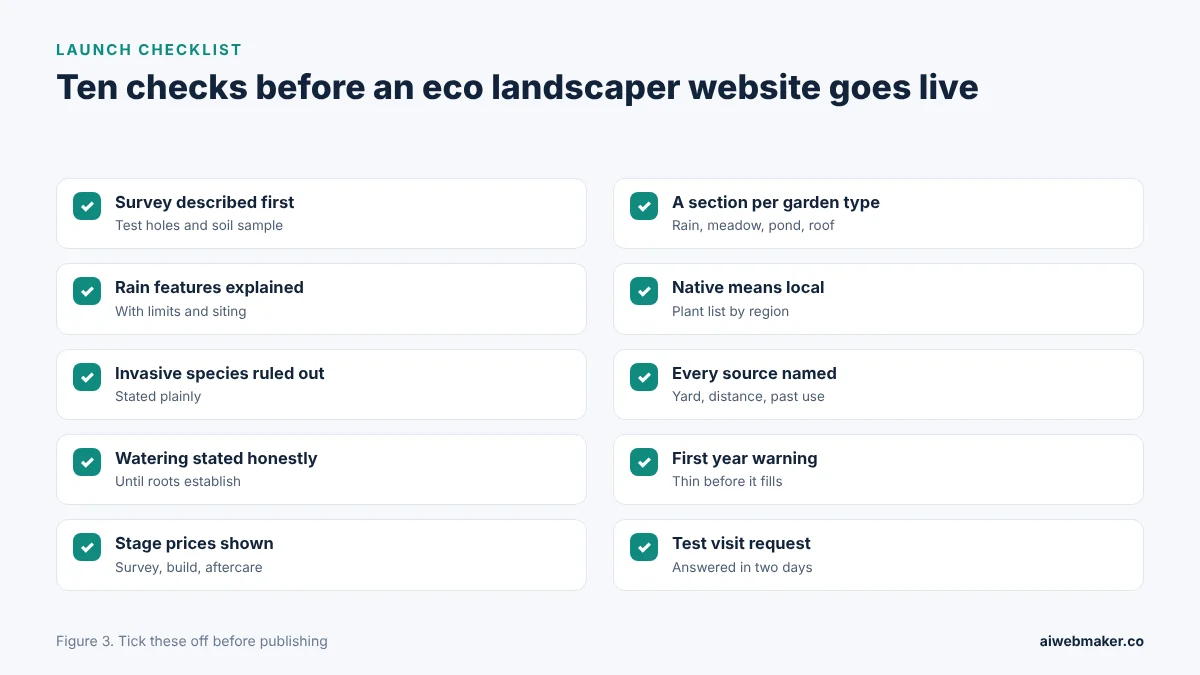
Careful buyers leave an eco garden site when every sentence says natural or sustainable and none explains how. Stock photos of perfect wildflower meadows suggest the firm has none of its own. A page that never mentions drainage testing makes a rain garden sound like a gamble with the foundations. Promises of a garden that never needs watering are spotted quickly by anyone who gardens. Prices hidden until after a survey leave families unable to tell whether the project fits their budget at all. Each of those doubts is answered, line by line, in the launch list pictured next.
Frequently asked questions
Will a wildlife garden look untidy to the neighbours?
A wildlife garden does not have to look untidy, and the website can explain how a designer prevents it. Crisp edges, mown paths and a neat area near the house signal that the garden is cared for. The wilder planting can sit further out, where long grass and log piles do their work. Photos of real gardens a season after planting show this balance far better than words. Clients who see that order and wildlife can live together book with more confidence.
How long before a new meadow flowers properly?
A meadow usually takes more than one season to look its best, and the website should set that expectation early. Sown meadows often look thin in their first summer while the perennials establish. Lawns converted by changing the mowing pattern can take a few years to gain variety. Soil fertility, the seed mix and the local climate all affect the pace. Patience written into the plan prevents disappointment in year one.
Does a pond or a living roof need permission?
Some ponds, living roofs and paving changes need permission, while many do not, and the answer depends on the place. Rules on drainage, building near boundaries and paving front gardens vary between countries and between local authorities. A living roof also needs a check that the shed or garden room can carry the weight when the soil is wet. The firm can confirm what applies before the design is final. Honest wording here protects both the client and the designer.
Can a rain garden sit close to the house?
A rain garden should sit several metres away from house walls, so that water soaking in never reaches the foundations. The exact distance depends on the soil, the slope and local guidance. Drainage tests show whether the ground can take the water at all. An overflow route carries the heaviest storms safely away. A firm that explains this clearly shows it treats water as seriously as planting.
How one rain garden settles the hosting bill
A single rain garden or meadow conversion usually brings in several times the yearly $119 needed to host an eco landscaper's pages. On the monthly route, $19 is less than the cost of the plants for one small border. Every survey that becomes a design and build adds work the pages helped start, and aftercare visits keep the relationship going for years. Provable claims, honest watering notes and named material sources persuade buyers who have learned to distrust green adjectives. Firms that keep posting gardens a season after planting show the method working in real soil. Enquiries that already mention the drainage test show visitors have read the pages with care.
Build your website in Minutes and get the AI Tools that work
Start Building Your Website →