Demolition Company Website Cost, Asbestos Surveys and Safe Sites
Demolition contractors keep their pages standing with $119 of AI Web Maker hosting a year, or a $19 monthly charge, and pay for the domain on the side. Inside: who hires a demolition firm, job pages, surveys, permits, methods, waste and recycling, visits and quotes, search and yearly costs.
- No coding required
- Live in minutes
- Blog, SEO and chatbot tools included
Demolition contractors keep their pages standing with $119 of AI Web Maker hosting a year, or a $19 monthly charge, and pay for the domain on the side. Every job card, the survey section and the waste table can be drafted and proofread in the preview, with no invoice raised for any of that work. Taking down one garage generally brings in more than the hosting year costs. The true challenge is reassurance, because clients picture dust clouds, angry neighbours, hidden asbestos and rubble dumped in a lay by. A demolition firm that shows its survey, its permits, its sequence and the destination of every load wins the work that careful owners and builders hand out. This piece walks through the clients, job pages, surveys and disconnections, permits and neighbours, methods, waste, visits and quotes, search, and a twelve month budget.
This article is part of our complete guide: Home Services Website Builder.
Owners, builders and developers: who calls a demolition contractor
Demolition clients range from a homeowner with a collapsing garage to a developer clearing a whole plot, and their worries differ accordingly. A family replacing an old bungalow wants to know how long the house will take to come down and what happens to the neighbours' walls. A builder planning an extension needs a rear wall or outbuilding removed safely before the groundworks start. Shop owners and landlords ask for interior strip outs between tenants. Developers want surveys, permits and waste handled without delay to their programme. Every one of them asks the same underlying question: will this firm keep people safe and leave a clean, legal site.
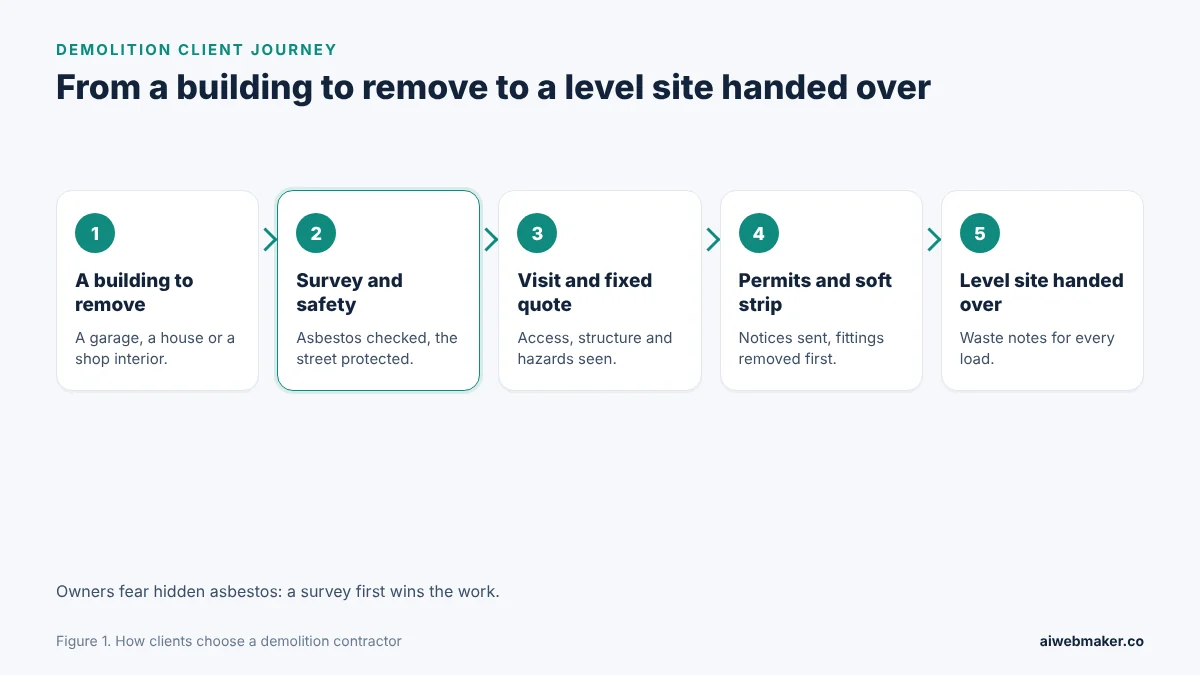
The route from an unwanted building to a clear plot runs through five stages, and the second one usually picks the contractor. A client starts with a structure to remove and a rough idea of the timetable. The highlighted stage is checking that the firm surveys for hazardous materials and works safely, since a careless contractor can expose the whole street to asbestos. A site visit and a fixed written quote follow, then permits, notices and the soft strip of fittings. The final stage, a level site with waste notes for every load, is what earns referrals from builders.
Job pages, the survey and the other sections a demolition site needs
A demolition website is more persuasive when each type of job has its own section, because a garage removal and a shop strip out involve very different risks. Whole houses, outbuildings, interiors, partial demolition, concrete breaking and site clearance cover most enquiries. Alongside them sit a section on the survey, a step by step sequence, a waste table and a safety section. A gallery of recent sites and a site visit request round it off. Clients who find all of this in one place rarely need a long phone call before booking a visit.
| Page or section | What the client asks | What it should cover |
|---|---|---|
| Whole house demolition | How long, and what about next door? | Sequence, protection, timescale |
| Garages and outbuildings | Is it a quick job? | Asbestos roofs, access, slab removal |
| Interior strip outs | Can the shell stay safe? | Soft strip, structure kept, waste |
| Partial demolition | Will the rest stay standing? | Engineer's advice, temporary props |
| Concrete breaking | How noisy is it? | Breakers, crushing, hours |
| Hazardous materials survey | What if there is asbestos? | Survey first, licensed removal |
| Waste and recycling | Where does the rubble go? | Sorting, recycling, waste notes |
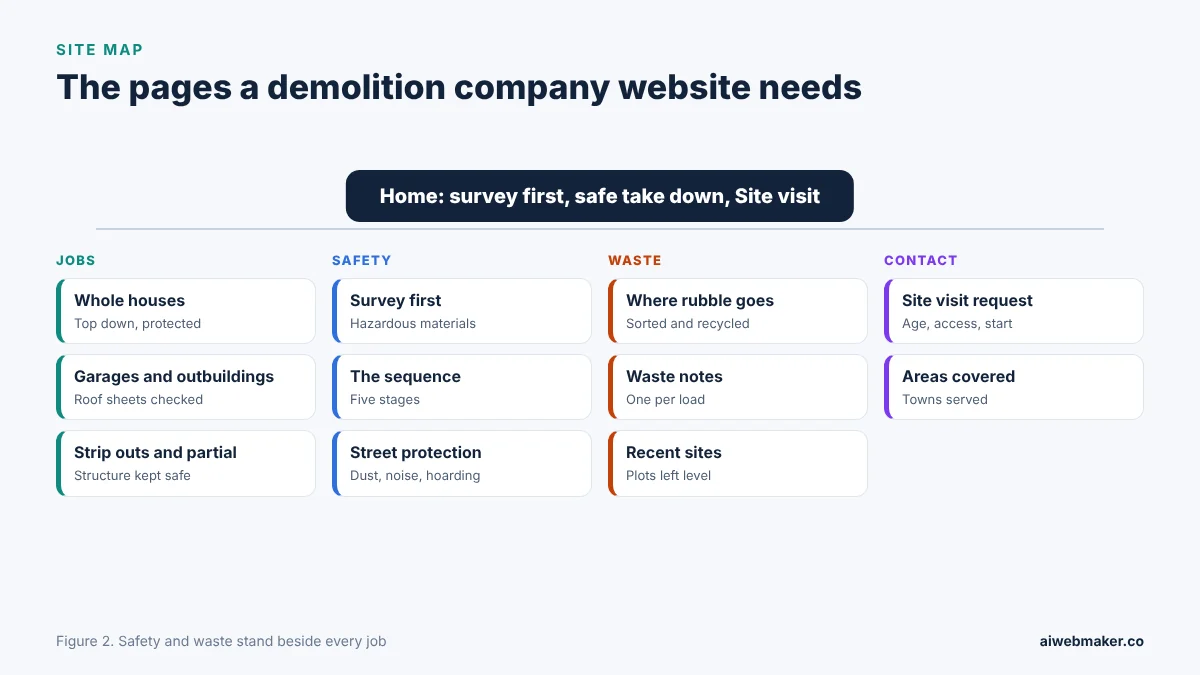
Read from left to right, the map shows jobs, safety, waste and contact as four equal pillars. Job pages cover whole houses, outbuildings and interiors with partial work. Safety pages hold the hazardous materials survey, the step by step sequence and how the street is protected. The sample business for this trade, Clearfell Demolition, presents whole house demolition, garages and outbuildings, interior strip outs, partial demolition, concrete breaking and site clearance as six job cards. A section stating that nothing comes down before the survey, a five stage sequence from first look to level site and a table showing where the rubble goes follow them. The demolition company website example with a survey first and a waste table closes with site safety, recent sites, questions and a request for a site visit.
Surveys and disconnections that come before any machine
Nothing should come down until the building has been surveyed for hazardous materials and every service has been safely cut off. A survey made for demolition looks into hidden places, such as floor voids and wall linings, to find asbestos, which older buildings often contain in roof sheets, pipe lagging, ceiling tiles and textured coatings. Gas, electricity, water and telecoms lines need formal disconnection by the relevant suppliers, not just switching off. Drains are usually capped so rubble and water do not enter them. In some countries protected wildlife, such as bats roosting in a roof, must be checked for before work starts. A page that lists these checks shows a contractor who plans before it swings a machine.
| Check before work | Why it matters |
|---|---|
| Hazardous materials survey | Finds asbestos and other materials needing special removal |
| Gas and electricity disconnection | Prevents fire, explosion and electrocution |
| Water and drains | Stops flooding and rubble entering the sewer |
| Protected wildlife | Some species legally delay or shape the work |
| Structure next door | Records the condition of shared or nearby walls |
Permits, notices and the neighbours next door
Rules on permission to demolish vary greatly between countries, cities and types of building, so the firm should explain how it checks them rather than stating one rule as universal. Some places require a demolition permit or formal notice to the local authority, and listed buildings or conservation areas often need specific consent. A shared wall with a neighbour can trigger extra procedures, for instance the formal notices required under English and Welsh party wall law. Notices to neighbours, agreed working hours and a named contact for complaints prevent most disputes. Traffic management may be needed when lorries load from the road. Clients appreciate a contractor who handles this paperwork and explains each step in plain language.
Soft strip, machine work and hand demolition explained in order
Demolition follows a sequence that clients rarely see explained, and laying it out on the website builds confidence. Soft strip comes first, removing fittings, doors, timber, plasterboard and anything that can be reused or recycled separately. The structure is then taken down, usually from the top downwards, using machines with long arms on larger buildings and hand tools close to boundaries or fragile neighbours. Partial demolition needs a structural engineer's advice, often with temporary props to keep the remaining building stable. Dust is kept down with water sprays, and hoarding or fencing keeps the public away. Explaining each stage in turn reassures owners that the job is planned rather than improvised.
Waste, recycling and the paperwork that follows every load
What happens to the rubble matters to clients, regulators and neighbours alike, and a clear table answers the question quickly. Brick and concrete can often be crushed on site or taken away for reuse as hardcore. Metals are separated for recycling, while timber, glass, cables and fittings each go to their own stream. Plasterboard is kept apart because in many places it must not be mixed with other waste. Asbestos and other hazardous materials need licensed removal and disposal under strict rules, which vary by country. Clients should receive a waste note or similar record for each load, proving that rubble went to a legitimate site.
| Material | Where it usually goes | Why it is kept apart |
|---|---|---|
| Brick and concrete | Crushed for hardcore or recycled | Reuse cuts landfill and cost |
| Steel, copper and aluminium | Metal recycling | Valuable and easily reused |
| Timber | Recycling or energy recovery | Keeps it out of rubble |
| Plasterboard | Separate recycling | Often banned from mixed waste |
| Glass, cables and fittings | Specialist recycling | Different processing |
| Asbestos and hazardous waste | Licensed disposal | Strict legal controls |
Walking the site before pricing, and the builder that sets up the pages
A demolition quote cannot be reliable without a visit, and the request page should say so before anyone asks for a price over the phone. The visit checks access for machines, the age and construction of the building, the neighbours and any obvious hazards. A fixed written quote then lists labour, machines and standard waste, with licensed asbestos removal priced separately if the survey finds it. The AI website builder for demolition contractors and their site visit requests turns a short account of the firm's jobs into job cards, a survey section, a waste table and a request page, and refining that draft in the preview carries no fee. Payment stages are best agreed directly with the client and set out in writing. A visible process from request to quote makes it easy for owners to take the first step.
Searches that bring owners and builders to a demolition firm
Owners and builders search for house demolition, garage removal, strip out contractors, concrete breaking, site clearance or asbestos survey, usually with a town. Phrases like knock down a garage or remove an outbuilding reflect how homeowners actually speak, so they belong in headings beside the trade terms. A distinct heading per job type helps search engines match each request. A map listing with the yard address, photos of real sites and the area covered brings in local calls. Reviews from builders who mention clean sites and accurate quotes carry weight with other professionals. Articles on what a hazardous materials survey involves or how long a bungalow takes to come down answer the questions clients bring to every visit.
A demolition firm's website budget, item by item
Two charges recur on a demolition firm's site: hosting and the domain, with twelve safety articles from AI credits adding about $7.80. Established contractors save most on the $119 annual plan. Firms taking on their first few sites can pay $19 monthly instead. Posting new job photos or updating prices costs nothing further. Yearly against monthly appears in the grid below, where the $189 tier sits on its own row for contrast.
| Item | Yearly | Monthly |
|---|---|---|
| Hosting the demolition pages | $119 | $228 over twelve months |
| Domain | Depends on the ending | Depends on the ending |
| Higher plan, for comparison | $189 a year | Not needed |
| Twelve site safety articles at about $0.65 | About $7.80 | About $7.80 |
| Job, price and gallery updates | No charge | No charge |
| Year before the domain | About $126.80 | About $235.80 |
Red flags that make clients wary of a demolition contractor
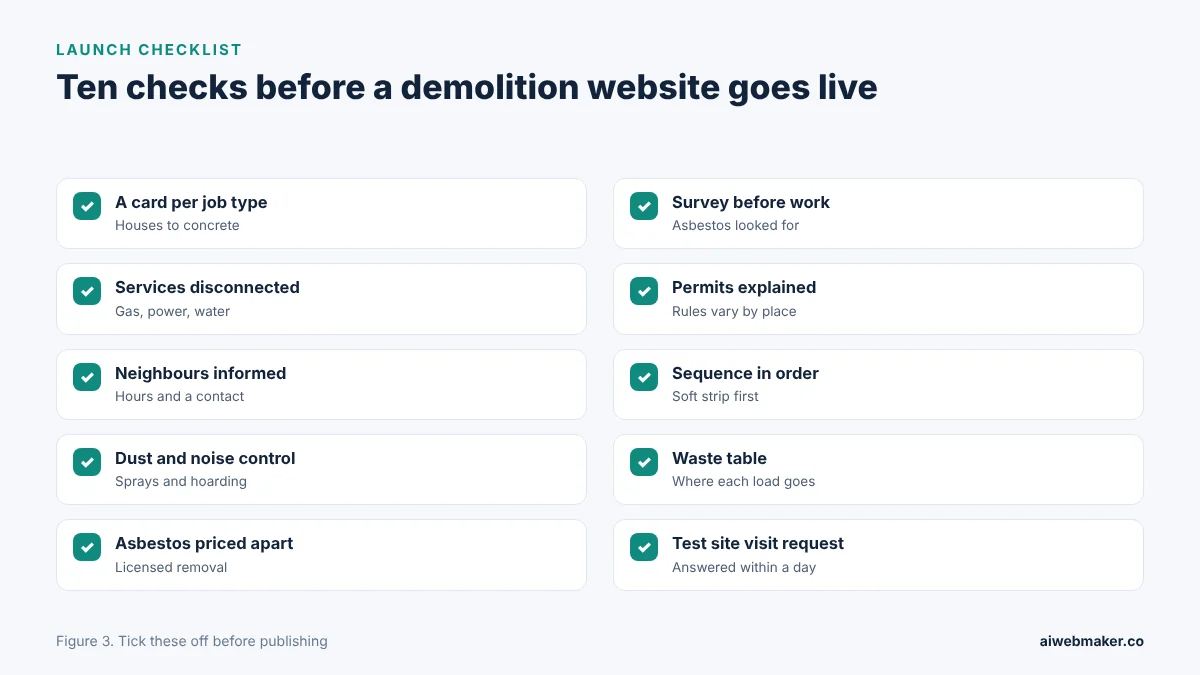
Clients grow wary when a demolition website never mentions a survey, because asbestos is the risk they fear most. A vague promise to clear everything, with no word on recycling or waste notes, suggests rubble may end up dumped. No mention of permits leaves owners worried about fines or a stopped job. Missing details on dust, noise and working hours make neighbours' complaints feel inevitable. Photos of other firms' machines or famous blasts prove nothing about the crew's own sites. Those red flags each have an answer in the ten checks drawn next.
Frequently asked questions
Is a permit needed to knock down a garage?
Whether a garage needs a permit depends on the country, the local authority, the size of the structure and whether it is attached or in a protected area. Some places allow small outbuildings to be removed without formal permission, while others require notice or a permit for any demolition. Many older garages have roof sheets that may contain asbestos, which brings its own rules regardless of size. A contractor should check the local requirements before quoting. Getting this right avoids fines and delays.
What happens if asbestos turns up partway through a job?
If suspected asbestos is found during demolition, work in that area should stop until it has been assessed. A licensed specialist may be needed to remove it, depending on the type and the rules where the job is. The extra cost and time should be agreed with the client before work continues, which is why a thorough survey at the start matters so much. A clear policy on the website prepares clients for this possibility. Calm, rule based handling protects workers, neighbours and the client alike.
How much dust and noise should neighbours expect?
Demolition always creates some dust and noise, but careful contractors keep both within reasonable limits. Water sprays suppress dust, while hoarding and sheeting stop debris leaving the site. Noisy work such as concrete breaking can be scheduled within agreed hours, which local rules often set. Writing to neighbours before work begins, with a contact number, reduces friction considerably. Honest expectations prevent complaints from becoming disputes.
Can the foundations and slab be left in place?
Foundations and the ground slab can sometimes be left if the next building is designed around them, but more often they are removed. Old foundations can clash with new ones, and slabs may hide drains or contamination. An architect or engineer planning the new build should decide what stays. The quote should state clearly whether slab and foundations are included. Clarity on this point avoids a costly surprise when the builder arrives.
Sizing one garage removal against the hosting year
One cleared garage or outbuilding pays a demolition firm more than its whole $119 hosting year. For contractors who pay monthly, $19 vanishes against the fuel for one day of machine work. Each strip out, partial demolition and plot clearance that begins with a request on the site adds to that margin. A visible survey process, clear waste records and honest words about dust reassure owners more than glossy promises. Firms that keep posting real sites, with the plot level and the skips sorted, build the reputation builders recommend. Site visit requests that already mention the building's age and access show the pages are informing every enquiry.
Build your website in Minutes and get the AI Tools that work
Start Building Your Website →