Custom Home Builder Website Cost, From Plot Appraisal to Handover
A custom home builder's pages need $119 in hosting fees per year, or twelve payments of $19, with the domain on top. Topics: how families pick a builder, the pages, plot appraisals, pricing, contracts, stage payments, rules, search and the budget.
- No coding required
- Live in minutes
- Blog, SEO and chatbot tools included
Twelve months of hosting for a design and build firm cost $119, or $19 when paid month by month, before a domain is added. Drafting, rewording and previewing those pages inside AI Web Maker is never invoiced. A single plot appraisal repays that sum several times, and a signed contract dwarfs it. Winning trust is the real test, since each family is spending more than ever before on a house that exists only as a drawing. How families choose, the pages that answer them, plot appraisals, pricing per square metre, contract routes, stage payments, approvals and the yearly budget are each taken in turn below.
This article is part of our complete guide: Home Services Website Builder.
Who commissions a one off house, and what do they weigh first?
People commissioning a one off house tend to sit in one of five camps, each carrying its own worry. Some already own a plot, often inherited or bought years ago, and want to know what it will allow. Others have land under offer and need a view before the sale completes, or are still searching. Families replacing a tired bungalow on the same site worry about demolition and where to live meanwhile. A smaller group arrives with drawings from their own architect and wants a firm to price and build them. Every group weighs the same three things first: whether the budget is realistic, whether the firm is solid and whether the plot hides surprises.
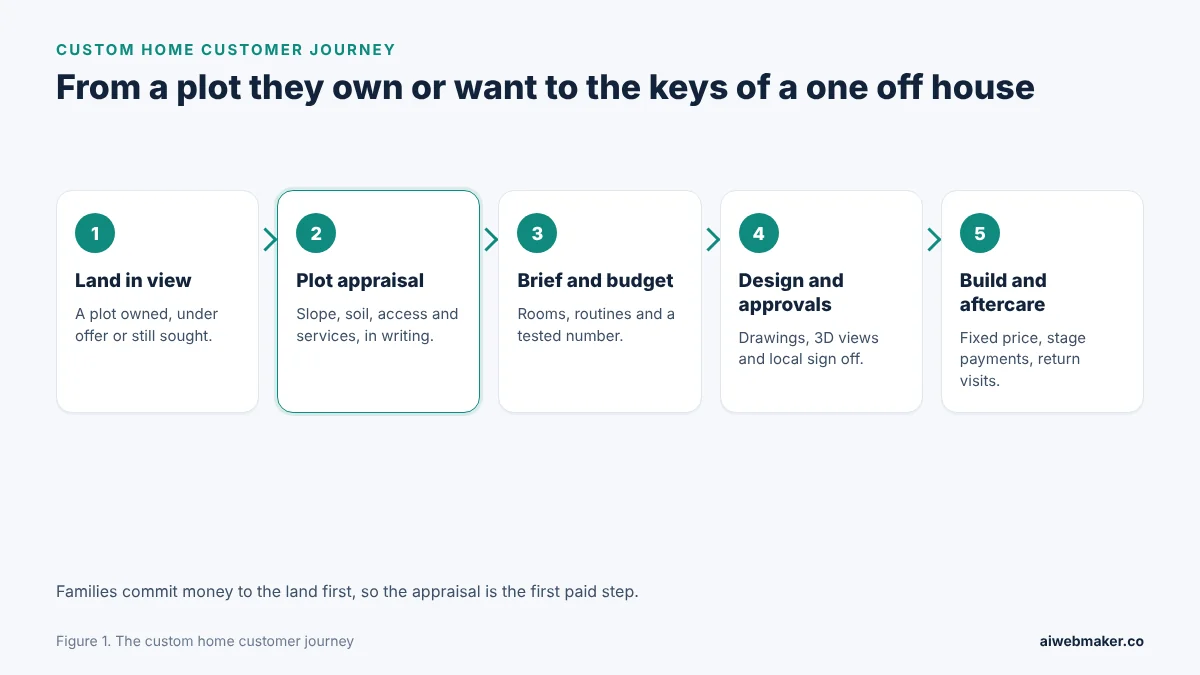
Read from left to right, this journey begins with land rather than a house, which is the order a careful builder's website should follow. The highlighted step is the plot appraisal, because a written report on slope, soil, access and services is the first paid commitment most families make. Brief and budget come next, turning a wish list into a number that can be tested against the ground. The fixed price contract, the build and the aftercare visits after handover decide what the family tells friends and neighbours. Serving each step in that order keeps a family moving forward rather than drifting away.
The pages a design and build firm needs, from the plot to the keys
A design and build firm needs fewer pages than a volume housebuilder, but each one has to carry more detail. The home page should say that the firm draws and builds one off houses, name its area and invite talk about a plot. A plot appraisal page sells the first paid step, while a stages page sets out the journey to handover with typical durations. Fees and stage payments deserve a page of their own, because money is where most builders go quiet and where families look hardest. A show home page, a gallery of houses on their plots and a page on local rules complete the proof.
| Page | Question it answers | What belongs on it |
|---|---|---|
| Home | Does this firm build houses like ours? | Design and build in one line, area, plot enquiry |
| Plot appraisal | Should we buy this land? | What is checked, when the report arrives, the fee |
| Stages | How long will it take? | Each stage with its typical months |
| Fees and payments | What do we pay, and when? | Design fees, price per square metre, payment schedule |
| Show home | Is the build quality real? | Visiting times, samples, a cutaway wall |
| Local rules | What could stop the house? | Approvals and limits checked for each plot |
| Contact | Will they build on our plot? | Office, hours, building radius |
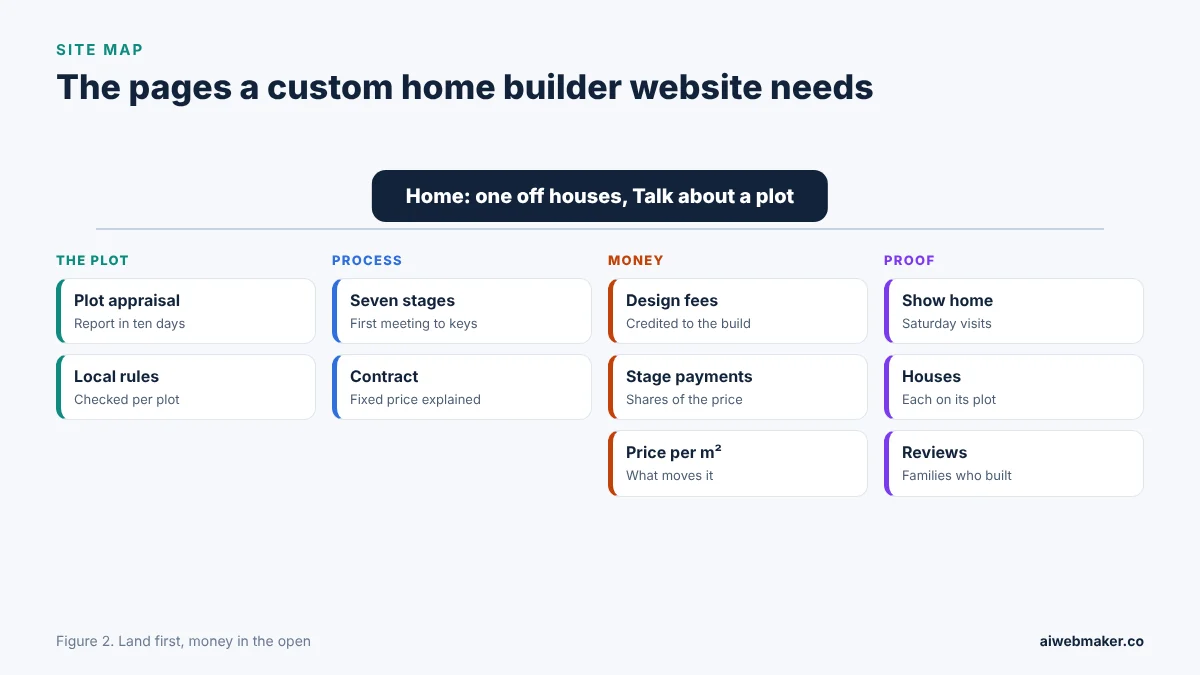
Beneath the home page this plan hangs four clusters, ordered the way a family's questions arrive. Plot pages hold the appraisal and local rules, process pages hold the stages and contract, money pages hold fees and payments, and proof pages hold the show home and reviews. Our sample firm, Timberline Custom Homes, lists three priced services: a plot appraisal from $650, a design package from $14,500 and design and build from $2,350 per square metre. Its single long page opens with the ground rather than a kitchen, shows stage payments running from 5% on signing to 5% at handover and invites visitors to a show home on Saturdays. The custom home builder website example with stage payments and a show home is a layout written by hand, not a real company. Any builder of one off houses can borrow its order and swap in its own figures.
Selling the plot appraisal before the land is bought
A paid plot appraisal is the natural first product for a custom builder, because it answers a question no family can answer alone. Its page should list what is checked, such as slope, soil, drainage, access for lorries and cranes, and where water, power and sewer can connect. It should name the deliverable, for example a written report within ten days covering the risks found, questions for the seller and a rough build cost range. Stating the fee, and whether it is credited against later design work, turns a vague consultation into a product. The AI website builder for firms that design and build one off houses drafts the plot, stages and fees pages after the firm describes in a few lines what it builds, and each page can be edited in the preview at no charge. A clear appraisal page gives families a reason to call before the land is theirs.
Pricing a house that has not been drawn yet
Families want a number long before a builder can honestly give one, so the website has to offer a range without pretending it is a quote. A price per square metre from recent houses lets a family test a 180 square metre house against its budget in seconds. The page should then say what moves that figure, such as a sloping plot, deep foundations, the level of finish and the number of bathrooms. Allowances for items not yet chosen, such as the kitchen or the tiles, should be explained with the sum set aside for each. A family that sees where every dollar sits is far less likely to walk away at the first surprise.
| Budget line | Usually set by | How the website can explain it |
|---|---|---|
| Land | The seller and the market | Paid by the family, outside the build price |
| Approval and permit fees | The local authority | Named as an extra, with typical ranges where known |
| Water, power and drain connections | Utility providers | Quoted by each provider after an application |
| Build price | The builder | A price per square metre, then one contract sum |
| Allowances for kitchens, tiles and fittings | The family's choices | A sum per item, adjusted once the choice is made |
Fixed price, cost plus or build only: contract routes to explain
Contract routes differ in who carries the risk of rising costs, and families deserve to see that difference before they sign. Under a fixed price contract the builder agrees one sum for a full specification, which moves only for changes or hidden ground. A cost plus arrangement passes the actual cost of labour and materials to the family with an agreed fee on top, which can suit unusual designs but leaves the final figure open. Some families bring their own architect's drawings and want a build only price, which leaves design responsibility with the architect. Names and legal forms vary by country, and the website should never suggest that one standard contract applies everywhere. A short, honest comparison shows that the firm understands contracts rather than hiding behind them.
| Route | How the price is set | Who carries cost risk | Often suits |
|---|---|---|---|
| Fixed price design and build | One sum for a full specification | Mostly the builder, apart from changes | Families who want certainty |
| Cost plus a fee | Actual costs plus an agreed fee | Mostly the family | Unusual designs and phased builds |
| Build only from outside drawings | Priced from the architect's set | Shared, with design risk on the architect | Families who already hired an architect |
Stage payments that follow inspected work and the lender's draws
Stage payments tell a family that money follows finished work, and setting them out clearly answers the fear of paying for a hole in the ground. Each stage should name what must be complete, such as footings and slab, frame and roof, or the house closed against the weather. Invoices should follow an inspection, ideally with photos, so the family and any lender see what they are paying for. Many construction loans and self build mortgages release money in stages, and the firm's schedule should bend to match them where it can. Some contracts hold back a small retention until the snagging list is closed. A schedule printed in plain percentages earns more trust than any promise in a banner.
Variations are the other half of the money story, because almost every family changes something once the walls are standing. Each change should be priced in writing and approved before anyone orders a new window. A change can also delay the programme, since a new staircase may hold up the plasterers for weeks. Hidden ground, such as rock or old foundations, is the classic source of unplanned cost and deserves naming in advance. Honest variation rules keep the final account close to the contract price.
Local rules, approvals and structural warranties
Approvals for a new house are set locally, so the website should explain what usually needs checking without stating any single rule as universal. Planning or zoning approval governs what may be built, while building codes govern how it is built and who signs it off. Licensing of builders differs widely too, since many states in the United States license residential contractors while other countries rely on registration schemes or none at all. Mortgage lenders in the United Kingdom, to take one example, commonly expect a new home to carry a structural warranty, typically for ten years. A page that says these rules vary, and promises to check them in writing for each plot, sounds like a builder who has done this before.
What families type when they want a house built on their own land
Families planning a one off house search with phrases that describe land and process rather than style. Typical searches include custom home builder near me, design and build homes, build a house on my land, knock down and rebuild, and self build help, usually beside a county name. Each phrase deserves a heading on the page that answers it, such as build on your land above the appraisal. A map listing for the design office or show home, with visiting times and photos of finished houses, helps nearby families find the firm. Reviews naming the site manager, the fixed price holding and the handover visit outweigh vague praise. Articles on what a plot appraisal checks or how stage payments meet a construction loan reach families early, which suits a purchase studied for a year.
The yearly bill for a builder's website, next to one appraisal
Beside the price of a single house, website hosting barely registers among a builder's overheads. Paying $119 once suits an established firm best, while a newly formed firm guarding its cash through the first contracts may choose the $19 monthly route. Articles about plots, approvals and stage payments can be drafted with AI credits for about $0.65 each. New house photos, revised prices per square metre and a wider building radius cost nothing extra to publish. Totals for both routes follow, the dearer tier placed alongside purely for reference.
| Item | Yearly | Monthly |
|---|---|---|
| Hosting the plot, stage and payment pages | $119 | $228 over twelve months |
| Domain | Depends on the ending | Depends on the ending |
| Higher plan, for comparison | $189 a year | Not needed |
| Twelve plot and approval articles at about $0.65 | About $7.80 | About $7.80 |
| New houses, prices and building radius | No charge | No charge |
| Year before the domain | About $126.80 | About $235.80 |
Gaps that send a family to another builder's site
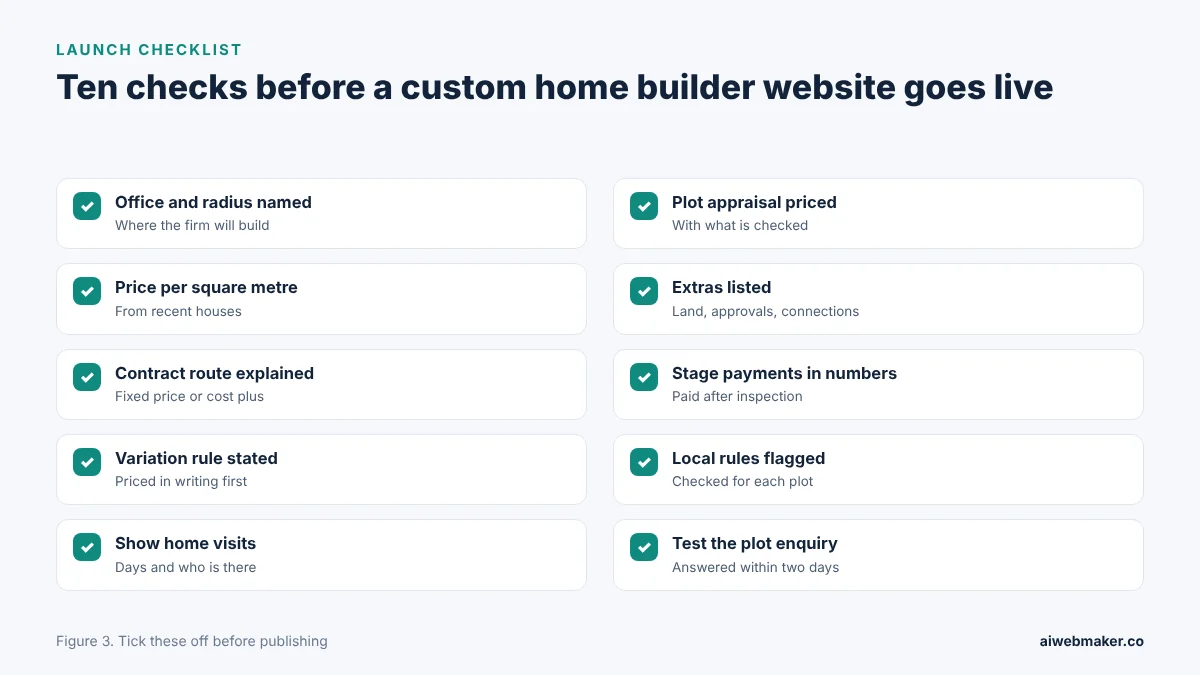
Families leave a builder's website quickly when it shows glossy renders but no price per square metre, no stages and no word on payments. A gallery of houses with no plots, no towns and no story suggests the images may not be the firm's own work. Silence on local rules looks inexperienced or evasive, and both are fatal here. A missing address or show home leaves families wondering whether the firm will still be trading in eighteen months. A contact form that ignores the plot entirely suggests a builder who thinks about kitchens before land. Each failing has a matching tick among the ten launch checks pictured next for one off house builders.
Frequently asked questions
Why quote a range per square metre instead of one price?
A range per square metre is honest because no two plots or specifications cost the same, yet it still lets a family test a budget early. The figure should come from the firm's own recent houses rather than a national average. Listing what lifts the figure, such as slopes, basements or high end finishes, keeps it useful. A note that the fixed price follows the detailed drawings sets the right expectation. Families appreciate a number to plan around, even one that moves.
Should design fees count towards the build contract?
Crediting design fees against the build contract rewards families who stay, and the website should say whether it applies. Families worry about paying twice, once for drawings and again for the house. A plain statement that the design fees are deducted from the contract price, as in the Timberline sample, removes that worry. Firms that do not credit fees should explain what the drawings are worth on their own, such as a full set ready for approval. Clear terms prevent disputes at the moment the contract is signed.
Can a builder price drawings from the family's own architect?
Many custom builders will price and build from an outside architect's drawings, and saying so widens the pool of families who can enquire. Its page can say that outside drawings are priced exactly as drawn, with anything costly or awkward to build flagged in writing. Design responsibility usually stays with the architect, which is worth stating plainly. Some firms also review the drawings for buildability before pricing them. Families with an architect already hired then know the door is open.
Is a show home worth a page if visits are by appointment?
A show home earns its page even when visits are by appointment, because the page itself proves that a finished house exists. It should give the visiting days, the samples on display and who answers questions on the day. Photos of the rooms and any cutaway wall give distant families a reason to travel. Mentioning lived in houses whose owners allow visits, where that is true, adds a second layer of proof. Booking a Saturday visit is frequently where idle browsing turns into a real conversation about a plot.
How many plot appraisals cover the year online?
One plot appraisal at the sample price of $650 would pay for more than five years of yearly hosting. A design package or a signed contract dwarfs it entirely. What earns those first appraisals is the order of the pages: the ground first, then the stages, then the money, then the proof. Families who find honest figures for prices per square metre and stage payments arrive at the first meeting better prepared. Measured against one appraisal, a year online costs the builder almost nothing.
Build your website in Minutes and get the AI Tools that work
Start Building Your Website →