Commercial Cleaning Company Website Cost, Priced Visit by Visit
A contract cleaning firm publishes its offer for $119 in one annual bill, or $19 when billed month by month, with its domain chosen separately. Sections follow on facilities buyers, premises pages, per visit pricing, scope and extras, keys and vetting, notice and audits, search and the budget.
- No coding required
- Live in minutes
- Blog, SEO and chatbot tools included
A contract cleaning firm can publish its whole offer for $119 paid in one annual bill, or $19 in each month for firms preferring smaller sums, plus a domain. No bill arrives while the pages are drafted and reviewed in the preview, so the scope and the plans can be argued over internally before anyone outside sees them. One office signed for two evenings a week earns more than that sum within the first weeks of the contract. The harder problem is that a facilities buyer pays for work done after everyone has gone home, which nobody on their side ever watches. Contracts are usually lost over a fridge that was never emptied or a team that changed every month, rarely over the weekly rate. What follows covers the buyers, premises pages, per visit pricing, scope and extras, keys and vetting, notice terms and audits, search and a yearly budget.
This article is part of our complete guide: Home Services Website Builder.
Office managers, practice managers and landlords: who buys contract cleaning
Contract cleaning is bought by people who run buildings for a living, and they compare suppliers at a desk during the working day. An office manager wants desks, kitchens and washrooms ready by nine without having to chase anyone. A practice manager at a dental or medical clinic needs a cleaner who follows the practice's own protocol and leaves clinical waste alone. Shop and showroom managers care about glass, fitting rooms and floors before the doors open. Building managers buy cleaning for entrances, lifts and stairs shared by several tenants, and they need a log every tenant can read. Each of them usually forwards the website to a colleague or a finance contact, so the page has to make sense to someone who never spoke to the cleaner.
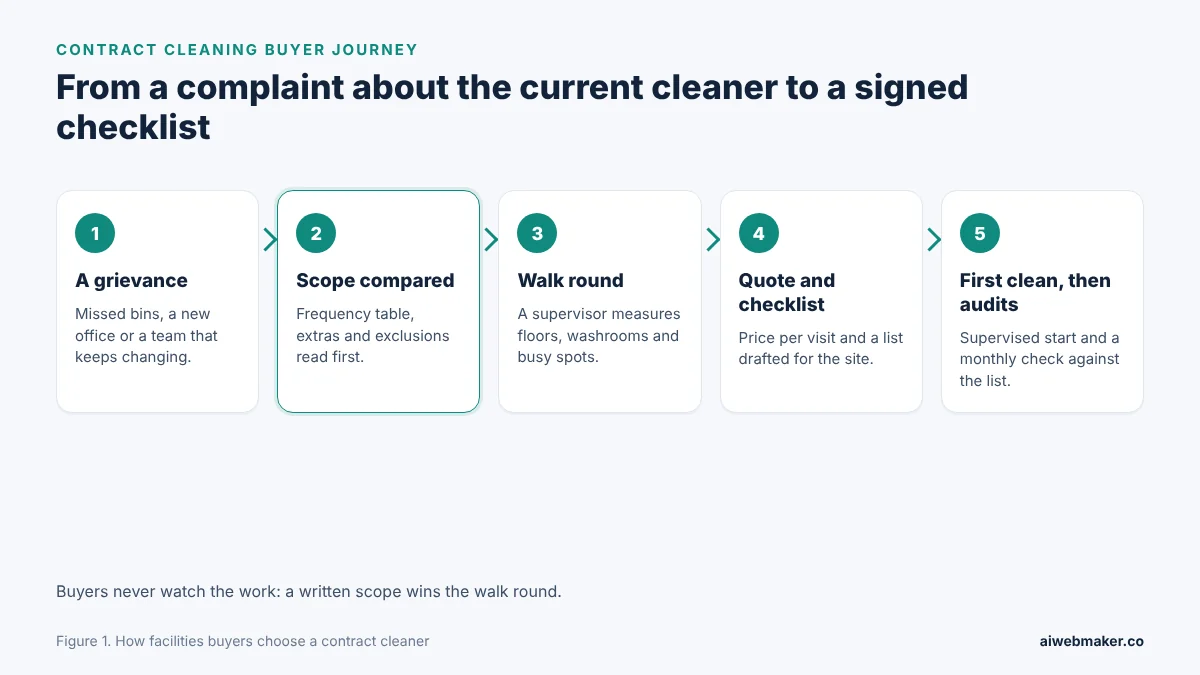
Most contract enquiries begin with a grievance rather than a blank sheet, and the first card in this journey reflects that. A manager has found the same bin unemptied three mornings running, or the business has moved into new premises with nobody lined up. The highlighted card is where the decision really happens, because the buyer compares scope tables and exclusions long before any price is discussed. A walk round follows, where a supervisor measures the space and notes the floors, washrooms and busy spots. The written quote and checklist then lead to a supervised first clean and a monthly audit, and those audits decide whether the contract renews.
Premises, frequencies and extras: the pages a contract cleaner publishes
Each kind of premises deserves its own section on a contract cleaner's site, because a coworking floor and a dental waiting room are dirty in different ways. The scope table needs a prominent place of its own, since it is the document buyers argue over later. Plans by frequency show how the price changes between two visits a week and a cleaner on site all day. Extras and exclusions belong on the same page as the scope, so nothing is assumed. A section on staff, keys and vetting answers the question every buyer asks before handing over a fob. The request route closes the page by asking for a walk round rather than an instant price.
| Page or section | What the buyer checks | What it should state |
|---|---|---|
| Offices and coworking floors | Desks, kitchens, meeting rooms | The evening or early routine, and what is left untouched |
| Clinics and practices | Protocol and waste | Areas covered, and treatment rooms only where the protocol says how |
| Shops and showrooms | Ready before opening | Glass, fitting rooms, counters and stockroom days |
| Shared areas in office buildings | Tenants and records | Entrances, lifts, stairs and a log kept at reception |
| Scope checklist | What happens, and how often | Every visit, once a week and once a month columns |
| Extras and exclusions | What costs more | Separately quoted jobs and work never taken on |
| Walk round request | The next step | Premises type, rough size, hours and a start date |
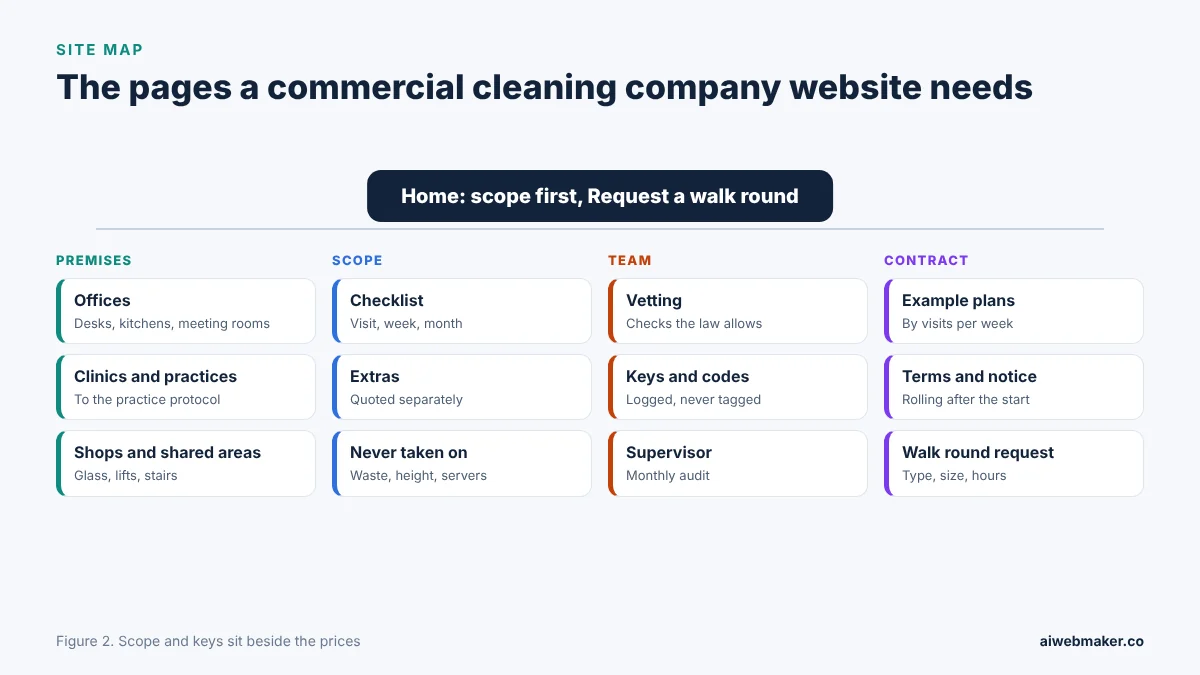
Beneath the home page sit four branches, and each answers one question a facilities buyer raises in a tender meeting. Premises pages cover offices, clinics, shops and shared building areas. Scope pages hold the checklist by frequency and the list of extras quoted separately. Team pages explain vetting, key handling and the supervisor who audits each site, while the contract branch carries example plans, notice terms and the walk round request. Brightdesk Commercial Cleaning, the sample contractor, runs all of this as one long page that a manager can forward, covering offices and coworking floors, clinics and practices, shops and showrooms, and shared areas in office buildings. The commercial cleaning company website example with a signed checklist for every visit also carries a room by room checklist, the extras it quotes separately, its vetting, five steps from walk round to monthly audit and three plans called twice a week, every weekday and day cleaner on site, before closing with a walk round request.
Pricing a contract per visit: floor area, washrooms and frequency
Contract cleaning is priced from minutes on site, and a buyer who understands what adds minutes accepts a quote far more readily. Floor area sets the baseline, but washrooms and kitchens take longer per square metre than any open office. Carpeted floors need vacuuming to the edges, while hard floors need mopping and periodic machine work. Footfall matters too, since a busy showroom collects more dirt in a day than a quiet back office does in a week. The time window changes the rate, because evening and early morning shifts cost more to staff than daytime work in many countries. A sensible page prices one clearly described example site, states its assumptions and explains why other premises will differ.
| Price driver | Why it moves the rate | How the page can show it |
|---|---|---|
| Floor area | More ground to cover each visit | State the size the example price assumes |
| Washrooms and kitchens | The slowest rooms to clean well | Count them in the example |
| Visits per week | Labour rises with every visit | Separate plans by frequency |
| Time window | Evening, early or daytime shifts | Name the hours each plan covers |
| Floor types | Carpet and hard floors need different kit | Note that machine work is quoted apart |
| Consumables | Soap, paper and bin liners | Say who supplies them, and at what price |
| Travel | Sites further out take longer to reach | Show travel on a line of its own |
The scope table, the extras and the work a cleaner turns down
Disputes with contract cleaners nearly always start when a client assumes a task happens every night and the contractor planned it monthly. A scope table with three columns, every visit, once a week and once a month, prevents that misunderstanding before it starts. Desks, kitchens, washrooms, floors, touch points and bins each deserve a row, so a manager can see that the fridge is emptied monthly and handles are wiped nightly. Jobs that need different machines or more time, such as carpet extraction or a floor strip and reseal, should be listed as extras priced on their own. Some work should be refused outright and said so plainly, because rules on waste and working at height exist for good reasons. Publishing the refusals alongside the scope tells a buyer the firm knows where its responsibility ends.
| Job | How it is usually handled | Why |
|---|---|---|
| Carpet hot water extraction | Quoted as an extra | Needs a machine and drying time |
| Hard floor strip and reseal | Quoted as an extra | Done out of hours with the floor closed |
| Windows above the ground floor | Quoted, often by a specialist | Access equipment and safety planning |
| Cleaning after building work | Quoted as an extra | Fine dust takes several passes |
| Clinical or sharps waste | Never taken on | Must go to a licensed waste carrier |
| Inside computers and servers | Never taken on | Risk to equipment and data |
Keys, alarm codes and vetted staff for buildings that stand empty at night
A cleaning crew holds keys, fobs and alarm codes for premises left empty all night, so vetting is a buying question rather than a footnote. The page should list the checks each cleaner passes, such as identity, right to work and references. Criminal record checks deserve careful wording, because which checks are allowed or required differs between countries and between kinds of work. Keys should be logged in a register and never tagged with the client's address, and the page can say exactly that. Photo identification on every visit, a named supervisor with a mobile number and holiday cover from people already trained on the site all reassure a buyer. Liability insurance belongs here too, with a note that the cover a lease or landlord demands varies by country and by building.
Contract length, notice periods and the monthly audit
Contract terms are where a cleaner shows it expects to keep clients by performance rather than by lock in. A short opening term followed by a rolling arrangement with a stated notice period gives both sides a fair exit. Price reviews should happen on a known date and never without written notice. The page should explain what happens when a visit is missed or a task is skipped, including how quickly a return visit follows and whether the missed visit is charged. A monthly audit, in which a supervisor checks the site against the list and sends the results, turns the checklist from a promise into a record. The AI website builder that drafts contract cleaning pages for offices and clinics writes the premises sections, the scope and a request route once the firm describes its sites and hours in a few lines, and those drafts can be reworked until the terms read exactly as the contract does.
What facilities buyers type when the current cleaner has let them down
Facilities buyers search with the type of premises and a place, such as office cleaning in a business district, dental practice cleaners or contract cleaning for shops. Many of these searches happen on a desktop during office hours, often while the buyer is already frustrated with someone else. Section headings that name each kind of premises, written in plain words, match those searches far better than a slogan. The map listing should show the districts and business parks covered, office hours for enquiries and real photos of sites at handover. Reviews from named roles, such as an office manager or a practice manager, carry more weight than anonymous praise. Short articles on what a cleaning specification should contain or how often washrooms need a deep clean bring in buyers who are still drafting their brief.
A contract cleaner's twelve month web budget
Over a contract cleaner's website year, hosting and the domain are the two lines that come back, and twelve credit drafted articles total roughly $7.80. A firm with settled contracts pays least by covering the year in one payment of $119. One still waiting on its first tender result can spread the cost at $19 a month instead. Editing the checklist, the plans or the districts covered is never billed. The $189 line is listed for reference and needs no decision.
| Item | Yearly | Monthly |
|---|---|---|
| Hosting the contract cleaning pages | $119 | $228 over twelve months |
| Domain | Depends on the ending | Depends on the ending |
| Higher plan, for comparison | $189 a year | Not needed |
| Twelve facilities articles at about $0.65 | About $7.80 | About $7.80 |
| Checklist, plan and district updates | No charge | No charge |
| Year before the domain | About $126.80 | About $235.80 |
Why office managers close a cleaner's tab and call the next one
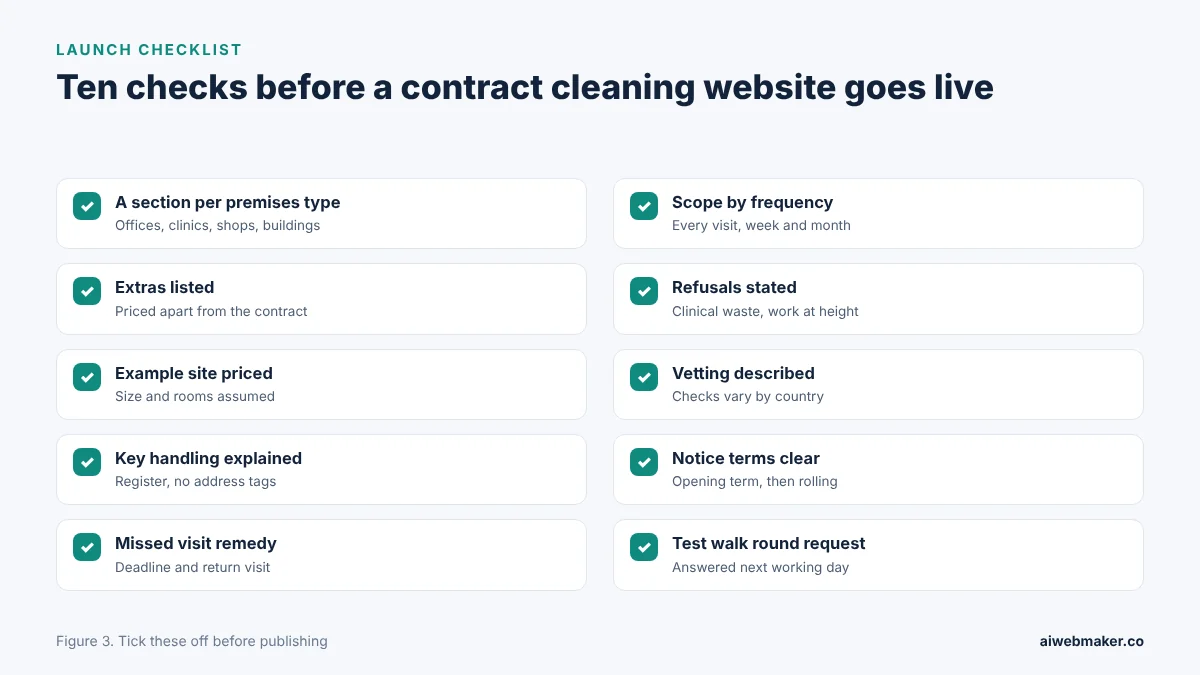
Office managers move on quickly when a cleaning site lists services but never says how often each task happens. An hourly rate with no example site leaves them unable to brief their finance team. Silence about keys, alarm codes and vetting worries anyone responsible for an empty building at night. A clinic manager who finds no mention of protocols or clinical waste assumes the firm has never cleaned a practice. Missing notice terms hint at a contract with no easy exit, which is exactly what a buyer escaping a poor cleaner fears. Every one of those gaps is closed by an item on the launch list drawn underneath.
Frequently asked questions
Does someone from the client need to stay while the team cleans?
Most contract sites are cleaned after closing, with keys or fobs recorded in the cleaner's register, so nobody from the client needs to stay. A manager usually walks the site with the supervisor the morning after the first clean. From then on, the signed checklist left on site shows what was done on each visit. Clients who prefer a presence can choose early morning cleans while staff arrive. The page should state the usual arrangement so buyers can plan around it.
Who supplies soap, paper towels and bin liners?
Consumables are supplied either by the client or by the contractor at a stated price, and the contract should say which. Some firms add a standing order for washroom supplies as an extra service. Cleaning products and equipment are normally brought by the contractor, chosen for each surface, with safety sheets kept on site. Buildings or practices that require particular products should say so at the walk round. Clear wording here prevents small but irritating invoices later.
Can a cleaning contractor work in a dental or medical practice?
A contractor can clean waiting rooms, corridors, offices and washrooms in a practice, following the practice's own protocol. Treatment rooms should be cleaned only where that protocol sets out how and the practice team agrees. Clinical and sharps waste stays with the practice's licensed carrier and never goes in the cleaner's bags. Infection control rules vary by country and by type of practice, so the cleaner follows the ones that apply locally. Careful wording on this point wins the trust of practice managers.
What happens when a visit is missed?
A good contractor sets a deadline for reporting a missed visit or task, such as noon on the next working day, and returns to put it right. The page should say whether a missed visit is charged, and many firms simply do not charge for it. Supervisors who report a missed task before the client notices earn more loyalty than any discount. The monthly audit should record what went wrong and what changed. Honest handling of failures is what keeps contracts running for years.
Two evenings a week at one office, and the website year is paid
A single office on a twice weekly plan returns the $119 hosting fee many times over across a normal year. Paid monthly instead, $19 is smaller than the value of one evening visit at almost any site. Every further practice, shop or shared building won through the site adds months of steady contract income. A clear scope table, honest exclusions and careful words about keys persuade facilities buyers more effectively than any promise of sparkle. Contractors who publish their audit routine show that the checklist is checked, not just printed. Renewals signed without a single sales call tell the firm its pages are persuading the right buyers.
Build your website in Minutes and get the AI Tools that work
Start Building Your Website →