Classic Car Restoration Website Cost, Bare Metal Budgets and Diaries
Hosting a restoration workshop's project pages for a year takes $119, roughly a third of one assessment fee, or $19 a month for workshops still filling the bays, plus a domain. Inside: owners and heirs, the pages, stage pricing, bare metal, the photo diary, originality and paperwork, stage invoices and parts, search and the year's sums.
- No coding required
- Live in minutes
- Blog, SEO and chatbot tools included
Hosting a restoration workshop's project pages for a year takes $119, roughly a third of one assessment fee, or $19 monthly while the first projects come in, plus a domain. Stage tables, photo diary pages and the enquiry form can be reworked in preview for as long as the workshop likes, and AI Web Maker sends nothing to pay before launch. A single strip and catalogue stage covers the hosting sixteen times. The deeper problem is that nobody knows the real bill for a restoration until the paint comes off, and owners are asked to trust a workshop for a year or more. They want honest ranges, proof of every hidden repair and a voice in each decision. Inside: owners and heirs, the pages, stage pricing, bare metal, the photo diary, originality and paperwork, stage invoices and parts, search and the year's sums.
This article is part of our complete guide: Home Services Website Builder.
Owners, heirs and buyers who have just collected a project
Restoration clients rarely shop on price alone, because they are handing over a car that may carry decades of family history or a lifetime of saving. Long term owners want the car they remember, restored with care and without surprises. Heirs who have inherited a car often need advice before deciding whether to restore, recommission or sell it. Buyers who have just collected a project car want to know how bad the hidden rust might be and what the full job could cost. Collectors look for a workshop that knows the era, documents everything and keeps the car's history straight.
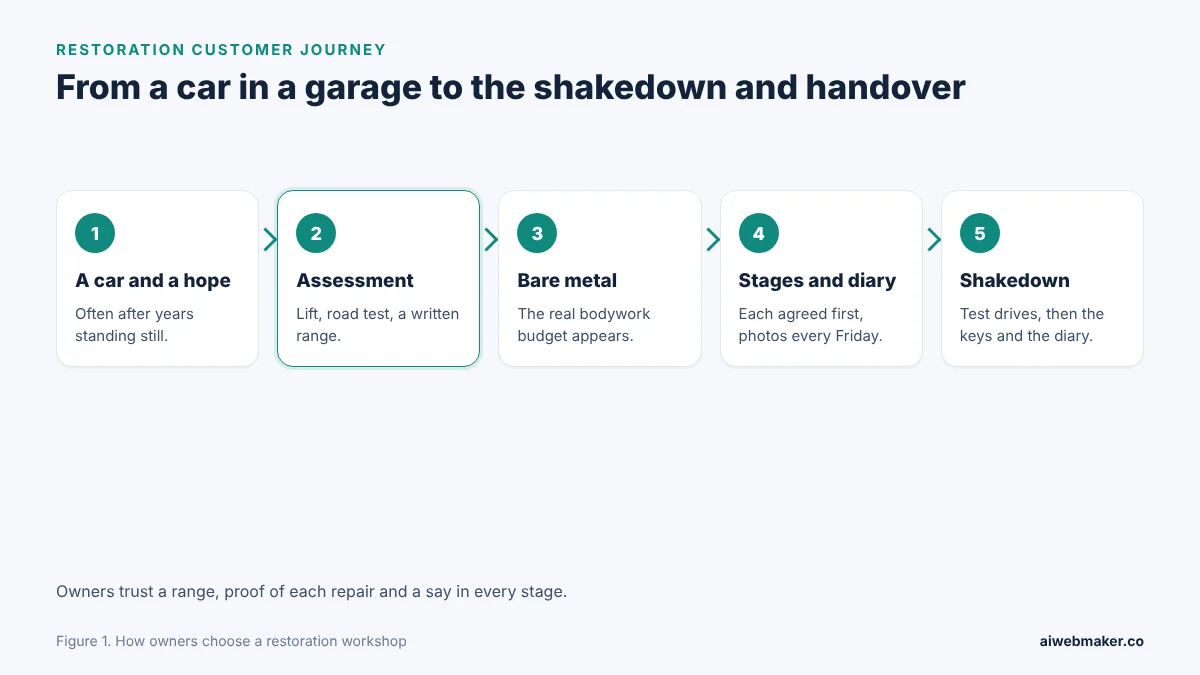
A car and a hope open this path, often after years of the car standing in a garage. The highlighted second step is the assessment, when the workshop inspects the car, road tests it if it runs and gives a written range. Stripping to bare metal comes next, which is the moment the real bodywork budget appears. Months of stages follow, each priced and agreed before it begins, with photos sent every week. A run of test drives and the handover close the journey, and the diary goes home with the car.
Stages, services, diaries and budgets: the pages owners read
A restoration workshop's website should explain the work as a sequence of stages, because owners need to understand where months and money go before signing anything. A page on why the real bill stays hidden until bare metal sets honest expectations. A stages page shows what happens at each step, and a services page serves owners who want only one part done. A diary page shows the weekly photos and notes owners will receive, while a budgets page sets out typical ranges and what pushes them up. An enquiry form completes the set, asking about the car, its condition and what the owner hopes to do.
| Page | What owners look for | Detail that matters |
|---|---|---|
| Before you start | Why there is no fixed price | Hidden rust, ranges, bare metal |
| Stages | What happens and in what order | Assessment to shakedown, each agreed first |
| Services | Help with one part only | Bodywork, paint, engine, trim, wiring, stored cars |
| Photo diary | How progress is shown | Weekly photos, notes, running total |
| Budgets | Typical ranges and time | What pushes each stage up |
| Cars we work on | Whether the era is covered | Age and body style rather than badge |
| Tell us about your car | An assessment date | Car, year, condition, runs or not, plans |
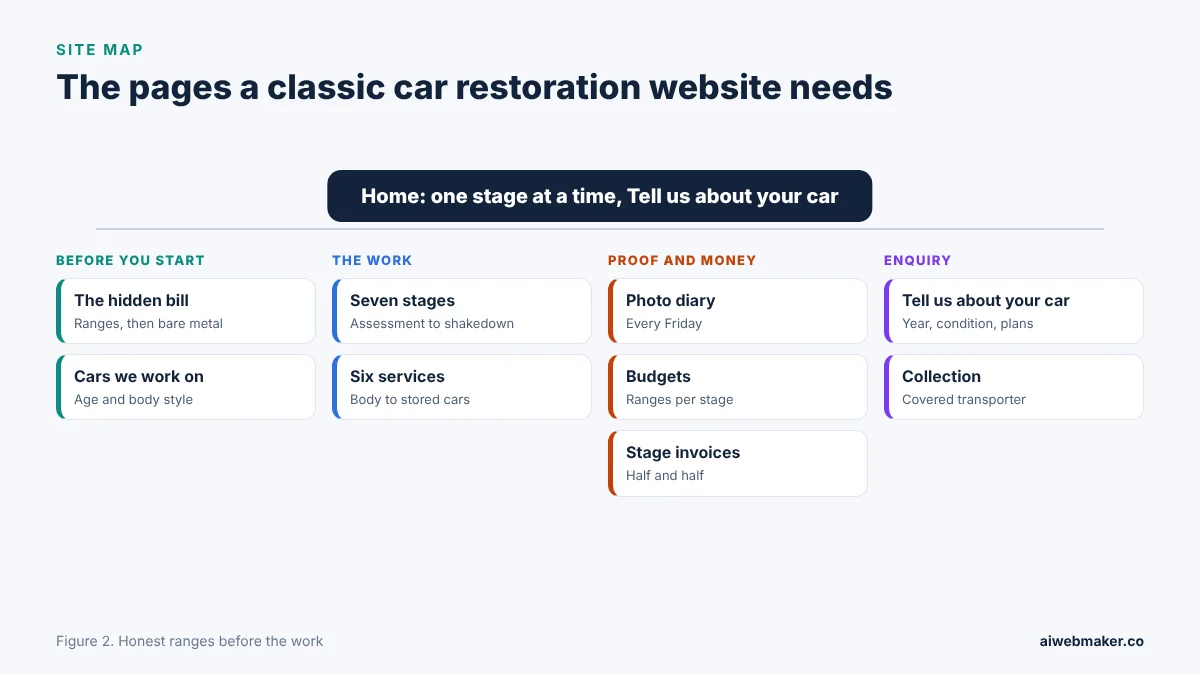
Four branches organise this workshop plan: honest expectations, the work itself, proof and money, and the enquiry. Heritage Motor Works, the invented workshop in the classic car restoration website example with stage pricing and a photo diary, opens with nine to eighteen months for most full restorations, new photos and notes every Friday and every stage priced before it begins. A section headed "Nobody knows the real bill until the paint comes off" explains why. Seven stages follow, from assessment, strip and catalogue and bare metal to metalwork, paint, mechanical rebuild, and trim and shakedown. Six services sit beside them, including bodywork and metal, a bare metal respray, engine and gearbox, interior and trim, wiring and electrics, and waking a stored car. A diary gallery, a table of stage times and ranges, a list of cars by age and body style, questions and an enquiry form complete the page.
Why a restoration is priced stage by stage
A full restoration cannot honestly be priced at the start, because the largest cost, the metalwork, is hidden under paint, filler and old repairs until the shell is stripped. A workshop can give a written range at assessment, then a firm price for each stage once it can see what that stage involves. No stage should start without the owner's go ahead, so the owner keeps control of the total. Ranges for each stage, with the factors that push them up, help owners judge whether the project suits their budget before they commit. Every figure should be marked as illustrative, since each car is different and prices vary widely between regions.
| Stage | Usual time | Illustrative range | What pushes it up |
|---|---|---|---|
| Assessment | Half a day | $350, taken off the first stage | Nothing, it is a fixed fee |
| Strip and catalogue | Two to four weeks | $2,000 to $4,500 | Seized fixings, missing parts |
| Metalwork | Two to six months | $8,000 to $30,000 | Rust in sills, floors, inner wings |
| Paint | Six to ten weeks | $9,500 to $16,000 | Colour change, detailed engine bay |
| Mechanical rebuild | Two to four months | $6,000 to $18,000 | Parts that must be made |
| Trim and shakedown | One to three months | $5,000 to $14,000 | Leather, replating, rare glass |
Bare metal: the week the real budget appears
Stripping a shell to bare metal is the turning point of every restoration, and the website should treat it as a decision point rather than a formality. Media blasting removes paint, filler and rust and shows the truth about sills, floors, inner wings and old repairs. A workshop should photograph every hidden problem before repairing it and share those photos with the owner. Many owners visit at this stage to see the shell for themselves, which builds trust that no photo can match. With the bodywork budget now firm, the owner can continue, scale back or rethink the project with full information.
The Friday photo diary as proof, history and provenance
A weekly photo diary turns a long, invisible project into something an owner can follow from home, and it becomes part of the car's history. Dated photos and short notes show what changed that week, what was found and what is planned next. A running total, updated whenever a stage is agreed, keeps the budget in view rather than in a drawer. Every part removed can be photographed, labelled and boxed, so nothing goes astray over the months. When the car is finished, the diary and the invoices travel with it, which buyers and insurers often value later.
Originality, upgrades and the paperwork that follows the car
Owners must decide early whether they want the car as it left the factory or with discreet improvements, and the website should present both choices without judgement. Better brakes, improved cooling, a modern ignition or a hidden stereo can make a classic more usable, while strict originality may suit a car destined for shows. Every change should be noted in the diary, so the car's history stays clear. British owners of older vehicles, for example, may qualify for exemptions from annual roadworthiness tests or vehicle tax, but substantial modifications can affect that status, and rules vary elsewhere. Insurers that specialise in classics often offer agreed value cover, for which a documented restoration helps support the valuation.
| Choice | Effect on the car | Paperwork note |
|---|---|---|
| Factory original | Period correct parts and finishes | Records of parts and sources |
| Discreet upgrades | Safer brakes, better cooling, reliability | Every change noted in the diary |
| Colour change | New look, possible effect on value | Register and insurer may need telling |
| Engine swap or major change | Very different car | Can affect historic status in some countries |
| Agreed value insurance | Cover based on an agreed figure | Diary and invoices support the valuation |
Stage invoices, parts orders and keeping a long project funded
A project that lasts a year or more needs payment terms that protect both sides, and the website should set them out plainly. Stage invoices, such as half when a stage is agreed and half when it is finished, keep cash moving without large sums paid in advance. Expensive parts, such as those over a stated amount, can be paid for when ordered, since they may be made specially. Hourly work billed in half hours, with parts charged at cost plus a handling fee shown on every invoice, removes suspicion about margins. The AI website builder that restoration workshops use for stage and diary pages drafts the stages, services, diary and enquiry pages once the workshop describes its cars and methods in plain words, and every range can then be checked in preview before publishing.
Rust repair and stored cars: what owners type into a search bar
Owners searching for a restoration workshop usually combine the car's era or body style with the work and the region. Typical phrases include classic car restoration near a named region, 1960s roadster restoration, rust repair for a classic car, bare metal respray and recommissioning a stored car. On the map listing, viewing hours by appointment and directions to a hard to find workshop save wasted journeys. Reviews from owners that name the car, the length of the project and how the diary kept them informed carry the most weight. Articles on checking a project car before buying, what bare metal reveals or how to wake a car that has stood for years attract owners early in their thinking.
A workshop's hosting bill beside one assessment fee
For a workshop spending thousands on one shell, the website is a small fixed cost: hosting, the domain and optional articles at sixty five cents in AI credits. Paying annually gives the lowest total once the workshop has a steady queue of projects. A new workshop may keep to monthly billing until its first restorations are under way. Adding a diary entry, changing stage ranges or listing a new kind of car never raises the bill. The two payment routes and the $189 comparison line appear together in the grid.
| Item | Yearly | Monthly |
|---|---|---|
| Hosting the classic car restoration stage and diary pages | $119 | $228 over twelve months |
| Domain | Depends on the ending | Depends on the ending |
| Higher plan, for comparison | $189 a year | Not needed |
| Twelve project car and bare metal articles at about $0.65 | About $7.80 | About $7.80 |
| Diary entries, ranges and car types | No charge | No charge |
| Year before the domain | About $126.80 | About $235.80 |
No ranges, no diary: why owners hand the keys to another workshop
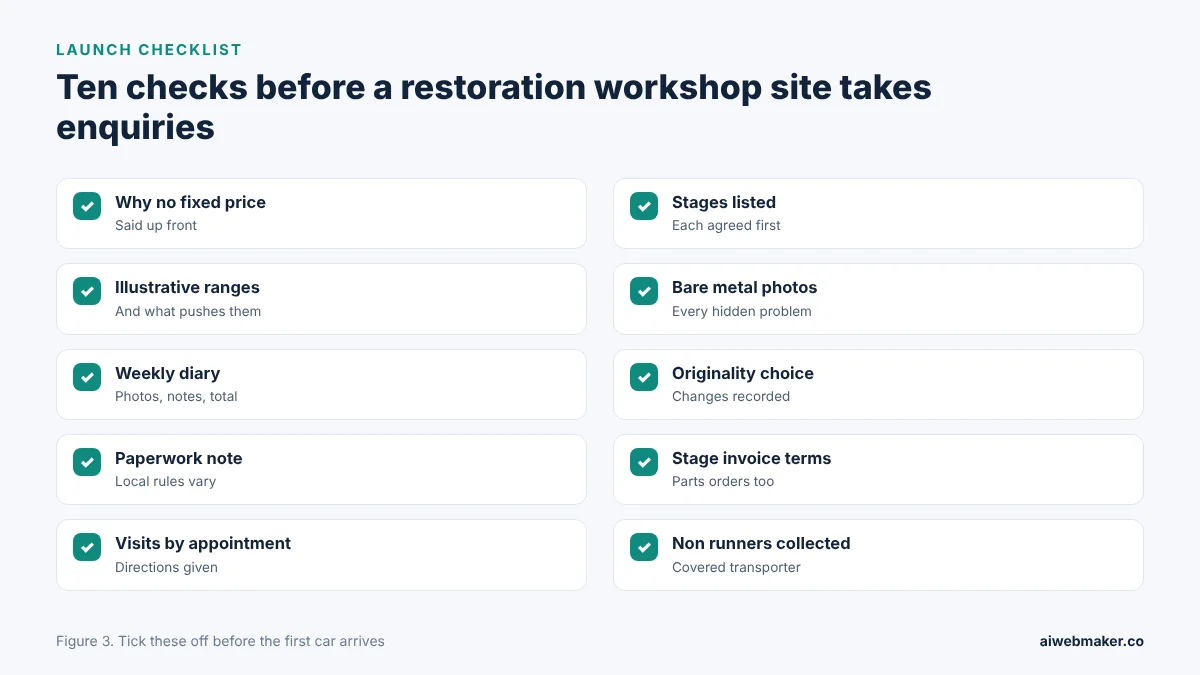
Owners leave a restoration workshop's site when it shows beautiful finished cars but no ranges or timescales, because they cannot judge whether the project is realistic. A promise of a fixed price for a full restoration worries experienced owners, who know what rust hides. No mention of a photo diary leaves them wondering how they will know what happens over the months. Vague payment terms on a project lasting a year or more feel risky. Silence on originality choices and paperwork suggests a workshop that has not thought about the car's history, and the ten checks drawn below settle every one of those doubts before an owner picks up the phone.
Frequently asked questions
Why can the whole restoration not be priced at once?
The largest cost, the metalwork, stays hidden until the car is stripped to bare metal. A workshop can give a written range at assessment, but a firm figure for every stage would be a guess. Firm stage prices follow once each stage can be seen and agreed. This protects owners from both inflated quotes and unpleasant surprises. Honest ranges build more trust than a confident number that later grows.
Is nine to eighteen months normal for a full rebuild?
Many full restorations take around that long, depending on the car, the rust and how hard parts are to find. Paint needs time to cure between coats, and some parts must be made rather than bought. A single stage, such as an interior or a recommission, can take a few weeks. The diary should show a planned date for each stage and be updated if anything moves. Realistic timescales prevent frustration on both sides.
Are workshop visits allowed while the shell is stripped?
Many workshops welcome visits by appointment, often on a set day of the week. Visiting at the bare metal stage lets owners see the shell and the repairs for themselves. A countryside workshop may need visits arranged in advance for directions and safety. A line on the site about visiting days saves awkward unannounced arrivals. Seeing the car in progress builds trust that photos alone cannot.
Will a documented restoration raise the car's value?
A careful, documented restoration often helps, but values follow the market, the model and the condition, so no workshop should promise a figure. The diary, photos and invoices become part of the car's history and can support a sale or an insurance valuation. Changes from the original specification can raise or lower value depending on the buyer. Owners should restore for the car they want rather than for a forecast. Honest advice here protects the workshop's reputation for years.
One assessment fee pays for nearly three years
The sample's $350 assessment fee alone covers almost three years of hosting, and a single stage of a full restoration covers decades. Paying monthly, a workshop finds each $19 lost in the rounding of one parts invoice. An owner who receives a weekly diary and honest stage prices often mentions the workshop to fellow members of a car club. Stage pricing, bare metal photos and clear payment terms persuade owners who are trusting a workshop with a car they love. A queue of cars waiting for their turn in the workshop is the plainest return on the site.
Build your website in Minutes and get the AI Tools that work
Start Building Your Website →