Cladding Website Cost, Siding Samples and Fire Rules Explained
Cladding firms put $119 a year into hosting, or $19 into each monthly bill, and register a domain on top. Covered: homeowners, material pages, how boards age, the layers behind them, fire rules and asbestos, samples and quotes, search and the budget.
- No coding required
- Live in minutes
- Blog, SEO and chatbot tools included
Cladding firms put $119 a year into AI Web Maker hosting, or $19 into each monthly bill, and register their web address separately at whatever that ending charges. Shaping material pages, colour swatches and the quote request in the preview leaves the AI Web Maker invoice untouched. A single repair to a few storm damaged boards normally covers that annual sum. The difficult part is that homeowners choose siding for how it looks, while the decisions that matter most sit behind the boards and in the fire rules. A contractor who shows samples against real walls, explains how each material ages and is open about safety wins the households that compare carefully. Below are the customers, the pages, materials, the layers behind the boards, fire rules and older cladding, samples and quotes, search and a yearly budget.
This article is part of our complete guide: Home Services Website Builder.
Tired boards, storm damage or a new look: who asks for siding
People ask for siding or cladding for practical reasons more often than for style alone, though style decides the final choice. A homeowner notices rotten boards, faded vinyl or paint peeling from timber that no longer holds a coat. A storm tears off a few boards and the family wants a match rather than a patchwork. Buyers of an older house want to change its look before moving in, and builders of extensions want new walls that suit the old ones. Landlords and owners planning external insulation ask how a new skin of boards fits over it. Each of them wants to see the material and colour on a wall like theirs, understand the upkeep and know what the price per area includes.
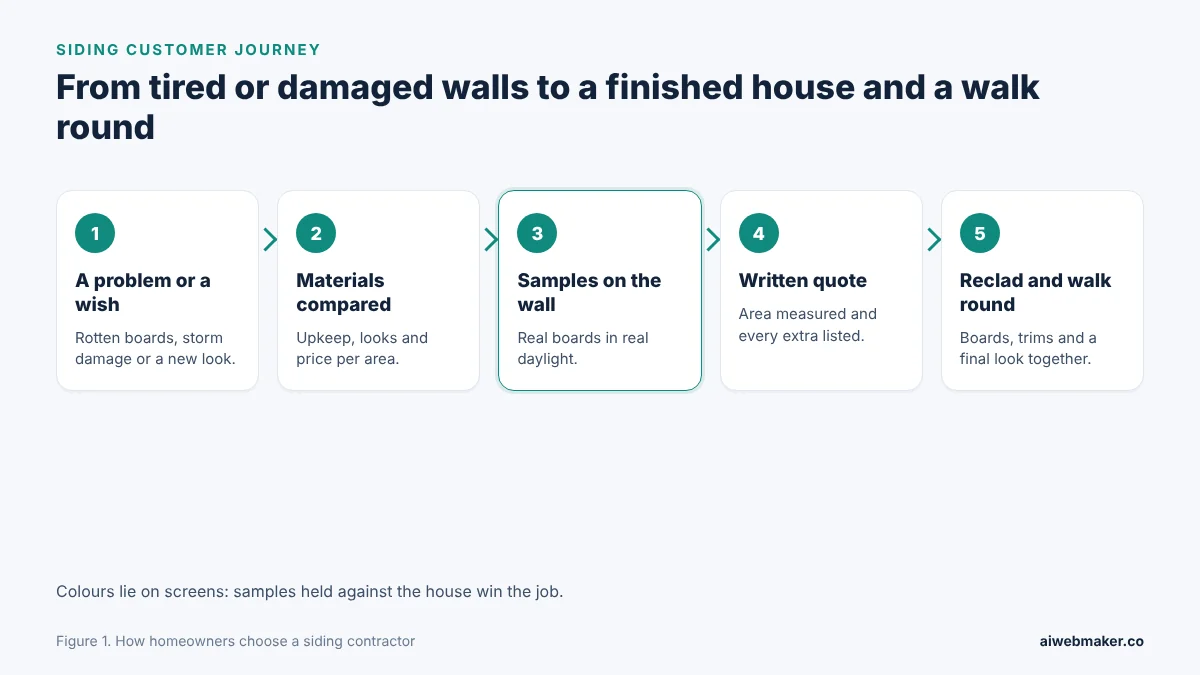
Five stages carry a homeowner from tired walls to a reclad house, and the sample visit sits at the heart of them. A problem or a wish to change the look begins the search. Photos and material comparisons online narrow the choice to two or three options. The highlighted step is seeing samples held against the actual walls, because colours shift in daylight and a small swatch on a screen rarely tells the truth. A written quote by area follows, then stripping, boarding and trims, finished with a walk round together. A contractor whose site leads naturally to that sample visit tends to win the job.
Material pages, colour samples and the rest of a siding contractor's site
Every material on a siding site earns separate space, since a homeowner drawn to cedar asks very different questions from one pricing vinyl. Repairs and board matching deserve a page of their own, as do soffits, fascias and trims. A comparison of materials, a colour sample section and a gallery of finished houses help the choice. A description of the sample visit and a quote request close the route. Each section should answer one question a homeowner would otherwise ask on the phone.
| Page or section | What the homeowner asks | What it should explain |
|---|---|---|
| Vinyl lap siding | Will it fade or crack? | Grades, colours, movement, cleaning |
| Timber cladding | How much upkeep? | Species, oiling or weathering, fixings |
| Fibre cement boards | Is it worth the price? | Durability, painted finish, fire rating |
| Shingles and shakes | Does it suit my house? | Look, coverage, exposure |
| Repairs and board matching | Can one board be replaced? | Matching faded colour, sourcing |
| Soffits, fascias and trims | What else gets done? | Ventilation, gutters, corner details |
| Colours and samples | What will it look like? | Swatches and a visit with real boards |
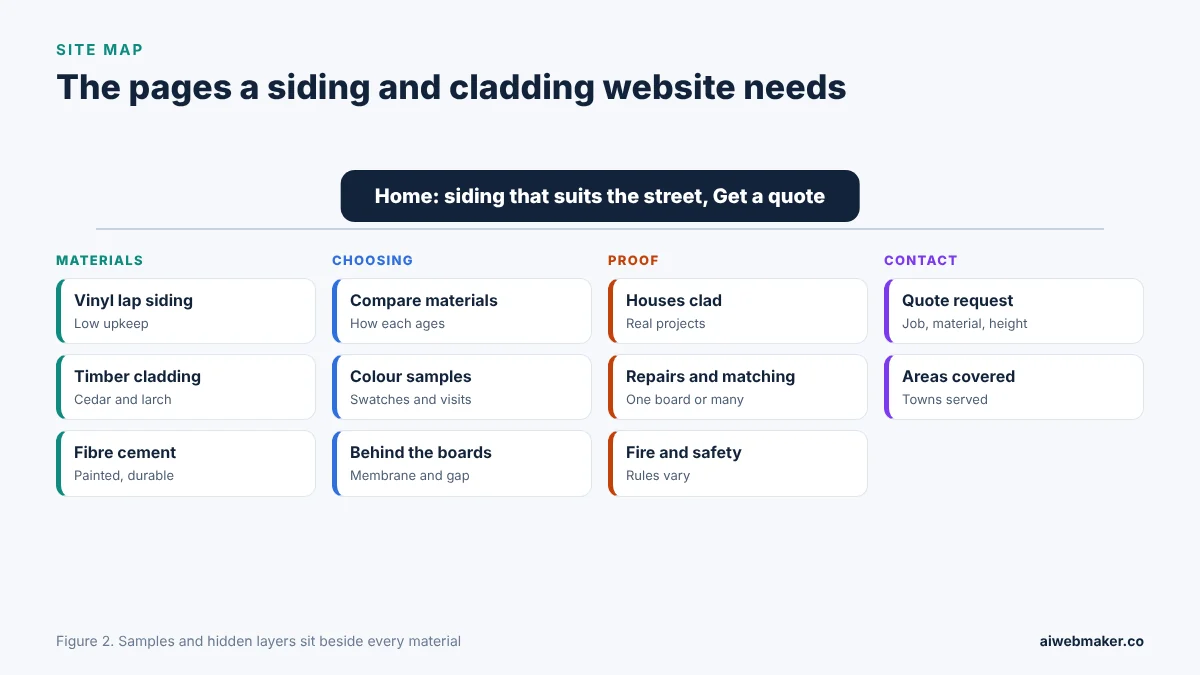
Following the homeowner's decisions, the site divides into materials, choosing, proof and contact. Material pages cover vinyl, timber and fibre cement, with shingles grouped alongside. Choosing pages compare upkeep, show colour samples and explain what lies behind the boards. Our sample contractor, Cladwell Siding and Exteriors, covers all of this in one long page with cards for vinyl lap siding, timber cladding, fibre cement boards, shingles and shakes, repairs and board matching, and soffits, fascias and trims. A material comparison, a set of colour samples running from Harbour Grey to Silvered Larch and a section on bringing boards to the walls come next. The cladding website example with colour samples and a sample visit closes with houses the firm has clad, the recladding steps, questions and a quote request.
Vinyl, timber, fibre cement and shingles over the years
The material decision is really a decision about the next twenty years of upkeep, so the comparison should focus on how each one ages. Vinyl needs little more than washing, but cheaper grades can fade or turn brittle in strong sun and cold snaps. Cedar and larch weather to a silver grey if left untreated, or keep their colour with regular oiling. Fibre cement holds paint well, resists rot and insects, and performs well in fire tests, though it is heavy and needs dust control when cut. Shingles and shakes give a textured, traditional look but take more time to install. A table setting these differences side by side helps homeowners choose with their eyes open.
| Material | Upkeep over the years | Where it works best | Points to mention |
|---|---|---|---|
| Vinyl | Washing, occasional board replacement | Budget projects, low upkeep | Fades in strong sun, moves with heat |
| Cedar or larch | Oil every few years, or weather to grey | Modern homes, extensions | Stainless fixings, fire rules |
| Fibre cement | Repaint every decade or so | Most houses and climates | Heavy, cutting dust controlled |
| Shingles and shakes | Inspect and replace singles | Gables, cottages | Slower to fit |
| Board and batten | Depends on the material | Barns, contemporary looks | Strong vertical lines |
Behind the boards: membranes, battens and a ventilated gap
Most cladding failures begin behind the boards, so a contractor who explains the hidden layers earns credibility quickly. A breathable membrane over the wall stops wind driven rain while letting moisture escape outwards. Vertical battens fixed over it create a ventilated gap, so any water that gets behind the boards can drain and dry. The boards themselves need the right fixings: vinyl is nailed loosely so it can expand and contract, while cedar needs stainless steel to avoid black stains. Insect mesh at the base and top of the gap stops nests without blocking airflow. Photos of these layers during stripping and fitting show homeowners the care they are paying for.
| Layer | What it does | What goes wrong when it is missed |
|---|---|---|
| Breathable membrane | Keeps rain out, lets vapour escape | Damp walls and rotting sheathing |
| Battens | Create a drained, ventilated gap | Trapped water behind the boards |
| Insect mesh | Keeps nests out of the gap | Blocked airflow, pests |
| Correct fixings | Hold boards while allowing movement | Buckled vinyl, stained timber |
| Trims and flashings | Seal openings and corners | Leaks around windows and doors |
Fire rules, building height and older cladding that may hide asbestos
Fire safety has become the first question many owners ask about cladding, and the website should answer it calmly and accurately. Rules on which materials may be used depend on the country, the height of the building, its use and how close it stands to a boundary. Taller residential buildings face much stricter limits on combustible materials in many places, and timber may be restricted near boundaries even on houses. The page can explain that the surveyor confirms what is permitted on each building during the sample visit. Older cement based sheets and some textured coatings may contain asbestos, so testing before removal is essential where the age of the building suggests it. Careful, accurate wording on fire and asbestos protects households and the contractor's reputation together.
Samples on the wall, quotes by area and a builder that drafts the cladding pages
Colours change dramatically between a phone screen, a printed swatch and a wall in afternoon light, which is why a sample visit is so persuasive. Holding real boards against the house lets the homeowner see the colour, texture and profile in their own street. The written quote should state the price per square metre or per square, the wall area measured and separate lines for stripping old cladding, scaffolding, trims and disposal. The AI website builder that drafts cladding pages with material cards and samples produces material cards, a comparison table and a quote request as soon as the contractor lists its materials in a brief paragraph, and revising that draft before launch costs nothing. Payment stages, if any, are best agreed directly in writing before work starts. A clear quote shows exactly how the total was reached.
Search phrases that lead homeowners to a siding contractor
Homeowners type siding installation, cladding repair, vinyl siding, fibre cement cladding, cedar cladding or soffits and fascias, often adding their town or suburb. The words change by country, with siding common in North America and cladding common in the United Kingdom and Australia, so a contractor can use both where it reads naturally. Each material page benefits from its own phrase near the top. On the map listing, finished house photos, the towns served and correct office hours matter most. Reviews mentioning colour matches, tidy scaffolding and careful trims help cautious buyers decide. Articles on how cedar weathers or why vinyl needs room to move answer questions homeowners ask on every sample visit.
Pages, domain and credits for a cladding contractor over twelve months
A cladding contractor's pages renew two charges each year, hosting and the domain, and twelve material guides from AI credits total about $7.80. Busy installers with a full order book pay least through the $119 yearly bill. A firm on its first few houses may prefer $19 a month. Adding colours, projects or new prices is not charged. Monthly and yearly payment share the next table, and a $189 row stands in purely as a benchmark.
| Item | Yearly | Monthly |
|---|---|---|
| Hosting the cladding pages | $119 | $228 over twelve months |
| Domain | Depends on the ending | Depends on the ending |
| Higher plan, for comparison | $189 a year | Not needed |
| Twelve siding and cladding articles at about $0.65 | About $7.80 | About $7.80 |
| Colour, project and price updates | No charge | No charge |
| Year before the domain | About $126.80 | About $235.80 |
Reasons a homeowner closes a cladding site unconvinced
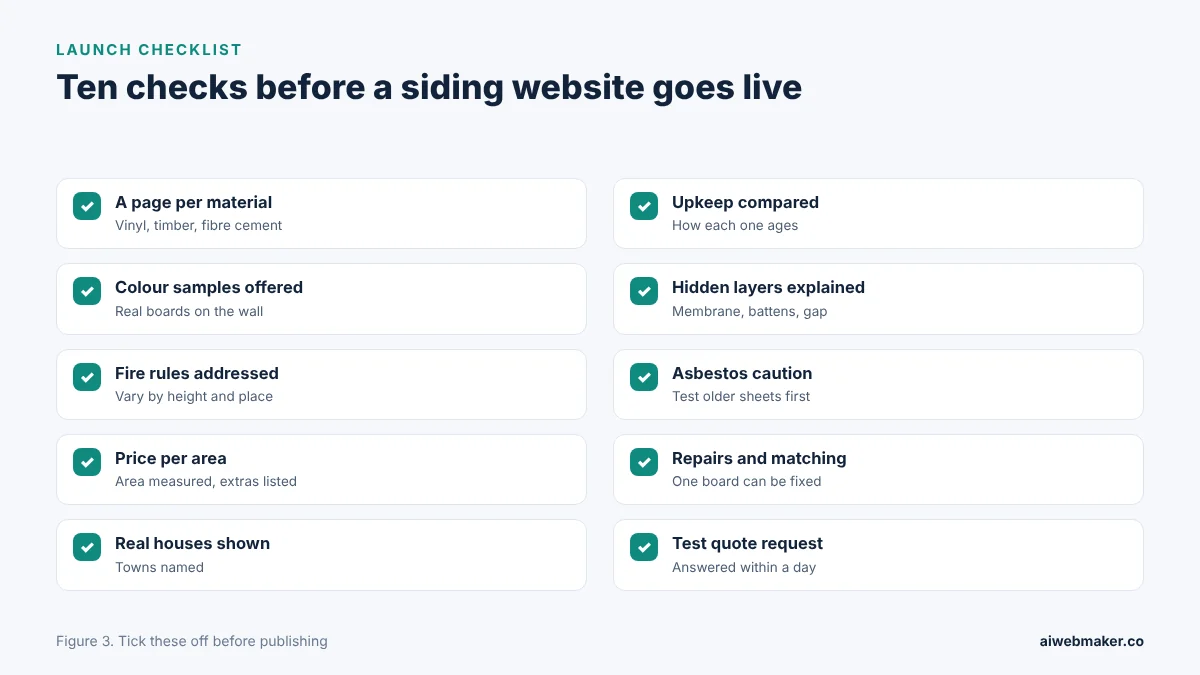
Homeowners leave a cladding website unconvinced when it shows colours only as tiny squares on a screen with no offer of real samples. A price given only as a total, with no area or extra lines, looks impossible to compare. Silence about fire rules leaves anyone who follows the news uneasy. No mention of what lies behind the boards suggests the firm simply nails new boards over old problems. A gallery of borrowed stock houses says nothing about the crew's own boards and trims. Each worry is matched by one of the ten checks pictured below.
Frequently asked questions
Is stripping the old boards always necessary?
Stripping old cladding is not always necessary, but it is usually the safer choice. New boards fixed over old ones can trap moisture, hide rot in the frame and make openings and trims awkward. Removing the old layer lets the contractor inspect the wall, renew the membrane and fix any damage before the new boards go on. Where old cladding is sound and the system allows it, overcladding may be possible, and the surveyor can explain the trade offs. Honest advice on this point prevents expensive problems later.
How is one storm damaged board matched?
Matching a single damaged board means finding the same profile, size and colour, which can be difficult after years of fading. Contractors often source boards from the same manufacturer and range where they are still made. If the colour has faded, a board can sometimes be taken from a hidden wall and the new one fitted there instead. Painted timber and fibre cement can be repainted to match more easily than vinyl. A photo of the damage and the house helps the contractor plan the repair.
What do fire rules mean for cladding a house?
Fire rules for cladding depend on the country, the height and use of the building and its distance from the boundary. Houses generally face fewer restrictions than tall residential blocks, but timber may be limited close to a neighbouring property in some places. A good contractor checks the rules for each building instead of assuming a single national standard covers it. Homeowners can ask which fire classification a product carries and how the system was tested. Clear answers on fire safety build trust quickly.
When is the best season for recladding?
Dry, mild weather suits most cladding work, because membranes, paint and timber all behave better when they are not soaked. Vinyl becomes more brittle in very cold weather and needs extra care when cut and fixed. Timber that arrives wet should be allowed to acclimatise before fitting. Many contractors book their busiest months well ahead, so homeowners are wise to arrange the sample visit early. Planning around the weather leads to a better finish.
Houses needed before the cladding pages pay their way
A modest repair to a few storm damaged boards usually takes in more than $119, which covers the cladding contractor's hosting for twelve months. Spread monthly, the $19 is lost inside the cost of a single trim. Every reclad house that starts with a sample visit booked online adds work the site helped secure. Real samples, frank comparisons of upkeep and calm words on fire safety win over cautious households more surely than slogans. Contractors who keep adding finished houses to the gallery show neighbours exactly what their street could look like. Quote requests that already name a material and a colour show the pages have done their teaching.
Build your website in Minutes and get the AI Tools that work
Start Building Your Website →