Carpet Installation Website Cost, Room Prices and the Underlay Beneath
A carpet fitter hosts its pages for a single $119 each year, or in twelve separate $19 payments, and registers a domain besides. From there: who books, the pages, room prices, sample visits, pile types, underlay, stairs and joins, fitting day, search and costs.
- No coding required
- Live in minutes
- Blog, SEO and chatbot tools included
A carpet fitter hosts its pages for a single $119 each year, or in twelve separate $19 payments, and the domain is registered on top. Pages can be drafted, previewed and redrafted without any invoice from AI Web Maker. One fitted bedroom earns more than that annual sum, and a staircase with a landing earns it several times. The challenge is that buyers see the carpet but never the underlay, gripper or fitting skill that decide how it feels and lasts. Many also fear the day itself, with furniture shifted, doors catching and old carpet to dispose of. This piece walks through who books, the pages, room prices, sample visits, pile types, underlay, stairs and joins, fitting day, search and the yearly budget.
This article is part of our complete guide: Home Services Website Builder.
New homes, worn stairs and quiet flats: who books a carpet fitter
Carpet fitters hear from people at turning points in a home's life rather than from browsers with time to spare. New homeowners want bedrooms and stairs carpeted before the furniture arrives. Families replace a worn staircase and landing that has gone bald in the middle of each tread. Flat owners often need acoustic underlay because their lease asks for quieter floors. Landlords want hard wearing carpet that survives tenants and cleans easily between lets. Each of them wants a fitted price for whole rooms, a chance to see samples in their own light and a fitting day that does not wreck the house.
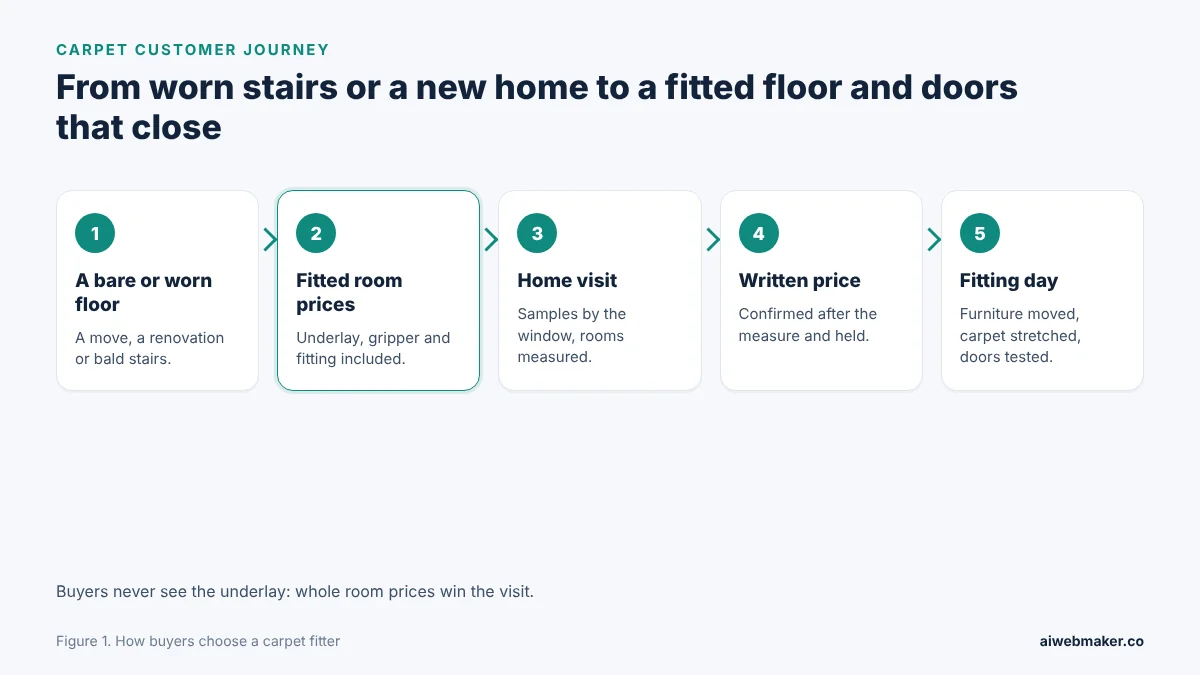
Following the five cards, a customer moves from a worn or bare floor to a fitted room with every door swinging clear of the pile again. It begins with a trigger, usually a move, a renovation or stairs that look tired. The highlighted card is the price check, where the buyer looks for a fitted room price that includes underlay, gripper and fitting rather than a vague rate per square metre. The home visit follows, with sample books laid by the window and every room measured. The written price and the fitting day complete the journey, and a fitter who moves the furniture and leaves no ripples earns the review.
Room prices, samples, underlay and fitting day: the pages a carpet fitter needs
A carpet fitter's pages should sell a finished floor rather than a roll of carpet, so the structure follows the job from price to fitting day. Fitted prices by room come first, with a note on what each includes. A section on the home visit explains why samples are chosen in the customer's own light. Pile types and underlay deserve sections of their own, because they decide comfort, noise and wear. Fitting day, furniture rules and doors that need trimming answer the questions every fitter hears on the phone. The request route asks which rooms need carpet and when a measuring visit would suit.
| Page or section | What the buyer asks | What it should state |
|---|---|---|
| Fitted prices by room | What will the bedroom cost? | Typical room sizes and what each price includes |
| The home visit | Can samples come to the house? | Sample books, measuring and floor checks |
| Pile types | Which carpet suits which room? | Twist, saxony, loop, wool blend and more |
| Underlay | Does underlay really matter? | Options by room, upgrade prices, heated floors |
| Fitting day | What happens to the furniture? | Steps, what is moved, what must be emptied |
| Stairs | How are stairs finished? | Firm underlay, nosings, runners |
| Measuring request | How does it start? | Rooms, timing and the area covered |
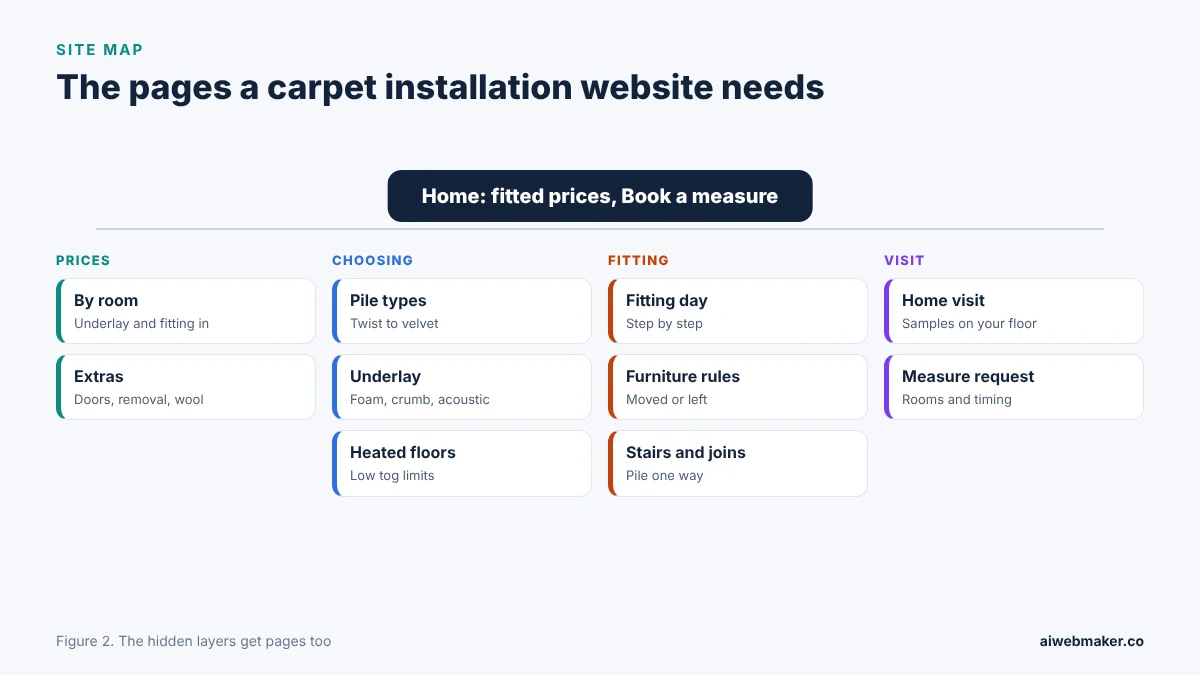
Organised by the buyer's decisions, a carpet fitter's site divides into prices, choosing, fitting and the visit. Price pages hold fitted room prices and the extras, while choosing pages cover pile types and underlay. Underlay Carpet Fitting, the sample firm, opens with fitted prices by room and a measuring visit that brings the samples to the customer's own floor, then shows what is in its sample books. Its underlay section lists PU foam at 10 mm, rubber crumb at 10 mm, acoustic underlay, low tog underlay for heated floors, deep foam at 12 mm, and gripper, bars and nosings. The carpet installation website example with sample books brought to the home continues from old carpet out to doors swinging again, says what the fitters move and what stays put, and closes with recent fits, questions and a request to book a measure.
Pricing whole rooms rather than square metres
A price per square metre means little to someone who has never measured a room, so fitted prices by room are far easier to trust. Carpet comes in fixed roll widths, commonly four or five metres in many countries, so a room's shape decides how much is cut and how much is wasted. Patterned carpets need extra length so the design lines up across joins. A room price can bundle the carpet, underlay, new gripper, door bars, fitting and moving the furniture, which matches how buyers think. Old carpet removal, door trimming and stair runners can then sit as clear extras. Confirming the exact figure in writing after the measure, and holding it for a stated period, completes the picture.
| Usually inside a fitted room price | Often priced as an extra |
|---|---|
| A mid range carpet from the sample books | Wool, wool blend and patterned carpets |
| Standard underlay | Upgraded underlay such as rubber crumb or acoustic |
| New gripper and a door bar | Doors trimmed to clear a thicker floor |
| Fitting by two fitters | Old carpet lifted and taken away |
| Moving beds, sofas and emptied wardrobes | Pianos, aquariums and safes, left to specialists |
Twist, saxony, loop or wool blend: matching pile to the room
Carpet buyers choose by colour first, so a fitter who explains pile types adds real value before the sample books open. Twist pile is hard wearing and forgiving, which makes it the everyday choice for living rooms and stairs. Saxony is long and soft for bedrooms, though it shows footprints. Loop pile has a flat, textured look but can snag with cats that claw. Wool blends bring natural warmth and spring, while polypropylene stands up to spills and scrubbing in busy homes and lets. Explaining these trade offs on the page means the home visit starts with a shortlist rather than forty books.
| Pile | Feel and look | Best rooms | Watch out for |
|---|---|---|---|
| Twist | Hard wearing, forgiving | Living rooms, stairs | Fewer luxurious finishes |
| Saxony | Long and soft | Bedrooms | Footprints and shading |
| Loop | Flat and textured | Studies, low traffic rooms | Snags from pets' claws |
| Wool blend | Warm, springy | Living rooms, bedrooms | Higher price |
| Polypropylene | Tough and easy to clean | Lets, busy family homes | Can flatten in walkways |
| Velvet | Short, dense, soft sheen | Quiet rooms | Shows marks and shading |
Underlay, the layer nobody sees and everyone feels
Underlay decides how soft a carpet feels, how quiet the room is and how long the pile lasts, yet most buyers treat it as padding. Foam underlay is springy and warm, suiting most bedrooms and living rooms. Rubber crumb is firmer and denser, holding up on stairs and landings where every foot lands in the same place. Acoustic underlay reduces footstep noise through the floor, which many flat leases require, so buyers should check the rating their lease asks for. Heated floors need low tog underlay, and the combined tog of carpet and underlay should stay within the heating maker's limit. A fitter who explains these choices earns trust that a cheaper quote cannot buy.
Stairs, joins and the direction of the pile
Stairs and joins are where a fitter's skill shows most, so they deserve their own section on the website. Each stair tread takes the hardest wear in the house, which is why firm underlay and a well fixed nosing matter. Stair runners, with bound edges and the wood showing at each side, need careful measuring and rods or clips placed evenly. Joins should be kept away from doorways and walkways, where they wear and lift first. Pile must run the same way across every piece, or neighbouring sections will look like different shades in daylight. Photos of finished stairs and invisible joins prove more about a fitter than any list of brands.
Fitting day: furniture, doors and the old carpet
Fitting day worries people more than the price, because their home will be upside down for a few hours. A clear sequence helps: small items cleared by the customer, furniture moved by the fitters, the old floor lifted and checked, gripper and underlay laid, then the carpet stretched, trimmed and finished with bars. The page should say what the fitters move, such as beds, sofas and emptied wardrobes, and what is left to specialists, such as pianos and safes. Doors may need trimming when the new carpet is thicker, and the price for that belongs on the page. Old carpet removal can be offered as an extra, or the old roll left behind if the customer wants it. The AI website builder for carpet fitters who bring samples to the home prepares the room prices, underlay and fitting day sections after the fitter describes its work and area in a few plain lines, and each draft can be reworked until it matches the way the firm fits.
Carpet fitters near me and the other phrases buyers search
People search for carpet fitters, carpet installation, carpet and underlay fitted or stair carpet fitting, almost always with a town. In North America installer is the more common word than fitter, so firms there should write it into headings. Searches for acoustic underlay or carpet for heated floors come from buyers with a specific problem, so each deserves a plain heading. The map listing should show the area served, measuring days and real photos of finished stairs and rooms. Reviews that mention furniture moved and doors that still close persuade buyers who fear fitting day. Articles on choosing underlay for stairs or carpet for a rented flat bring readers before they request a measure.
Twelve months of hosting for a carpet fitting firm
Year on year, a carpet fitter's website carries two repeating lines, the hosting and the domain, while twelve underlay and stair articles produced with credits total around $7.80. A fitter with a full diary pays least through a single $119 bill. A firm just starting can settle $19 each month while its first stairs are photographed. Updating room prices, underlay options or the area covered is never billed. As a contrast only, the table adds the $189 tier.
| Item | Yearly | Monthly |
|---|---|---|
| Hosting the carpet fitting pages | $119 | $228 over twelve months |
| Domain | Depends on the ending | Depends on the ending |
| Higher plan, for comparison | $189 a year | Not needed |
| Twelve underlay and stair articles at about $0.65 | About $7.80 | About $7.80 |
| Room price, underlay and area updates | No charge | No charge |
| Year before the domain | About $126.80 | About $235.80 |
Square metre rates and silence about furniture: why buyers ring another fitter
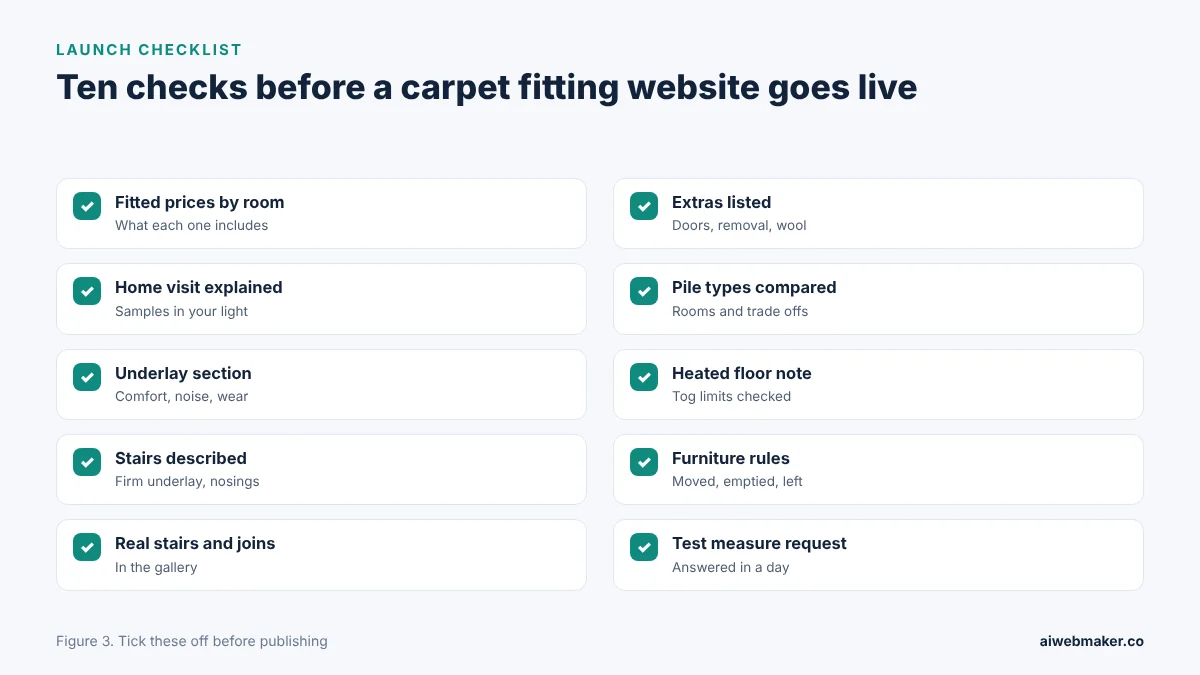
Buyers ring another fitter when a carpet site lists only a rate per square metre with no room prices to compare. No mention of underlay suggests the cheapest padding will go under the new carpet. Silence about furniture leaves people imagining a day spent emptying rooms themselves. Missing notes on doors and old carpet removal hint at extras on the invoice. Stock photos of perfect rooms say nothing about stairs, joins or the fitter's own work. Ten ways to close those gaps form the launch list placed here.
Frequently asked questions
How soon after the measure can carpet be fitted?
Fitting often happens within a couple of weeks of the measure, depending on whether the chosen carpet is in stock. Wool and patterned carpets can take longer to arrive from the maker. The fitter should confirm the date once the order is placed. Customers moving house can plan the measure around their completion date. Clear timing on the website helps buyers plan furniture deliveries.
Can a fitter lay carpet bought elsewhere?
Many fitters will lay carpet bought elsewhere, provided the size is right and the roll has no faults. Fitting only is usually priced per room, with underlay and gripper added if needed. The fitter should check the roll before cutting, since faults are hard to claim once fitted. A carpet bought without a measure may be too short, which causes problems on the day. Stating the fitting only policy avoids awkward calls.
Will the doors still close over new carpet?
A thicker carpet and underlay can catch the bottom of a door, especially where the old floor was thin. Fitters check every door on the day and trim any that drag. The price for trimming should be stated on the website. Fire doors may need extra care, since local rules can set gaps and seals. Mentioning this in advance prevents surprise on the invoice.
When can the room be walked on?
A newly fitted carpet can usually be walked on straight away. Heavy furniture should stay off any glued joins for a few hours. Some loose fibres appear in the first weeks, and regular vacuuming clears them. Furniture feet can leave dents that recover over time. Simple aftercare notes on the website reassure buyers after the fitters leave.
One fitted bedroom, and the hosting year is behind the fitter
A single fitted bedroom usually earns more than a carpet fitter's whole $119 hosting year. Spread across months, $19 is less than the gripper and door bar for one room. Every staircase, landing and hall that follows adds work the pages helped win. Room prices, honest underlay advice and clear furniture rules persuade buyers more than any discount banner. Fitters who post their own stairs and joins show the craft hidden under every carpet. Measuring requests that already list the rooms and the preferred underlay show that buyers have used the pages properly.
Build your website in Minutes and get the AI Tools that work
Start Building Your Website →