Blinds Company Website Cost and the Path From Browser to Home Measure
Blinds, shutter and curtain fitters host an AI Web Maker site for $119 every year, or $19 each month, plus a domain. This guide explains how to present products room by room, fabrics and light control, motorised options, child safety, samples, the home measure, fitting, pricing and the first year budget.
- No coding required
- Live in minutes
- Blog, SEO and chatbot tools included
Window covering firms spend $119 a year hosting their shutter and blind pages, or $19 a month if a fitter prefers monthly billing, with a domain bought on top. Building and reviewing the blinds pages in the AI Web Maker preview costs nothing. For a firm that measures and fits made to measure products, that bill is covered by a single room, yet the website has a bigger job than its price suggests. That bigger job is visible on the blinds and curtains company website that AI Web Maker put together for a fitter who is purely fictional, a complete sample taking shoppers from measure to fit. Shoppers browse window coverings for weeks, comparing styles, fabrics and prices online before they let anyone into their home to measure. They want to see products in rooms like their own, understand light control and privacy, and feel sure the fitter will not pressure them during the visit. This guide explains how a blinds website can carry a shopper from first idea to a booked home measure.
How do people shop for blinds and shutters online?
Blinds shopping starts with a room and a problem: a bedroom too bright at dawn, a bathroom needing privacy, a lounge that overheats. They then look at styles that solve that problem, comparing how each one looks, how much light it blocks and how easy it is to clean. Price comes next, usually as a rough comparison between products rather than an exact figure. Only after that do they look for a firm to measure and fit, judging it by photos of real installations, reviews and how easy the visit is to arrange. Families with young children add safety to the list, and renters often look for easy fitting options. A website that follows this sequence feels helpful rather than pushy.
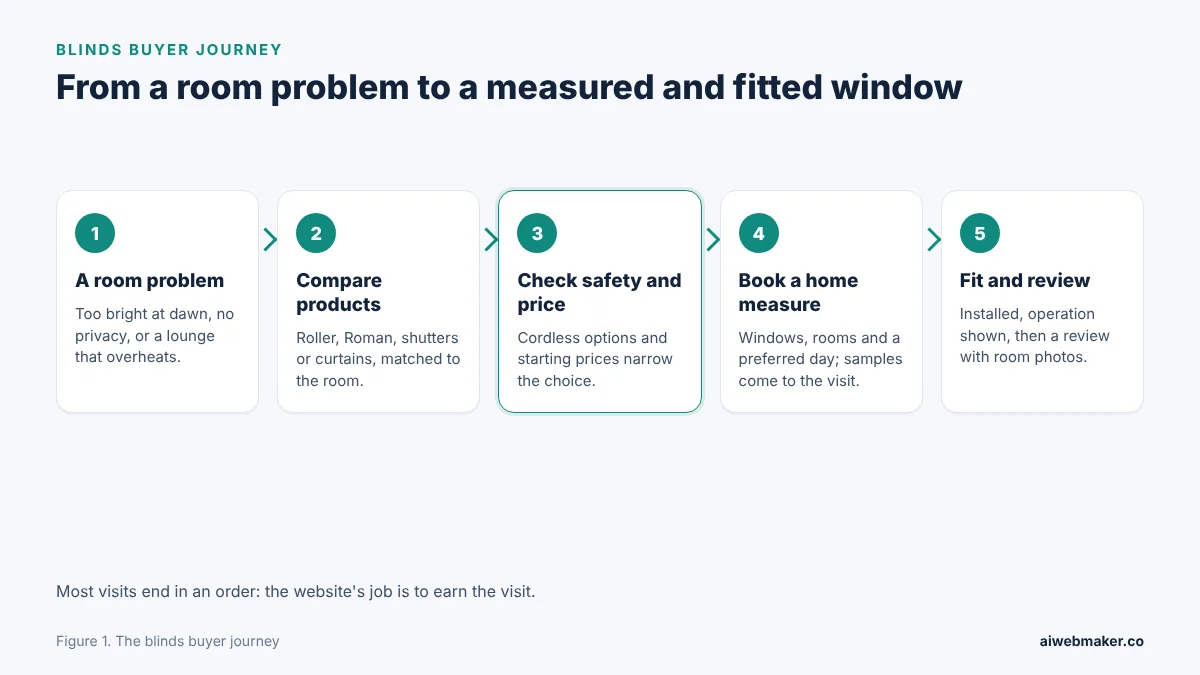
The journey shows that the room is the real starting point. Firms that organise their sites only by product type make visitors work out the answer themselves. A section that starts from rooms and problems, then points to suitable products, matches how buyers think. The home measure is the turning point, because once a fitter is in the house with samples, most visits end in an order. Everything before that step should build confidence; everything after it should deliver on the promise. Reviews collected after fitting feed the next buyer's research.
Which products should a blinds website present, and how?
A blinds website should present each product with photos in real rooms, the rooms it suits best, the light control it offers and how it is operated and cleaned. Shoppers search for products by name, so roller blinds, Roman blinds, Venetian blinds, vertical blinds, pleated blinds, shutters and curtains each deserve a clear section. Every section can show fabrics or finishes, the operating options and any limits, such as windows that are too shallow for certain fittings. Photos taken in clients' homes, with permission, are more convincing than catalogue images. A comparison table helps visitors narrow the choice before they look closely at any one product.
| Product | Rooms it suits | Light and privacy | Points to explain |
|---|---|---|---|
| Roller blinds | Kitchens, bedrooms, offices | From sheer to full blackout fabrics | Fabric choice, cassette or open roll, operation |
| Roman blinds | Living rooms, bedrooms | Soft folds, lined or blackout | Fabric weight, lining, stacking height |
| Venetian blinds | Kitchens, bathrooms, offices | Angle slats for light and privacy | Aluminium or wood, cleaning |
| Vertical blinds | Large windows and patio doors | Rotate slats to control light | Stack direction, fabric or rigid slats |
| Pleated blinds | Conservatories, unusual shapes | Many fabrics, including thermal | Top down and bottom up options |
| Shutters | Front rooms, bay windows, bedrooms | Louvres tilt for light and privacy | Materials, panel styles, lead time |
| Curtains | Bedrooms, living rooms | Lined, thermal or blackout | Tracks and poles, heading styles, fullness |
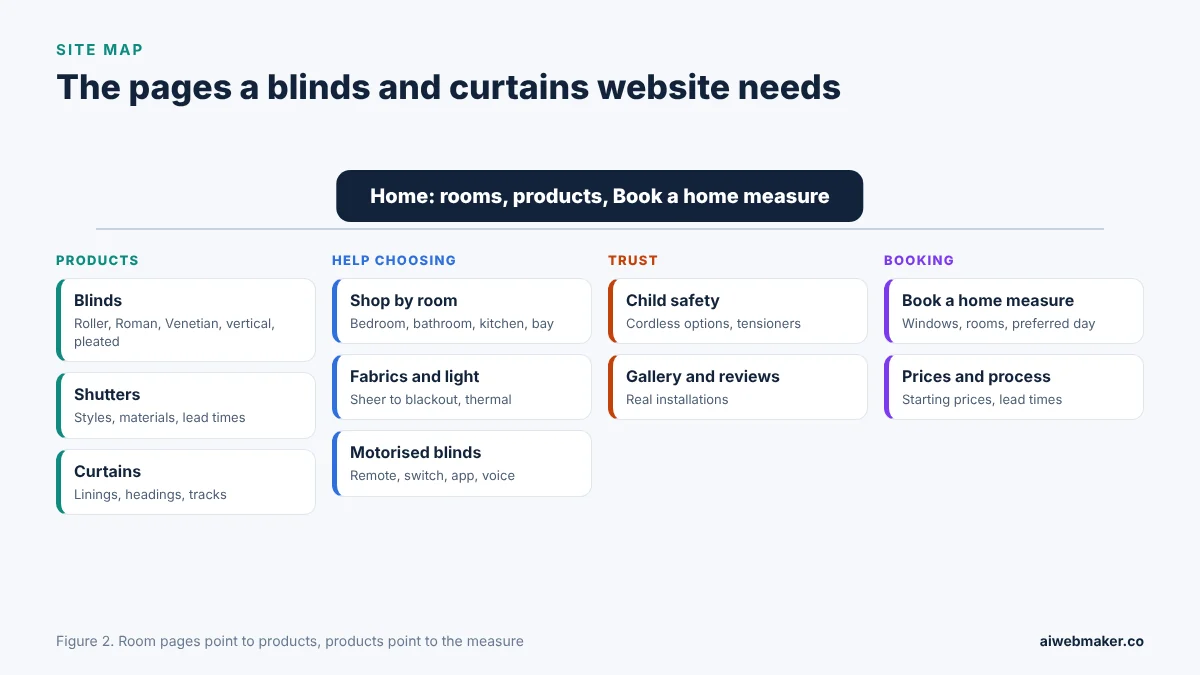
Grouping a window covering site into products, help choosing, trust and booking mirrors the order in which most buyers make up their minds. Product pages for blinds, shutters and curtains answer the first question of what the business actually sells. Shopping by room, fabric and light control comes next, because buyers think about a nursery or a bright office before a slat width. Child safety and a gallery of fitted windows reassure parents and landlords alike. The home measure page, with prices and the process, then turns a browser into an appointment. A visitor who lands on any page can reach the measure request in a single tap.
How should fabrics and light control be explained?
Fabrics and light control should be explained in plain terms, because shoppers often confuse dim out with blackout or do not realise that lining changes both light and warmth. Sheer and translucent fabrics soften light while keeping the view, which suits living spaces. Dim out fabrics reduce light significantly, while blackout fabrics block most of it and suit bedrooms and nurseries. Thermal or insulating fabrics help keep rooms warmer in winter and cooler in summer. Moisture resistant materials suit bathrooms and kitchens. A short glossary on the products page prevents disappointment when the blind is installed.
| Fabric type | What it does | Where it works best |
|---|---|---|
| Sheer or voile | Softens light, keeps the view | Living rooms, behind curtains |
| Translucent | Diffuses light with some privacy | Kitchens, home offices |
| Dim out | Reduces light considerably | Living rooms, guest rooms |
| Blackout | Blocks most light | Bedrooms, nurseries, media rooms |
| Thermal | Helps hold warmth and reflect heat | Bedrooms, sunny rooms, conservatories |
| Moisture resistant | Copes with steam and splashes | Bathrooms, kitchens |
Samples bridge the gap between a photo and a real window. The site can explain how samples are seen, such as during the home measure, by post or at a showroom with opening hours. Customers can describe their windows and the colours they like in the request, so the fitter brings a suitable selection. A note on how colours look different in morning and evening light shows expertise. Clear fabric guidance reduces returns and remakes. It also makes the home visit shorter and more focused.
How should motorised blinds be presented?
Motorised blinds should be presented by what they make easier, such as reaching high windows, opening several blinds at once or setting blinds to close in the evening. Buyers care less about motor specifications than about how they will control the blinds day to day. The page can explain the main options, such as remote controls, wall switches, phone apps and voice assistants, and whether battery or wired power is used. Notes on battery charging, quiet operation and what happens during a power cut answer frequent questions. Motorisation also removes cords entirely, which matters to families with young children. A dedicated page lets buyers who want automation find it quickly.
What child safety information belongs on a blinds website?
Child safety information belongs on every blinds website because looped cords and chains can strangle young children, and responsible fitters explain how they remove that risk. The United States Consumer Product Safety Commission advises, in its window covering safety guidance, that cordless window coverings are the safest choice in homes with young children. A clear safety section can describe cordless and motorised options, cord tensioners, safe installation heights and keeping furniture away from windows. Fitters can explain that they check existing blinds during a home visit and advise on replacements. Parents shopping for nurseries and children's rooms look for exactly this information. Safety guidance shown plainly builds trust with families.
A short link to the safety notes from every product page keeps them in view when parents are choosing. Products that are cordless by design can be marked as such in the product comparison. Fitters who follow the standards that apply where they work can say so without overstating. A short note encouraging parents to check older blinds in the home adds genuine value. Firms that take safety seriously are remembered and recommended. It is a small page that carries a great deal of weight.
How should the home measure and fitting be described?
Describe the home measure and fitting step by step, so buyers know the visit length, what happens and that ordering is optional. A typical visit includes measuring each window, discussing light, privacy and style, showing samples and leaving a written quote. Once an order is placed, the website should state typical lead times for each product, because made to measure blinds and especially shutters take time to manufacture. Fitting day can be explained too, including how long it usually takes per window and how the fitter leaves the room. A firm that describes the whole process honestly sets itself apart from high pressure sellers. Calm, clear steps are what persuade cautious buyers to invite someone into their home.
| Step | What happens | What to tell buyers |
|---|---|---|
| Measure request | Rooms, number of windows, preferred day | No obligation to order |
| Home visit | Measuring, samples, advice, written quote | How long the visit usually takes |
| Order | Fabrics and options confirmed | Lead time for each product type |
| Manufacture | Made to measure in the workshop | Shutters often take longer than blinds |
| Fitting | Installation, operation shown, care advice | Typical time per window, tidy finish |
| Aftercare | Adjustments and warranty | Who to contact and how |
How should a measure request be handled online?
A home measure works best as a short request naming how many windows need covering, which rooms they sit in and a preferred day. The firm confirms the visit or suggests another time, so the fitters can plan their routes sensibly across the area. The AI website builder that blinds and curtain fitters use for measure requests sets this form up beside the product and room pages, all editable. Replying quickly matters, because buyers often book two or three visits in the same week. A short confirmation that states the visit window, the expected length and what to have ready makes the firm look organised. A smooth start often decides who wins the order.
How should prices be shown for made to measure products?
Prices for made to measure products should be shown as starting points for a typical window size, with a clear explanation of what increases the figure. Buyers need a sense of whether roller blinds or shutters fit their budget before they book a visit. Fabric grade, window size, motorisation, special shapes and the number of windows all change the price. Some firms offer whole house discounts, which can be mentioned on the pricing page. Mentioning that motorisation and premium fabrics raise the figure prevents surprises at the quote. Honest starting points attract buyers who are ready to proceed.
How do window covering firms get found in search?
Buyers search for terms like blackout blinds, plantation shutters or bathroom blinds plus their area, and the pages should echo them. Each main product page or section should use its name in the heading and the first lines. A Google Business Profile showing installation photos, with details that match the website, helps the firm appear in map results. Reviews that mention the product and the room are especially useful. Articles answering common questions, such as how to choose blinds for a bay window or whether shutters keep a room warm, attract buyers in the research phase. Patient, specific content builds a steady flow of measure requests.
What does a blinds company website cost across a year?
Across a year, a blinds company pays its hosting, its domain and, if it chooses, a few dollars of article credits. Yearly billing is the cheaper route for an established firm, while monthly billing lets a new fitter begin without a large payment. Adding products, fabrics, photos and price changes carries no extra fee. For completeness, the $189 tier appears in the table too. The totals are small next to a single fitted room.
| Item | Yearly billing | Monthly billing |
|---|---|---|
| Hosting the firm's site | $119 | $228 over the year |
| Domain | Depends on the ending | Depends on the ending |
| Higher yearly plan, for comparison | $189 | Not needed |
| Room by room guides, twelve at about $0.65 | About $7.80 | About $7.80 |
| New products, fabrics, prices | Included | Included |
| Total before the domain | About $126.80 | About $235.80 |
Which mistakes stop blinds websites producing measure requests?
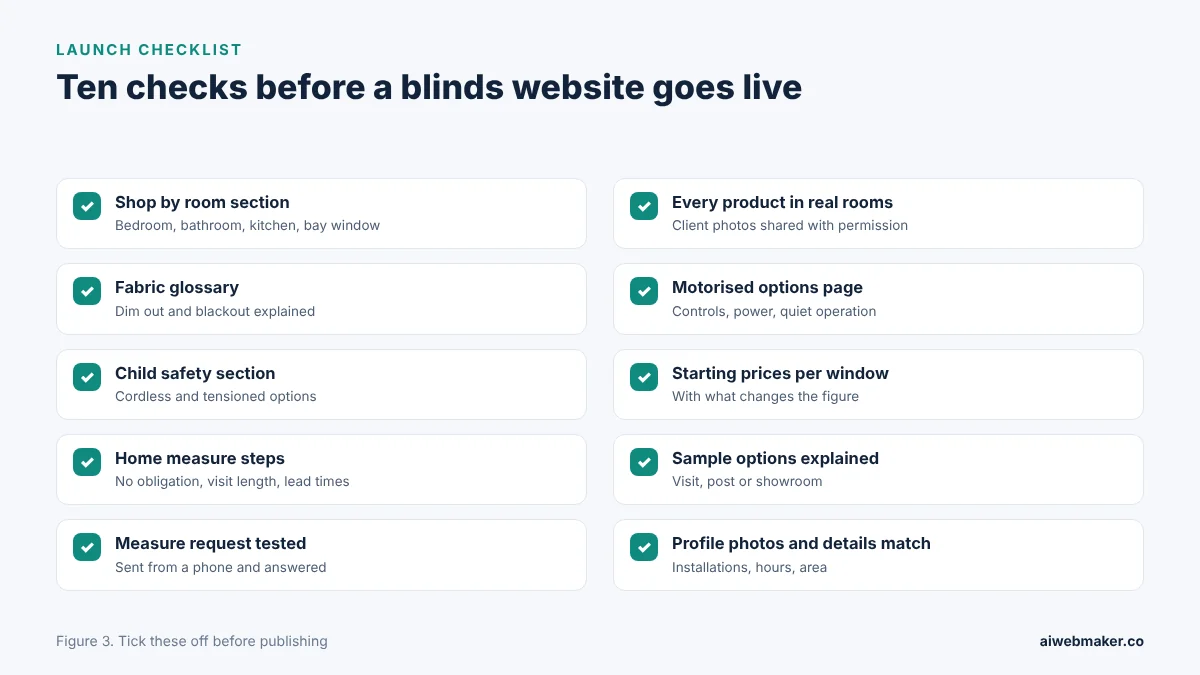
The mistake that costs the most is a site organised only by product names, which leaves buyers to work out which product suits which room. Missing prices push buyers toward firms that give at least a starting figure. A thin gallery of catalogue images, with no real installations, makes the firm look like a reseller rather than a fitter. Ignoring child safety loses the trust of parents, who are a large share of buyers. A measure request that asks too many questions, or replies that come days later, wastes the interest built by every other page. The pictured list turns these lessons into ten checks.
Frequently asked questions
Should prices per window appear before the home measure?
Starting prices per window help buyers decide whether to book a visit, and they filter out enquiries far below the firm's range. The page should state the window size the starting price assumes and list what changes it. A note that the written quote after measuring is the final figure keeps expectations clear. Firms that prefer not to publish prices can at least show price bands by product type. Some indication of cost is better than none.
Can customers see fabric samples before the visit?
Customers can usually see samples during the home visit, and some firms also post samples or welcome visitors to a showroom. The website should explain whichever options the firm offers, with showroom hours if there is one. Asking customers to mention preferred colours in their request helps the fitter bring a relevant selection. Seeing fabric in the room's own light is the best way to choose. Easy access to samples speeds up the decision.
How long do made to measure blinds and shutters take?
Lead times vary by product and supplier, with many blinds arriving within a few weeks and shutters often taking longer. The website should state the firm's typical lead times and update them in busy seasons. Buyers furnishing a new home or preparing for an event need this information early. A note that the exact date is confirmed when the order is placed sets fair expectations. Honest timing prevents frustration later.
Do blinds fitters work on commercial premises too?
Many fitters also equip offices, clinics, schools and shops, and a separate commercial section helps those buyers find them. Commercial clients care about durability, fire rated fabrics where required, consistent appearance across many windows and fitting outside working hours. The page can mention the kinds of premises the firm has fitted and how quotes are arranged. Commercial work smooths out seasonal dips in domestic orders. A clear commercial page opens a second stream of enquiries.
How many fitted rooms pay for the website?
One fitted room of shutters likely earns more than a full year's $119 hosting, and a small repair covers a month at $19. Every measured home after that is an opportunity the website helped create. Each review and installation photo makes the next buyer more confident about inviting the firm in. Window fitters curious how neighbouring trades lay out their pages will find them in the home services website builder for window fitters and trades section. Fitters who organise their sites by room, explain fabrics clearly and treat child safety seriously win the most visits. A full diary of home measures is what the yearly fee delivers.
Build your website in Minutes and get the AI Tools that work
Start Building Your Website →