Tractor Hire Website Cost, Day Rates and the Operator Question
A machinery yard's hosting is $119 for the year or $19 by the month, and a domain is added. Inside: hirers, the pages, machine cards, rate drivers, operators and self drive, servicing and safety, requests, search and the budget.
- No coding required
- Live in minutes
- Blog, SEO and chatbot tools included
Twelve months of hosting for a machinery yard's website come to $119 on AI Web Maker, with $19 as the monthly alternative, and the domain is added by its ending. Machine cards, the rate guide and the request page can be assembled and road tested in preview, a stage for which AI Web Maker raises no fee. One day of a mid sized tractor on hire outearns the year's hosting, so the cost hardly registers in a harvest season. The real challenge is pricing, because farms need machines at the same moments, delivery distances vary widely, and the choice between an operator and self drive raises questions about licences, insurance and safety. Hirers want a clear rate, a firm date and a machine that will not break down in the middle of a field. Ahead come the hirers, the page list, machine and implement cards, what moves the rate, operators and self drive, servicing and safety, requests, search and the yearly sums.
This article is part of our complete guide: Food Business Website Builder.
Farmers in a hurry, contractors and smallholders: who hires a tractor
Tractor hire customers range from large farms short of a machine at harvest to smallholders who need a compact tractor for a weekend. Arable farms look for ploughs, drills and combines in narrow seasonal windows, often booking weeks ahead. Livestock and mixed farms hire for silage, muck spreading or haulage, sometimes at short notice after a breakdown. Smallholders, orchards and equestrian yards want compact machines that fit narrow gates, usually with an operator or a careful handover. Contractors fill gaps in their own fleet and care about specification, availability and delivery time. A site that lets each hirer see the right machine, the rate and the availability quickly wins the booking before a rival yard answers the phone.
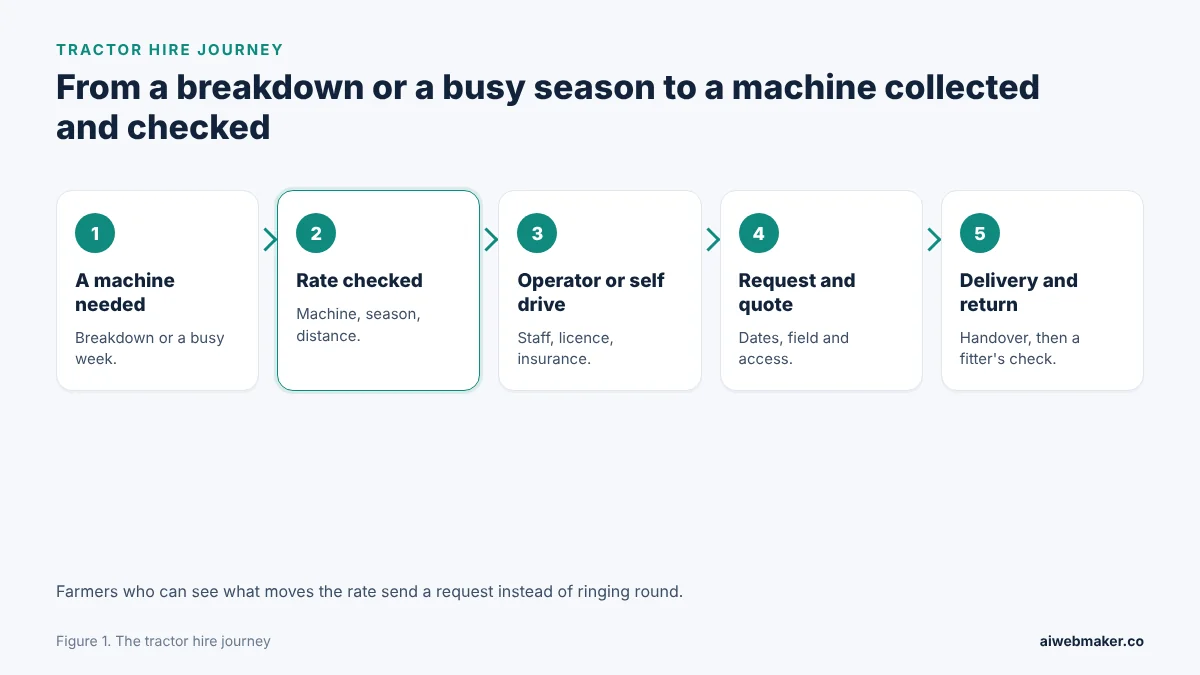
A breakdown or a busy planting week starts the chain on the left, and a machine collected and checked by a fitter ends it on the right. The second box carries the highlight, the rate check, because hirers need to see what the machine, the season and the distance will add before they ask. Choosing between an operator and self drive follows, shaped by the hirer's own staff and experience. The request with dates and the field location leads to a quote and then delivery on the low loader. A smooth handover and a machine that works all day earn the repeat booking next season. Every page should shorten one link in that chain.
Tractors, implements, rates and operators: the page list for a machinery yard
Five kinds of page carry a machinery hire site: machine cards, implements, a rate guide, operators and a request route. Each should suit a busy farmer reading on a phone in the yard. Tractor cards give horsepower, typical work and the day rate. Implement cards show what each tool does and what tractor it needs. The rate guide explains why prices change through the year and with distance. Pages on operators, servicing and the hire steps answer the questions that otherwise slow every booking. A tight set of pages like this keeps the phone line open for the calls that matter.
| Page | Hirer question | What it should show |
|---|---|---|
| Tractors | Which machine for this job | Horsepower, typical work, day rate, key features |
| Implements | What can go behind it | Width, tractor power needed, set up included |
| Rate guide | Why this price | Machine, season, distance, operator, fuel |
| Operators | Who drives | Trained operators, self drive rules, work done for you |
| Servicing | Will it break down | Checks between hires, handover, breakdown help |
| Hire request | How to book | Machine, dates, operator choice, field, job size |
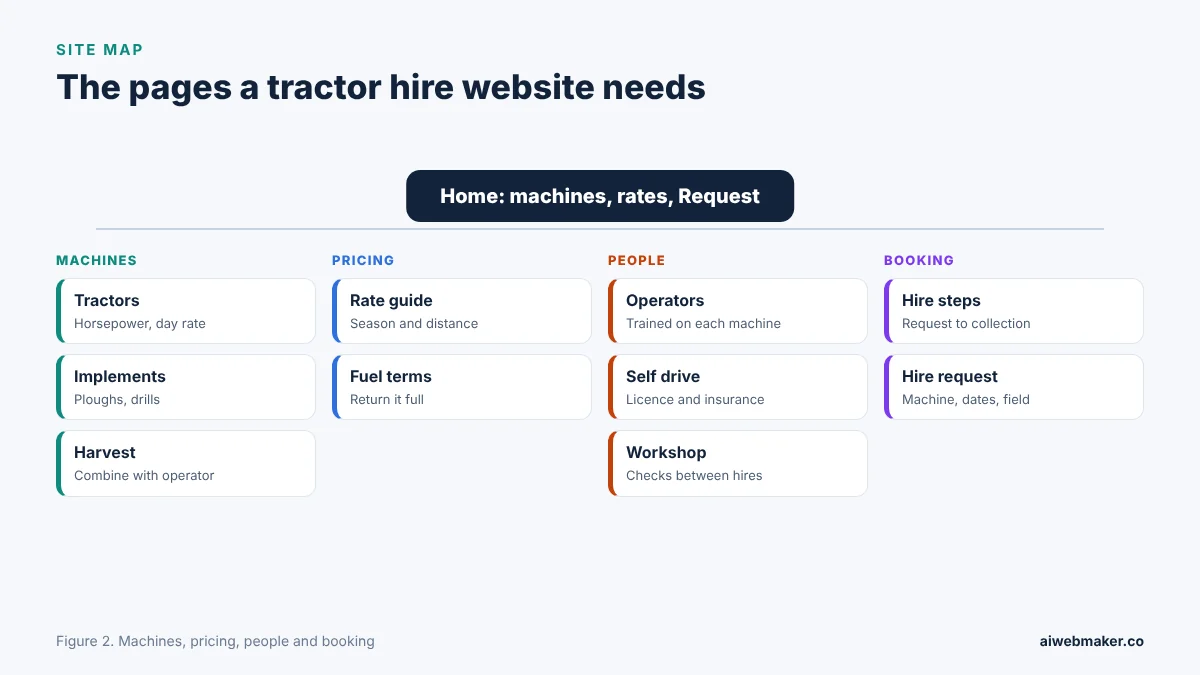
Fanning out from a home page with machines, rates and a request button, the yard's pages divide into machines, pricing, people and booking. Our sample, Furrow Plant and Tractor Hire, lists a compact tractor, a mid range tractor and a large tractor by the day, then a reversible plough, a power harrow and drill, a row crop planter and a combine with operator. A rate guide follows, explaining how the machine, the season, the distance, an operator and fuel each move the price. Sections on the workshop and on three ways to hire, with one of the yard's operators, self drive hire or work done for you, lead into four hire steps, photos and reviews. The tractor hire website example with trained operators and peak week rates finishes with six common questions and a request that captures the machine, the first and last day and where the field lies. Most hire yards can follow the same order, since it matches the questions a farmer asks before agreeing a hire.
Machine cards a farmer can compare in the yard
Machine cards should let a farmer match a tractor to a job without phoning, so each needs horsepower, typical work, the day rate and the features that matter. Compact tractors suit orchards, paddocks and yards, mid range tractors handle ploughing, drilling and haulage, and large tractors take on heavy cultivation. Features such as a front loader, front linkage, air brakes for heavy trailers, satellite guided steering or low pressure tyres change which jobs a machine can do. Implement cards should state the working width, the tractor power needed and whether the yard sets it up for the soil or the seed before delivery. Harvest machines, which often go out only with the yard's operator, should say so on the card. Cards built this way turn a vague call into a precise request.
| Machine | Typical work | Details for the card |
|---|---|---|
| Compact tractor | Orchards, paddocks, yards | Horsepower, loader, tyres, gate width |
| Mid range tractor | Ploughing, drilling, haulage | Horsepower, linkage, brakes, ballast |
| Large tractor | Heavy cultivation | Horsepower, guidance, tyres, cab |
| Plough or drill | Seedbeds and sowing | Width, power needed, set up before delivery |
| Combine | Harvest | Header width, operator included, fuel terms |
What moves the day rate: season, distance, operator and fuel
Farmers accept higher prices more readily when they can see why a day costs more, so a rate guide should break each quote into its parts. The machine sets the base day rate, since bigger tractors and harvest machines cost more to own, insure and run. Planting and harvest weeks book out first and often carry a seasonal premium, which should be stated as a rule rather than a surprise. Delivery by low loader adds cost beyond a set distance, and an operator adds a daily charge. Fuel terms, such as returning the machine full or paying for fuel at cost, prevent arguments at collection. A transparent rate guide makes every quote easy to check and hard to dispute.
| Rate driver | Why it matters | How to show it |
|---|---|---|
| The machine | Size and running costs | Day rate on each card |
| The season | Everyone needs machines at once | Peak weeks and the premium |
| Distance | Lorry, driver and time | Distance included, then a rate per km |
| Operator | Skilled labour and care | Daily operator charge |
| Fuel | Long days use a lot | Return full, or charged at cost |
Trained operators, self drive hire and work done for you
Offering an operator, self drive hire or contracting by the hectare lets one yard serve very different farms, and each option needs its own rules. Operators should be described as trained on the machines they drive, with field experience, because that is what a farmer pays for. Self drive hire needs clear conditions: the licence the hirer's country requires, proof of insurance and a handover before the first run. Tractor licensing, insurance and road law are national matters, so the page should commit to checking each hirer's position instead of quoting a single rule. Work done for you, priced by area, suits farms that want the job finished without managing a machine. Clear choices let each farm pick the arrangement that fits its people and its risk.
Workshop checks, shaft guards and the handover walk round
Hirers fear a breakdown in the middle of a field more than a high price, so servicing deserves a page of its own. Describing the checks a fitter carries out between hires, such as oil, filters, tyres, brakes, lights and hitches, shows the machine is looked after. Power take off shafts and their guards are a serious safety point on any farm, and stating that guards and warning signs are inspected every time reassures careful hirers. A walk round at handover, with a signed checklist travelling with the machine, sets clear expectations for both sides. The page should explain what happens if a machine breaks down, who to call and whether lost days are charged. Visible care in the workshop is what turns a one off hire into a regular account.
Hire requests, quotes and the low loader
A request should collect the machine, operator or self drive, the first and last day, the field location, the size of the job and any notes on access. Access details matter, because a low loader needs room to turn and unload, and soft ground or narrow lanes change the plan. The AI website builder that machinery yards use for machine cards and hire requests drafts these pages once the yard lists its machines, rates and area in a few lines. Each request arrives at the hire desk, which can confirm it with a quote, propose different dates or a substitute machine, or turn it down when the fleet is out. Invoices, deposits for harvest bookings and payment are handled between the yard and the farm directly, and the platform keeps nothing from the hire fee. Because nothing is confirmed until the desk replies, the yard keeps control of its busiest weeks.
Tractor hire near me, combine with driver: how machinery searches begin
Farmers search for phrases such as tractor hire near me, plough hire, combine harvester hire with driver, compact tractor rental or contract ploughing, usually with a county or district. Machine and implement pages whose titles carry those words, along with the area served, meet those searches. A map listing with yard hours, the delivery radius and photos of machines in fields helps farmers judge whether the yard can reach them. Reviews that mention punctual delivery, a quote that matched the bill and an operator who knew the machine weigh heavily. Seasonal articles on preparing for harvest, choosing a drill or working safely around power take off shafts bring readers before the rush. A yard that writes through the year becomes the name farmers recall when a machine fails.
A machinery yard's website bill beside one hire day
Website spending at a hire yard comes to hosting, the domain and some credit for articles. Yards working all year usually pay annually, the cheaper of the two routes over a full year. A new yard testing demand through its first harvest may pay monthly. New machines, revised day rates and a wider delivery area can be added with no extra charge. Both totals appear next, along with a single row for the $189 tier.
| Item | Yearly | Monthly |
|---|---|---|
| Hosting the tractor hire pages | $119 | $228 over twelve months |
| Domain | Depends on the ending | Depends on the ending |
| Higher plan, for comparison | $189 a year | Not needed |
| Twelve seasonal machinery articles at about $0.65 | About $7.80 | About $7.80 |
| New machines, rates and delivery areas | No charge | No charge |
| Year before the domain | About $126.80 | About $235.80 |
Why a farmer rings another yard instead
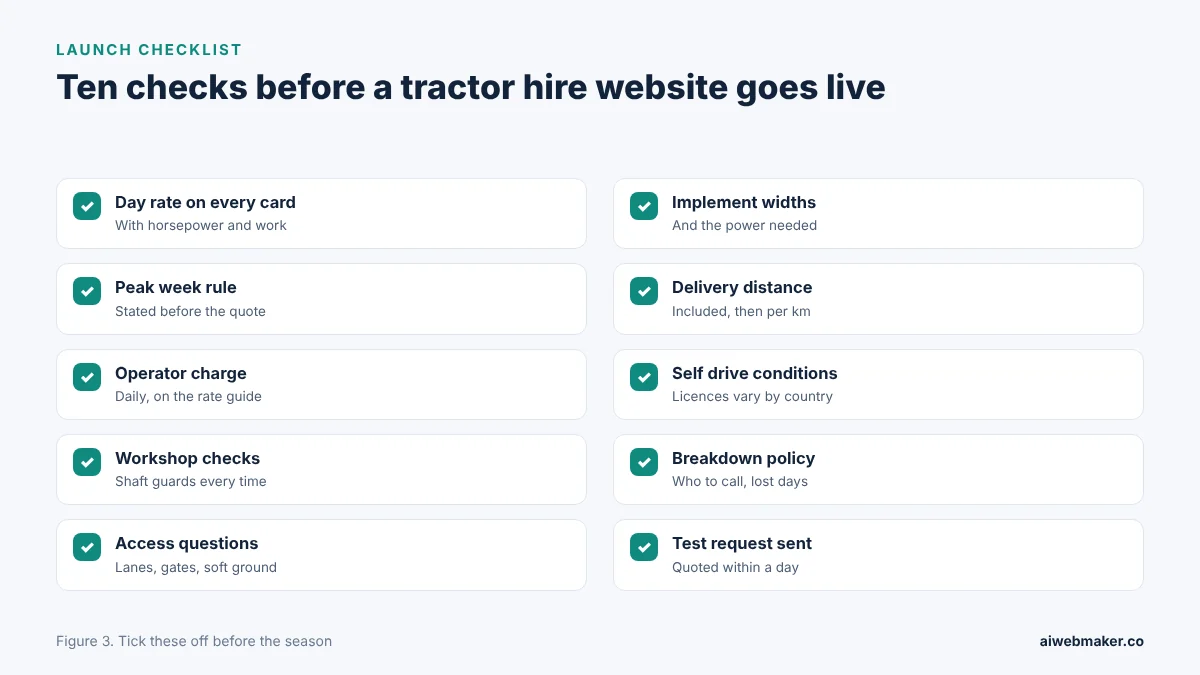
Farmers ring another yard when the site shows machines without day rates. A rate with no word on peak weeks or delivery distance feels like a trap. No mention of operators, licences or insurance leaves self drive hirers unsure whether they qualify. Silence about servicing and breakdowns raises the fear of losing a day in the field. A request that asks only for a name and phone number suggests the yard will need several calls to quote. The launch checklist that follows covers those gaps in ten points.
Frequently asked questions
Who can hire a tractor without an operator?
Self drive hire usually suits farms with experienced drivers who hold the licence their country requires and suitable insurance. Yards often give a handover before the first run and may suggest an operator for a machine the driver has not used. Rules differ widely between countries, so each yard should check what applies before agreeing. The website should list the documents needed so hirers can prepare them. Clear conditions protect the hirer, the machine and anyone nearby.
Why do tractor hire rates rise at planting and harvest?
Every farm needs the same machines in the same short windows, so those weeks book out first. Many yards add a seasonal premium during peak weeks, which should be stated on the rate guide. Booking early secures a machine and avoids last minute disappointment. Off peak hires may be cheaper and easier to arrange. Explaining the reason makes the higher rate easier to accept.
What happens if a hired machine breaks down?
The hirer should call the yard, which may talk through simple fixes or send a fitter. If the machine cannot be repaired in the field, a replacement may be sent when one is available. The website should say whether days lost to a breakdown are charged. A clear policy reassures farmers working against the weather. Prompt help in a breakdown is what hirers remember most.
How far will a yard deliver a tractor?
Delivery range depends on the yard's low loaders and how far they can travel and return in a day. Many yards include a set distance and charge for travel beyond it. The website should state the radius and the charge so farmers can work out the total. Road rules for moving large machines vary by country and may limit routes. A clear delivery note avoids surprises on the quote.
One day of a mid range tractor against twelve months online
A single day of a mid range tractor on hire earns a yard more than its $119 hosting year. On monthly billing, a few hours of a compact tractor cover the $19. Every farm that books after reading the rate guide, and every contractor who returns after a smooth handover, adds work to the yard's diary. Clear machine cards, an honest rate guide and visible care in the workshop persuade farmers who cannot afford a lost day. Yards that update rates and availability before each season meet the rush with their pages ready. A request landing at night and a low loader at the farm gate by morning is the pattern the pages are built to produce.
Build your website in Minutes and get the AI Tools that work
Start Building Your Website →