Service Apartments Website Cost and Rates That Fall as Stays Grow
An apartment operator's layouts and rates stay online at an annual $119 or a monthly $19, and a domain is bought as well. The guide covers who books, length of stay rates, company invoices, inclusions, arrivals, local rules, extensions, search and a twelve month budget.
- No coding required
- Live in minutes
- Blog, SEO and chatbot tools included
An apartment operator's layouts and rates stay online through AI Web Maker hosting at an annual $119 or a monthly $19, and the domain comes on top. No bill arrives while the layouts and the length of stay table are being drafted and tried in the preview. One quiet week in a studio at the sample's $640 covers that yearly hosting more than five times. The real work lies in explaining why the nightly price falls as a stay grows, what the rent already covers and how a company receives one invoice instead of a pile of receipts. Guests on a secondment or between homes compare apartments as carefully as they would compare a lease. This guide moves through who books, rates by length of stay, company stays, inclusions, arrivals, local rules, extensions, search and the yearly budget.
This article is part of our complete guide: Food Business Website Builder.
Secondments, relocations and stays between homes: who books an apartment by the week
People who book serviced apartments usually need a home for weeks rather than a room for a night, and they judge every page by that need. Consultants and engineers on a project want a desk, fast internet and a kitchen close to the office or the station. Families relocating to a city, or living between a sale and a purchase, need two bedrooms, a washer dryer and somewhere for parcels to land. Company travel bookers and relocation agents compare several operators at once and ask about invoices, cancellation and extensions before anything else. Insurance clients displaced by a flood or a fire may stay for months while repairs run, so flexible end dates matter to them as well.
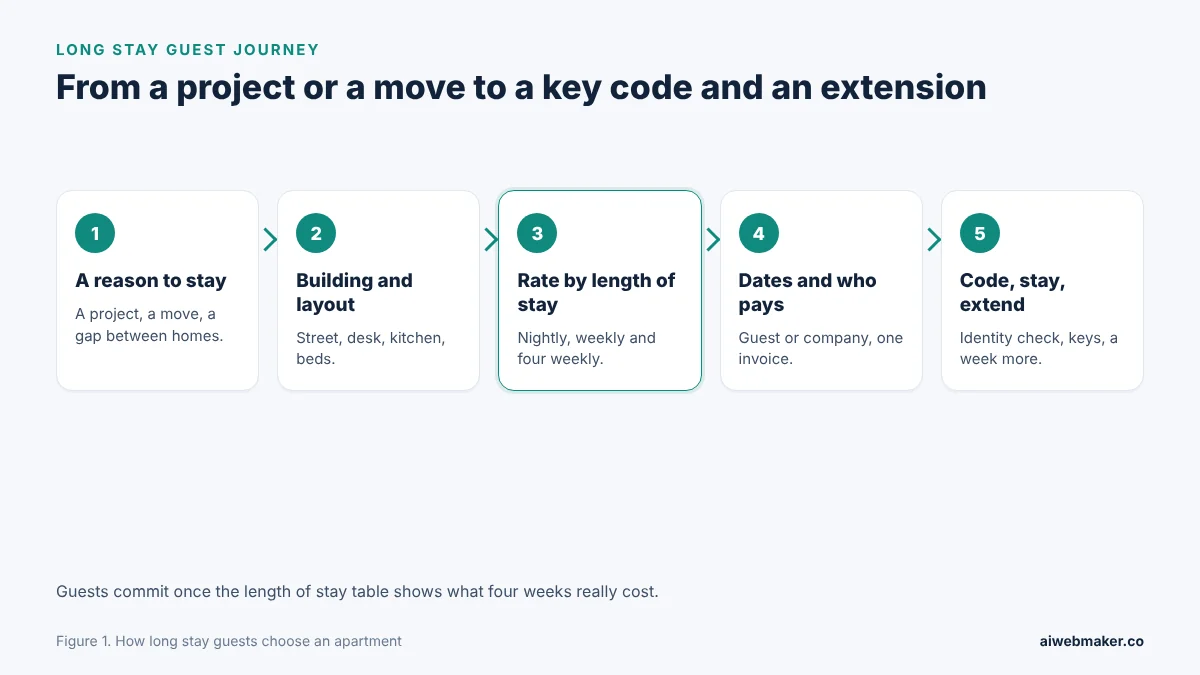
The coloured step is the rate check by length of stay, where a reader judges whether the price sits sensibly between a hotel and a lease. Most journeys begin with a work project, a move or a gap between homes, followed by a look at the buildings and their neighbourhoods. Once the rate makes sense, a guest or a company booker asks for dates and states who is paying. Arrival is usually by code, which is why the identity check and key instructions must be clear before the guest travels. A stay that runs smoothly often ends with a request to extend, the cheapest booking any operator ever wins.
Layouts, length of stay rates and arrival steps: the apartment site's pages
Fewer pages serve an apartment operator than a hotel, yet every one of them has to settle something a tenant would otherwise phone about. The home page names the buildings, the layouts and the lowest weekly rate. Layout pages show the beds, the kitchen and the desk, because those three things decide most long stays. A rates page sets out nightly, weekly and four weekly prices by season, while an inclusions page lists what the rate covers. Company, arrival and house rule pages sit beside a dates request that asks who will pay.
| Page | Question it answers | What to put on it |
|---|---|---|
| Home | Is this the right part of the city? | Buildings, layouts, lowest weekly rate |
| Buildings | Which address suits the stay? | Distance to the station, character of each street |
| Layouts | Will a family or a team fit? | Beds, bathrooms, desk, kitchen photos |
| Rates | What will four weeks cost? | Nightly, weekly and four weekly prices by season |
| In every apartment | What is already paid for? | Bills, cleaning, linen, laundry, internet |
| Company stays | Can the employer pay? | Invoicing, named contact, extensions |
| Arrival and keys | How does the first night work? | Identity check, code, times, checkout |
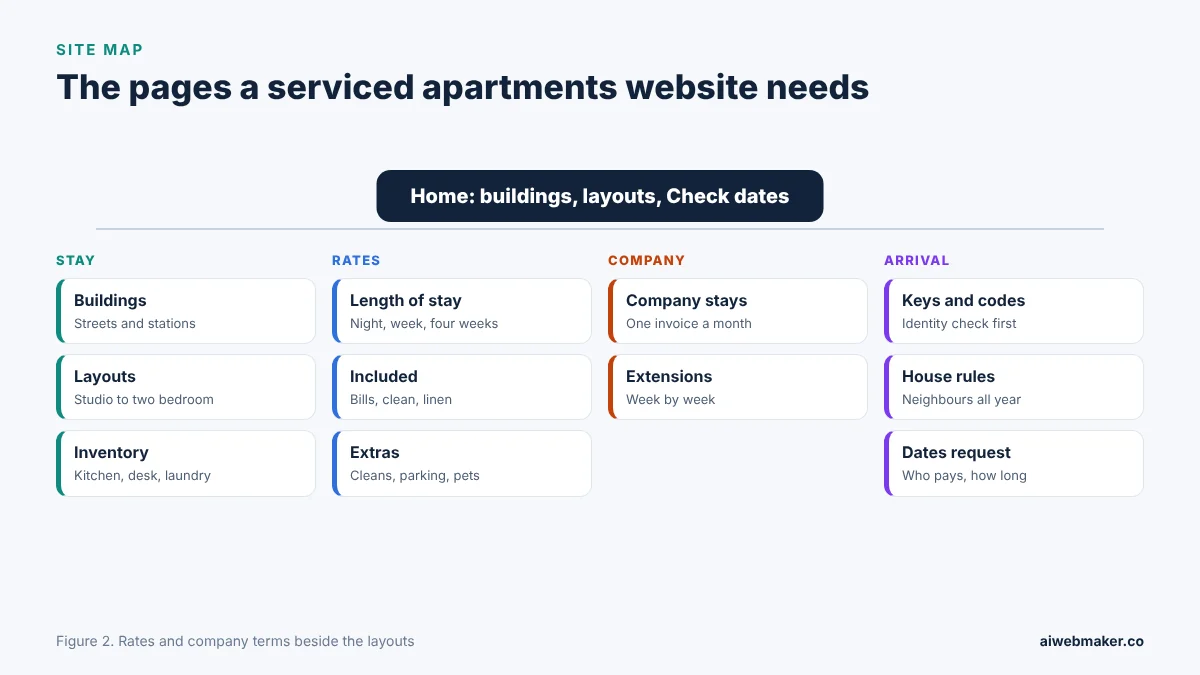
The diagram splits the site into stay pages, rate pages, company pages and arrival pages, with the dates request at the end of the last group. Stay pages cover the buildings, the layouts and the inventory of each kitchen. Rate pages hold the length of stay table and the list of what the rent includes. Keyholder Serviced Apartments, the invented operator behind our serviced apartments website example with weekly and four weekly rates, offers a Studio, a One bedroom, a Two bedroom and a Two bedroom, two bathroom layout across three city centre buildings. Every apartment card promises a kitchen you can cook in, a weekly clean and linen, a washer dryer, a desk for real work, bills included and help with post and parcels.
Nightly, weekly and four weekly: rates that fall as the stay grows
Length of stay pricing is the money question that sets serviced apartments apart, and the page should show the steps rather than hide them in a quote. A short stay carries a nightly rate that pays for cleaning and turnover, while a week or a month spreads those costs over more nights. Many operators also lift weekly rates in a city's busy months, when conferences and festivals fill every bed, and keep monthly rates steady all year. A minimum stay, such as the sample's three nights, should sit at the top of the table instead of appearing in the small print. Showing all three steps lets a guest see the saving from booking four weeks at once.
| Length of stay | Rate applied | Why the price falls | What the page should state |
|---|---|---|---|
| Three to six nights | Nightly | Cleaning and turnover fall on few nights | The minimum stay |
| Seven to 27 nights | Weekly, by season | Turnover costs spread across a week | Which months count as busy |
| 28 nights or more | Four weekly | Fewer changeovers, steady occupancy | Whether the rate holds all year |
| Open ended stays | Four weekly, extended | Lowest risk of an empty apartment | How extensions are agreed |
Company stays, purchase orders and one invoice a month
Company bookings often decide whether an operator fills its apartments in quiet months, so the company page deserves as much care as the layouts. Travel bookers want to hold several apartments under one booking and receive a single invoice each month with the company's details. A named contact who knows the whole group saves hours of emails when a project date moves. Invoice requirements, such as tax numbers or purchase order references, vary by country and by client, so the page can invite bookers to send theirs with the first request. Clear company terms turn one secondment into a standing relationship with a whole team.
Bills, linen and the cupboard inventory: what the rate includes
An inclusions list removes the fear of hidden extras that keeps many long stay guests from booking. Utilities, internet, a weekly clean and fresh linen are the items guests ask about first, and each should be marked clearly as included or charged. A kitchen inventory, from pans and knives to a dishwasher, tells a guest whether they need to shop on the first evening. Extras such as additional cleans, parking or a pet charge should carry a figure, as the sample does with a $45 extra clean and a $90 pet cleaning charge. Fewer surprises on the final invoice mean fewer disputes over the deposit.
| Item | Keyholder sample | What any operator should say |
|---|---|---|
| Electricity, heating, water, internet | In the rate | Whether any cap applies |
| Weekly clean and linen | In the rate | Day of the week and what is cleaned |
| Extra clean | $45 for smaller layouts | Price by layout |
| Washer dryer | In every apartment | Iron, racks, detergent or not |
| Parking | Nearby car park, $20 a day as an example | Where, and how to reserve |
| Pets | One building only, $90 a stay | Which buildings, which animals |
Key boxes, identity checks and arriving after midnight
Most serviced apartments let guests in by code, which keeps arrivals flexible but places the whole first night in the written instructions. The arrival page should give the earliest check in time, the hour the code is sent and what happens when a flight lands after midnight. Many countries require operators to record the identity of each adult guest, and the details differ, so the page should say what the operator asks for and why. House rules on noise, rubbish and smoking matter more in a residential building than in a hotel, because neighbours live there all year. A guest line answered at any hour, like the sample's line for guests in residence, settles most first night problems quickly.
Short let rules, tenancy limits and taxes that change with the length of stay
Local rules shape what a serviced apartment operator can offer, and they differ widely between countries and even between districts of one city. Some cities cap the number of nights a home can be let for short stays or require a registration number to appear on every listing. Tourist or occupancy taxes may apply to short stays and fall away beyond a certain length in some places, while very long stays can begin to look like tenancies under local law. The rates page should say that taxes are added at the rate in force and that the final total follows the rules for the dates booked. Operators should take local advice before publishing long stay offers, since a page that ignores these rules can create problems a quote cannot undo.
Extensions, early departures and the dates request
Flexibility on end dates is often worth more to long stay guests than a lower rate, and the request page should explain it before anyone asks. The sample agrees extensions week by week while the apartment is open, and lets stays of four weeks or more end early with seven days' notice. The AI website builder that drafts layout, rate and company stay pages for apartment operators produces this kind of site once the operator outlines its buildings, layouts and pricing steps, and every line can then be changed in the preview. Guests and bookers send dates as a request, and the bookings desk confirms it, suggests another apartment or declines it. Deposits and rent travel between guest and operator directly, and the platform claims no slice of either.
Monthly rental near the station and other searches by people on the move
People needing a temporary home type phrases such as serviced apartments city centre, monthly apartment rental, corporate housing, apartment with kitchen for a month or long stay near the station. Pages built around those phrases, with the district named in each heading, catch both the guest and the company booker. A map listing for each building, with photos of the kitchen, the desk and the entrance, helps people who search on a map near their new office. Reviews that mention a quiet street, a reliable weekly clean or a tidy monthly invoice persuade other long stay guests. Articles on moving to the city, what a month in each district costs or how a secondment stay works bring readers long before their start date.
Laundry contracts, utilities and the website's share of the year
Cleaning teams, linen services, utilities and building costs leave the website as a minor line in an apartment operator's year. Paying $119 for the year beats the monthly route, though a building that has just opened may like the $19 rhythm while its first guests arrive. Endings for the domain run to about 400, and the price follows the one chosen. Twelve articles for relocating guests cost close to $7.80 of credits, and changing a seasonal rate or adding a new building's photos costs nothing extra. The $189 row is there purely as a yardstick, since an apartment site has no need of that tier.
| Item | Yearly | Monthly |
|---|---|---|
| Hosting the serviced apartment pages | $119 | $228 over twelve months |
| Domain | Depends on the ending | Depends on the ending |
| Higher plan, for comparison | $189 a year | Not needed |
| Twelve relocation articles at about $0.65 | About $7.80 | About $7.80 |
| Rate, layout and building updates | No charge | No charge |
| Year before the domain | About $126.80 | About $235.80 |
Nightly prices only, no desk photos and silence on invoices: why long stay guests move on
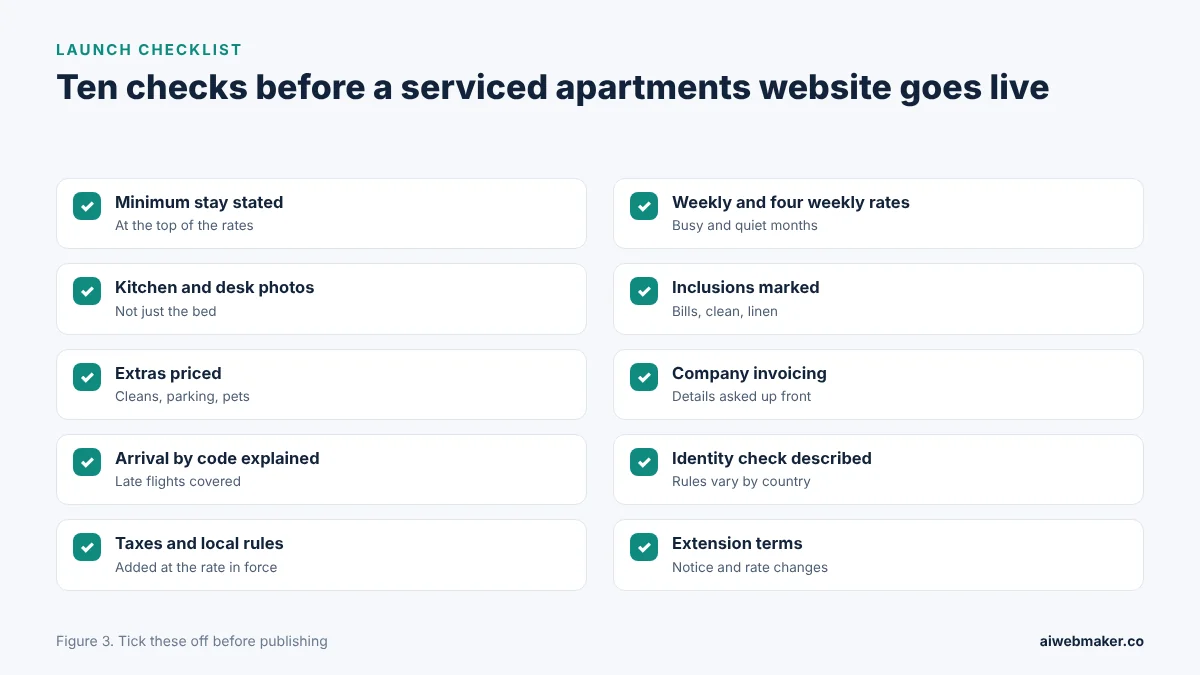
Long stay guests close a site that shows only a nightly price, because they cannot work out what a month would cost. Photos that skip the kitchen and the desk suggest a hotel room with a kettle rather than a home. Bookers leave when they find nothing about company invoices, extensions or cancellation. Missing arrival instructions worry anyone landing late, and vague words about cleaning make families wonder who changes the beds. Each of these worries is answered somewhere in the ten apartment checks shown here.
Frequently asked questions
Can a guest extend a stay after arriving?
Most operators allow extensions while the apartment is still open, and the website should explain how that works. Agreeing extensions week by week keeps the arrangement simple for both sides. When the apartment is already promised to someone else, an operator with several buildings can often offer another one nearby. The page should say how much notice the operator needs and whether the rate changes once the stay passes four weeks. Clear rules make an extension a quick message rather than a negotiation.
Can an employer pay for a long stay?
Many long stays are paid by employers, and the website should invite bookers to give the company's name and billing details with the first request. Operators commonly invoice the company directly, often monthly for long stays. Details such as tax numbers and purchase order references depend on the country and the client. A named contact for the company keeps changes to dates or guests in one place. Simple company billing is a strong reason for a booker to return.
Is tourist tax charged on a stay of several weeks?
That depends entirely on where the apartment is and how long the guest stays. Some places charge tourist or occupancy taxes on every night, some stop charging after a set number of nights, and some treat very long stays under different rules altogether. The operator should check the rules for its own city and say on the rates page that taxes are added at the rate in force. Guests then know the total may change with the length of their booking. Honest wording avoids an unwelcome line on the final invoice.
What happens to post that arrives after a guest leaves?
Policies vary, so the website should state what the operator does with letters and parcels that arrive late. Some operators hold post for a short period and ask the guest to collect it or pay for forwarding. Building hosts who accept parcels during a stay, as in the sample, should say whether that service ends on the day of departure. Guests moving to a permanent address should be reminded to update their details before they leave. A short note saves a lost delivery and an awkward message weeks later.
A week in a studio against a year of hosting
One quiet week in the sample's studio brings in more than five times the $119 annual hosting. Where the operator pays monthly, a single night in that studio more than covers the $19. A company that books a team of four for a month brings in many years of hosting in one invoice. Rates that show the saving of a longer stay, a full inventory and simple company terms win the guests who stay the longest and complain the least. An inbox where bookers ask to extend rather than to cancel shows the pages are working.
Build your website in Minutes and get the AI Tools that work
Start Building Your Website →