Safari Lodge Website Cost, Priced by the Rains and the Conservancy Fee
Hosting a tented camp's pages comes to $119 when the lodge pays for the year at once, or $19 in any month paid alone, plus a domain. Covered here: how travellers choose, season bands, inclusions and fees, transfers, guides, camp safety, deposits, search terms and the lodge's annual costs.
- No coding required
- Live in minutes
- Blog, SEO and chatbot tools included
Hosting for a tented camp's pages through AI Web Maker comes to $119 when the lodge pays for the year at once, or $19 for any single month, plus a domain. Drafting the suite cards and testing the seasonal rate table in the preview cost the lodge nothing. At the sample lodge's lowest rate of $760 for a suite and a night, one green season night outweighs the hosting bill more than six times. The harder task is explaining a price that rises and falls with the rains, a fee paid to the community that owns the land, and wildlife that no guide can order up. What follows works through seasons, inclusions, transfers, guides, safety in an unfenced camp, deposits, search and the yearly budget in turn.
This article is part of our complete guide: Food Business Website Builder.
Honeymooners, families and returning bush lovers: who plans a lodge stay
Most guests who reach a lodge's own website are planning months ahead and comparing two or three camps in the same region. Honeymooners and couples marking an anniversary look for privacy, an outdoor bath and a deck with a view. Families need the youngest age allowed on drives, a suite that links two bedrooms and the option of a private vehicle. Returning safari travellers ask sharper questions about guiding, vehicle numbers at sightings and the season that suits the animals they hope to see. Travel agents read the same pages for itineraries, so every figure has to be exact.
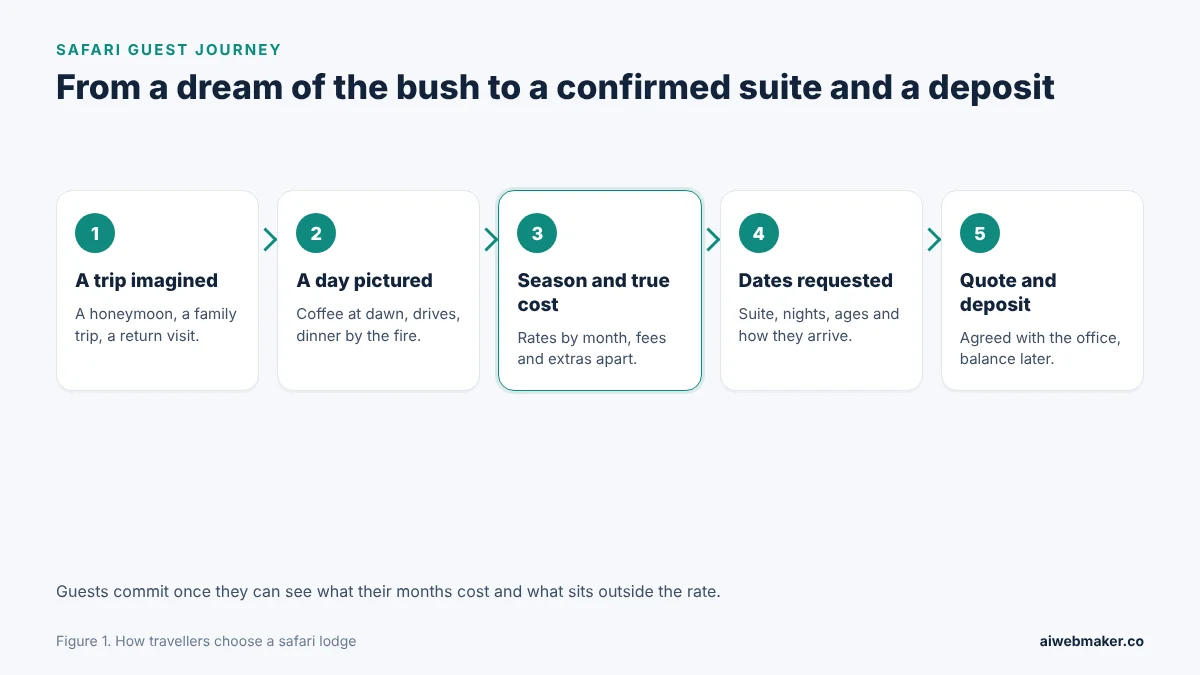
The highlighted step is where most lodges lose their careful readers, because the season and the true cost decide the trip long before the suite does. A traveller starts with an idea of the bush, then pictures a day at the lodge from the morning coffee to the fire after dinner. Next comes the rate table, read alongside a note of what sits outside it, such as the conservancy fee. Only a guest who understands the price for their months sends a dates request, and the reply turns it into a quote and a deposit. Answering the money question plainly at the third step keeps far more readers moving towards the fifth.
Suites, seasons, inclusions and the dates form: the lodge's page list
Pages for a lodge are best arranged around the sequence of a guest's worries, starting with the experience and ending with the practical details. The home page sets the scene and states the number of suites, the drives each day and the lowest rate. A day at the lodge comes next, because few first timers know that drives leave before dawn. Suite pages, the season table and an inclusions page carry the money, while guide and sighting pages carry the trust. Safety, health and getting there close the list, beside a dates form that asks how the guest will arrive.
| Page | Guest's question | What it should hold |
|---|---|---|
| Home | Is this the camp we imagined? | Number of suites, drives a day, lowest rate |
| A day here | What does a day actually look like? | Times from coffee at the tent to dinner |
| Suites | Which tent suits us? | Beds, bath, view, children allowed |
| Seasons and rates | What will our months cost? | Green, shoulder and dry rates, with the months |
| In the rate | What will be added later? | Inclusions, fees, extras, transfers |
| Guides and manners | Will the wildlife be respected? | Training, trackers, rules at a sighting |
| Dates request | How do we ask? | Suite, nights, travellers, how they arrive |
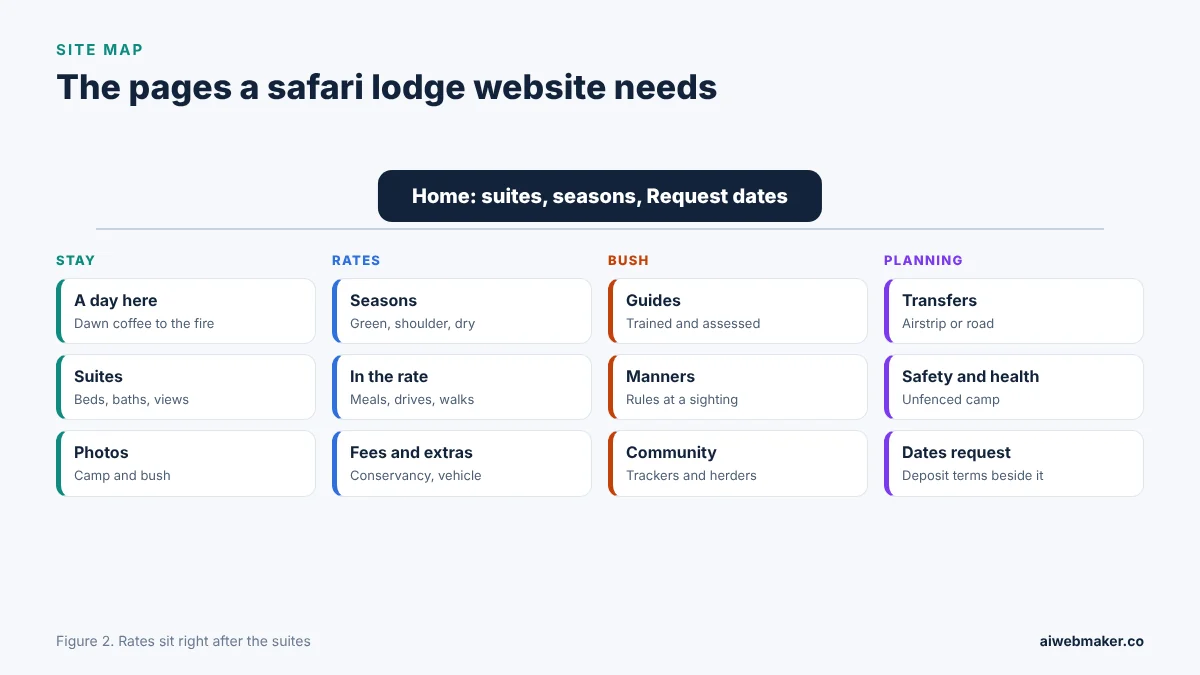
Four columns hang under the home page here, and the rates column sits second because most guests open it straight after the suites. Stay pages hold a day at the lodge and the suites, while rates pages hold the season table and the inclusions. Bush pages cover guides, trackers and the manners kept at every sighting, and planning pages carry transfers, safety notes and the dates form. Acacia Ridge Safari Lodge, the invented camp in our safari lodge website example with seasonal rates and a dates form, sets all of this on a single scrolling page with a Ridge suite, a River view suite, a Family suite and The Lookout. Its inclusion cards list meals and house drinks, two shared drives a day and guided bush walks, then set the conservancy fee, a private vehicle and transfers apart as separate lines.
Green, shoulder and dry: pricing a suite by the rains
Seasonal pricing is the first money question every guest asks, and a lodge should answer it with a table rather than the words rates on request. In much of eastern and southern Africa the dry months draw animals to rivers and waterholes, so demand and rates peak then. The green season brings fresh grazing, newborn animals, afternoon storms and fewer vehicles, usually at the lowest rates of the year. Shoulder weeks sit between the two and often reward guests who can be flexible. Months differ between regions and even neighbouring reserves, so the page must name its own months and price each suite for two guests sharing, as Acacia Ridge does.
| Season | What guests tend to find | Where the rate sits | Line the page should add |
|---|---|---|---|
| Green | Lush grass, young animals, short storms | Lowest of the year | Which tracks or walks may close after rain |
| Shoulder | Mixed weather, quieter camps | Middle band | The exact weeks covered |
| Dry | Animals near water, clear skies, busy camps | Highest of the year | How early the best suites fill |
| Festive weeks | Family trips, long stays | Often priced as peak | Minimum nights, if any |
In the rate and on top of it: meals, drives and the conservancy fee
An inclusions page prevents the most common complaint in lodge reviews, a final bill that differs from the first quote. Guests should see at a glance which meals, drinks, drives, walks and laundry services the rate covers. Park entry or conservancy fees deserve their own line, because they are often paid to a public authority or a community trust rather than to the lodge. Extras such as a private vehicle, cellar wines or a night in a fly camp should carry a price or a note that the office will quote one. Gratuities for guides and camp staff are customary in many safari regions, and a short note on the lodge's own practice spares guests an awkward guess on the last morning.
| Item | Often in the rate? | What the page should say |
|---|---|---|
| Meals and house drinks | Yes, at many camps | Which drinks count as house drinks |
| Shared drives and walks | Yes | Number per day, ages allowed on walks |
| Conservancy or park fees | Varies | Amount per person per night, who receives it |
| Private vehicle and guide | Rarely | Daily price, and who benefits most |
| Transfers | Sometimes | Airstrip and road prices, meeting points |
| Gratuities | No | The lodge's own suggestion, if it has one |
Airstrips, road transfers and the private vehicle
Getting to a remote camp is part of the price, so the transfer page should read like a travel plan rather than a footnote. Many guests arrive by light aircraft, and the air operators set their own luggage rules, often soft bags only, which the page can point to without quoting another firm's limits. Guests who drive in need the meeting point, the condition of the road and the time it takes from the nearest town. A lodge vehicle collecting guests at the airstrip or the gate should carry a stated price, as the sample's airstrip transfer does. A private vehicle suits photographers and families with young children, and its daily rate belongs on this page too.
Guides, trackers and the sighting nobody can promise
Wildlife honesty separates a trusted lodge from one that disappoints, so the guide page should promise skill and patience rather than particular animals. Guide training and assessment schemes are not the same everywhere, so the guides page should name the standard recognised where the lodge operates instead of claiming a universal licence. Trackers from neighbouring communities, first aid training and a radio in every vehicle all deserve a mention. A short list of manners at a sighting, such as engines off nearby, a limit on vehicles and no feeding, shows guests that the animals come first. Guests who arrive with honest expectations write warmer reviews, even after a quiet drive.
Unfenced camps, children's ages and travel health
Sleeping in an unfenced camp is part of the appeal, and the safety page should describe it calmly and precisely. Animals often pass through camp at night, so staff escorts after dark, a radio and a torch in each suite and clear instructions for the first evening should all be written down. Minimum ages for shared drives and bush walks vary between camps and sometimes follow local rules, so each lodge should state its own, as the sample does with six for drives and twelve for walks. Advice on vaccinations and malaria differs by home country and changes over time, so the page should send guests to a travel health clinic rather than give medical advice. An evacuation plan for a serious emergency and a firm suggestion of travel insurance complete the picture without frightening anyone away.
Holding a suite: deposit share, balance date and the request
Deposit terms decide how confident a guest feels about committing to a trip months away, so they should sit beside the request rather than in a document sent later. The AI website builder that drafts suite, season and rate pages for tented camps produces this layout once the lodge sums up its suites, months and daily rhythm, and each line can be reworded in the preview. A guest then sends a dates request, which the reservations office can accept, move to other nights or turn down. Money for the deposit and the balance passes straight from guest to lodge, with no cut kept by the platform. The sample's own terms, a 30 percent deposit and a balance due 60 days before arrival, show how short that note can be.
Green season safari, private vehicle and other phrases travellers type
Lodge guests type the trip they already picture, such as tented safari lodge, family safari lodge, green season safari or private vehicle safari. Others add lodge with bush walks or the name of a reserve, and pages titled with those exact ideas meet them as they narrow down a region. A map listing with the lodge's position, photos of the suites and the reservations office's hours helps guests and agents who search by area. Reviews that mention guiding, accurate bills and a smooth transfer persuade the next guest more than any description of sunsets. Articles on what each month brings or what to pack for a light aircraft attract planners a year ahead of their trip.
Fuel, rations and radios beside a small hosting line
Vehicles, fuel, food carried in over gravel roads and conservancy commitments dwarf what a lodge spends on its web pages each year. Yearly billing at $119 is the lower route, while $19 a month suits a camp opening its first season, and the domain's price follows from the ending chosen from about 400 available. Twelve articles on seasons, packing and guiding use about $7.80 in AI credits between them. Changing a seasonal rate, adding a suite photo or rewriting the transfer note adds nothing at all. A $189 row appears below only as a comparison, since a lodge site of this kind does not need it.
| Item | Yearly | Monthly |
|---|---|---|
| Hosting the safari lodge pages | $119 | $228 over twelve months |
| Domain | Depends on the ending | Depends on the ending |
| Higher plan, for comparison | $189 a year | Not needed |
| Twelve season and packing articles at about $0.65 | About $7.80 | About $7.80 |
| Rate, suite and transfer edits | No charge | No charge |
| Year before the domain | About $126.80 | About $235.80 |
Missing seasons, hidden fees and promised lions: why travellers close the tab
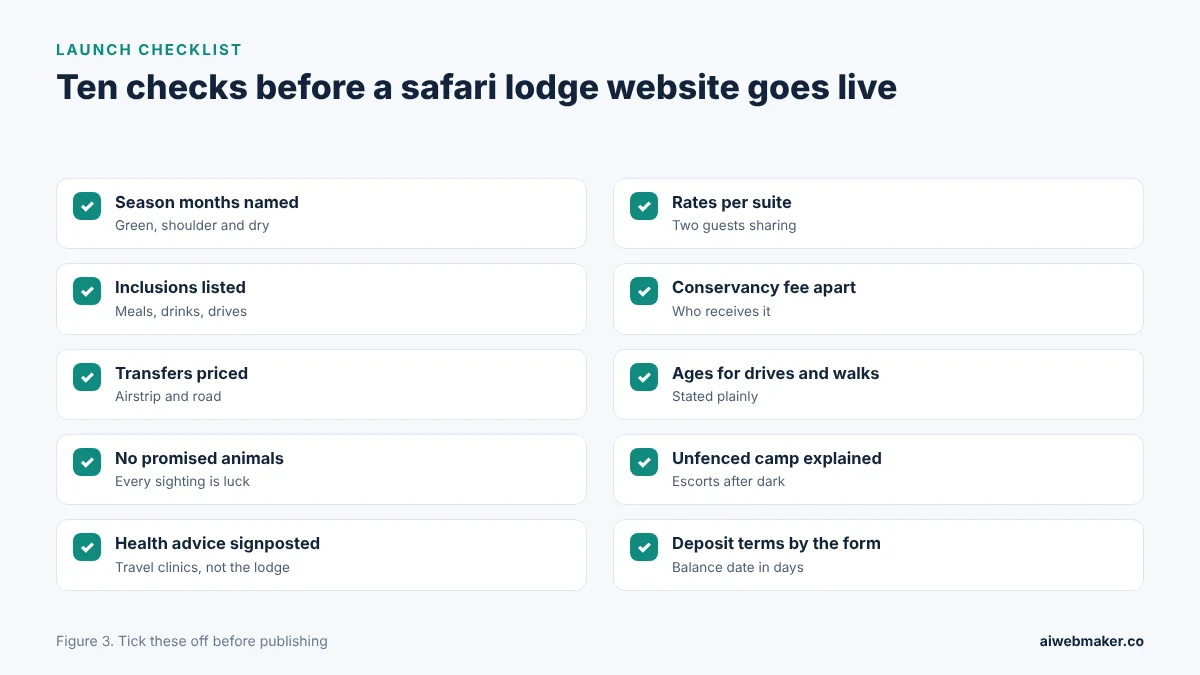
Careful travellers leave a lodge's site the moment the rates disappear behind the words price on request. A conservancy fee mentioned only in the confirmation feels like a trick, even when the money goes to a good cause. Photos borrowed from other reserves or promises of particular animals make experienced guests doubt everything else on the page. Silence about the unfenced camp, children's ages or how to reach the airstrip leaves families unsure whether the trip is possible at all. Ten lodge checks, drawn below, settle each of those doubts before a guest drifts away.
Frequently asked questions
Is a green season stay worth the lower rate?
For many travellers it is, as long as the page explains what the green season brings and what it may take away. Fresh grass, young animals, dramatic skies and fewer vehicles reward guests who can accept afternoon storms. Some tracks or walking routes may close after heavy rain, and long grass can hide animals that are easy to spot in the dry months. A lodge should describe its own green months honestly instead of selling them as a bargain with no catch. Guests who choose the season knowingly are usually the happiest ones in the lodge book.
Can a lodge quote a rate that already includes the conservancy fee?
A lodge can quote either way, but showing the fee as its own line usually earns more trust. Guests can then see what the community or the park receives, and agents can compare camps on equal terms. Park fees set by a public authority can change during the year, which is why the rates page should mention that the current fee applies on arrival. Folding everything into one figure hides the work the fee pays for. A separate line turns a cost into part of the lodge's story.
How far ahead do travellers request dry season dates?
Guests hoping for the busiest months often start asking many months ahead, especially for family suites and the most private tents. The exact pattern depends on the region, the size of the camp and the type of guest it attracts. A lodge can say on its rates page which suites fill first and suggest that guests ask early for peak weeks. Shoulder and green season dates usually stay open for longer. Honest timing advice helps guests plan without feeling pushed.
What should guests pack for a light aircraft transfer?
Luggage rules are set by the air operator, and many light aircraft accept only soft bags within a weight limit, so guests should check with the operator they fly with. The lodge page can suggest neutral clothing, layers for cold early drives, a hat, sun cream and binoculars. Camera gear and medicines belong in hand luggage. Laundry in the rate, where it applies, means guests can pack less than they expect. A short packing list saves many emails in the weeks before arrival.
One night in a ridge suite against a year online
A single green season night in the sample's Ridge suite earns more than six years of hosting at $119 a year. A camp paying $19 a month covers each payment with less than half of one guest's airstrip transfer. Every guest who books directly after reading an honest rate table and a clear fee line is worth far more than the whole yearly budget. Seasons laid out month by month, fees explained and wildlife described without promises win over the careful travellers who fill a lodge outside the peak weeks. When dates requests start naming the season and the suite the guest has already chosen, the pages have done their job.
Build your website in Minutes and get the AI Tools that work
Start Building Your Website →