Kayak Rental Website Cost, River Checks and Boats Priced by the Hour
Riverside hires pay $119 yearly or $19 monthly to keep a kayak rental website hosted, then buy a domain. Covered here: how paddlers choose, boat pricing, safety, river checks, routes, reservations, search and the yearly budget.
- No coding required
- Live in minutes
- Blog, SEO and chatbot tools included
Keeping a boathouse online with AI Web Maker means $119 once a year, or a monthly $19 if the hire prefers, with its domain on top. No invoice covers drafting the boat cards, the safety rules or the reservation page, nor the rounds of checking them in preview. One sunny Saturday of half day hires outearns that bill, which makes the fee a rounding error against a season of paddling. The harder task is persuading a family in the car park that the river is safe today, that the boat suits a seven year old and that the price covers everyone aboard. Paddlers decide quickly, often on a phone with a weak signal, and a hire that hides its prices, its rules or its river check loses them to the next boathouse downstream. What follows works through hire lengths, buoyancy aids, gauge readings, routes, reservations, search and the yearly bill, one decision at a time.
This article is part of our complete guide: Food Business Website Builder.
Who hires a kayak, and what do they check from the car park?
Kayak and canoe hirers fall into a few groups, and each arrives with its own first question. Families want to know whether a child of six can sit in a double, whether the boat is stable and how long the shortest hire lasts. Groups of friends compare routes, picnic stops and the price of several boats at once. Holiday visitors look for the river check, because they have a single open afternoon and cannot gamble it on a closed river. Nervous first timers search for guided trips, so a page that puts a guide in the water beside them settles the doubt. Answering each group near the top of the page turns quick glances into reservations.
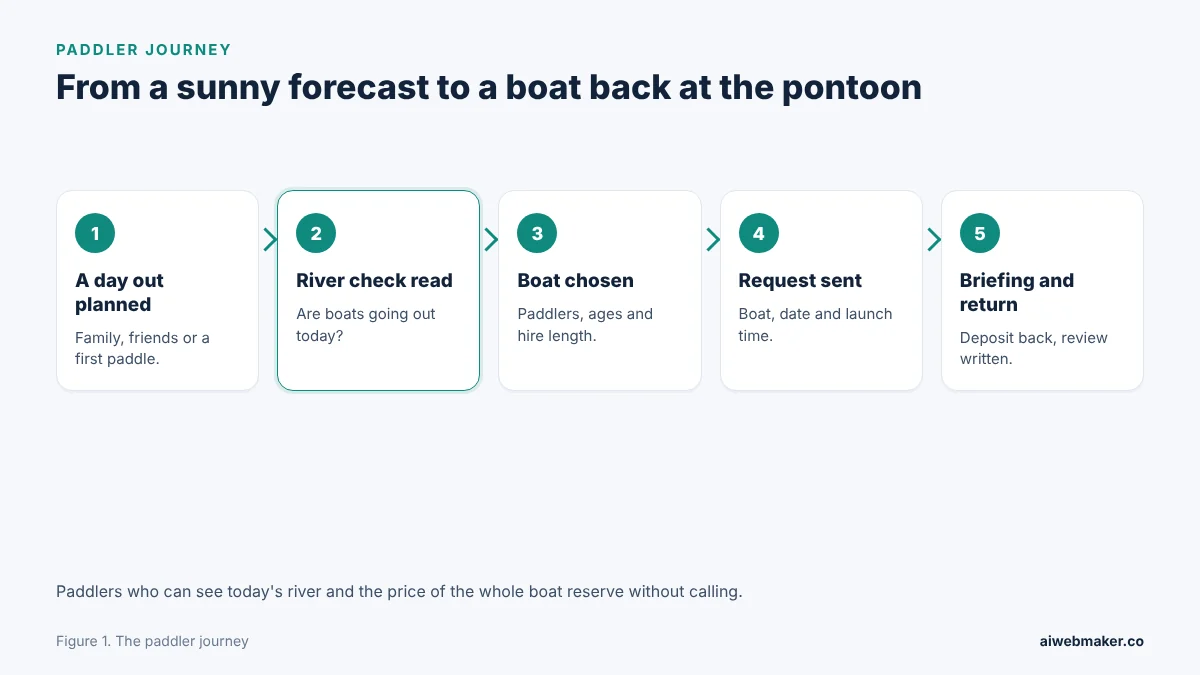
Five boxes run from a hopeful forecast on the left to wet shoes and a written review on the right. The highlighted step is the river check, because a visitor who cannot tell whether boats are going out today rarely reserves one. Choosing the boat comes next, and it depends on the number of paddlers, their ages and the length of the hire. The reservation request turns that choice into a firm plan, and the briefing on the bank shapes how safe the day feels. A smooth return, with the deposit handed back promptly, is what prompts the review and the next visit. Every page on the site should move a paddler one step further along this line.
Boats, rules and the river check: the pages a paddling hire needs
A short run of pages is enough for a paddling hire, provided each settles a question that would otherwise ring the boathouse phone at eight in the morning. The boats page carries the prices and the paddler counts, and it is the page most visitors open first. Safety and the river check sit next to it, because they decide whether the day happens at all. A reservation page and a contact page with the parking, the season and the hours close every route. Kept to this short list, the site stays quick to read on a phone beside the water.
| Page | Question it answers | What it should show |
|---|---|---|
| Boats and prices | Which boat, and what it costs | Paddlers per boat, ages, two hour, half day and day prices |
| Safety | Whether it is safe for us | Buoyancy aids, the briefing, age rules, alcohol rule, emergencies |
| River check | Whether boats go out today | Level and wind limits, the time the check is posted |
| Routes and extras | Where we can paddle | Distances, rough times, landings, pick up, barrels, wetsuits |
| Reservation | How to book | Boat, number of boats, date, launch time, ages and experience |
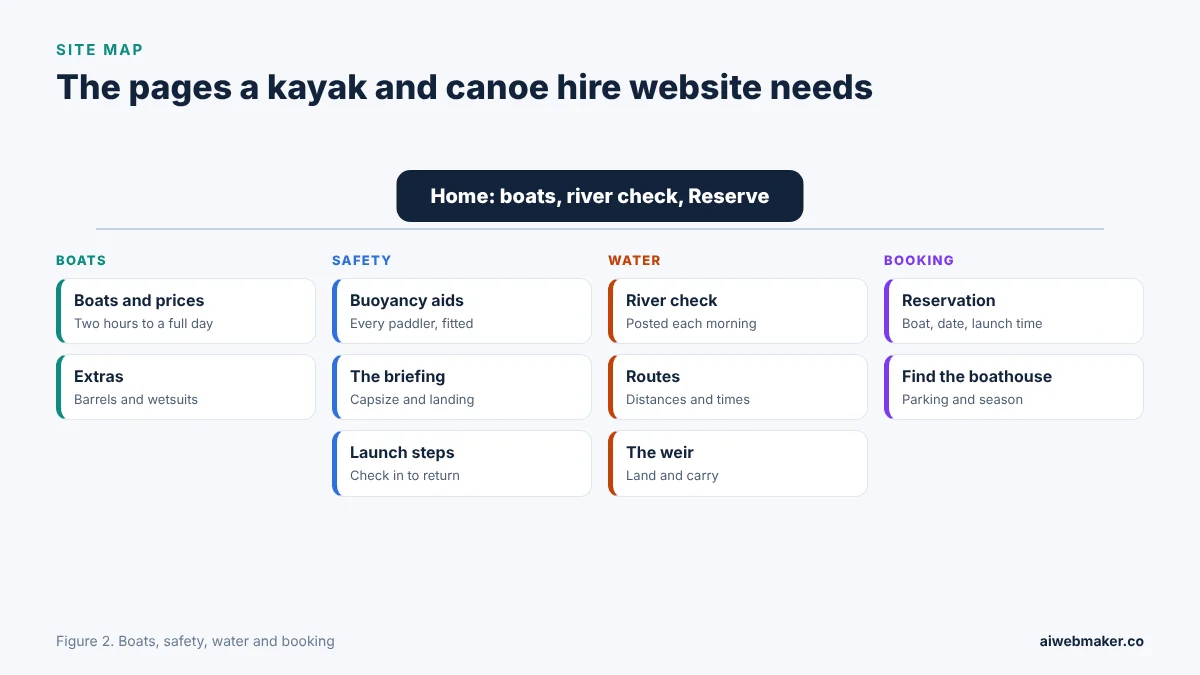
Branching from a home page with the reservation button, four groups of pages cover the boats, the safety rules, the water and the booking. The boats group holds the prices and the extras, the safety group holds the buoyancy aid rules and the launch steps, and the water group holds the river check and the routes. Our sample, Riverbend Kayak Hire, fits all of this on one page, starting with a single kayak, a double kayak, an open canoe and a guided river trip, each priced for the whole boat. Below the boats come safety rules, a river level table and outings such as Bridge to the willows, The weir and back and Down to the mill, with a picnic barrel and wetsuits as extras. The kayak rental website example with river levels and a reservation request ends with launch steps, reviews, questions and a form asking for the boat, the date and the launch time. Any river hire can reuse that order as it stands.
Two hours, half a day or a full day: pricing the whole boat
Paddlers think in hours rather than days, so a hire page that shows only a day rate forces people to ask before they book. Short hires of about two hours suit families and first timers, half days suit groups with a picnic, and full days suit the longer one way runs. Pricing the whole boat, rather than each person, lets a family work out the cost in seconds and avoids arguments about fares for children. Each card should say how many paddlers the boat takes, the ages it suits and what comes with it, such as paddles, buoyancy aids, a dry bag and a map. Clear figures on every card remove the hesitation that sends visitors back to the search page.
| Boat or trip | Usually suits | Hire lengths to show | Points to state |
|---|---|---|---|
| Single kayak | Confident teenagers and adults | Two hours, half day, day | Minimum age to paddle alone |
| Double kayak | A parent and child, or two friends | Two hours, half day, day | Youngest age, who steers |
| Open canoe | Families with a small child, picnics | Half day, day, one way runs | Seats, room for a barrel |
| Guided trip | First timers and groups | Fixed length, set start times | Group size, ages, kit included |
Buoyancy aids, the bankside briefing and age rules
Safety rules belong on the website as well as on the bank, because parents decide whether to come long before they reach the pontoon. A buoyancy aid for every paddler, adults included, fitted by staff and checked again before launch, is the rule most hires state first. The briefing should be described in plain words: getting in and out, holding the paddle, what to do after a capsize and where to land. Age rules, the expectation that paddlers are confident in water and a ban on alcohol before or during the hire answer questions that otherwise arrive by phone. Waterway rules, licences and insurance vary by country and by river, so the page should say the hire follows the rules where it operates. A closing line telling paddlers to call the local emergency number first if someone is hurt in the water gives the page the seriousness it needs.
Gauge boards, wind limits and the morning river check
A river that is perfect on Saturday can be dangerous on Sunday after a night of rain, and visitors cannot judge that from a holiday photo. Publishing the conditions the hire paddles in, as thresholds rather than promises, explains closures before they happen. Each threshold should say what goes out and what happens to the booking, whether that means a shorter route, a guided trip instead, a new date or a refund. Readings only make sense for one stretch of water, so the page should say so rather than suggesting the numbers apply anywhere. Posting the river check at the same time every morning, and saying where to find it, cuts the early calls to the boathouse. Consistent rules also keep refund decisions fair, which protects the reviews a hire depends on.
| Condition on the day | What usually goes out | What happens to the booking |
|---|---|---|
| Normal level, light wind | Every boat and route | Goes ahead as booked |
| Low summer water | Kayaks on the short route | Goes ahead, or a change of boat |
| River running fast | Guided trips on sheltered water | Switch, move the date or refund |
| Flood level or floating branches | Nothing | New date or a full refund |
| Strong wind or thunder | Boats called back | Unused time refunded |
Routes, landings and the weir, described honestly
First time paddlers often go too far upstream and run out of energy on the way back, so route descriptions do real safety work. Each route should give a distance, a rough time and the kind of paddler it suits, from a sheltered round trip for families to a one way run with a pick up. Hazards such as weirs, bridges with strong flow or shallow gravel should be named in every route that goes near them, with the instruction to land and carry. A waterproof map in each boat, marking the landings and the turning points, backs up what the website says. Honest route notes turn the river into a plan a family can follow with confidence.
Reservation requests, deposits and the boathouse diary
A reservation request should collect what the boathouse needs to plan the day: the boat, the number of boats, the date, the launch time and the length of the hire. A box for the paddlers' ages and experience lets staff suggest a steadier boat or a guided trip before anyone arrives. The AI website builder that paddling hires use for boat cards and reservation requests drafts these pages once the hire describes its boats, routes and rules in a few lines. Each request then lands with the hire, which can accept it, move it to another launch time or decline it when every boat is out. Payment and any deposit are settled between the hire and the paddlers directly, and AI Web Maker keeps no share of the takings. Because nothing is fixed until the boathouse replies, the diary stays in the hands of the people who can see the water.
What paddlers type before a day on the river
Paddlers search for phrases such as kayak hire near me, canoe rental, guided kayak trip or family canoeing, often adding the name of a river or a town. Putting the boats, the river and the nearest town into the boats page headings and first lines helps those searches land on the hire. The map listing matters greatly for a business people visit on impulse, so its season, launch times, pictures of boats afloat and the website address should all be correct. Reviews praising a calm briefing, steady boats and a fair call on a high water day persuade far better than bare star ratings. Articles on what to wear for a first paddle, how to choose between a kayak and a canoe or the best autumn routes bring readers before the season starts.
A season of river pages, priced for the whole year
For a paddling hire, the website bill is mostly hosting, with the domain as the only other fixed line. A boathouse open only from spring to autumn can still pay yearly, since the pages keep working through winter while people plan ahead. Hires that prefer to spread the cost can pay monthly, which totals more across twelve months. Twelve articles on routes, kit and river safety add only a few dollars in credits. Prices, routes and season dates can be changed whenever needed without any extra charge.
| Item | Yearly | Monthly |
|---|---|---|
| Hosting the kayak rental pages | $119 | $228 over twelve months |
| Domain | Depends on the ending | Depends on the ending |
| Higher plan, for comparison | $189 a year | Not needed |
| Twelve paddling and route articles at about $0.65 | About $7.80 | About $7.80 |
| New boats, prices and season dates | No charge | No charge |
| Year before the domain | About $126.80 | About $235.80 |
Why paddlers close a hire site and drive to the next river
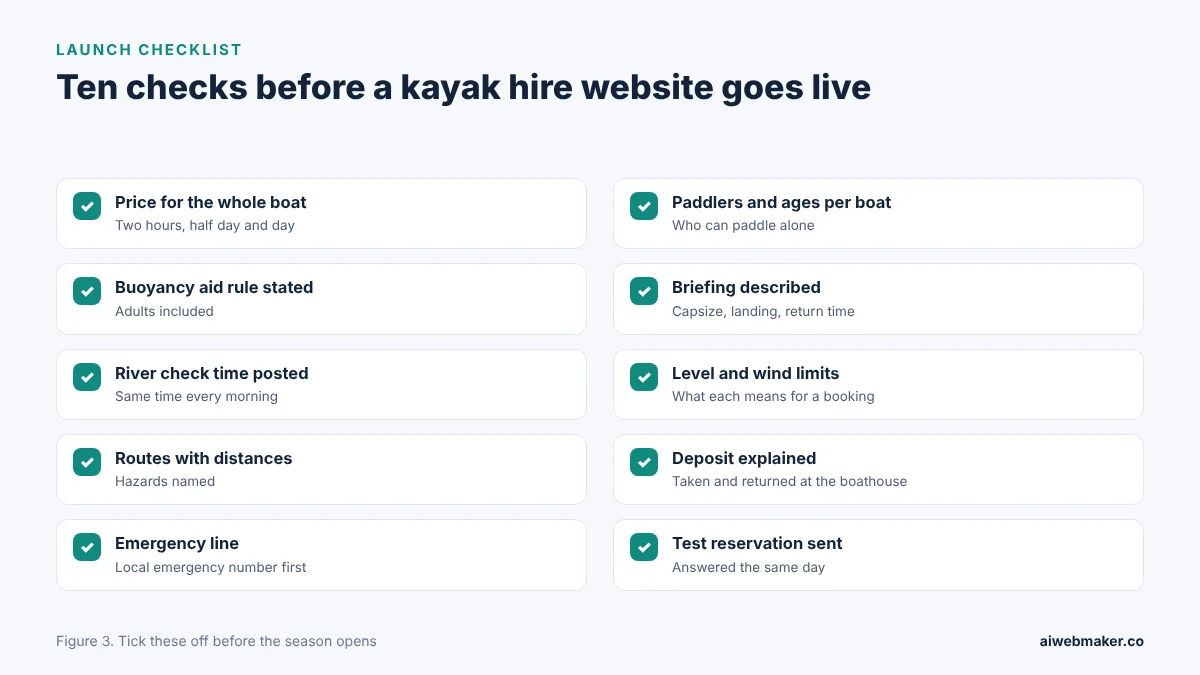
Paddlers leave a hire site when the only price shown is for a full day. A missing river check makes visitors assume the worst, or worse, turn up when no boats are going out. Vague safety notes worry parents, while rules buried in small print surprise groups at the pontoon. Routes without distances or times leave people guessing how far they can manage. A reservation request that asks nothing about ages or experience suggests nobody will check that the boat suits the group. Ten ticks in the next figure answer those gaps one by one before the first boat launches.
Frequently asked questions
Do paddlers need to swim to hire a kayak?
Most hires ask that every paddler is confident in water, even though buoyancy aids keep people afloat. A paddler who would panic after a capsize is usually safer on a guided trip or in a double with a confident adult. The website should state the hire's own rule plainly and explain why it exists. Asking about swimming confidence on the request lets staff suggest the right boat in advance. A clear answer here prevents uncomfortable conversations at the pontoon.
How young can children be in a hired boat?
Age limits differ between hires, rivers and countries, so each hire should publish its own. Many hires seat young children in a double kayak or a canoe with an adult, and let older children take a single kayak alone. Children usually need an adult named on the hire form, and every child wears a correctly fitted buoyancy aid. The boats page can show the youngest age for each boat so parents choose correctly. Clear limits protect children and spare families a wasted journey.
What happens to a booking when the river is too high?
A good hire page answers this before anyone asks, with a table of conditions and what each means for the booking. When the level limits the boats, paddlers might switch to a guided trip on sheltered water or a shorter route. When the river is closed, a new date or a full refund is the usual offer. Posting the river check at a fixed time each morning gives groups time to change their plans. Consistent rules keep every decision fair and easy to explain.
Is a deposit fair for a kayak hire to ask?
Many hires take a refundable deposit per boat to cover lost paddles or damage, and return it when the boat comes back on time. The amount and the conditions should be stated beside the prices, not revealed at the boathouse. The deposit is arranged and returned by the hire itself, because the website only carries the request. Explaining it clearly prevents disputes and makes the hire look organised. Paddlers accept a deposit easily when they know exactly how they get it back.
A few half day hires on one Saturday settle the year
The yearly $119 is matched by a few half day canoes on one bright weekend. Hires on monthly billing recover the $19 with one short family paddle. Every group that reserves several boats after reading the routes and the river check adds a morning of work that would have gone elsewhere. Clear prices for the whole boat, honest safety rules and a river check posted on time persuade cautious parents that the day will go well. Hires that keep these pages current through the season find more visitors arriving already sure of their boat. Paddlers who reach the pontoon already knowing their boat, their route and their landing are proof that the pages pull their weight.
Build your website in Minutes and get the AI Tools that work
Start Building Your Website →