Eco Lodge Website Cost and Green Claims a Guest Can Check
A lodge of solar cabins keeps its readings and rates public for a year at a hosting cost of $119, or on $19 for each month online, with its domain registered on the side. Inside: guests and their questions, pages, green claims, meter readings, off grid comfort, seasonal rates, getting there, search and the budget.
- No coding required
- Live in minutes
- Blog, SEO and chatbot tools included
A lodge of solar cabins can publish its rates and readings through AI Web Maker, whose hosting bill is $119 for the year or $19 per month, with the domain bought apart. The cabin pages, the readings table and the dates request cost nothing while they are drafted, and nothing while they are reviewed in preview. A two night stay in one cabin covers the hosting year, so cost is the smallest question on the site. The largest question is trust, because guests have grown suspicious of green labels, and regulators in several regions now treat vague environmental claims as misleading. An eco lodge earns bookings by publishing what it measures, admitting what it has not solved and telling guests plainly what off grid comfort means. Covered in order: guests, pages, claims that hold up, meter readings, comfort before arrival, wet and dry season rates, travel without a car, search and the budget.
This article is part of our complete guide: Food Business Website Builder.
Birdwatchers, families on a first wild holiday and guests who read the small print
Guests who choose an eco lodge are often more careful readers than ordinary hotel guests, because they care how the stay is run as well as how it feels. Walkers and birdwatchers want guides, routes and quiet, while families on their first wild holiday want to know about safety, food and whether children will be bored without screens. Couples seeking a retreat check comfort, privacy and what the cabin really has inside. A growing group reads the environmental claims closely and leaves if they sound like slogans. Each of them needs honest detail before they will send a request.
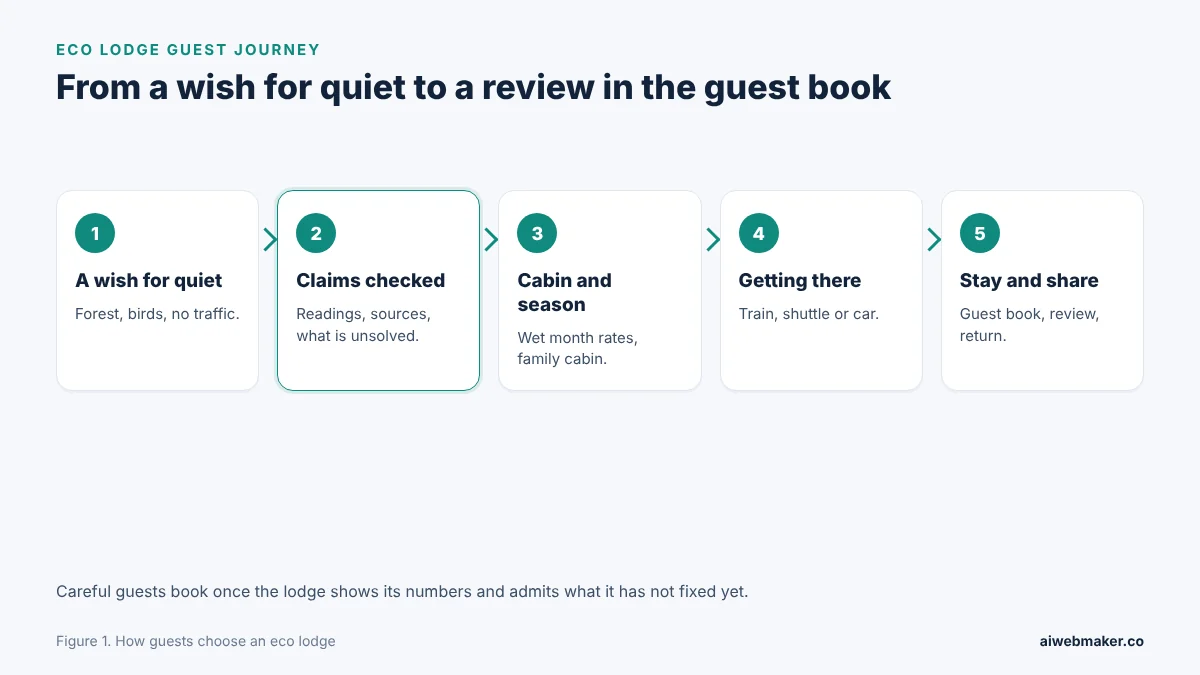
Checking the claims is the highlighted step, because a guest who doubts the lodge's green credentials will not read on to the rates. Most of these journeys open with a longing for quiet and nature, often prompted by a photo or a friend's recommendation. Once the claims hold up, the guest picks a cabin and a season, usually weighing a lower wet month rate against drier weather. Getting there is the next worry, especially without a car, and a clear travel page settles it. The stay itself, and the honesty guests found on the site, shape the review they write afterwards.
Power, water, cabins, rates, walks and the dates request
An eco lodge's site needs the pages any small hotel needs, plus a page that explains how the place actually runs. The home page sets the cabins among their trees, with one clear way to ask for dates. A page on power, water and waste explains each system in plain words and links to the latest readings. Cabin and rate pages give sizes, what is inside, what is missing and how prices change across the seasons. Food, walks, travel and a dates request complete the route.
| Page | Guest's question | What it should show |
|---|---|---|
| Home | Is this the setting we want? | Cabins among the trees, a dates button |
| Power, water and waste | Is the green claim real? | Each system, how it works, what is unsolved |
| Readings | Can the numbers be checked? | Meter readings by period and their source |
| Cabins | What is inside? | Beds, shower, sockets, no air conditioning, deck |
| Rates by season | What will our dates cost? | Wet, shoulder and peak months, taxes, minimum stay |
| Getting here | Can we arrive without a car? | Trains, buses, shuttle, road directions |
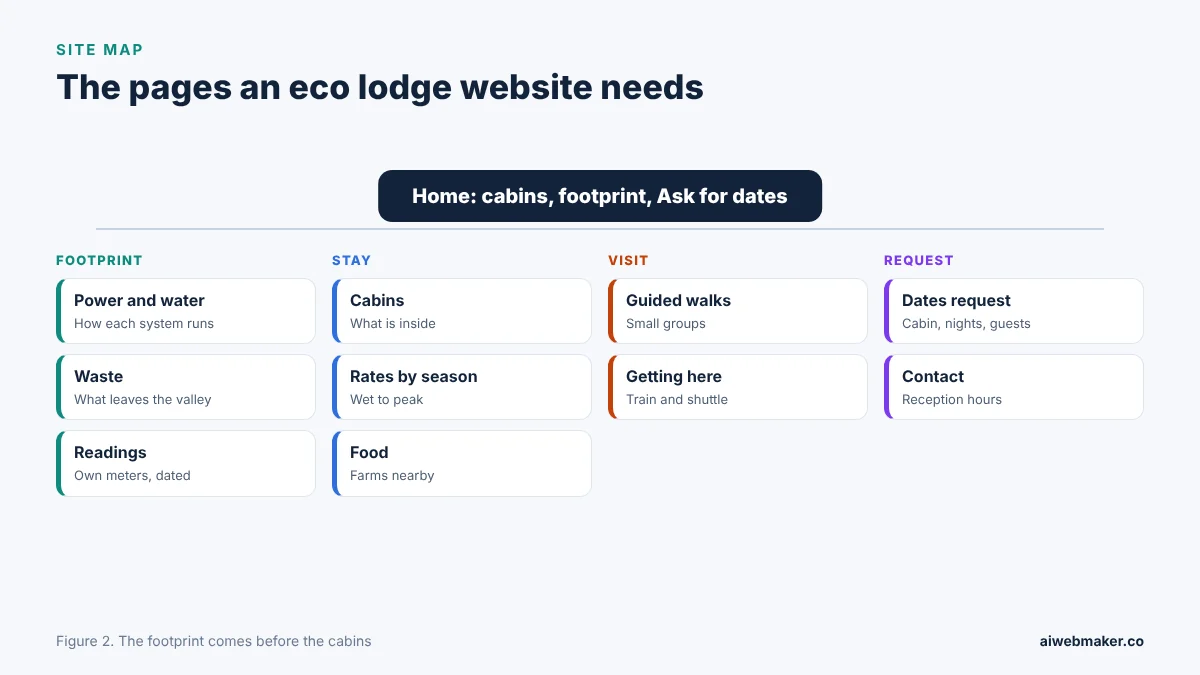
The footprint pages sit at the front of this plan, ahead of the cabins, because careful guests read them first. The footprint group covers power, water and waste with the readings, the stay group holds cabins, rates and food, and the visit group carries walks and travel beside the dates request. Canopy Eco Lodge, the invented lodge behind our sample, rents a Forest cabin, a Stream cabin and a Family cabin. Its account of how the place runs covers Power from the roofs, Hot water from the sun, Rain tanks and a borehole, Shower and sink water, Food scraps and the garden and What leaves the valley, followed by last year's readings and the cabins. The eco lodge website example with meter readings and solar cabins finishes on its dates form and a note on reaching the valley.
Green claims that hold up: measured, dated and sourced
Environmental claims are under closer legal scrutiny in many regions, and an eco lodge's site should be written as if a regulator might read it. Rules on green claims differ, but authorities in places such as the European Union, Britain and the United States have all published guidance or rules against vague or unsupported environmental statements. The safe pattern is specific, measured and dated: a figure, where it came from, the period it covers and what it leaves out. Words such as natural, green or carbon neutral need evidence behind them, and some are best avoided unless a recognised method supports them. Local rules vary, so a lodge should check the guidance where it trades before publishing any claim.
| Claim | Weak version | Version that can be checked |
|---|---|---|
| Energy | Powered by nature | Share of electricity from the panels, from the meter, for a stated year |
| Water | Water wise | Litres per guest night, and how they were measured |
| Waste | Low waste | Rubbish sent to landfill per period, from collection records |
| Food | Locally sourced | Share of kitchen spending within a stated distance |
| Carbon | Carbon neutral | Best avoided unless a recognised method and evidence back it |
| Certification | Eco certified | The scheme's name, what it assessed and when |
Meter readings as a page guests can read
Publishing the lodge's own readings is the strongest proof an eco lodge can offer, because numbers that change week by week are hard to fake and easy to question. A simple table can show electricity from the panels, hours the generator ran, water used per guest night, rubbish sent to landfill and the share of kitchen food from nearby farms. Readers deserve to know how and when the readings are taken, and that they come from the lodge's own meters and receipts rather than an outside audit, unless one has genuinely been done. Admitting what is not yet solved, such as a generator for cloudy weeks, builds more trust than a perfect looking chart. Readings updated at a set interval give returning guests a reason to look again.
Off grid comfort, stated before anyone packs
Guests who arrive expecting hotel comforts at an off grid lodge leave unhappy, so the site should say what the cabins have and lack before anyone books. Limited solar power may mean no air conditioning, no kettles or hair dryers in the cabins and a set place to charge laptops. Wifi may be weak or limited to the main lodge, and phone signal may be patchy in a valley, which some guests welcome and others need to plan for. Hot water heated by the sun may run cooler after several grey days, and the page can say how the lodge handles that. Precise expectations turn possible complaints into part of the experience guests chose.
Wet months, dry months and minimum stays
Rates at an eco lodge usually follow the weather and the school calendar, and a seasonal table explains the pattern better than a single price. Wet months often bring the lowest rates and the greenest landscape, while dry months and school holidays carry the highest. The page should describe what each season is actually like, including muddy paths, insects or closed routes, so guests choose with open eyes. Minimum stays protect a remote lodge from single nights that are costly to service, and local taxes should be noted as added at the rate set where the lodge stands. Honest seasons turn the quieter months into a choice rather than a compromise.
| Season | Typical pattern | Rule worth printing |
|---|---|---|
| Wet months | Lowest rates, greenest valley, fewer guests | Muddy paths, which walks still run |
| Shoulder months | Rates rise, mixed weather | Which routes open, booking lead times |
| Peak months | Highest rates, dry weather, school holidays | Longer minimum stays, earlier deposits |
| Local taxes | Set by local or regional authorities | Added at the local rate |
| Minimum stay | Often two nights or more | Stated beside every rate |
Trains, shuttles and the travel footprint
Travel is often the largest part of a trip's footprint, so an eco lodge that helps guests arrive without a car makes a meaningful offer. A travel page can list the nearest station or bus stop, timetables to check, any shuttle the lodge runs and the walk or ride from the road. Claims about offsetting travel need great care, since offset quality varies widely and much official guidance warns against leaning on offsets for green claims. The AI website builder for eco lodges and their footprint pages drafts the cabins, readings, rates and travel pages once the owner describes the place, the systems and the seasons, and each figure can be corrected in the preview. A clear route from station to cabin often decides whether a guest without a car books at all.
Off grid cabins and the searches nature lovers type
Guests search with phrases such as eco lodge, off grid cabin, solar powered cabin, forest lodge with guided walks or nature retreat, usually with a region or a park name. Cabin, walk and footprint pages that carry those words, and name the valley or the nearest town, catch these searches. The map listing should show an accurate location, photos of cabins and the route from the road, since remote places are easy to misplace. Reviews that mention the guides, the food and the honesty of the claims persuade careful guests more than any badge. Articles on what to pack for wet months, how the solar system works or the birds seen each season attract readers long before they book.
Batteries, guides and the website: a lodge's yearly bill
Battery maintenance, guides' wages, food from nearby farms and the upkeep of timber cabins dwarf an eco lodge's website costs. AI Web Maker hosting amounts to $119 for a lodge that pays yearly and $19 a month for one that prefers monthly bills, with the domain's price following its chosen ending. Twelve articles on seasons, walks and the solar system come to roughly $7.80, at around 65 cents of AI credit for each. Posting new readings or changing a seasonal rate costs nothing. Listed purely for comparison, the $189 tier rounds out the table.
| Item | Yearly | Monthly |
|---|---|---|
| Hosting the cabin and footprint pages | $119 | $228 over twelve months |
| Domain | Depends on the ending | Depends on the ending |
| Higher plan, for comparison | $189 a year | Not needed |
| Twelve season and walk articles at about $0.65 | About $7.80 | About $7.80 |
| New readings and rate changes | No charge | No charge |
| Year before the domain | About $126.80 | About $235.80 |
Vague green words, missing readings and other reasons careful guests leave
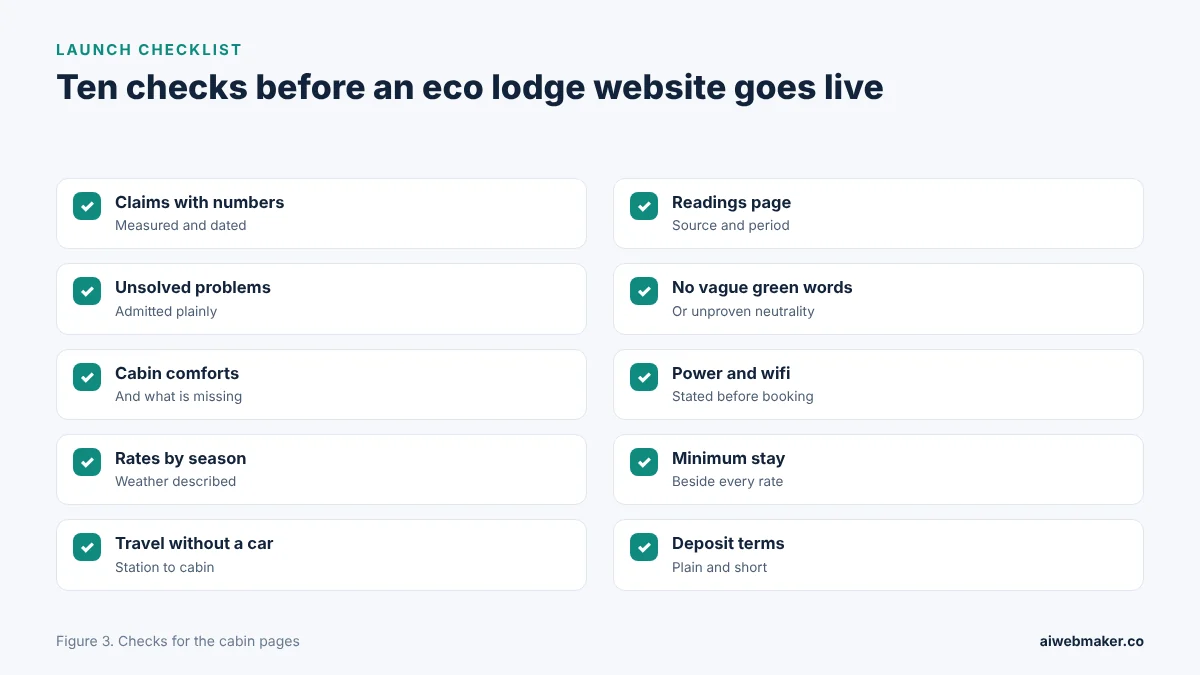
Careful guests leave an eco lodge's site when its claims are all adjectives and no numbers. Photos of cabins without a word about power, wifi or air conditioning raise fears of an uncomfortable surprise. Carbon neutral claims with no method behind them make informed readers distrust the rest of the site. No help with travel leaves guests without a car unsure they can reach the valley at all. Ten fixes for these failures fill the checklist shown below.
Frequently asked questions
Can guests charge laptops and phones in an off grid cabin?
Most off grid cabins can charge phones and cameras, though laptops may need the main lodge, depending on the size of the solar system. The page should state what each cabin's sockets can handle and what is not allowed, such as hair dryers or heaters. Cloudy weeks can reduce the power available, and a lodge with a backup generator can explain when it runs. Guests who need to work during a stay should ask before they book. Plain answers prevent a frustrating first evening.
Is there wifi at an eco lodge?
Many eco lodges offer wifi only in shared spaces, or none at all, either because of the remote location or as a deliberate choice. Mobile signal in valleys and forests can be weak or absent, and the site ought to admit it. Guests who need to stay in touch, such as parents or people on call, can be told where signal is strongest. Some guests see limited connection as the point of the stay, while others need to plan around it. Honest detail lets each guest decide before arriving.
Does the lodge offset guests' travel?
Offsetting travel is a complicated claim, and many guidance documents on green marketing warn against relying on offsets to call a trip carbon neutral. A lodge that does buy offsets should name the scheme, explain what it funds and avoid suggesting that it cancels the impact of a flight. Many lodges prefer to reduce travel impact directly, with station pick ups, longer minimum stays and advice on trains and buses. Since rules on environmental claims change from country to country, local guidance should shape the final wording. Care here protects the lodge's credibility on every other claim.
How do deposits and cancellations work at an eco lodge?
Remote lodges often take a deposit, such as one night's rate, once a cabin is confirmed, because a late cancellation is hard to fill. The page should give the deposit, the date the rest is paid and the cancellation deadlines, along with how weather closures are handled. Payment is arranged by the lodge directly, and the site should say how. Refund rights differ from one country's consumer law to the next, so a lodge should have its terms checked where it trades. Clear terms give a guest the confidence to request dates without a middleman.
Two nights in a forest cabin against the hosting year
A two night stay in one cabin generally exceeds what the lodge spends on twelve months of hosting. Where the lodge pays monthly, each $19 charge is dwarfed by a single cabin night. Each guest who arrives having read the readings, the comfort notes and the travel page settles in faster and complains less. Returning guests who check the new readings each year become the lodge's most loyal direct bookings. Requests that mention the station shuttle or ask about the solar system show the footprint pages are being read.
Build your website in Minutes and get the AI Tools that work
Start Building Your Website →