Corporate Catering Website Cost, Labelled Lunches and PO Invoices
Office caterers can host menus and order pages on a $119 annual plan or a $19 monthly one, before adding a domain. Covered: who orders, the pages, per head menus, named labels and allergens, ordering routes, accounts and invoices, search and the budget.
- No coding required
- Live in minutes
- Blog, SEO and chatbot tools included
The menus, ordering terms and account pages of an office caterer need $119 of hosting each year, or $19 a month, with a domain added. AI Web Maker bills nothing for the drafting stage, however many times the menus are rewritten before launch. One working lunch for twenty at the sample's $14 a head comes to $280, which would fund more than two years of hosting. Selling to an office is hard because the buyer is an office manager with a deadline and a finance team behind them. That buyer needs proof of reliability, accurate labels and clean invoices before flavour even enters the decision. Who orders, the pages, per head menus, named labels and allergens, ordering routes, accounts and invoices, search and the yearly sums each get a section of their own.
This article is part of our complete guide: Food Business Website Builder.
Office managers, people teams and finance leads: who places the order
Corporate catering is usually ordered by someone whose own reputation rides on the meeting going smoothly. Office managers and executive assistants order breakfasts and working lunches, often the afternoon before. People teams book training days and company meetings that run from morning coffee to evening canapés. Finance leads rarely eat the food but decide whether a caterer stays on the approved supplier list. Facilities and reception teams care about delivery times, signing in and what happens to the trays. Each of them checks the cut off time, the diets covered and how the invoice will look before anything else.
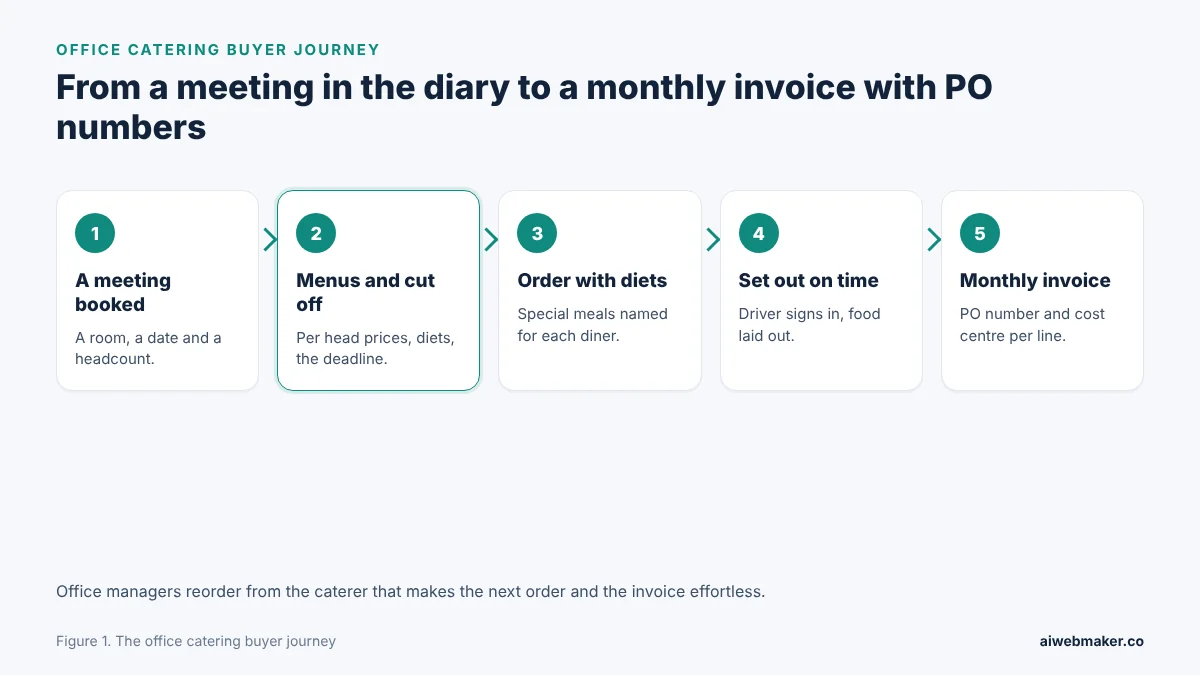
This journey is decided at the second step, where an office manager checks the menus, the price per head and the ordering deadline. A menu that states what each person receives, and a cut off printed beside it, lets the order go in within minutes. The order itself should carry diets by name, so special meals arrive labelled for the right people. Food set out before the meeting begins, with plates and allergen cards, is what the room notices. A monthly invoice that matches every order is what the finance team notices, and it decides whether the caterer is used again.
Pages an office caterer needs before the first purchase order
Readers of an office caterer's site are ordering at work between other tasks, so every page must settle a buying question fast. The home page should state the cut off for next day orders, the smallest order and the delivery area. A menus page sets out each option with a price per head and the diets it can cover. A page on labels and allergens explains how special meals are named and how the shared kitchen is managed. Ordering, invoicing and delivery pages close the set for office managers and finance teams alike.
| Page | Office manager's question | What it should show |
|---|---|---|
| Home | Can they feed tomorrow's meeting? | Cut off time, smallest order, delivery area |
| Menus | What does each person get? | Set menus per head, diets each can cover |
| Diets and allergens | Will special meals be safe and named? | Named labels, allergen cards, shared kitchen note |
| Ordering | How do weekly orders work? | One meeting, weekly lunch, event day |
| Invoicing | Will finance accept the paperwork? | PO numbers, cost centres, terms, sales tax |
| Delivery | Where, and when? | Area, delivery windows, tray collection |
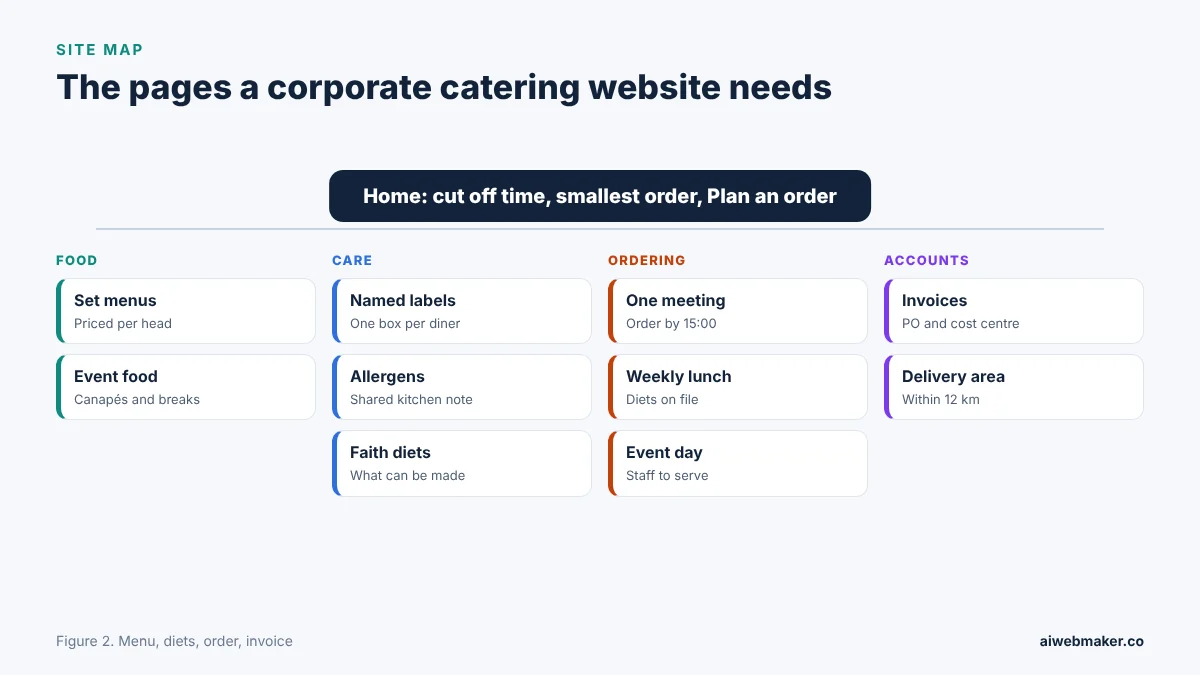
Office buyers move through this plan in the order a purchase order does: menu, diets, order and invoice. Food pages hold the set menus and event food, care pages hold named labels and allergens, ordering pages hold the three ways offices buy, and account pages hold invoices, terms and the delivery area. Our sample, Boardroom Kitchen Catering, offers one meeting from $14 a person, a weekly team lunch from $12.50 and an event day from $38, with ten people as the smallest order. It sets a 15:00 cut off for next day orders, delivers within 12 km and sends approved accounts one invoice a month carrying each order's PO number. The corporate catering website example with named diet labels and monthly invoices was written by hand as a model, and no sandwich has ever left its kitchen. Its habit of naming every special box is the detail office managers would notice first.
Per head menus, minimum orders and the cut off
Corporate catering sells by the head, so set menus with a clear price per person are the core of the website. Each menu should list what one person receives, the smallest order and which diets it can cover, box by box. A cut off for next day orders, stated near the top of every menu page, answers a question that comes up constantly. Prices should say whether sales tax is included, since rules on how tax appears differ by country and region. Breakfasts, working lunches, hot bowls, afternoon breaks and reception canapés cover most office occasions. A menu page built this way lets an office manager order in minutes without picking up the phone.
| Menu | Per person | What each person gets |
|---|---|---|
| Early start | $9 | Two small pastries, a fruit pot, yoghurt with granola, juice |
| Working lunch | $14 | Two sandwich or wrap halves, a salad pot, fruit, a cookie |
| Hot lunch bowls | $18 | A main bowl, a side and a dessert |
| Salad and grain table | $16 | Four salads, roast vegetables, a protein to share, bread |
| Afternoon break | $8 | Traybakes, cut fruit, cheese and crackers |
| Reception canapés | $24 | Eight canapés each, four hot and four cold |
Named labels, allergens and the honest limits of a shared kitchen
Named labels separate a corporate caterer from a sandwich delivery, because office managers carry the blame when a diet goes wrong. Each special order can arrive in its own box with the diner's name and diet on it, and every label can list the allergens inside. Shared platters need a card listing what each dish contains. Allergen law differs by region, with fourteen allergens named for declaration under European Union and British rules and nine major food allergens recognised in the United States, so the caterer should follow the rules where its kitchen is registered. A kitchen that handles gluten, nuts, sesame, milk and egg every day should say that traces are possible, and that it will advise ordering elsewhere when a severe allergy cannot be made safe. Honesty about those limits protects diners and the caterer's name alike.
Weekly lunches, event days and repeat orders
Offices order in three patterns, one off meetings, weekly team lunches and full event days, and each needs its own terms on the website. Weekly lunches are the most valuable, because one decision by an office manager can mean fifty orders a year. Diets kept on file by name, and headcounts that can change until the cut off, make the repeat order effortless. Event days need more notice, staff to serve and clear, and plates, glasses and linen. The AI website builder for office caterers with per head menus drafts the menus, ordering and invoicing pages once the caterer describes its kitchen, delivery area and cut off briefly, and every sentence stays editable in the preview at no cost. Clear terms for each route turn a first meeting order into a standing weekly lunch.
| Route | From, per person | Terms worth stating |
|---|---|---|
| One meeting | $14 | Order by 15:00 the day before, ten people or more |
| Weekly team lunch | $12.50 | Same day each week, headcount changes until 15:00 |
| Event day | $38 | Staff to serve and clear, five working days of notice |
Accounts, purchase orders and the supplier checks procurement runs
Corporate buyers rarely settle each lunch on the spot, so the website should explain accounts, invoices and terms before a finance team asks. Approved accounts can receive one invoice a month listing every order with its date, room, cost centre and purchase order number. New customers may pay for the first order before delivery while the account is opened, as the sample describes. Procurement teams often ask suppliers for proof of insurance, food business registration and hygiene inspection results, such as a food hygiene rating in the United Kingdom, so a page listing what can be supplied saves weeks. Payment terms, such as 30 days, are agreed and settled between caterer and client directly. Paperwork that matches the orders exactly is what keeps a caterer on an approved supplier list.
Searches office managers run the afternoon before a meeting
Office managers search for speed, diets and occasion far more than for a caterer's name. Typical phrases include corporate catering near me, office lunch delivery, breakfast meeting catering, team lunch catering and office catering with dietary labels, often with a business district or postcode. Echoing those phrases in headings lets the breakfast page catch the person searching for a breakfast meeting. A map listing for the production kitchen, with its delivery area and order desk hours, helps buyers nearby. Reviews from office managers and finance leads that mention named labels or tidy invoices persuade the next buyer in the same role. Articles on ordering for mixed diets or how much food a training day needs reach planners before the meeting is even booked.
What the order desk's website costs in a year
Compared with one working lunch for a team, the yearly hosting bill is a rounding error in a caterer's costs. An established kitchen keeps it lowest by paying $119 once, while a caterer winning its first office accounts may prefer $19 a month. Twelve articles on diets, menus and event days add roughly $7.80 in credits. Updating menus, prices per head or the delivery area costs nothing extra. The two billing routes are listed in full, with a $189 tier added for comparison alone.
| Item | Yearly | Monthly |
|---|---|---|
| Hosting the menus, ordering and invoicing pages | $119 | $228 over twelve months |
| Domain | Depends on the ending | Depends on the ending |
| Higher plan, for comparison | $189 a year | Not needed |
| Twelve office diet and menu articles at about $0.65 | About $7.80 | About $7.80 |
| Menus, prices and delivery area | No charge | No charge |
| Year before the domain | About $126.80 | About $235.80 |
Gaps that push an office manager to a different caterer
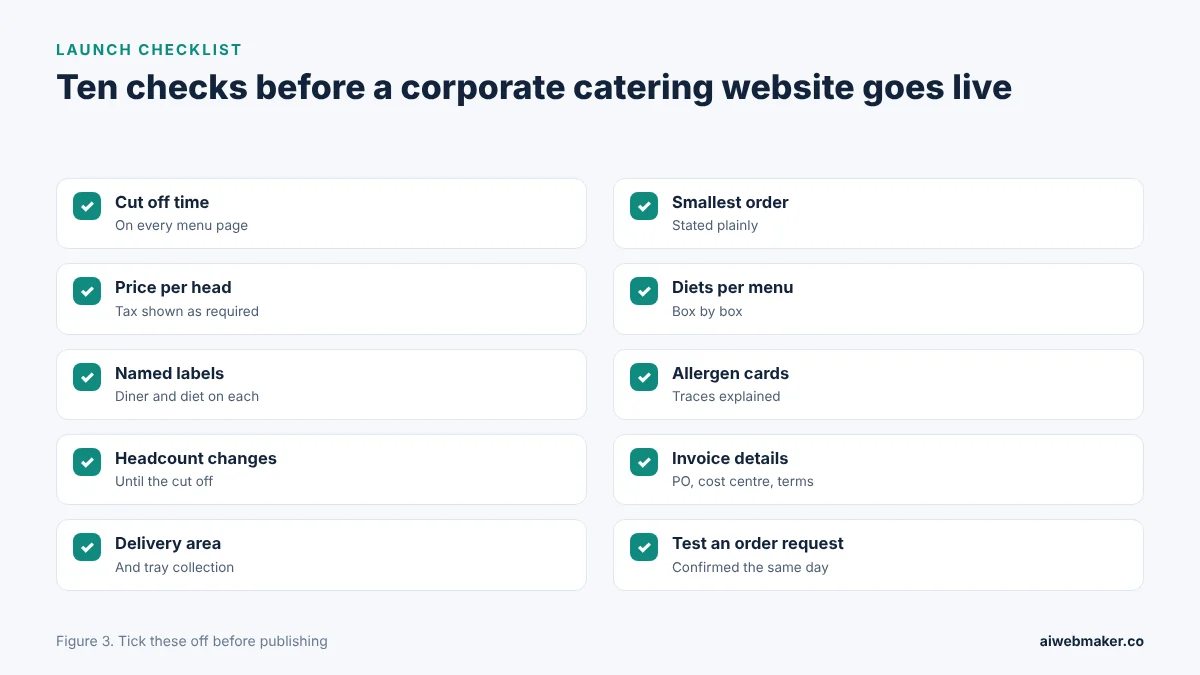
An office manager leaves a caterer's site at once when no cut off time appears for next day orders. Menus without a price per head make it impossible to stay inside a budget. Silence on named labels and allergens is a risk no one ordering for colleagues wants to take. No word on invoices, PO numbers or terms means the finance team will refuse the supplier anyway. Without a stated delivery radius, a buyer two districts away cannot tell whether ordering is even possible. Ten order desk checks, drawn next, put each of those failings right.
Frequently asked questions
What is a sensible smallest order for office catering?
A smallest order protects the kitchen from deliveries that cost more to make than they earn, and the website should state it on every menu. The sample sets ten people for any menu, which suits most meeting rooms. Some caterers let smaller teams order at the price for the minimum, which helps for client meetings. Stating the rule clearly prevents frustrated calls from people ordering for four. A visible minimum lets buyers plan rather than guess.
Can the headcount change after an order is placed?
Headcounts change constantly in offices, so the website should explain exactly when changes are still possible. A cut off, such as 15:00 on the day before delivery, gives the kitchen time to plan. Extra people can sometimes be added later from what the kitchen has made, but new diets may not be possible. Weekly lunch accounts benefit most from a clear rule, because numbers shift every week. Clear limits keep both the office and the kitchen calm.
How should halal, kosher and other faith diets be handled?
Faith diets deserve precise wording, because guessing can offend colleagues and break real rules. A caterer that can source halal meat should say which menus include it and how to ask. Kosher meals usually need a supervised kitchen or a certified supplier, so many caterers either buy them in sealed or say plainly that they cannot provide them. The sample takes the second route and says so. Honest answers let office managers plan for every colleague with confidence.
Do offices need a kitchen on site for delivered catering?
Most delivered office catering arrives ready to eat, so a kitchen on the client's floor is rarely needed. Hot dishes can travel in insulated boxes and be set out on a meeting table or counter. A sink nearby helps on event days, though it is seldom essential. The website should say what the driver brings and what is collected afterwards. Clear answers here remove one more reason for a busy office manager to hesitate.
How many working lunches cover the caterer's year online?
Nine single working lunches at the sample's $14 a head already outweigh the $119 hosting bill. A weekly team lunch for ten covers the whole year in its very first week. What wins those weekly accounts is reliability made visible: cut off times, named labels, honest allergen notes and invoices that match the orders. Diets kept on file and headcounts that flex until the cut off then keep the account for years. Caterers who keep menus and terms current give office managers no reason to look elsewhere. Measured in lunches, the website pays for itself before most meetings have started.
Build your website in Minutes and get the AI Tools that work
Start Building Your Website →