Comedy Club Website Cost, Weekly Line Ups and Honest House Rules
A comedy club runs its line ups and house rules online for $119 of hosting a year, or $19 in a given month, with a domain alongside. Inside: audiences, pages, nights, seats, rules, line up changes, hire, search and costs.
- No coding required
- Live in minutes
- Blog, SEO and chatbot tools included
A comedy club can run its line ups, seating and house rules online for $119 a year of hosting, or $19 in a given month, with a domain alongside. Every rewrite of the week's bill, the seating plan and the rules can be tried in the preview first, and those rehearsals are not billed. Eight seats sold on one Thursday at the sample's prices cover the whole year. The real work lies in selling a night out whose content changes every week, to audiences who fear being picked on, offended or turned away at the door. A club's site has to be honest about strong language, age limits and front row banter while still sounding like a great night. Below come the people who read a comedy club's site, the pages, nights of the week, seats and tickets, house rules, line up changes, hire and the room, search, costs and the gaps that lose a booking.
This article is part of our complete guide: Food Business Website Builder.
Date nights, office groups and new acts: who reads a comedy club's site
Comedy club websites are read by couples planning a date, friends after a cheap midweek laugh, office organisers booking a group and comedians hoping for a spot. Couples check who is on, where they will sit and whether the front row means being talked to. Groups want blocks of tables, food and a price per head that fits a team budget. Regulars look at the week's line up and the nights that suit them, from rough open mics to polished headliners. New acts read the open mic rules, how spots are given out and how long a set lasts. Answering each of these readers directly keeps them from drifting to a cinema listing.
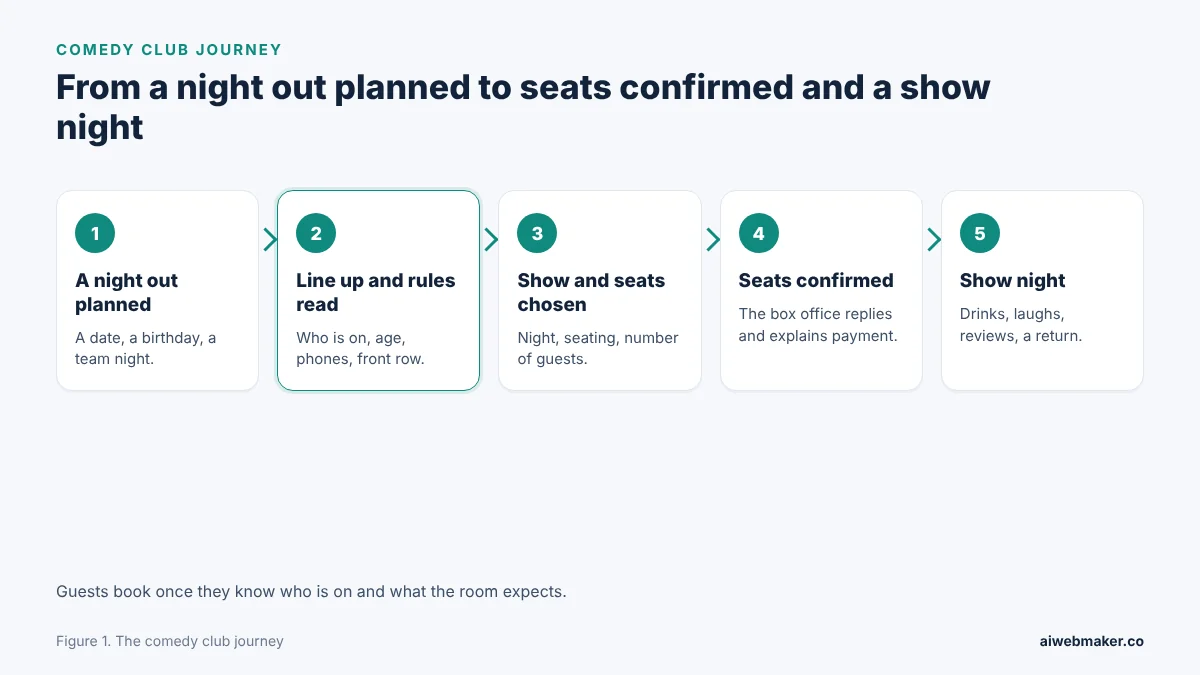
Line ups and house rules light up the second step of this comedy club journey, because nobody books a night without knowing who is on and what the room expects. Couples and groups start with a plan, often a birthday or a Friday with nothing booked. Choosing a show and a seat follows, and the ringside question matters more than most clubs realise. The box office reply turns a request into seats held, with payment explained. Show night then decides whether the group writes a review and comes back for another headliner. Each page should move a hesitant reader from curiosity to a table.
Line ups, seats and house rules: the pages a comedy club runs
A comedy club needs fewer pages than a theatre, but each must stay current because line ups change every week. A what's on page lists the nights, the format, door and show times and ticket prices. A seating page explains standard seats, ringside tables and group blocks. House rules gather the policies on age, language, phones, heckling and latecomers. A room page shows the venue, the drinks and food and the access arrangements, and a seat request page and directions finish the set. Kept up to date, these pages answer most of what the box office would otherwise be asked.
| Page | Reader's question | What it must show |
|---|---|---|
| What's on | Who is on this week | Nights, format, door and show times, prices |
| Seating | Where will we sit | Standard, ringside, group blocks, access seats |
| House rules | What does the room expect | Age, language, phones, heckling, latecomers |
| The room | What is the night like | Photos, drinks, food, table service |
| Open mic | How can a new act get a spot | Sign up route, set length, how spots are given |
| Seat request | How do we hold seats | Show, date, guests, seating choice |
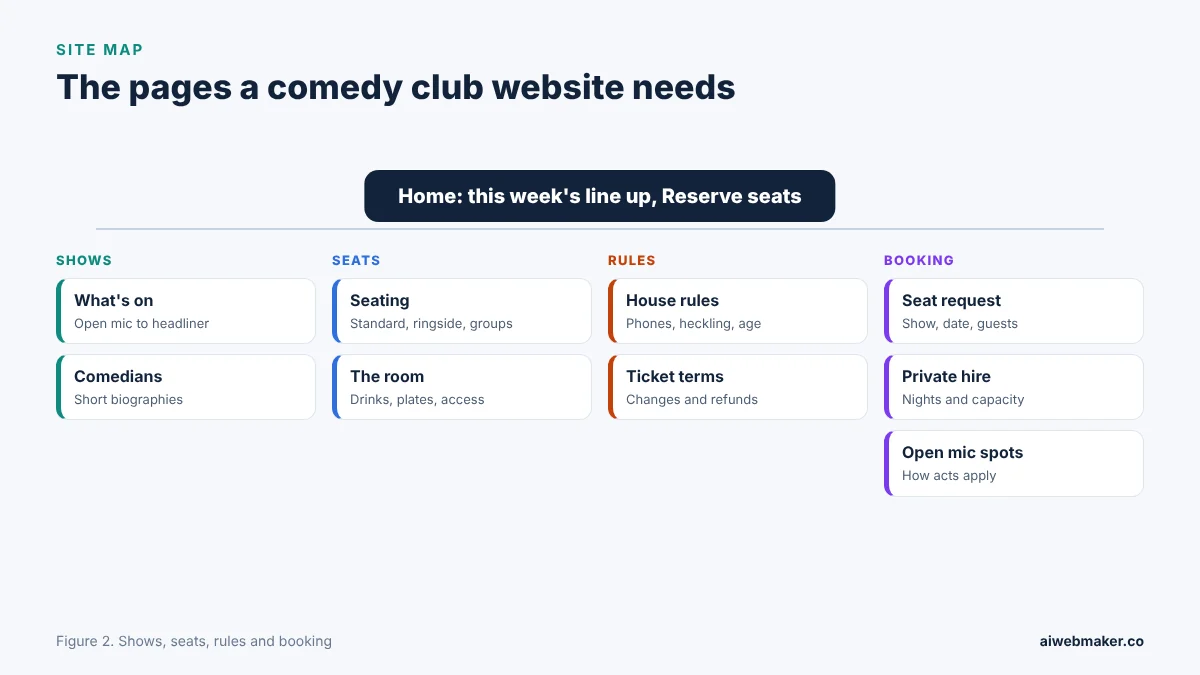
Shows, seats, rules and booking form the four branches of this comedy club's plan, with this week's bill printed across the top. Our sample club, The Punchline Room, sets out its week in a table, from a Tuesday open mic and a Wednesday work in progress night to headliner nights at the weekend and a Sunday family matinee. Its seating section offers a standard seat, a ringside table and a group night, and a short outline explains how a night runs from doors to the closing act. House rules cover strong language, the age policy, phones away, heckling, latecomers and looking after each other. The comedy club website example with a weekly line up, seating and house rules closes on a seat request covering the show, its date, how many are coming and where they would like to sit. That structure puts the awkward rules in front of guests before they arrive, which is where they belong.
Open mic to headliner: describing each night of the week
Each night of a comedy club's week should be described by its format, because the same ticket price can buy very different evenings. An open mic gives new acts short slots and suits audiences who enjoy rough edges at a low price. Work in progress nights let established comedians test new material, and audiences should know that the jokes are still being shaped. Showcase nights with a host and several acts are the safest choice for groups and first visits. Headliner nights add a well known closing act after support sets, usually at a higher price and with earlier sell outs. A short line on each format sets expectations, which is the best protection against disappointed reviews.
| Night | What the audience gets | Who it suits |
|---|---|---|
| Open mic | Many new acts on short slots | Regulars, students, curious locals |
| Work in progress | Seasoned acts testing new material | Fans who like seeing jokes take shape |
| Showcase | A host and several polished acts | First visits, dates, groups |
| Headliner night | Support acts, then a known closer | Celebrations and weekend plans |
| Family or clean show | Sets without strong language | Families with older children |
Ringside, standard and group seats, with the ticket terms
Seating causes more anxiety at a comedy club than at almost any other venue, because the front row is where acts talk to the audience. The website should say plainly that ringside guests may become part of the show, and offer seats further back for those who would rather watch. Standard seats, group blocks and accessible seats each need a short description and a starting price. Ticket terms belong on the same page: when payment is taken, what happens if a show is cancelled and whether a changed line up allows a refund. Consumer rules on refunds vary by country, so the club's terms should be written with local law in mind. Guests who know where they will sit arrive relaxed rather than braced.
| Seat or term | What guests want to know |
|---|---|
| Ringside table | That acts may talk to them, and the price |
| Standard seat | Sightlines, ordering at the table, price |
| Group block | Tables together, platters, a host mention only on request |
| Accessible seats | Level access, where they are, how to ask |
| Cancelled show | A full refund, and how it is made |
| Changed line up | Whether it affects the booking |
House rules on phones, heckling, age and latecomers
House rules protect the comedians, the audience and the club, and a short, friendly list works better than a wall of warnings. Phones away during sets matters because acts test material, and a clip online can kill a joke before it is finished. Heckling rules should separate laughing loudly from talking over the stage, and say what happens after a warning. Age policies depend on licensing and content, and identification checks at the door should be mentioned. Latecomer rules, such as seating guests during a pause between acts, prevent disruption. A line on who to tell if someone is bothering a guest shows that the club looks after its audience as well as its acts.
Line up changes, cancellations and keeping the week current
Line ups in comedy change often, through illness, travel or a comedian landing a television slot, so the website must handle change gracefully. The weekly page should carry a date and be updated as soon as an act changes. A clear statement that a changed act does not alter the booking, while a cancelled show is refunded, prevents disputes, provided the policy matches local consumer law. Short biographies of headliners, with a line about their style, help audiences decide without searching elsewhere. Clubs that post the coming week on a fixed day train regulars to check back. A current, honest listing is the single page that keeps a comedy club's regulars loyal.
Private hire, birthday groups and the room itself
Group nights and private hire bring a comedy club its biggest single bookings, and the room itself is part of what sells them. A group page should describe reserved tables, sharing platters, how the host treats birthdays and the price per guest. Private hire needs the nights available, the capacity, a starting price and whether the club books the line up. A page about the room, with its seats, drinks and small plates, table service rules and level access, answers practical questions before they are asked. The AI website builder that drafts comedy club pages from a few lines about the room writes first versions of the what's on, seating, rules and hire pages, which the club then sharpens in the preview. Practical detail about the room makes a night out easier for a group to agree on.
Searches that fill a comedy club on a weeknight
Comedy audiences type phrases such as comedy club near me, stand up comedy tonight, open mic comedy or comedy night for a birthday, often with the city named. Comedian names attract searches of their own, so each headliner's name written as plain text on the line up can bring in their fans. The main phrases belong in the heading of the what's on page, right beside the dates. Door times on the map listing must match the club's own, with photos of the cellar or hall and a link straight to the week's bill. Articles about comedy etiquette, what an open mic is like or how a work in progress night differs from a headliner show give new audiences confidence. Steady listings and articles make the club the obvious answer when someone asks what is on tonight.
Twelve months of stand up listings, priced
Keeping a comedy club's listings online involves three budget lines: hosting, a domain and some credit for articles. Hosting is $119 when paid for the year, whereas twelve monthly charges of $19 reach $228. The domain is chosen from about 400 endings, each with its own price. Twelve articles on comedy nights and etiquette use about $7.80 of credits. A $189 tier is shown purely to compare, and the weekly line up can be rewritten as often as the acts change without any fee.
| Item | Yearly | Monthly |
|---|---|---|
| Hosting the comedy club pages | $119 | $228 over twelve months |
| Domain | Depends on the ending | Depends on the ending |
| Higher plan, for comparison | $189 a year | Not needed |
| Twelve comedy night articles at about $0.65 | About $7.80 | About $7.80 |
| Line up, seating and rule updates | No charge | No charge |
| Year before the domain | About $126.80 | About $235.80 |
Stale line ups and silent rules that lose the booking
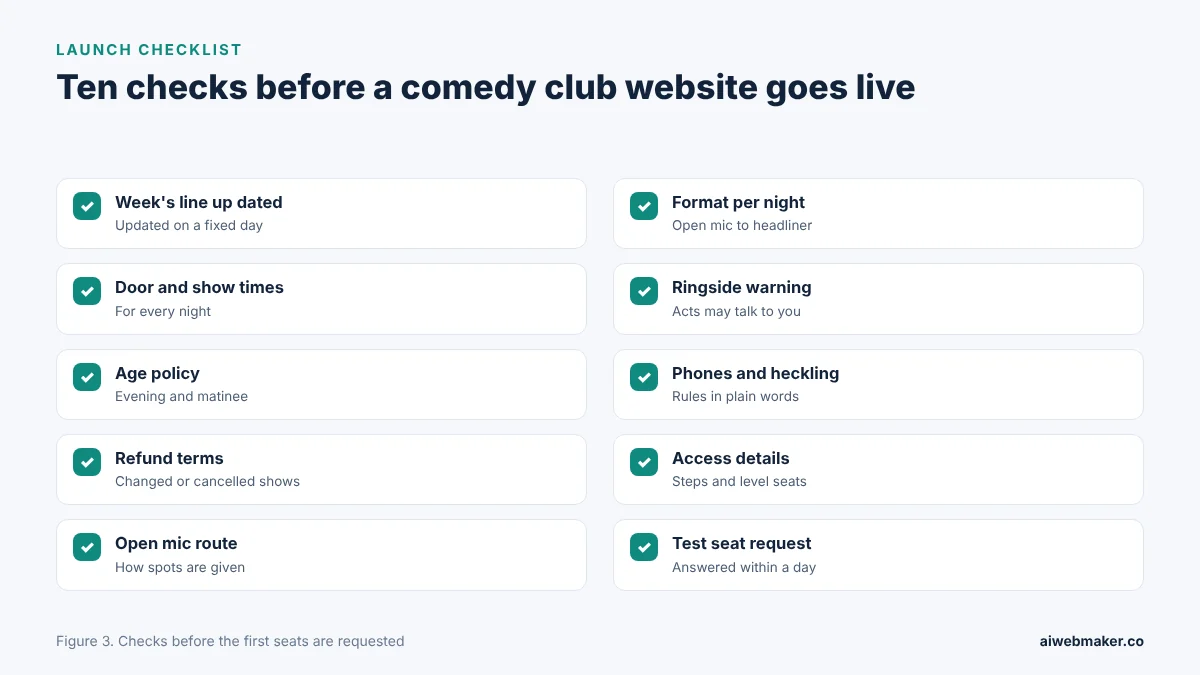
Visitors leave a comedy club's website when this week's line up is missing or still shows last month's acts. Missing age rules leave mixed age groups unsure who will get through the door. Silence about the front row puts off the many people who dread being picked on. Unclear refund terms for changed or cancelled shows make cautious buyers hesitate. No mention of steps or level access excludes guests who need to know before they book. Each of these gaps has a tile among the ten pictured here.
Frequently asked questions
Will comedians pick on the front row?
Comedians often talk to the front rows, because crowd work is part of live stand up. The website should say so plainly and offer seats further back for guests who would rather stay out of it. Ringside tables can be described as the place for guests who enjoy being part of the show. Hosts can also be asked not to mention a birthday unless the group requests it. Honest seating descriptions let every guest choose the night they want.
Can teenagers come to an evening show?
Whether teenagers can attend depends on the club's licence, the content of the show and local law, which varies between countries. Many clubs restrict evening shows to adults because of strong language and alcohol service, with identification checked at the door. Some run family or clean matinees for older children with an adult. The website should state each policy and the ages that apply. Clear rules prevent a group being split at the door.
What happens if the headliner changes?
Headliners can change at short notice, so the website should explain the club's policy before anyone books. Many clubs treat a changed act as part of live comedy and do not refund for it, while a cancelled show is refunded in full. Consumer rules vary by country, so the policy should be checked against local law. The line up page should change the moment the club hears of a swap. Transparency here keeps trust even when plans change.
How can a new act ask for an open mic spot?
A new act usually asks for an open mic spot by contacting the club's booker with a name and a summary of their experience. The website should explain how spots are allocated, how far ahead they are given and how long a set lasts. Clear rules on timing, behaviour and bringing guests make the night fair for everyone. Some clubs keep a waiting list, and saying so manages expectations. An open and fair process builds the reputation that draws better acts over time.
One Thursday house against a year of hosting
Eight standard seats on a Thursday, priced as the sample club prices them, already beat the $119 yearly hosting bill. Four tickets to the sample's Tuesday open mic clear a $19 month. Group nights, ringside tables and private hire then add revenue a club could otherwise lose to a quiet week. An honest line up, plain house rules and seating that warns about the front row reassure first timers more than any promise of laughs. Clubs that update the week on a fixed day turn first timers into regulars. A full room on a wet Thursday is the result those pages chase.
Build your website in Minutes and get the AI Tools that work
Start Building Your Website →