What a Café Website Costs and How It Turns Passers By Into Regulars
For $119 a year a coffee shop keeps its site online, or $19 monthly for cafés keeping payments small, plus a domain. Inside: who visits, the menu, selling beans, sourcing and brew guides, practical details, events and hire, search and the yearly budget.
- No coding required
- Live in minutes
- Blog, SEO and chatbot tools included
For $119 a year a coffee shop keeps its site online, while cafés keeping payments small choose $19 monthly, and a domain is bought separately. The menu, bean shop and brewing guides can all be built and polished in AI Web Maker before the first payment is taken. As you polish them, the coffee shop website example is a useful yardstick: an invented café AI Web Maker built around bean origins, roasts and the counter. A few days of extra flat whites cover the cost of the year, so the money hardly enters the decision. What matters is whether the website turns a passer by into a regular and a regular into someone who buys beans to brew at home. Café customers check opening hours, the menu, whether there is space to work and whether their dog is welcome, usually on a phone a few streets away. The sections ahead show how each page answers those questions and adds a second till through online bean sales.
This article is part of our complete guide: Food Business Website Builder.
Who looks up a coffee shop online, and why?
Several kinds of people look up a coffee shop online, and each wants a quick answer. Locals check opening hours, especially on holidays and weekends. Remote workers want to know about seating, wireless internet and whether laptops are welcome all day. Visitors to the area look for highly rated cafés nearby and judge them by photos. Parents check for space for prams and a children's menu, while dog owners look for a welcome sign. Coffee enthusiasts look for the origin of the beans and whether they can buy a bag to take home. A website that answers each of these in seconds earns more visits.
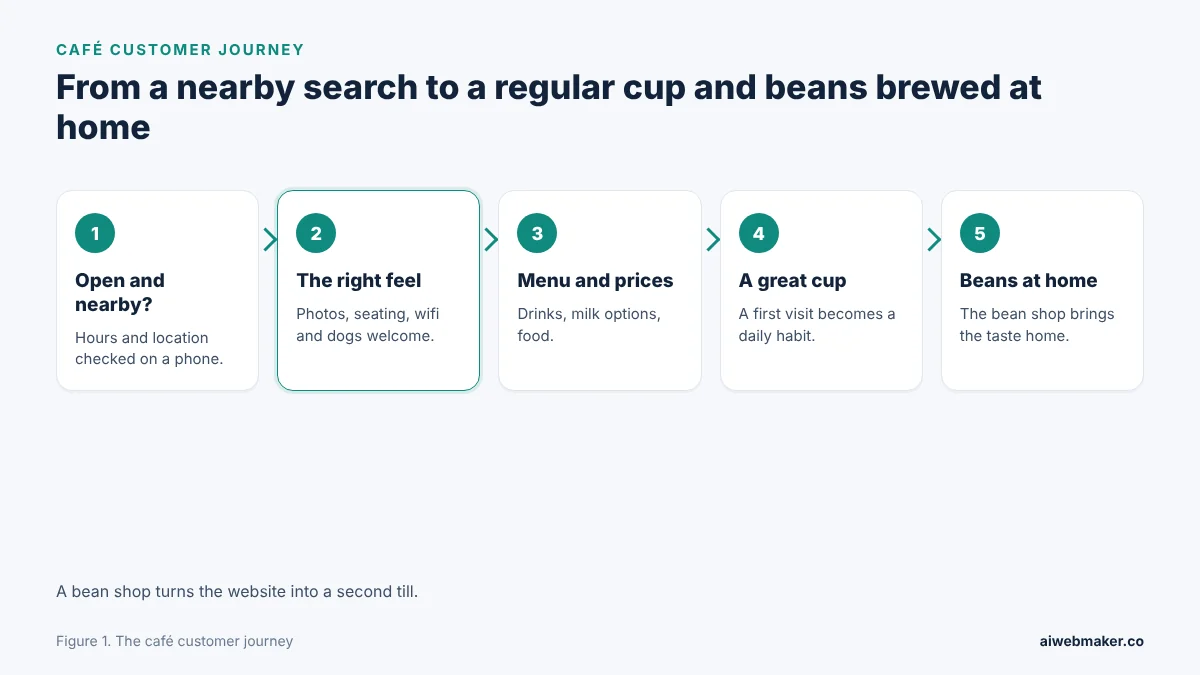
The figure follows a customer from a quick search on a phone to a daily habit that continues at home. Most people first check that the café is open and close by. Photos of the room and the counter decide whether it feels right for the moment, whether a quick takeaway or an afternoon of work. The menu and prices confirm the choice. A great cup turns a first visit into a regular one, and the bean shop lets that customer bring the taste home. Every page of the site supports one of these moments.
How should a café menu be presented online?
A café menu should be presented as real text with prices, grouped into coffee, other drinks, food and extras, so it reads easily on a phone. Coffee drinks can be listed with sizes and the price of extra shots or syrups. Milk options, including oat, soy and other plant milks, should be shown with any extra charge. Food, such as pastries, sandwiches and breakfast dishes, can carry short descriptions and dietary labels. Seasonal drinks give regulars a reason to return and deserve a line of their own. A clear, current menu answers the most common question before customers walk through the door.
| Menu section | What to list | Helpful detail |
|---|---|---|
| Espresso drinks | Espresso, flat white, latte, cappuccino | Sizes and prices |
| Filter and pour over | Rotating single origins | Current beans and tasting notes |
| Milk options | Dairy and plant milks | Any extra charge |
| Other drinks | Tea, hot chocolate, cold drinks | Seasonal specials |
| Food | Pastries, sandwiches, breakfast | Dietary labels |
| Extras | Extra shots, syrups, decaf | Prices |
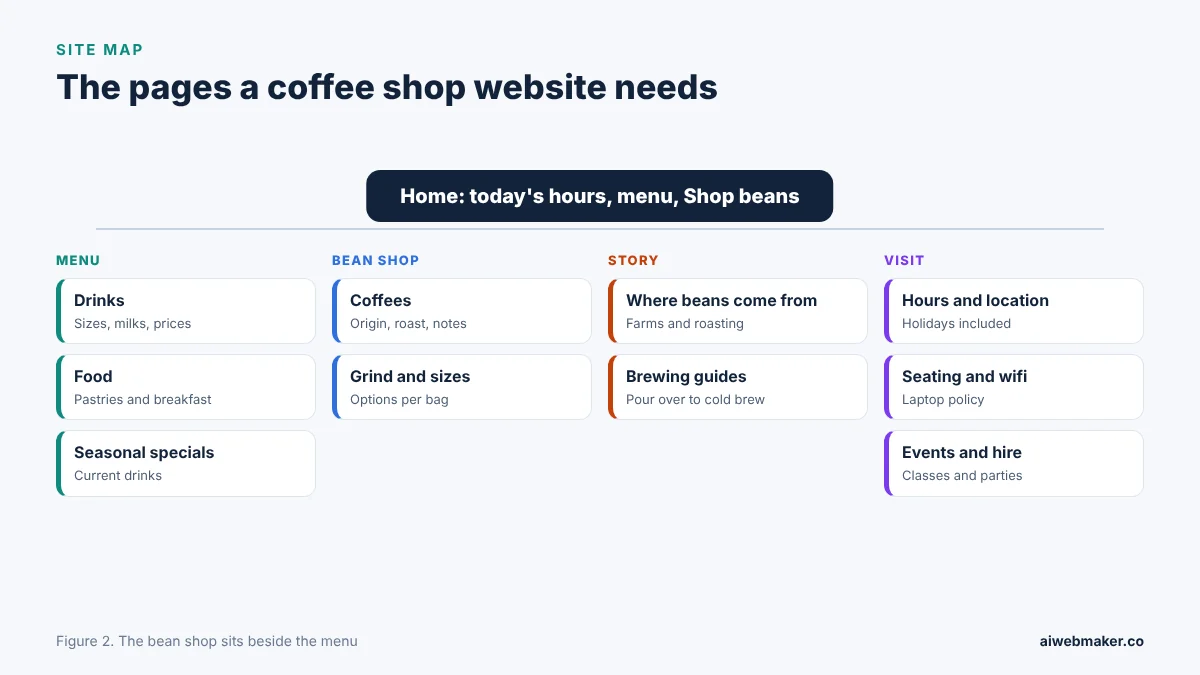
A coffee shop's site map, shown in this figure, splits into the menu, the bean shop, the story and the practical visit pages. Menu pages carry drinks, food, milk options and prices. Shop pages list beans with origins, roast levels, grind options and bag sizes. Story pages explain where the coffee comes from, how it is roasted and how to brew it at home. Visit pages cover hours, seating, wireless internet, accessibility, dogs and private hire. Our sample, Copper Kettle Coffee, has a shop page with three coffees supported by a page on where the beans come from, how they are roasted and how to brew them at home; the coffee shop website example with a bean shop and brewing guides was created in 44 seconds.
How can a café turn its beans into online sales?
Selling beans online starts with one product page per coffee, offering grind and bag size choices. Shoppers add their picks to a bag, and the checkout totals the order with delivery included. Customers who enjoyed a cup in the café can buy the same beans to brew at home, often without needing a reason to visit. Each product page should describe the origin, the roast level and the tasting notes in plain language. Grind options for espresso, filter and cafetière help customers who do not own a grinder. Discount codes can reward regulars or launch a new single origin. The AI website builder that cafés use for their menu and bean shop pages creates these product pages along with the menu once the café lists its coffees.
| Product detail | What to include |
|---|---|
| Origin | Country, region, farm or cooperative where known |
| Roast level | Light, medium or dark, with a short description |
| Tasting notes | Three or four plain flavour words |
| Grind options | Whole bean, espresso, filter, cafetière |
| Bag sizes | Common sizes and prices |
| Brewing suggestion | The method that suits the coffee best |
What do origin stories and home brewing pages add?
Sourcing stories and brewing guides help a coffee shop because they show genuine expertise and give customers reasons to trust the café's taste. A page about where the beans come from, who grows them and how they are chosen adds depth that a menu cannot. Brewing guides for popular methods, such as pour over, cafetière and moka pot, help customers enjoy the beans they buy. Google's guidance on creating helpful, reliable, people first content explains why original, useful pages like these tend to perform well in search. Short videos of the barista demonstrating a brew add a personal touch. Over time, these pages bring coffee lovers who become loyal customers.
| Brewing method | Grind | What the guide should cover |
|---|---|---|
| Pour over | Medium fine | Ratio, water temperature, pouring rhythm |
| Cafetière | Coarse | Steeping time and plunging |
| Moka pot | Fine | Heat control and timing |
| Espresso at home | Fine | Dose, yield and shot time |
| Cold brew | Coarse | Steeping time and dilution |
Which practical details do café visitors check first?
Café visitors check practical details first, because they decide whether the café suits the moment. Opening hours, including holidays, must be accurate, since a closed door after a walk across town loses a customer for good. Seating, power sockets and wireless internet matter to remote workers, and a clear laptop policy prevents awkward moments at busy times. Step access, accessible toilets and space for prams make the café welcoming to more people. A note about dogs, whether inside or on the terrace, saves owners a wasted trip. These small details often decide which café people choose.
| Practical detail | Why visitors look for it |
|---|---|
| Opening hours | Avoiding a closed door |
| Seating and terrace | Planning a meeting or a long visit |
| Wireless internet and sockets | Working for an afternoon |
| Laptop policy | Knowing when space is limited |
| Accessibility | Step access, toilets, pram space |
| Dogs | Inside, terrace only or not at all |
Should a coffee shop promote events and private hire?
A coffee shop should promote events and private hire if it has the space, because they bring in customers outside the morning rush. Latte art classes, coffee tastings, book clubs and live music build a community around the café. Evening private hire for small parties or meetings can turn a quiet room into income. An events page with dates, prices and how to reserve a place keeps regulars informed. A private hire page should state capacity, available times, food and drink options and minimum spend. Events give people another reason to visit and to talk about the café.
How do people find a coffee shop nearby?
People find coffee shops nearby through searches such as coffee shop near me, best flat white, café with wifi, specialty coffee beans or brunch, usually with a district or town. Pages whose headings use these phrases reach the right visitors. The map listing deserves careful attention, with accurate hours, bright photos of drinks and the room, and a link to the website. Reviews that mention favourite drinks, friendly staff and a comfortable space make the listing stand out. Articles on brewing, new single origins or the café's suppliers attract coffee lovers from further away. A café that shares its passion online becomes a destination rather than a convenience.
Which yearly costs come with running a café website?
The recurring website costs are hosting and a domain, while brewing guides drafted with credits barely add a dollar a month. A café with steady trade pays the least on yearly billing. A new café may prefer monthly payments while it builds a regular crowd. Updating the menu, adding beans or changing hours adds nothing to the bill. Both payment routes are shown below, with the $189 tier for comparison.
| Expense | Yearly | Monthly |
|---|---|---|
| Hosting the café pages and bean shop | $119 | $228 over twelve months |
| Domain | Set by its ending | Set by its ending |
| Higher plan, for comparison | $189 a year | Not needed |
| Twelve brewing articles at about $0.65 | About $7.80 | About $7.80 |
| Menu, bean and hours updates | No charge | No charge |
| Year before the domain | About $126.80 | About $235.80 |
What makes a coffee lover choose a different café?
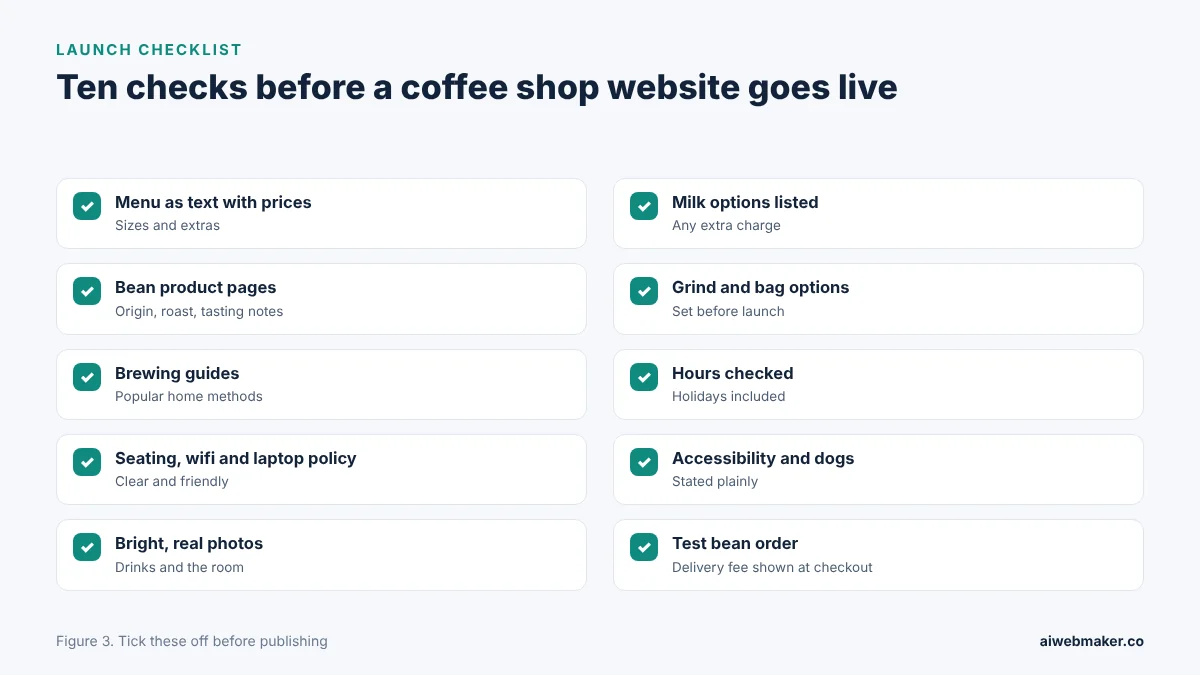
Coffee lovers choose a different café when the website shows no menu or prices at all. Opening hours that are wrong on holidays send people to a locked door. No information about seating or wireless internet loses remote workers to the place down the road. A bean shop without origins or tasting notes feels generic. Dark, blurry photos make even a beautiful room look unwelcoming. The figure that follows sets out ten checks that keep visitors on the page.
Frequently asked questions
Should a café list its prices online?
Listing prices online helps customers decide quickly and builds trust, especially for visitors comparing cafés nearby. Prices should include sizes, extra shots and any charge for plant milks. Updating them takes minutes when costs change. Customers who know the price in advance are more likely to visit. Clear pricing also reduces questions at a busy counter.
Can a coffee shop sell beans through its website?
Yes: each coffee gets a product page, customers fill a bag, and checkout works out delivery before payment. Each coffee can offer options for grind and bag size. Discount codes can reward regulars or introduce a new origin. Selling beans online turns the website into a second till that works while the café is closed. It also keeps customers connected to the café between visits.
Is a laptop policy worth stating on the website?
A laptop policy is worth stating if the café limits laptops at busy times or reserves tables for diners at lunch. Clear guidance prevents awkward conversations and helps remote workers plan. Many cafés welcome laptops in the morning and afternoon but ask for space at peak times. The policy can sit on the visit page alongside wireless internet details. Honest information keeps both workers and diners happy.
When should the menu page be refreshed?
A café should update its menu page whenever prices change, seasonal drinks arrive or new beans appear on the filter menu. A quick check each month catches small errors before customers notice. Seasonal specials deserve a fresh line at the start of each season. Updating hours before holidays is essential. A current menu shows that the café is cared for.
How many coffees pay for a café's website?
A few days of extra coffees typically match the yearly $119 hosting fee. On the monthly plan, a handful of flat whites pays the $19. Every bag of beans sold online adds income while the café is closed, and every regular adds months of daily visits. An honest menu, accurate practical details and a bean shop with real stories persuade more customers than any slogan. Cafés that keep these pages fresh turn passing trade into a loyal community. A morning queue of familiar faces says the website is doing its part.
Build your website in Minutes and get the AI Tools that work
Start Building Your Website →