Boutique Hotel Website Cost and Rooms Sold by Their Own Names
Room pages for a boutique hotel run on AI Web Maker hosting, billed as $119 once a year or as $19 every month, and the hotel picks its own domain. Topics: guests who book direct, pages, named rooms, seasonal rates and minimum stays, direct requests and deposits, the dining room, staff walks, small print, search and the budget.
- No coding required
- Live in minutes
- Blog, SEO and chatbot tools included
A boutique hotel can put every one of its rooms online on AI Web Maker hosting of $119 a year, or $19 billed monthly, then buy its domain. Writing the room pages, the rate table and the dates request, then testing them in the preview, is unbilled. One direct night in the smallest room tends to cover the year's hosting, so cost is not where a hotelier should worry. The worry is that guests find a boutique hotel on a booking platform, admire its rooms and then book through the platform, which charges the hotel commission on every stay. A hotel's own site wins those guests back only when it sells each room's character, explains rates and deposits plainly and makes a direct request feel safe. The order from here: guests who book direct, pages, named rooms, seasonal rates and minimum stays, direct requests and deposits, the dining room, staff walks, small print, search and the budget.
This article is part of our complete guide: Food Business Website Builder.
Weekend couples, returning guests and the traveller who wants the green room
Guests drawn to a boutique hotel are usually choosing character over consistency, and they read the website looking for proof that the character is real. Couples planning a weekend, travellers who dislike chain hotels and guests celebrating an anniversary often compare a handful of small hotels in the same district. Returning guests frequently want a particular room again, and they book direct if the site lets them ask for it by name. Some visitors come for the dining room or a local guide written by the staff rather than for the bed alone. A site that lets each of them picture their room, their evening and their walk the next morning wins the direct request.
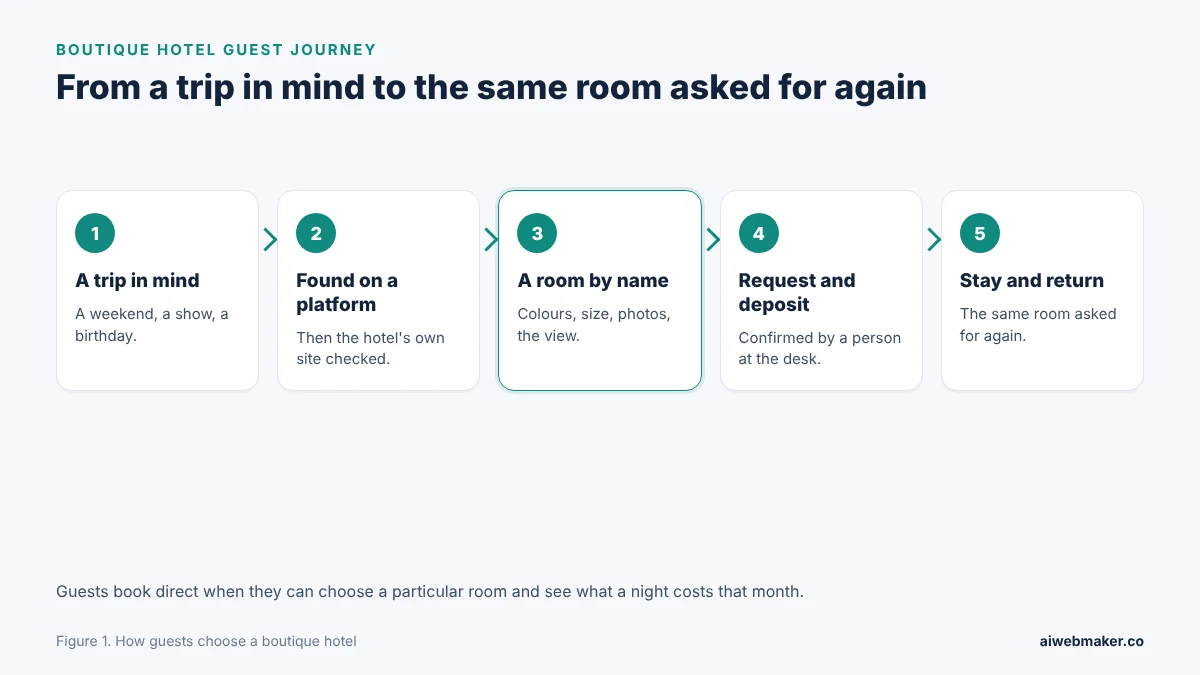
A room by name is the highlighted step, since a guest who has fallen for one room is the guest most likely to bypass a platform. The journey often starts elsewhere, on a map or a booking platform, before the guest checks the hotel's own pages for more detail. Photos, sizes and colours for each room then turn general interest into a specific wish. A request answered by a person at the desk, with a clear deposit rule, removes the last reason to book through someone else. Guests who return for the same room become the steadiest direct bookings a small hotel has.
Rooms, rates by season, dining, walks and the dates request
Compared with a large hotel, a boutique hotel publishes fewer pages, but each must carry more personality and more precise detail. The home page shows the house, the street or square outside and a button to ask for dates. A rooms page groups rooms by size and gives each its own photos and name, and a rates page shows how prices move across the year. Dining, walks and a page of practical answers cover what a guest does outside the room. A dates request and a contact page with arrival times finish the route.
| Page | Guest's question | What it should show |
|---|---|---|
| Home | Is this the kind of place we want? | The house, the street, a dates button |
| Rooms | Which room is ours? | Sizes, names, colours, photos, beds, views |
| Rates by season | What will our dates cost? | Quiet, shoulder and busy months, breakfast, taxes |
| Dining room | Can we eat in? | Breakfast, dinner nights, tables for non residents |
| Walks | What is nearby? | Routes written by staff, timings, weather options |
| Dates request | How do we book direct? | Room size, dates, guests, a favourite room, deposit rule |
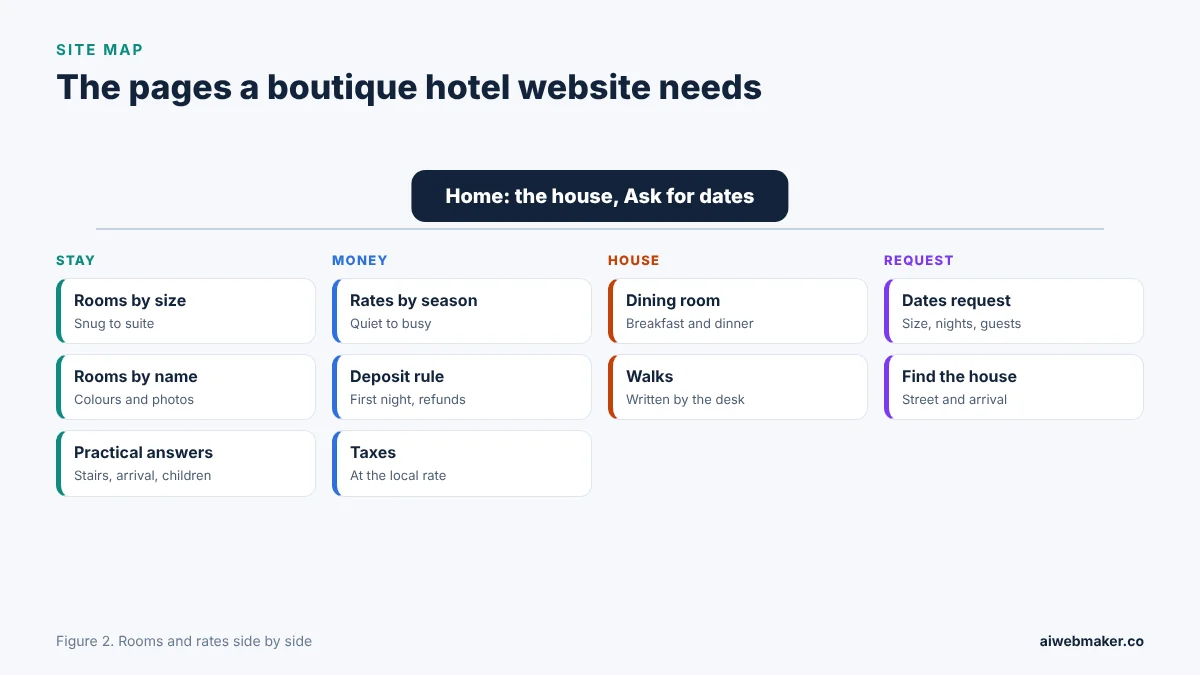
Rooms and rates sit next to each other in this plan, because guests check the price of a room the moment they like it. The stay group holds the rooms and their colours, the money group carries seasonal rates and the deposit rule, and the house group covers the dining room and the walks. Larkspur Townhouse Hotel, our invented sample, sells an Attic snug, a Classic room, a Grand room and The Larkspur Suite. Its walks include Three bakeries before ten, Print shops and secondhand books, The river at dusk, After the theatre, A rainy afternoon and A morning run, and its page runs from room sizes and colours to seasonal rates and the dining room. The boutique hotel website example with named rooms and seasonal rates closes with a dates request and directions to the house.
Selling a room by its name, size and colour
Individually designed rooms are a boutique hotel's main asset, yet many sites hide them behind a single category and one generic photo. Grouping rooms by size keeps prices simple, while giving each room its own name, photos and a line about its colours lets guests choose the one they want. The page should state bed sizes, floor, bathroom type and anything that matters for comfort, such as steep stairs to an attic or a view over a busy street. A clear note on whether a named room can be guaranteed or only requested prevents disappointment at check in. Selling rooms this way gives returning guests a reason to book direct.
| Room detail | Why guests look for it | How to show it |
|---|---|---|
| Size group | Sets the price band | Attic, classic, grand, suite |
| Name and colours | Lets guests pick a favourite | A photo set for each room |
| Bed and bathroom | Comfort and accessibility | Bed size, bath or shower |
| Floor and stairs | Access with luggage | Floor number, lift or stairs |
| View and noise | Sleep quality | Garden side or street side |
| Room by request | Avoids disappointment | Held when possible, or guaranteed |
Quiet, shoulder and busy months: rates and minimum stays
A boutique hotel's rates follow its city's calendar, and a table by season is far more honest than a single starting price. Quiet months after the New Year, shoulder months in spring and autumn and busy months in summer and around major holidays usually set three price bands, though the pattern differs from place to place. Minimum stays at weekends or during events protect the hotel from single nights that block longer bookings, and they should be stated beside the rates. City or tourist taxes, where they apply, are set by local authorities and vary widely between countries, so the rates page can note that they are charged at whatever the local rate is. A rate table that matches what the desk quotes ends most price disputes before they start.
| Season | Typical pattern | Rule worth printing |
|---|---|---|
| Quiet months | Lowest rates, fewer events | Midweek offers, shorter minimum stays |
| Shoulder months | Rates rise with spring and autumn trips | Weekend minimum stays may apply |
| Busy months | Highest rates, summer and holidays | Longer minimum stays, earlier deposits |
| City events | Prices follow concerts, fairs or festivals | Named dates and their rules |
| Taxes | Set by local authorities | Added at the local rate, stated separately |
Direct requests, deposits and the commission arithmetic
Every stay booked through a platform costs the hotel a commission, which is why a direct request deserves the clearest route on the site. A dates request that asks for the room size, the nights, the number of guests and any favourite room gives the desk everything it needs to reply within hours. Deposit and cancellation rules, such as the first night charged once a room is confirmed, belong in plain words beside the request, and consumer rules on deposits and refunds differ by country. Contracts with booking platforms sometimes limit how a hotel may price rooms on its own site, and rules on such clauses vary between regions, so a hotelier should check those agreements before promising a lower direct rate. The AI website builder for boutique hotels and their named room pages drafts the rooms, rates and dates pages once the hotelier describes the house, the rooms and the seasons, and the drafts can be corrected in the preview before any guest sees them.
The dining room, breakfast and neighbours at the next table
A small dining room can be a reason to choose a boutique hotel, and its page should serve both residents and neighbours. Breakfast included in every rate deserves a sentence and a photo, since guests compare it with the café down the street. Dinner nights, hours and whether tables can be held with a room help guests plan an evening without leaving the building. Opening the dining room to non residents brings local diners who later recommend the rooms to visiting friends, and the page should say whether they need to reserve. Rules on allergen information differ between countries, so the page can explain how guests share dietary needs and receive details.
Walks written by the desk, and honest small print
Local guides written by the people who work at the hotel are a boutique hotel's best content, because no platform can copy them. A walk to three bakeries, an afternoon of bookshops or a route for a rainy day tells a guest what staying in this district feels like. The same pages bring visitors searching for things to do nearby, some of whom book a room after reading. Small print matters as much: stairs without a lift, arrival and departure times, children, pets and late check in should be stated plainly, since a townhouse often cannot offer what a large hotel can. Honest answers about access let guests with limited mobility choose wisely before they arrive.
Boutique hotel in the old town and the phrases guests search
Guests search with phrases such as boutique hotel with a district name, small hotel near a landmark, romantic weekend hotel or townhouse hotel, often with a city. Room pages and walks that use those words, together with the street and nearby landmarks, meet these searches. The map listing matters a great deal for hotels, with accurate photos of rooms, check in hours and a link to the dates request. Reviews that mention a particular room, the breakfast or a walk from the desk carry more weight than generic praise does. Rainy afternoon ideas or where to eat after the theatre make articles that bring visitors who may book on their next trip.
Linen, laundry and the website: a small hotel's yearly bill
Linen, laundry, breakfast stock and the commission paid on platform bookings each cost a boutique hotel far more than its website. AI Web Maker's hosting is $119 when the hotel pays a year at once, or $19 for each monthly payment, while the domain price varies by ending across some 400 options. Twelve articles on walks, seasons and local events, written with AI credits at around $0.65 each, total about $7.80. Updating rates for a new season or adding a room photo is never charged. The $189 tier appears in one row so the hotel can see it beside the others.
| Item | Yearly | Monthly |
|---|---|---|
| Hosting the room and rate pages | $119 | $228 over twelve months |
| Domain | Depends on the ending | Depends on the ending |
| Higher plan, for comparison | $189 a year | Not needed |
| Twelve walk and season articles at about $0.65 | About $7.80 | About $7.80 |
| Seasonal rates and room photo updates | No charge | No charge |
| Year before the domain | About $126.80 | About $235.80 |
Generic photos, missing rates and other reasons guests return to the platform
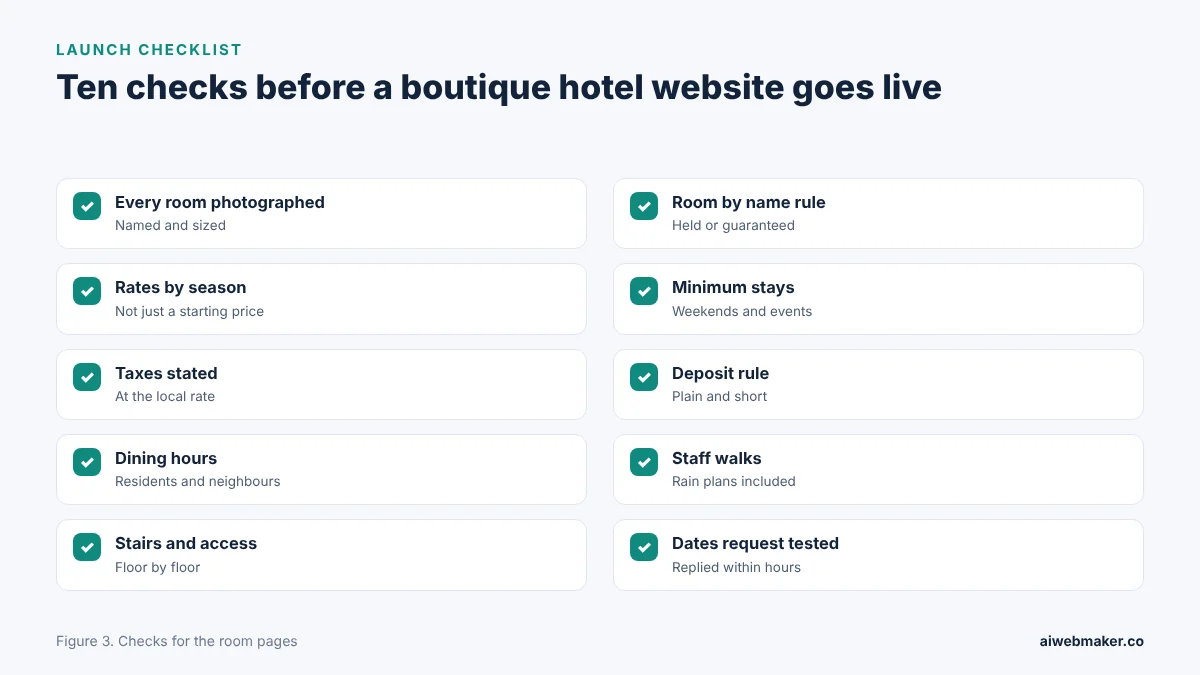
A hotel site with fewer room photos than its platform listing sends guests straight back to the platform. A rates page with only a starting price makes them suspect the real figure for their dates is much higher. No clear deposit or cancellation rule makes a direct request feel riskier than a platform booking. Missing details on stairs, arrival times or children send cautious guests to a place that answers them. The checklist pictured next sets out ten fixes, from photos of every room to a plain deposit rule.
Frequently asked questions
Can guests choose a particular room by name?
Many boutique hotels let guests ask for a room by name, and some guarantee it for a supplement while others hold it whenever possible. The page should say which approach applies, so a guest returning for the green room is not disappointed. Rooms in the same size group usually share a price, which keeps requests simple. Guests can mention the room in the dates request, and the desk confirms whether it is available. A clear rule on named rooms turns a lovely detail into a reason to book direct.
How should a boutique hotel explain deposits and cancellations?
A deposit rule should be short and specific, such as the first night charged once a room is confirmed and refunded if the guest cancels before a stated date. Busy dates or events may carry stricter rules, and those should be named on the rates page. Consumer law on deposits and refunds is not uniform across countries, so a hotelier should check the wording against local rules. The site should also say how and when the hotel arranges payment with the guest. Plain rules make a direct request feel as safe as any platform booking.
What should a townhouse hotel say about stairs and access?
Many townhouse hotels occupy old buildings with steep stairs, narrow corridors and no lift, and guests need to know before they book. The page should state which floor each room is on, whether a lift exists and whether staff can carry luggage. Rooms on the ground floor, if any, should be marked clearly for guests with limited mobility. Accessibility law for old buildings varies by country, so an honest description of the building beats any claim of standards it cannot meet. Precise access details prevent the worst kind of arrival, when a guest discovers the stairs at the front door.
Why do guests book direct when a platform shows the same room?
Guests book direct when the hotel's own site offers what the platform cannot, such as a named room or a quick reply from the desk. A walk card sent before arrival is another small advantage. Clear rates and deposit rules remove the main reason to stay on the platform, which is the feeling of safety. Direct guests can also share allergies, celebrations or arrival plans with the people who will meet them. Whether a hotel may offer lower prices directly depends on its platform contracts and on local rules, so perks are often easier to offer than discounts. Each direct stay keeps the commission in the hotel's own accounts.
One direct night and the hosting year
A single direct night in the smallest room usually matches a boutique hotel's $119 hosting year. Spread across months, each $19 payment is a sliver of one room night. Every guest who returns for the same room by name, and every neighbour who books the dining room and then a room for visiting family, adds direct income the platform never sees. Rates, deposits and room photos that answer every question keep guests from drifting back to the listing. A diary with more direct requests than platform bookings in the quiet months shows the pages are earning what commission would otherwise take.
Build your website in Minutes and get the AI Tools that work
Start Building Your Website →