Bike Rental Website Cost: Fleet Prices, E Bike Rules, Route Cards
A bike rental shop is charged $119 for twelve months of hosting or $19 per month, with the domain extra. Following: who rents, the pages, fleet and prices, e bike rules, helmets, hire terms, route cards, search and the yearly bill.
- No coding required
- Live in minutes
- Blog, SEO and chatbot tools included
Tyres, chains and batteries cost a bike rental shop far more than its website, whose AI Web Maker hosting is charged at $119 per twelve months or $19 per month, domain extra. The fleet pages, e bike rules and route cards can be sketched, ridden through on a phone and corrected in the preview over several evenings, and that preparation is never billed. Three e bikes out for one day at the sample's price clear the year. The real challenge is trust in both directions, since riders want safe, well kept bikes and clear rules while the shop needs deposits, identification and accurate heights before a bike leaves the door. Visitors also arrive with questions about e bike laws, helmets and where they may ride, which differ from one country and city to the next. Following are who rents and why, the pages, fleet and prices, e bike rules, helmets and sizing, hire terms, route cards, search, what the year costs and the gaps that send riders elsewhere.
This article is part of our complete guide: Food Business Website Builder.
Tourists, families and trail riders: who rents a bike, and why
Tourists, families, trail riders and long stay visitors make up most bike renters, and each opens the website with its own worry. Tourists want to know whether they can ride from the shop to the sights, what a day costs and whether bikes can be delivered to their hotel. Families look for children's bikes, child seats, trailers and flat, quiet routes with a café on the way. Trail riders check mountain bike sizes, suspension and the gradient of local trails. Visitors on longer stays compare weekly prices, and e bike riders ask about range, spare batteries and the rules for riding. A shop that answers each worry on the page rents more bikes before the morning rush.
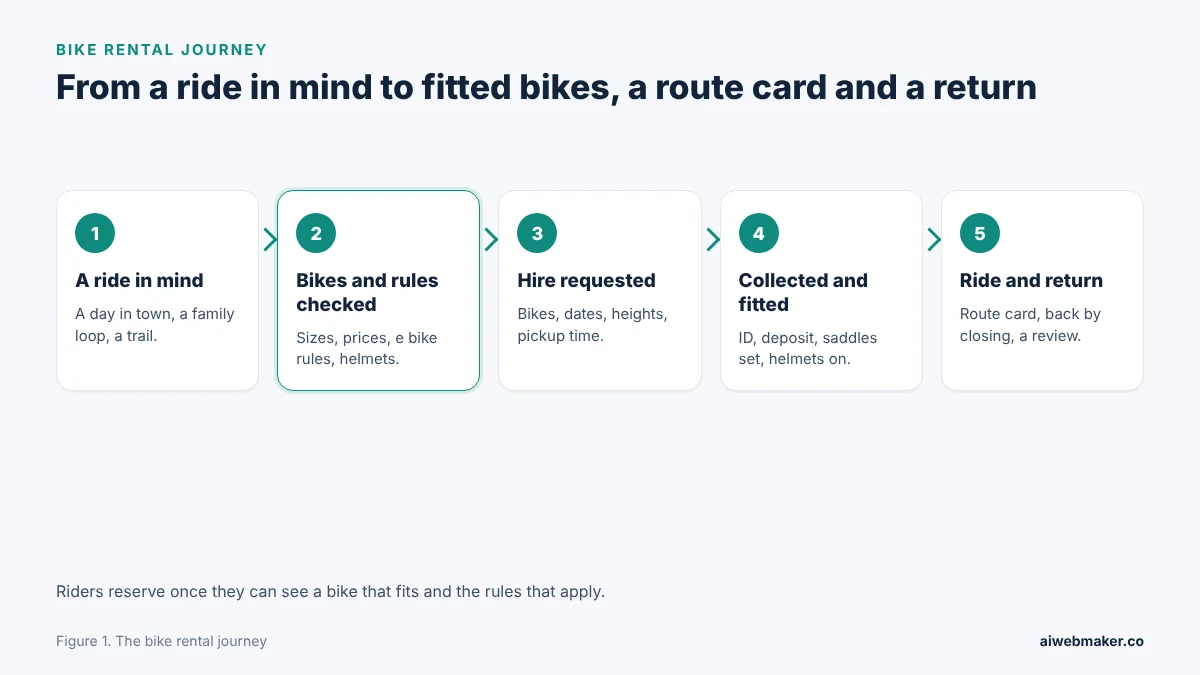
Checking bikes and rules is the decisive point of this rental journey, since a rider who cannot see a suitable size or the e bike age limit will not reserve. The ride usually starts as an idea, such as a day in town, a family loop or a trail ridden on holiday. The hire request follows, with dates, bike types and each rider's height so the shop can set bikes up in advance. At the counter, identification, the deposit and a helmet fitting turn the reservation into a ride. A smooth return and a route that lived up to its card are what produce reviews and repeat hires. Each page on the shop's site should take a rider one step nearer the saddle.
Fleet, rules, routes and hire terms: the pages a rental shop needs
A bike rental website needs pages that work like a counter conversation, answering questions in the order a rider asks them. The fleet page shows each bike type, what it suits, its sizes and its price by the hour, day and week. An e bike rules page explains age, assistance speed, range and where e bikes may be ridden. A safety page covers helmets, lights, locks and riding with children. Route pages sell the ride itself, and a hire terms page explains deposits, identification and returns. The request and directions pages finish the path from first visit to collected bikes.
| Page | Rider's question | What it should state |
|---|---|---|
| Fleet and prices | Which bike, and what does it cost | Types, sizes, hourly, daily and weekly prices |
| E bike rules | Is a rider allowed, and how far will it go | Age, assist speed, range, where to ride |
| Helmets and safety | Will we be safe | Helmet fitting, lights, locks, children |
| Routes | Where can we go | Distance, climbs, surface, traffic, cafés |
| Hire terms | What do we sign and leave | Deposit, identification, damage, late returns |
| Hire request | How do we reserve | Bikes, dates, pickup time, rider heights |
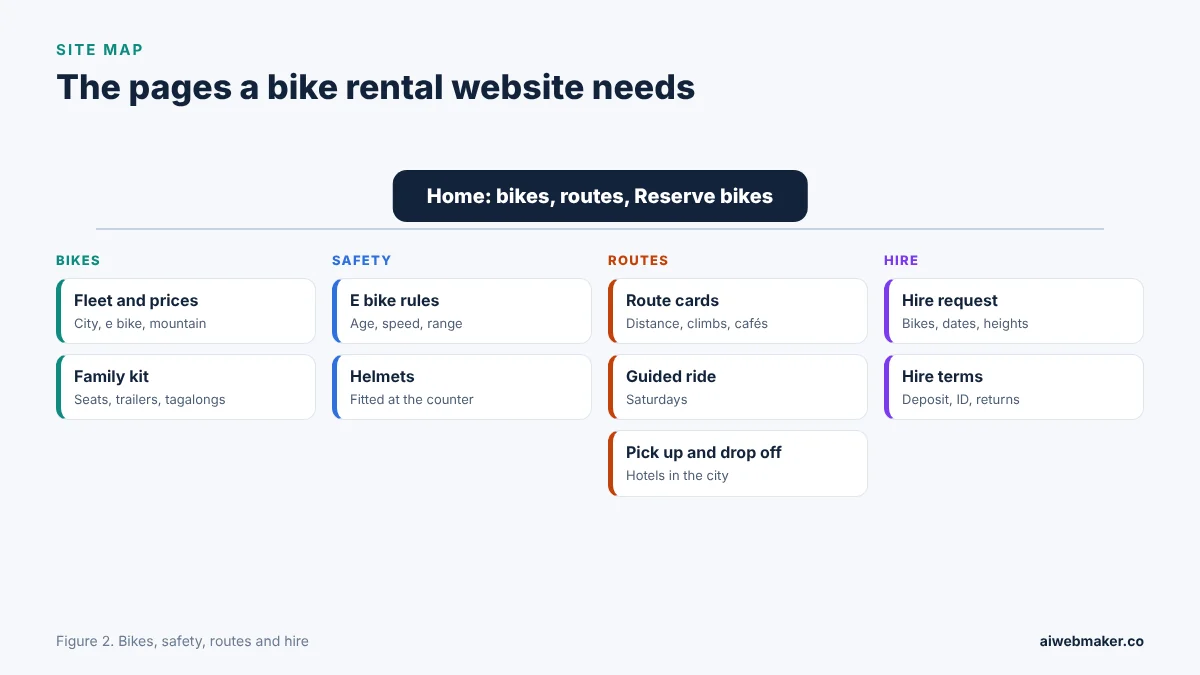
Bikes, safety, routes and hire are the four branches in this rental plan, with the request reachable from every route card. Our sample shop, Spoke and Saddle Bike Hire, prices a city bike, an e bike, a mountain bike and kids and family kit, each hired with a helmet, a lock and lights. It follows with a plain table of e bike rules, a section on fitting helmets and four route cards: the canal loop, the old town and markets, out to the lakes and the woodland trail. A Saturday guided ride and a pick up and drop off service sit beside the routes, and a short outline explains how to collect, ride and return. The bike rental website example with e bike rules, helmets and route cards finishes with a hire request for the bikes, the dates, the pickup time and each rider's height. That sequence answers safety and rules before money changes hands, which is exactly where a careful rider looks.
City bikes, e bikes and mountain bikes, priced by the hour, day and week
Fleet pages should describe each bike by the ride it suits, because most renters know where they want to go better than what they want to ride. City bikes with upright seats, gears, baskets and lights suit town days and flat routes. E bikes widen the range and flatten hills, but need clear notes on battery range and the minimum age. Mountain bikes need sizes from small to extra large and a word on suspension and tyres, while children's bikes, child seats, trailers and tagalongs make family days possible. Hourly, half day, full day and weekly prices let a rider choose without calling, and weekly rates reward longer stays. A table pairing each bike with its ride and its prices does much of the selling on its own.
| Bike | Best for | What to list |
|---|---|---|
| City bike | Town days, flat routes, sightseeing | Gears, basket, sizes, day and week price |
| E bike | Hills, long days, mixed fitness groups | Range, battery, minimum age, price |
| Mountain bike | Waymarked trails and gravel | Sizes, suspension, tyres, price |
| Children's bike | Riders too small for adult frames | Ages and heights, helmet, price |
| Child seat, trailer, tagalong | Families with younger children | Weight and age limits, price |
E bike rules that change at the border
E bike rules are the part of a rental website most likely to be wrong, because they change between countries and sometimes between cities. Across the European Union and in the United Kingdom, for example, pedal assisted bikes are commonly limited to motor help up to 25 km/h, while other countries use different classes and speeds. Minimum riding ages vary, with some places setting none at all, and helmet laws differ just as widely, so the shop should present its own rules, which may be stricter than the law. Range depends on hills, wind, rider weight and the assist level, so it should be shown as a span, along with the price of a spare battery. Paths, parks and towpaths that ban e bikes should be marked on the route cards. Accurate rules protect riders, the shop and the shop's insurance.
| Question | What the page should state |
|---|---|
| Minimum age | The shop's rule, noting that legal ages vary |
| Assist speed | The speed at which the motor stops helping |
| Helmet | The shop's rule, and that laws vary by country |
| Battery range | A realistic span and the price of a spare |
| Where to ride | Roads and paths allowed, and any bans on route cards |
Helmets, frame sizes and the check before a bike leaves
Every hire should start with a bike that fits and a helmet that sits correctly, and the website can explain both before the rider arrives. Asking for each rider's height in the hire request lets the shop set frames and saddles in advance, which shortens the queue at the counter. Helmet fitting can be described simply: level on the head, a couple of fingers above the eyebrows and straps snug under the chin. Lights front and back, a lock and a puncture kit with every bike reassure riders who are far from the shop. A short note on children riding with an adult, and on following local traffic rules, sets sensible expectations without lecturing. A breakdown number for anyone stuck on a route completes the safety picture.
Deposits, identification, damage and late returns
Hire terms decide whether a rental feels fair, so deposits, identification and late returns should be written out before anyone reaches the counter. Most shops take a refundable deposit per bike, often higher for e bikes, along with photo identification, and the amounts should appear on the page. Damage and theft rules need plain wording about what the rider pays if a bike is damaged or stolen, and why the lock matters. Return times, late fees and what to do when running late in the evening prevent tension at closing. Multi day hires should state whether bikes stay with riders overnight and how they should be stored. Terms that read as fair turn first time renters into people who recommend the shop to friends.
| Term | What riders want to know |
|---|---|
| Deposit | Amount per bike, and how it is returned |
| Identification | Which documents are accepted |
| Damage and theft | Who pays, and the role of the lock |
| Late returns | Closing time, late fees, calling ahead |
| Multi day hire | Overnight storage and the return date |
Route cards that sell the ride, not just the bike
Route cards are a rental shop's strongest sales page, because they turn a bike into a plan. Each card should give the distance, the time a relaxed rider needs, the climbs, the surface and where the route shares the road with traffic. Cafés, viewpoints and bike racks along the way make a route feel like a day out, and a note on which bikes suit it keeps city bikes off rough trails. Guided rides and delivery to hotels can sit beside the routes for visitors who want less planning. The AI website builder that drafts bike hire pages from the shop's own notes writes first versions of the fleet, route and terms pages once the owner outlines the bikes and rides, and the owner then corrects them in the preview. Routes written by people who ride them every week read as local knowledge rather than a brochure.
Phrases riders type before they hire
Riders type phrases such as bike hire near me, e bike rental in a named city, family bike hire or cycle routes from a station. Putting one of those phrases in the heading of each fleet and route page helps search engines pair it with the right rider. The map listing should show daily opening hours, photos of the bikes and the shop front, and a link to the fleet page. Reviews that mention well maintained bikes, careful helmet fitting and a great route card outweigh general praise. Articles on the best family rides, what to know before riding an e bike or seasonal routes give tourists reasons to choose before they arrive. Visitors who plan from home often reserve the day before, so these pages earn rentals well ahead of the ride.
Hosting, domain and credits for a rental shop's year
A bike rental shop's website bill has three parts: hosting, a domain and article credits. Hosting costs $119 for a year paid at once, or $228 if the shop pays $19 every month. Each of the roughly 400 domain endings has its own price. Twelve route and riding articles need around $7.80 in credits. As a benchmark the table adds the $189 tier, while new route cards, price changes or rule updates are made without any charge.
| Item | Yearly | Monthly |
|---|---|---|
| Hosting the bike rental pages | $119 | $228 over twelve months |
| Domain | Depends on the ending | Depends on the ending |
| Higher plan, for comparison | $189 a year | Not needed |
| Twelve route and riding articles at about $0.65 | About $7.80 | About $7.80 |
| Fleet, route and rule updates | No charge | No charge |
| Year before the domain | About $126.80 | About $235.80 |
Missing sizes, hidden deposits and riders who go elsewhere
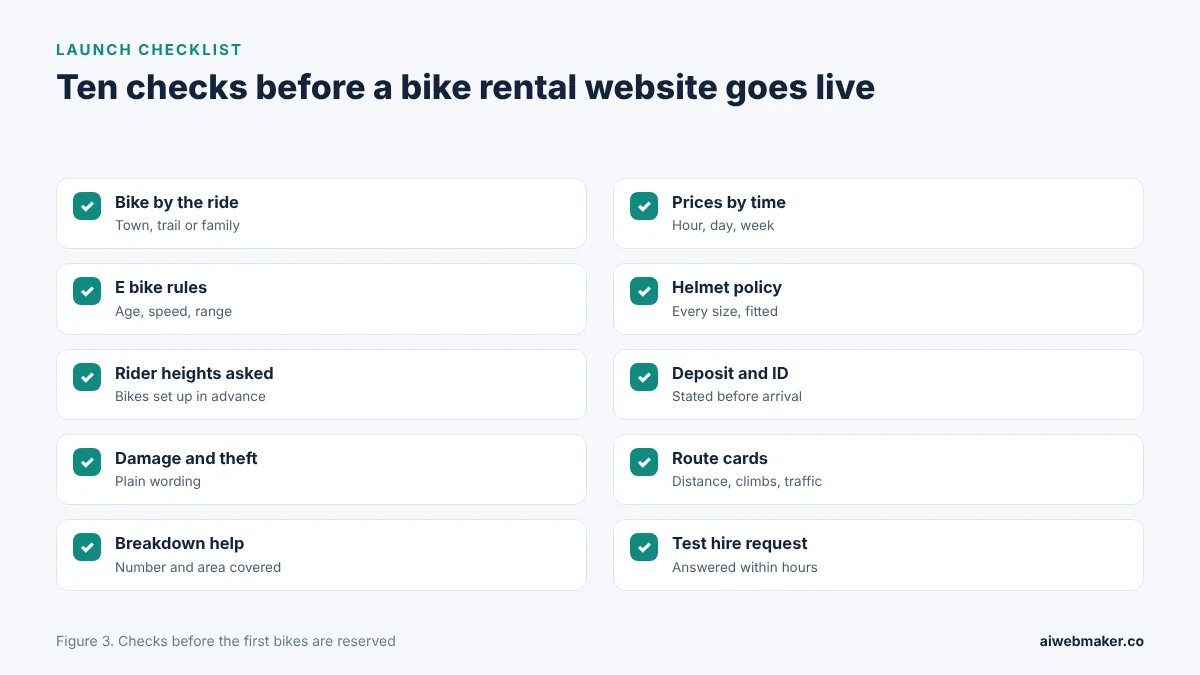
Riders leave a bike rental website when they cannot tell which bike suits their ride or what a full day costs. E bike pages without an age rule or a range figure leave cautious renters guessing. Deposit amounts that only appear at the counter feel like a trap. Route cards without distances or climbs make families fear being stranded halfway. Missing opening and return times cause late returns and tense evenings at closing. The figure lines up ten repairs for exactly these problems.
Frequently asked questions
Do riders need to wear a helmet?
Helmet laws differ sharply from place to place, and some require helmets only for children or for e bike riders. Many rental shops supply a helmet with every hire and ask all riders to wear one, whatever the local law says. The website should state the shop's own rule and offer helmets in sizes from small child to extra large. Fitting each helmet at the counter shows the shop takes it seriously. Clear helmet rules reassure families before they arrive.
Can bikes be kept overnight?
Many shops offer multi day hires where bikes stay with the rider overnight, usually with a request to store them indoors or locked to something solid. The website should explain the pickup and return days, the price per extra day and any weekly rate. Riders should know what happens if a bike is stolen overnight, which links to the shop's damage and theft terms. Delivery and collection from hotels, if offered, can make longer hires easier. Clear overnight rules avoid confusion on the return day.
What happens after a puncture on the route?
A puncture kit in each bag lets confident riders fix a flat themselves, and the website can say so. Shops that offer breakdown help should state the phone number, the area covered and whether a replacement bike is brought out. Riders on longer routes appreciate knowing how far help will travel. A note on what to do if a bike is damaged in a fall belongs here too. Clear breakdown terms let riders explore further with confidence.
How far does an e bike battery last?
Battery range depends on hills, wind, rider weight, tyre pressure and the assist level, so a website should show a realistic span rather than a single figure. Riders planning long routes should be told how to save battery and whether a spare can be hired. Route cards can suggest which rides suit an e bike and which need a full charge. Honest range figures prevent riders running flat far from the shop. Good battery advice makes long days on an e bike a pleasure.
Six city bikes for a day against the hosting bill
Six city bikes out for one day at the sample's starting price pay the $119 hosting bill with change. A single city bike day clears a $19 month on the sample's price list. Weekly hires, guided rides and hotel deliveries then add income well beyond the cost of the site. Clear e bike rules, fitted helmets and honest route cards persuade careful riders more than glossy photos of mountain views. Shops that keep fleet prices, routes and opening times current see riders return every season. An empty bike rack by mid morning on a sunny Saturday is the sight every page of the site works towards.
Build your website in Minutes and get the AI Tools that work
Start Building Your Website →