BBQ Catering Website Cost, Priced per Guest and Cooked on Site
A barbecue caterer's website hosting totals $119 yearly, or $19 taken monthly, with the domain priced apart. Inside: how organisers choose, the pages, per guest packages, the pitch, fire and food rules, the event day clock, search and the budget.
- No coding required
- Live in minutes
- Blog, SEO and chatbot tools included
A barbecue caterer's pages stay hosted for $119 across a year, or $19 on a monthly plan, with a domain picked and paid for on its own account. AI Web Maker raises no invoice while the packages, the pitch checklist and the event day timeline are written and tested in its preview. A single Pit Plate booking for the minimum 40 guests, at $26 a head, comes to $1,040, enough for almost nine years of hosting. The real hurdle is logistics, because a smoker trailer weighing about 2.5 tonnes, an open fire and an overnight cook must all fit a venue the caterer may never have seen. Organisers want the price per guest, the menu and the venue's obligations settled before they hold a date. Who books, the pages, per guest packages, the pitch, fire and food rules, the event day clock, search and the yearly sums follow here.
This article is part of our complete guide: Food Business Website Builder.
Who hires a smoker for the day, and what they settle first
Barbecue catering attracts organisers who want food cooked in front of their guests rather than delivered in boxes. Couples planning weddings in barns, fields and gardens are a large group, often with a guest list well over a hundred. Companies book summer days and staff parties, and they care about serving speed and a clear invoice. Birthday and anniversary hosts with a big garden want a relaxed meal that feels like an event in itself. Venue managers often join the conversation, because a smoker and an open fire raise questions about ground, access and safety. Every one of them settles the price per head, the menu and whether the venue will allow a smoker before anything else.
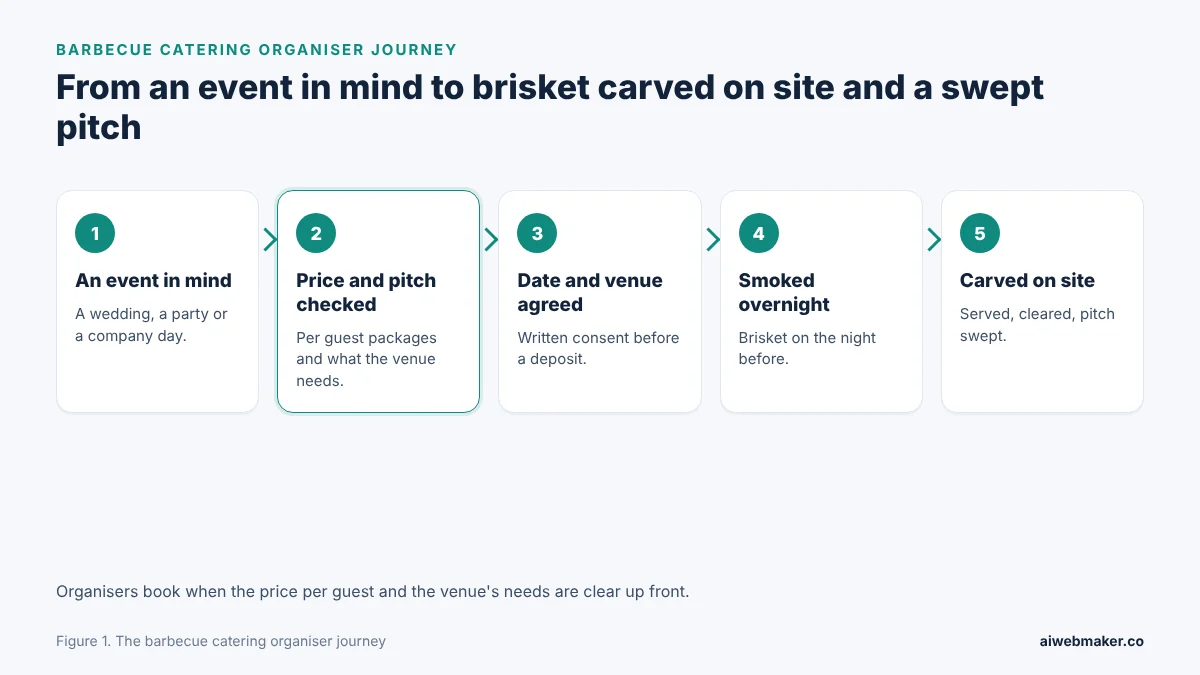
This journey turns on the second step, where an organiser checks the price per guest and what the venue must provide. A visitor who can multiply a package price by a guest list, and see the pitch requirements beside it, can decide in minutes. The date and venue check that follows should end in written agreement from the venue before any deposit is paid. The overnight cook and the morning tow are invisible to guests but explain why dates fill early. Service, carving and a pitch left swept and clean are what guests remember and reviews describe.
Pages a caterer with a smoker trailer needs
A barbecue caterer's website needs pages that settle money, menu and logistics, because those decide whether a booking can happen at all. Up front, the home page needs three facts: the smoker travels to the venue, the smallest booking is stated, and a date can be checked. A packages page sets out prices per guest and what each includes. A menu page lists every dish with its wood, hours and allergens, and a pitch page explains what the venue must provide. An event day page with timings and an enquiry page complete a set that answers organisers and venue managers alike.
| Page | Organiser's question | What it should show |
|---|---|---|
| Home | Can they cook at our venue? | Smoker towed on site, smallest booking, check a date |
| Packages | What does it cost per guest? | Three packages, inclusions, minimum numbers |
| Menu and allergens | What is in each dish? | Wood, hours, allergens, the vegan tray |
| The pitch | What does the venue need? | Level ground, access, room around the fire, water |
| Event day | How does the day run? | Timeline from the night before to the swept pitch |
| Enquire | Is our date open? | Date, guests, where the smoker would stand |
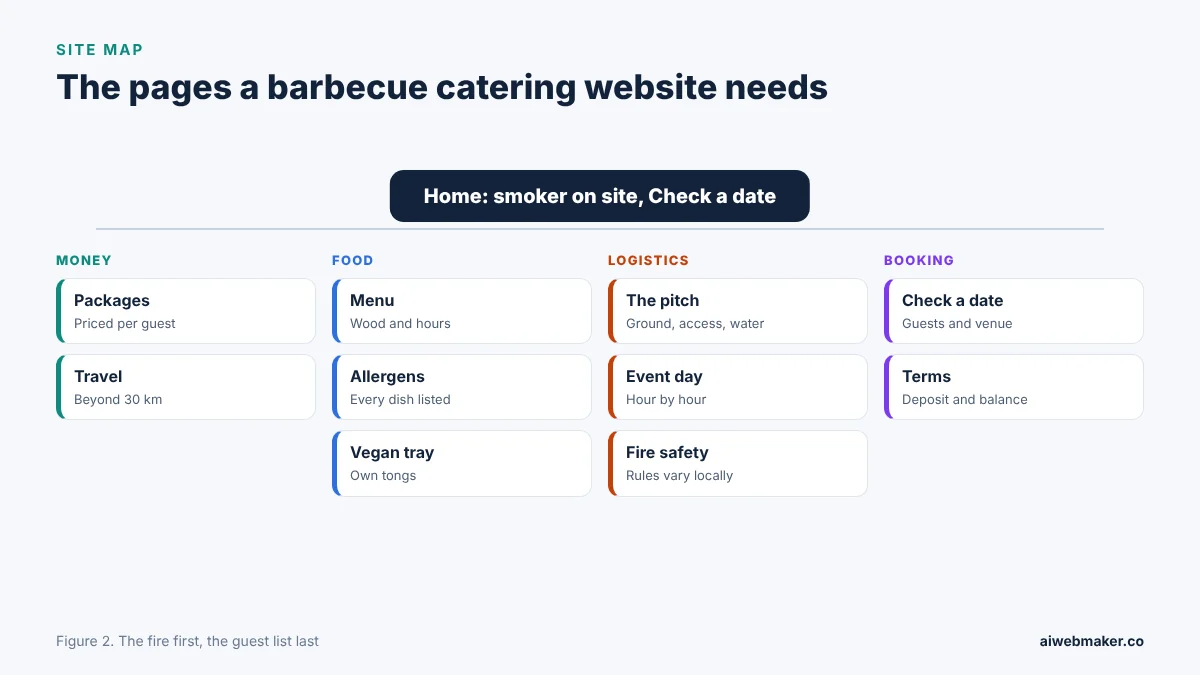
The plan here starts with the fire and works outwards to the guest list, a sensible order for a caterer whose kitchen arrives on a trailer. Money pages hold the packages and travel charges, food pages hold the menu and allergens, logistics pages hold the pitch and the event day clock, and booking pages hold the date check and the terms. Our sample, Smokehouse BBQ Catering, prices its Pit Plate at $26 a guest, its Full Spread at $38 and its Whole Hog Day at $52, with 40 guests as the smallest booking. Its pitch list asks for a level area of 6 by 4 m, a way in for the trailer, room around the fire, water within 30 m, power where available and the venue's agreement in writing. The bbq catering website example with per guest packages and a pitch checklist was written by hand for this guide's sample library, and nobody has eaten its brisket. Any caterer with a smoker can follow its order and replace the figures with its own.
Per guest packages, minimum numbers and meat per head
Per guest pricing suits barbecue catering because meat, sides and crew all scale with the head count. Each package should name what is included, such as the number of meats and sides, the crew, the smoker on site, plates and the clear down. A minimum booking protects the economics of towing a smoker and lighting a firebox for a small party. The page can also explain how much cooked meat is planned per adult, for example the sample's figure of about 250 grams across all meats, with children counted at half. Travel beyond a stated distance should be priced openly, by the kilometre or in bands. Organisers who can multiply a price by a guest list before calling arrive ready to book.
| Package | Per guest, from | What is included |
|---|---|---|
| Pit Plate | $26 | Two smoked meats, three sides, pickles and rolls |
| Full Spread | $38 | Brisket carved to order, pork, ribs, four sides, a vegan main |
| Whole Hog Day | $52 | A whole pig pulled on site, brisket, sides and late sliders |
The pitch, the trailer and the venue's written agreement
A barbecue caterer's real kitchen is a patch of ground at someone else's venue, so the website must say exactly what that ground needs. Level hard standing or firm grass for the trailer and a serving tent, a gate wide enough for the trailer and no soft ground on the way in are the basics. Distance from marquees, trees and walls matters for safety, and some venues ask for more than the caterer's own minimum. Water for hand washing and cleaning, and power if it is available, change what the crew must bring. Written agreement from the venue before any deposit protects both sides, because some venues ban smokers or open flames outright. A pitch checklist on the website turns the venue manager into an ally rather than an obstacle.
| Need | Why it matters | Sample's standard |
|---|---|---|
| A level pitch | Trailer and tent stand safely | 6 by 4 m of hard standing or firm grass |
| A way in | The trailer weighs about 2.5 tonnes | A gate at least 3 m wide, firm ground |
| Room around the fire | Smoke and heat kept from people | At least 6 m from marquees, trees and walls |
| Water nearby | Hand washing and cleaning | A tap within 30 m, or tanks brought |
| Power | Lights and warmers | A socket, or a quiet generator |
| Venue agreement | Some venues ban open flames | In writing before a deposit |
Fire, smoke and food rules that change by district
Smokers and open fires fall under local rules on fire safety, smoke and food hygiene that differ from one country and district to the next. A caterer should say that it checks those rules with each venue before confirming, and list what it brings, such as extinguishers, a fire blanket and a steel tray beneath the firebox. Food businesses usually have to register with or be licensed by a local authority, for example the council in the United Kingdom, and the website can say the caterer holds what is required and will show it on request. Hot food has to stay hot and cold food cold, at temperatures set by local food rules, and leftovers are a frequent question. Where rules allow it, leftover meat can be chilled, boxed and dated soon after service, while food that has stood on the line is usually thrown away. A clear rules section shows organisers they are hiring professionals rather than a weekend hobby.
One smoker, one date: the overnight clock behind every booking
Low and slow cooking sets a hard limit on how many events one smoker can serve, which is why barbecue dates tend to fill early in summer. Brisket may go on the yard smoker the night before, the trailer leaves in the morning, and the crew arrives hours ahead of service to light the fire, raise the tent and rest the meat. Showing that timeline on the website explains why a date cannot simply be squeezed in, and why early enquiries matter. The AI website builder for barbecue caterers who cook at the venue drafts the packages, pitch and event day pages once the caterer describes its smoker, menu and towing distance in a few lines, and every word can be changed in the preview before any charge. Deposits, balances and cancellation terms, such as the sample's 25% deposit after the venue agrees, sit well beside that timeline as the caterer's own rules. An organiser who understands the clock behind the meat accepts the booking rules without argument.
Searches for smoked meat at a wedding or company day
Organisers looking for barbecue catering usually name the event, the food or the guest count in their search. Typical phrases include bbq catering near me, wedding bbq catering, smoked brisket catering, company barbecue catering and whole hog roast, often with a county or venue name. Each package and event type deserves a heading in those words, letting a wedding section meet the couple who typed wedding. A map listing for the smoke yard, with photos of the trailer, the firebox and brisket being carved, helps local organisers find the business. Reviews that mention smoke drifting away from guests, the vegan tray or a pitch left spotless reassure the next venue manager. Articles on how much meat to order per guest or what a venue needs for a smoker draw organisers while their plans are still taking shape.
The smoke yard's yearly website sums
Against a single event's takings, the hosting bill is barely a rounding error. Caterers with a full summer calendar keep it lowest by paying $119 once a year, while a new outfit still financing its trailer may spread it at $19 a month. A dozen articles on brisket timings, meat per guest and venue pitches add roughly $7.80 in credits. New packages, revised prices per guest and a longer towing distance publish with no extra charge. Both billing routes are paired in the table, a $189 tier set beside them purely to compare.
| Item | Yearly | Monthly |
|---|---|---|
| Hosting the packages, menu and pitch pages | $119 | $228 over twelve months |
| Domain | Depends on the ending | Depends on the ending |
| Higher plan, for comparison | $189 a year | Not needed |
| Twelve smoking and event articles at about $0.65 | About $7.80 | About $7.80 |
| Packages, prices and towing distance | No charge | No charge |
| Year before the domain | About $126.80 | About $235.80 |
Missing answers that cost a barbecue caterer the booking
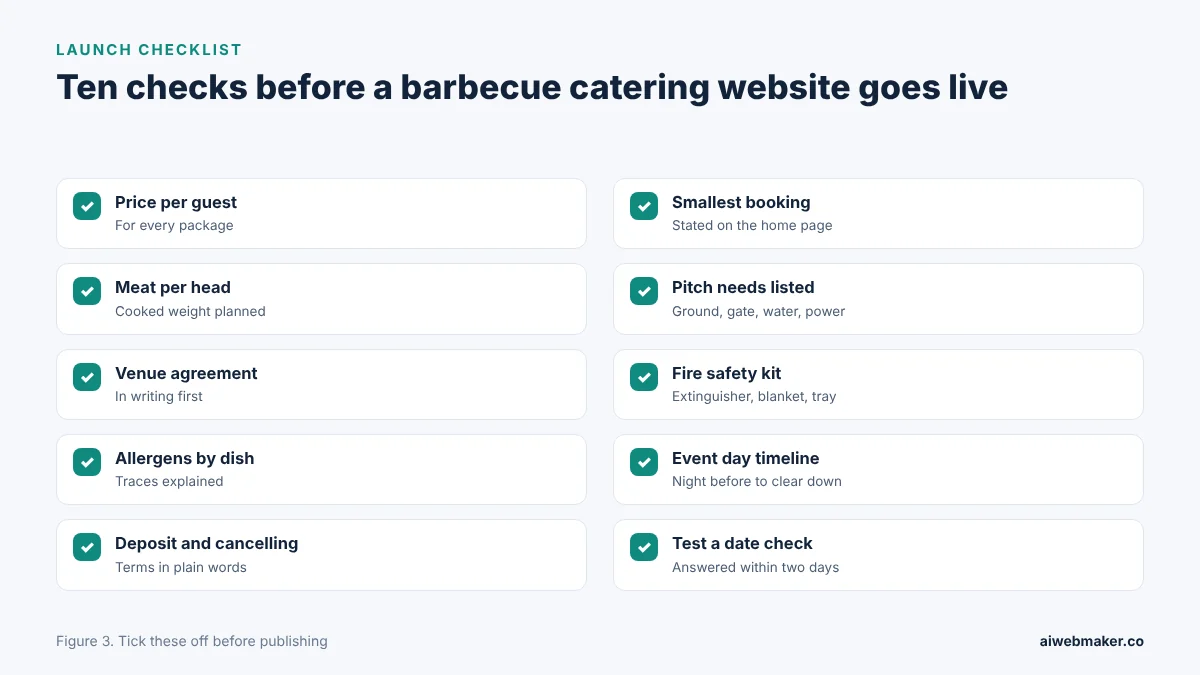
Organisers abandon a barbecue caterer's site when there is no price per guest, only a request to get in touch. Silence on what the pitch needs leaves the venue manager unable to say yes, and the booking stalls. A menu without allergens or a vegan option makes a wedding planner with a mixed guest list look elsewhere. Photos of plated food with no sign of the smoker, the crew or a real venue suggest the cooking happens somewhere else. Missing deposit and cancellation terms make a large booking feel risky. Each of those gaps maps onto one of the ten pitch side checks pictured underneath.
Frequently asked questions
How much meat should a barbecue caterer plan per guest?
A caterer should state its own planning figure, because organisers want to know they will not run short. The sample plans about 250 grams of cooked meat per adult across all the meats, a little more for an evening crowd, with children counted at half. Raw weight is much higher than cooked weight for brisket and pork shoulder, which is worth explaining. Showing the figure lets organisers compare packages fairly. Clear quantities prevent both empty trays and wasteful leftovers.
What happens if it rains on the day?
A smoker works in rain, so most barbecue caterers carry on under a serving tent, and the website should say so. High winds are a different matter, because smoke and sparks may mean moving the pitch further from buildings. Asking about the ground in advance gives the crew room to adapt. A short weather note on the event day page saves anxious calls the week before. Calm, practical wording shows organisers that the caterer has cooked through bad weather before.
Can a smoker feed vegans and guests with allergies?
A barbecue caterer can usually offer a vegan main, such as smoked jackfruit in its own tray with its own tongs, and should list every dish with its allergens. Everything may still come off one smoker and leave from one counter, so traces are possible. Where an allergy is severe, the honest answer may be that the serving line is the wrong place to eat, as the sample says. Allergen law is national or regional, so the caterer follows whichever rules govern the places it cooks. Plain, honest wording protects guests far better than a vague promise.
Does the venue need a kitchen?
A caterer that cooks on its own trailer does not need a venue kitchen, and saying so widens the venues it can serve. It does need water nearby, or a note that tanks must come with the crew. Power is useful for lights and warmers but can be replaced with a quiet generator. Waste, ash and grease should leave with the caterer, which venue managers appreciate. A clear answer here often removes the last obstacle to a field or garden wedding.
How many guests pay for the smoker's year online?
Five guests on the Pit Plate at $26 a head already exceed the yearly $119 hosting fee. A single minimum booking of 40 guests covers it close to nine times over. What wins those bookings is clarity about price per guest, what the pitch needs and how the day runs. Allergen tables, a vegan tray and honest weather notes then remove the doubts that stall a wedding planner. Caterers who keep packages and event photos current give organisers fresh proof every season. Measured in plates of brisket, the yearly bill is gone before the first tray is empty.
Build your website in Minutes and get the AI Tools that work
Start Building Your Website →