Preschool Website Cost and the Answers Parents Need Before a Visit
Hosting a preschool site costs $119 a calendar year, or $19 per monthly invoice, and either way the domain is added. Inside: how parents choose, rooms and ratios, safeguarding, fees and funding, visits, photos, search and the sums for the year.
- No coding required
- Live in minutes
- Blog, SEO and chatbot tools included
Twelve months of hosting for a preschool website cost $119, while settings that prefer smaller instalments pay $19 each month, and a domain is added to either route. While the rooms, the routine and the fee table take shape in the AI Web Maker preview, no invoice is raised. One child booked into a few morning sessions covers the whole year, so the price is not where the difficulty lies. The difficulty is that a parent reading the site is deciding who will care for a two year old, and every vague sentence reads as something being hidden. Safeguarding, ratios, collection rules and fees therefore need plainer wording here than in almost any other trade. What follows covers how parents shortlist a setting, the sections they expect, rooms and policies, fees and funded hours, visits, photos, search and the year online.
This article is part of our complete guide: Fitness Website Builder.
Which worries do parents carry into a first preschool search?
Parents usually start looking for a preschool because of a date, such as a return to work, a new baby or a child who is ready to play with others. The first filter is practical, since a setting has to be close to home or work and open for the hours a family actually needs. Safety comes next, and it is judged on how openly the website talks about checks, ratios and who may collect a child. Only then do parents weigh the feel of the place, through photos of the rooms, the garden and the food. Recommendations from other parents at the school gate often settle the final choice between two or three settings.
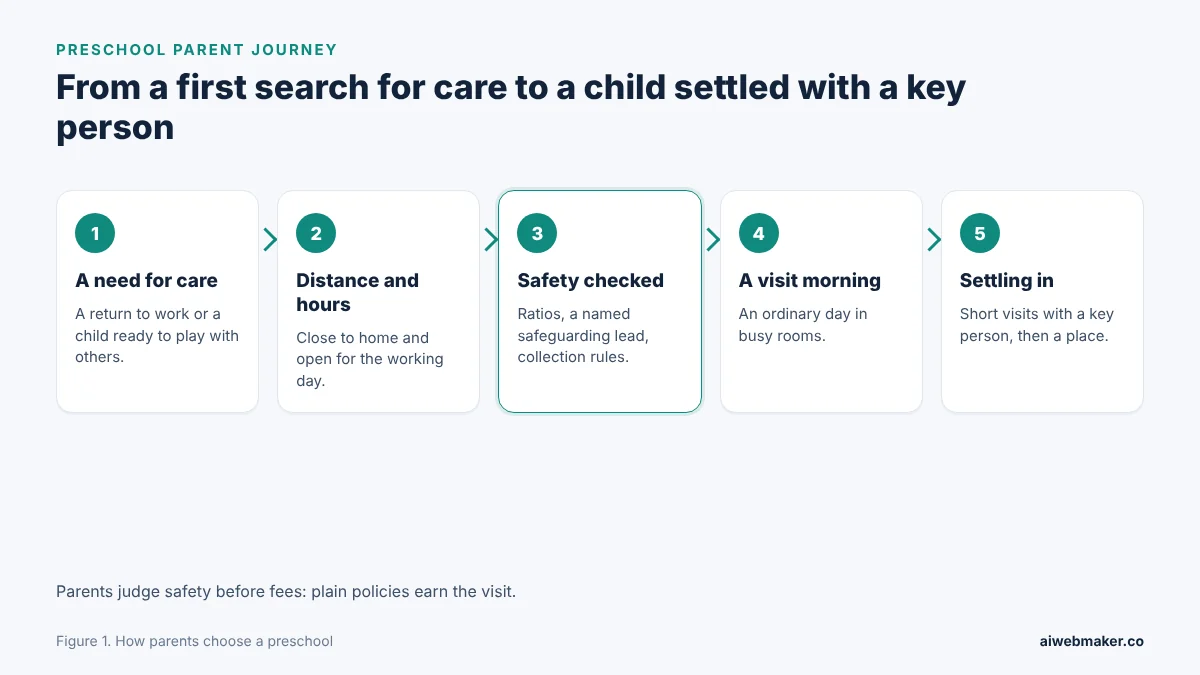
Running across five steps, this journey opens with a need for care and closes with a child who has settled beside a familiar key person. The step carrying the most weight is the third, where parents look for safeguarding, ratios and collection rules before they agree to a visit. A website that tucks those answers into a downloadable policy loses families at exactly that point. The visit morning is where trust is confirmed or lost, because parents compare what they read with what they see in the rooms. Every section of the site should nudge a parent one step closer to that settled child.
Which sections carry a family from a search to a visit morning?
A preschool website works best as a short run of sections that each settle one parental question, rather than a long brochure that repeats the same welcome. The opening view should state the ages taken, the opening hours and the area, with a clear way to arrange a visit. A daily routine turns abstract promises into an ordinary Tuesday that a parent can picture. Safeguarding, fees and the visit request then answer the questions that decide whether a family gets in touch at all. Settings that keep these sections short and specific earn more visits than those leading with mission statements.
| Section | What parents want to know | What it should state |
|---|---|---|
| Opening view | Is this setting near, open and right for my child | Ages, hours, area and a visit button |
| Rooms by age | Where my child would spend the day | Age range, adult to child ratio, activities |
| Daily routine | What an ordinary day looks like | Meals, rest, outdoor play and home time |
| Safety and collection | Who is with my child and who may collect | Checks, safeguarding lead, collection list, first aid |
| Fees and funding | The monthly total and what it covers | Sessions, inclusions, notice, funded hours |
| Visit request | How to see the rooms | Child's age, days needed, preferred date |
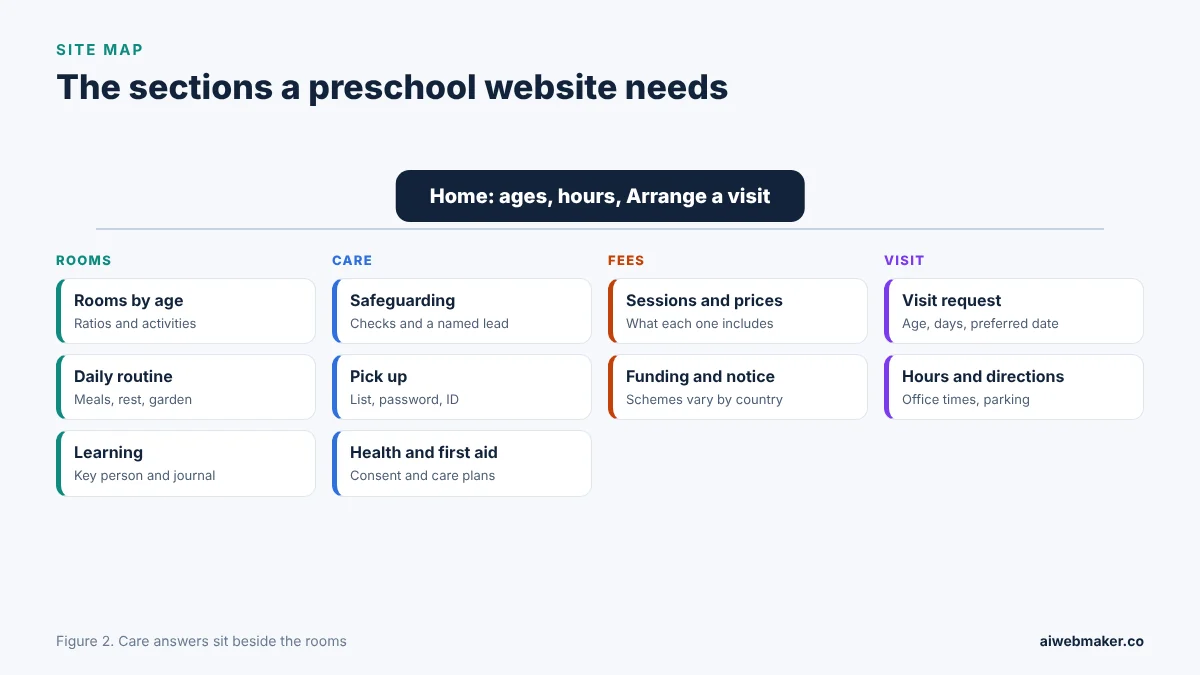
Grouped this way, the preschool site falls into four clusters that follow a parent's own order of questions. The rooms cluster describes each age group, the routine and the approach to learning, while the care cluster gathers safeguarding, ratios, collection and first aid. The fees cluster sets out sessions and notice, and the visit cluster holds the enquiry form, office hours and directions. Little Acorns Preschool, the invented setting behind our preschool website example with three rooms by age and visit mornings, fits all four clusters onto one page. Its Acorn room takes children aged two to three, the Sapling room three to four and the Oak room four to five, and a routine table runs from early arrivals through to tea. Safeguarding, ratios, pick up, and health and first aid each get a short paragraph, followed by the fee table and a visit request with just three questions about the child and the days wanted.
How should rooms, ages and ratios read to a parent?
Each room description should tell parents what a day feels like for a child of that age, not just the room's name and colours. Parents of two year olds ask about naps, nappies and messy play, while parents of four year olds ask about getting ready for school. The adult to child ratio for every room should be stated in numbers, with a note that ratio rules are set by regulators and differ between countries and regions. A key person system, in which one named adult gets to know each child and family, deserves a sentence in plain words. Clear room descriptions let a family imagine their own child in the space before they ever visit.
| Room focus | Questions parents ask | What the description should cover |
|---|---|---|
| Youngest children | Naps, nappies, comfort toys | Sleep room, home routines followed, changing |
| Middle years | Friendships and independence | Longer projects, serving lunch, taking turns |
| Year before school | Readiness for the classroom | Early mark making, counting, coats and zips |
| Moving up | When and how it happens | Readiness rather than birthdays, short visits first |
| Ratios | How many adults per child | Numbers per room and the rule that applies locally |
What belongs in the safeguarding and collection section?
The safeguarding section is the part of a preschool website that parents read most closely, so it should use plain sentences rather than policy language. It should explain that every adult is background checked before starting, using whatever vetting the law provides where the setting is registered. Naming a designated safeguarding lead, and saying who deputises, shows that responsibility sits with real people. The page can state that concerns about a child are reported to the local child protection service as the law requires, without any case detail. Collection rules deserve the same care, including the named list, a family password and an identity check for anyone new at the door. Health wording should stay general, describe exclusion periods and emergency steps, and send families to their own doctor with medical questions.
| Policy | What the website should say |
|---|---|
| Staff checks | Vetting before the first day, with safeguarding training renewed each year |
| Safeguarding lead | Who holds the role and who deputises |
| Collection | The named list, the password and identity checks for new adults |
| First aid | How many staff trained in child first aid are always on site |
| Medicines and allergies | Written consent for medicines, care plans checked at every meal |
| Illness | When a child should stay home, and when parents are phoned |
How can fees and funded hours be shown without confusing families?
Preschool fees are among the largest monthly bills a young family pays, so they belong in a clear table rather than a phone call. Each session should list its hours, what it includes and its price, whether that is a morning, an afternoon, a full day or a full week. A registration fee, the notice needed to reduce or end a place and any charge for late collection belong beside the table rather than deep inside a contract. Many governments fund some early years hours, but schemes, ages and conditions vary widely, so the page should simply say how any funding is taken off the bill and shown in writing. A family that can do the sums at home arrives at the visit ready to talk about the child rather than the invoice.
| Fee detail | Why parents look for it | How to present it |
|---|---|---|
| Session prices | To work out a monthly total | Hours and price for each session |
| What is included | To compare settings fairly | Meals, snacks, nappies, outings |
| Registration fee | To know the cost of holding a place | Amount, and whether it comes off the first bill |
| Notice and late collection | To avoid surprises | Notice to change a place, charge for late pick up |
| Funded hours | To know what the family really pays | How a public scheme is deducted, noting that schemes vary |
How should visit mornings and settling in be offered online?
A visit request should be short enough to send from a phone with a toddler on one hip, asking only what the office needs to offer a time. A line on when the office replies, and that no place is held until the registration form is in, stops parents reading silence as a refusal. Visit mornings held while the rooms are busy show an ordinary day rather than a staged one, and saying so sets the right expectation. Settling in can be explained in a few lines, such as two or three short visits alongside a parent before a first session alone. The AI website builder that drafts preschool rooms, fees and a visit enquiry form turns a few sentences from the manager about the setting into a first draft of these sections. Every part of that draft can then be reworked in the preview before any bill begins.
Which photos can a preschool share, and with whose consent?
Photos sell a preschool better than any slogan, yet pictures of other people's children call for more care than in almost any other trade. Written consent from parents should be in place before any child appears online, and many settings choose images where faces are turned away or not shown. Children's names should never sit beside their photos, and nothing should reveal a child's routine beyond the setting itself. Data protection and image rules differ between countries, so the photo policy should match the law where the setting is registered. Careful photos tell parents that their own child's privacy will be guarded too.
Which early years phrases do parents put into a search bar?
Parents searching for care type phrases such as preschool near me, play based preschool or part time preschool for two year olds, often with their district. In many countries the same kind of setting is called a nursery school or an early learning centre, so the site can use both names where they fit. A map entry that lists true opening hours and the address, with pictures of the rooms and a website link, wins parents who compare settings on a phone. Reviews from families that mention settling in, kind staff and clear communication carry more weight than star ratings alone. Short pieces on settling in, toilet training and the year before school help parents long before they enrol, and they make the setting the name parents pass on.
How small is the yearly hosting bill for an early years setting?
Only two items recur for a preschool site, hosting and the domain, and each parent article from AI credits is priced near sixty five cents. A setting with a full roll saves by paying once a year. A setting in its first term may prefer twelve smaller payments while numbers grow. Changing fees, rooms or term dates carries no extra charge at all. For comparison only, the dearer $189 plan is shown on its own row.
| Item | Yearly | Monthly |
|---|---|---|
| Hosting the preschool pages | $119 | $228 over twelve months |
| Domain | Depends on the ending | Depends on the ending |
| Higher plan, for comparison | $189 a year | Not needed |
| Twelve parent guidance articles at about $0.65 | About $7.80 | About $7.80 |
| Fee, room and term date updates | No charge | No charge |
| Year before the domain | About $126.80 | About $235.80 |
What sends a worried parent to another setting's page?
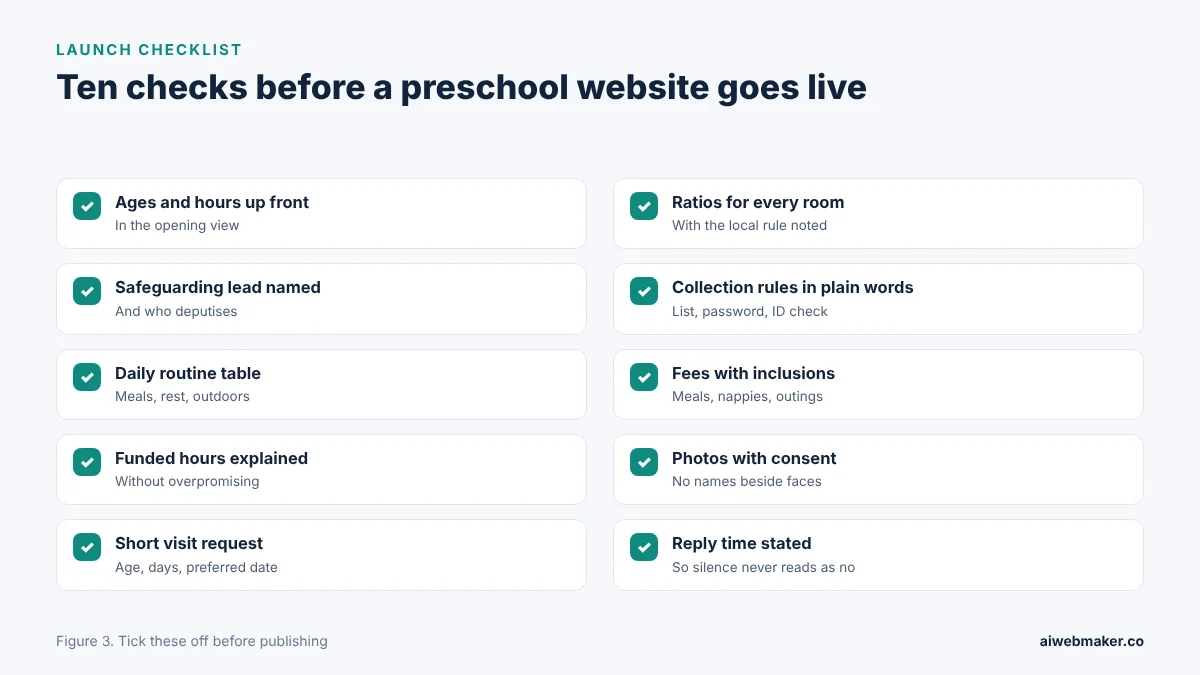
Parents leave a preschool website quickly when ratios, safeguarding or collection rules are missing or buried in a download. Fees that appear only after a phone call suggest the total is higher than a family expects. Generic pictures of grinning toddlers ring false beside settings that show their own rooms and garden. A visit form that asks for pages of detail before anyone has met puts off busy parents. Ten checks that close each of these gaps appear in the preschool launch graphic.
Frequently asked questions
Is consent needed before children appear in preschool photos?
Written consent from parents is needed before any child appears on the website, and many settings avoid identifiable faces altogether. Pictures of hands at work, children seen from behind and empty rooms set up for the day show the setting just as well. Names should never appear next to photos of children. Consent should be easy to withdraw, with images taken down promptly when a parent asks. Rules on children's images differ by country, so the setting should follow the guidance of its own regulator.
Should funded hours be explained on the fees page?
Funded hours deserve a short explanation wherever a public scheme applies, because parents often do not know how it changes their bill. The page can say which ages and hours a local scheme covers, and point families to the official source for eligibility. It should explain how the funded amount is shown on invoices and whether extras, such as meals, are still charged. Wording should stay general where rules change often or differ by region. A clear note saves the office from repeating the same conversation at every visit.
How long does settling in usually take?
Settling in can last anything between a few days and a few weeks, depending on the child's age, temperament and past time away from home. Many settings start with short visits alongside a parent, then a first session of an hour or two alone. The key person can agree the pace with the family and slow it down if the child needs more time. A note that a longer settling period is normal and welcome reassures anxious parents. Explaining this before a visit sets kind and realistic expectations on both sides.
What should a preschool visit request ask for?
A preschool visit request needs the child's age, the days wanted, a rough start date, a preferred visit date and a way to reply. A short message box can invite notes on allergies or languages spoken at home. Anything more detailed belongs in the registration form after the visit. The page should state how soon the office replies and that a place is held only once registration is complete. Short forms are the ones busy parents actually send.
Does one enrolled child repay the preschool's year online?
A single child attending a few morning sessions brings in many times the $119 a preschool spends on a year of hosting. Families on the monthly route would see the $19 vanish inside one week of fees for one child. Every family that books a visit after reading clear ratios and fees fills a place that might otherwise have stayed empty. Plain policies, a believable routine and a short visit form win parents over in a way that glossy brochures cannot. When the visit mornings fill up through the enquiry form, the site has more than paid its way.
Build your website in Minutes and get the AI Tools that work
Start Building Your Website →