Golf Course Website Cost: Green Fees, Members and Society Days
Golf clubs pay $119 of hosting a year or $19 a month, and a domain on top, to present the course online. Inside: who reads the site, green fees, membership, beginners, conditions and dress, societies and events, search and the yearly bill.
- No coding required
- Live in minutes
- Blog, SEO and chatbot tools included
Green fees, memberships and clubhouse dinners can all sit on a golf club's website, which AI Web Maker hosts for $119 yearly or $19 monthly, with the domain separate. Nothing is billed while the pro shop and the office shape those pages, check each fairway photo and polish the wording in the preview. One society golf day, or a single new membership, repays that year many times. The difficulty is that a golf club speaks to several audiences at once, from visitors after a tee time and nervous beginners to future members and couples planning a reception. Each of them tends to assume the site was written for somebody else. Ahead lie how each group chooses, the pages to build, green fees, membership categories, beginners, conditions and dress, societies and events, search, the yearly bill and the gaps that lose bookings.
This article is part of our complete guide: Fitness Website Builder.
Visitors, members, beginners and societies: who reads a golf club's site
A golf club's website is read by visiting golfers, prospective members, complete beginners, society organisers and people planning events that have nothing to do with golf. Visitors want the green fee, the tee time process, the handicap rule and whether buggies are available. Prospective members compare categories, costs, joining arrangements and how busy the course is at weekends. Beginners look for reassurance that nobody will mind a slow round, plus lessons and clubs to borrow. Society organisers check group sizes, start formats and the dinner, while event planners look only at rooms, menus and capacity. A clear route for each reader keeps the club from losing several kinds of booking at once.
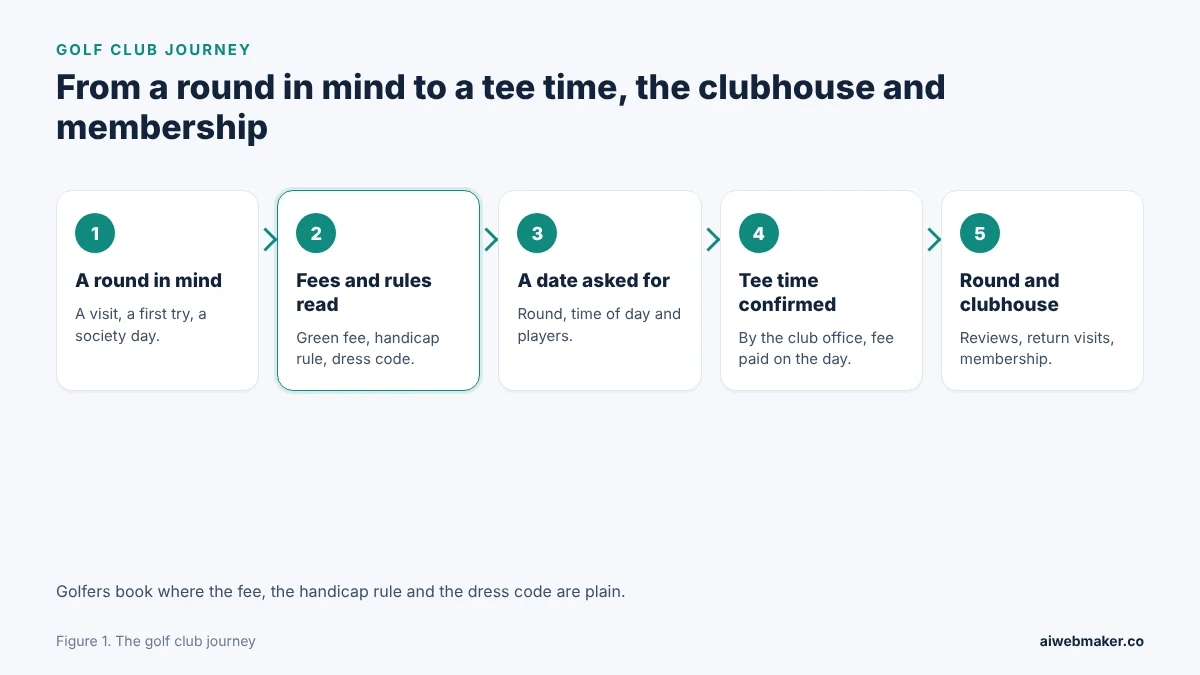
This journey follows a visitor or a newcomer from the first thought of a round to the clubhouse afterwards, and sometimes to a membership form. The bright step is reading the fees and rules, because a golfer who cannot see the price, the handicap requirement or the dress code will try another course. Asking for a date comes next, with the round, the time of day and the number of players. The club office then confirms the tee time, and many clubs settle the green fee in the pro shop on the day. A good round and a friendly bar are where membership conversations begin. From the first tee to the nineteenth hole, each page ought to point a golfer towards the next shot.
Green fees, membership and clubhouse pages a course should publish
A golf club website needs more pages than most leisure businesses, because its audiences rarely overlap. Green fees and tee times serve visitors, the membership page serves future members and the new golfer page serves those who have never played. Practice and lessons cover the range, the short game area and coaching. A course page with the scorecard, hole descriptions and current conditions answers questions that otherwise arrive by phone. Clubhouse and society pages handle the events that keep the dining room full, and an enquiry route with directions completes the set.
| Page | Main reader | What it should state |
|---|---|---|
| Green fees | Visiting golfers | Rounds, weekday and weekend prices, handicap rule |
| Membership | Future members | Categories, cost, what each includes, joining |
| New golfers | Beginners | Tasters, lessons, borrowed clubs, a relaxed welcome |
| Practice and lessons | Improvers and juniors | Range, short game area, coaches, academy |
| The course | Everyone planning a round | Scorecard, hole notes, current conditions |
| Societies and events | Organisers | Packages, capacities, menus, deposits |
| Enquiries and visit | All readers | Date requests, office hours, directions |
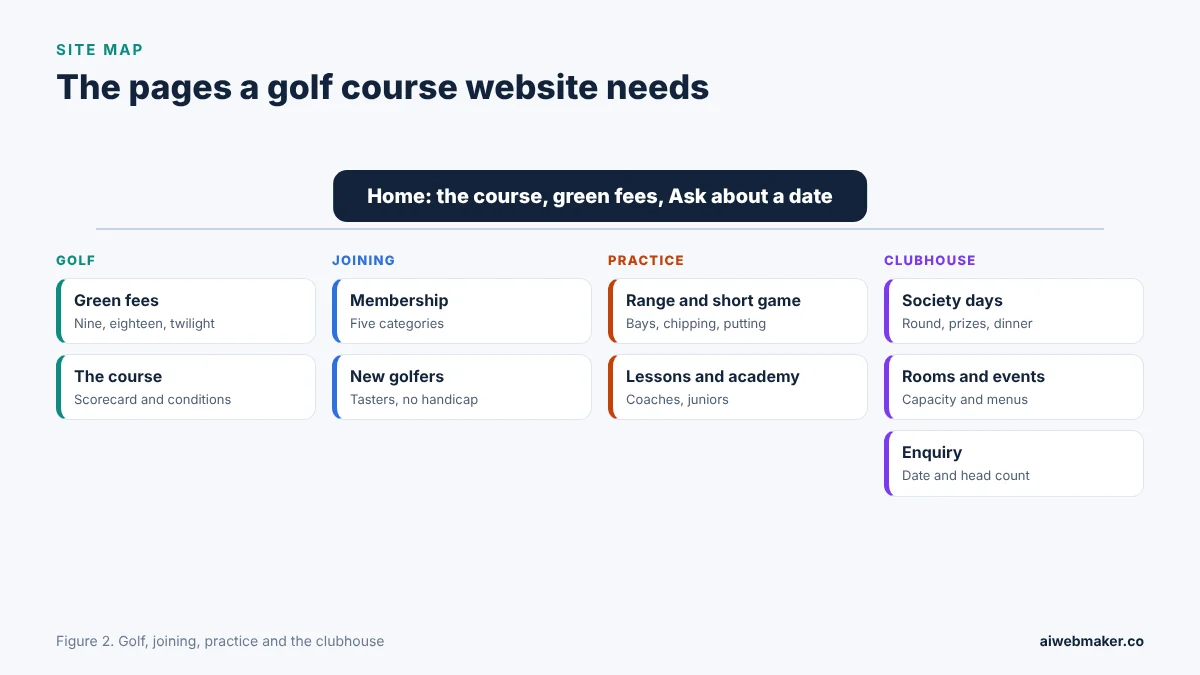
Four groups sit under the home page here: golf, joining, practice and the clubhouse, with the date request reachable from each of them. Golf holds green fees, the course and its conditions, joining holds membership and the new golfer welcome, practice holds the range and lessons, and the clubhouse holds societies, dining rooms and the enquiry route. Our sample club, Larchmere Golf Club, prices the Lakeside Nine, the full eighteen and twilight golf for visitors, then sets out five membership types in a table. Its practice section lists a covered driving range, a short game area, a Saturday taster, private lessons, a junior academy and club hire and repairs, while a society golf day sits beside the Larch Room and the terrace and lounge. The golf course website example with green fees, membership and a society day closes with one form asking what is planned, the date, the time of day and the head count. That single route keeps visitors, beginners and organisers from hunting for a phone number.
Weekday, weekend and twilight: setting out green fees
Green fees should be set out as a small table of rounds, days and times, because golfers compare figures faster than they read paragraphs. Most clubs price weekday and weekend rounds differently, and many add twilight rates after a set hour in summer. Nine hole rounds suit beginners and players short of time, while the full course suits visitors who have travelled. The page should say whether a handicap certificate is needed, whether members can sign in guests at a lower rate and what buggies or club hire cost. Seasonal changes, such as winter rates or temporary greens, belong on the same page with dates. Golfers who see the whole price before they call book with fewer questions.
| Fee type | When it applies | What to state |
|---|---|---|
| Weekday round | Monday to Friday | Price per player, nine or eighteen holes |
| Weekend round | Saturday, Sunday, holidays | Price and any morning restrictions |
| Twilight | After a set hour, often in summer | Start time and the months it runs |
| Guest of a member | When a member signs in a visitor | Rate and how many guests are allowed |
| Buggy and club hire | Any round | Price per round and how to reserve |
| Winter or temporary greens | Off season | Reduced rate and course limits |
Membership categories explained without the club jargon
Membership pages lose prospective members when they use labels such as five day, country or intermediate without explaining what each means in practice. A table pairing each category with the golfer it suits, what it includes and its cost makes comparison simple. First year or academy memberships, combining lessons with limited play, help beginners move from tasters into the club. Junior and social categories bring families and partners into the clubhouse. The page should explain how joining works, whether by a waiting list, a playing assessment or a friendly conversation. Clarity here turns a casual visitor into a member who renews year after year.
| Category | Usually suits | Points to explain |
|---|---|---|
| Full or seven day | Regular weekend golfers | Competitions, guest rates, tee time access |
| Five day | Weekday and shift workers | Which days are included |
| First year or academy | New golfers | Lessons, limited holes, handicap support |
| Junior | Under eighteens | Times of play, academy, parental rules |
| Social | Partners and friends | Clubhouse use, dining, a few rounds a year |
A welcome for people who have never held a club
Beginners are the golfers a club most needs and the ones most likely to feel unwelcome, so the website should address them directly. A short course or nine hole loop, open without a handicap, gives newcomers somewhere to play without holding up experienced golfers. Saturday tasters with a coach, clubs and balls included remove the cost of buying equipment before knowing whether golf suits them. A plain description of what to wear, how long a round takes and how to book prevents the embarrassment many people fear. Photos of real beginners, rather than only low handicap players, show that the club means its welcome. A warm page for newcomers fills the lesson diary now and the membership list a year later.
Scorecards, course conditions and the dress code
Golfers check the course itself before they travel, and the website is the right place to answer their questions in advance. A scorecard with par, length and stroke index for each hole helps visitors plan, and short hole notes add character. A conditions note, updated when greens are temporary, buggies are restricted or frost delays the first tee, saves wasted journeys. The dress code should be specific, since tidy and relaxed means different things to different people, and many clubs now ask less than they once did. Notes on lightning, pace of play and course etiquette can sit on the same page. Visitors who know what to expect arrive in the right clothes and on time.
Society days, dinners and receptions in the clubhouse
Society days and clubhouse events often earn a club more per booking than any green fee, so they deserve their own pages with packages, capacities and prices. A society package usually combines coffee on arrival, the round, scoring and prizes, and a dinner, with shotgun starts for larger groups. Dining rooms and terraces can host company dinners, birthdays, christenings and receptions, and each needs its seated capacity, menus and any late licence. The club's own deposit and cancellation terms should be printed, because organisers compare them carefully. The AI website builder that drafts golf club pages from an owner's outline writes first versions of these event, fee and membership pages after the office sums up the course, rooms and prices in a few lines, and staff then edit them in the preview. A well described clubhouse keeps the dining room busy on days when the course is quiet.
Searches golfers make before choosing a course
Golfers search with phrases such as golf course near me, green fees in a named town, twilight golf, golf lessons for beginners, society golf days or golf club wedding venue. Each of those deserves a heading on the matching page, so search engines connect the phrase with the right content. The club's map listing should show the clubhouse hours, photos of signature holes and a link to green fees. Reviews from visitors who mention course condition, a friendly welcome or a well run society day are the most persuasive kind. Articles on preparing for a first round, how handicaps work or what a twilight round involves bring golfers in between seasons. Over time this writing helps the club appear for golfers who have never heard of it.
Greenkeeping budgets and the website line
Set against mower fuel and greenkeeping, a golf club's website costs are tiny: hosting, a domain and credits for articles. Annual billing holds hosting at $119, while paying $19 each month totals $228. Domains are priced according to their ending, and about 400 endings exist. A year of monthly course articles uses roughly $7.80 of credits. The $189 tier is shown only as a yardstick, and posting new fees, conditions or event menus costs the club nothing.
| Item | Yearly | Monthly |
|---|---|---|
| Hosting the golf club pages | $119 | $228 over twelve months |
| Domain | Depends on the ending | Depends on the ending |
| Higher plan, for comparison | $189 a year | Not needed |
| Twelve course and coaching articles at about $0.65 | About $7.80 | About $7.80 |
| Fee, condition and menu updates | No charge | No charge |
| Year before the domain | About $126.80 | About $235.80 |
Missing fees and jargon that send golfers elsewhere
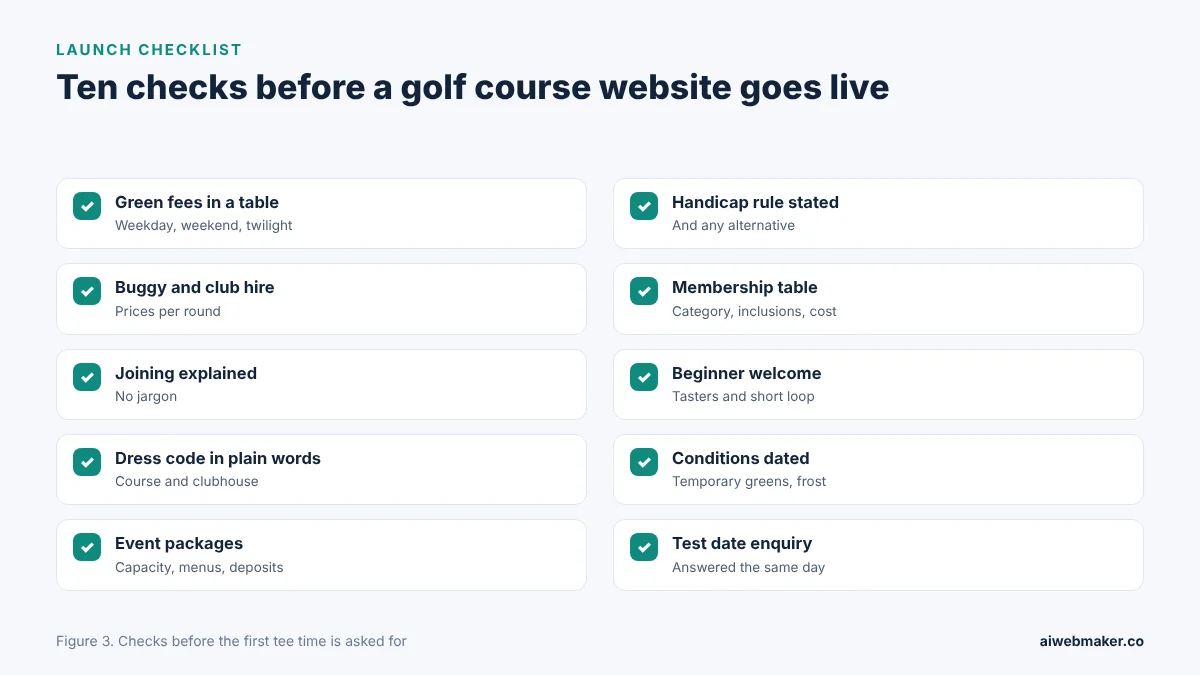
Visiting golfers leave a club's website when the green fee is missing or hidden in a downloadable file. A membership page full of jargon, with no costs, suggests the club is not really looking for new members. Beginners give up when nothing on the site says they are welcome without a handicap. Out of date conditions, such as a closed course still shown as open, cause wasted journeys and annoyed reviews. Event organisers move on when capacities and menus are missing. Ten fixes that keep each of these readers on the page are pictured here, one per tile.
Frequently asked questions
Do visitors need a handicap to book a round?
Handicap rules differ between clubs and between countries, so the website should state the club's own requirement clearly. Some clubs ask visitors for a handicap certificate on the full course, while short loops and par three courses are often open to anyone. A club can offer a short check on the range with a coach as an alternative. Stating the rule beside the green fees prevents awkward conversations at the pro shop. Clear wording also encourages newer golfers who might otherwise assume they are not allowed.
What dress code wording suits a modern club?
Dress code wording works best when it lists what is welcome rather than only what is banned. Many clubs ask for tidy trousers or tailored shorts, a collared shirt or plain sports top and golf shoes or flat trainers. Rules for the clubhouse can differ from rules on the course, and the page should say so. A friendly tone shows newcomers that the code is about respect for the course, not about keeping anyone out. Specific wording saves visitors from turning up in the wrong clothes.
How open should a club be about membership costs?
Being open about membership costs helps, because prospective members compare clubs before they ask for a tour. Showing a starting monthly or yearly figure for each category, with what it includes, steers enquiries towards people who can join. Joining fees, locker charges or levies should be mentioned if the club has them. A note on how subscriptions are paid, monthly or yearly by arrangement, removes another doubt. Transparent costs build the trust a long term membership depends on.
When should course conditions be refreshed online?
Course conditions should be refreshed whenever something changes a visitor's round, such as temporary greens, buggy restrictions, frost delays or closures after heavy rain. A dated note at the top of the course page shows golfers the information is current. The same change should appear on the map listing where possible. Members value the update as much as visitors, since it saves them a wasted trip. Reliable condition notes are one of the simplest ways a club shows it is well run.
A society day, a membership and the hosting bill
At the sample club's prices, two players on the full eighteen already outweigh the $119 that hosts the club's site for a year. A $19 month is cleared by a single beginner booking the Saturday taster that the sample prices. A single society golf day or a new seven day membership is worth many years of hosting on its own. Clear fees, honest membership tables and a real welcome for beginners sell the club better than glossy aerial photos. Clubs that keep conditions, fees and event menus current see visitors return as members. A full tee sheet on a weekday morning is the reward for pages that answer golfers before they ask.
Build your website in Minutes and get the AI Tools that work
Start Building Your Website →