Beauty School Website Cost: Courses, Fees and an Honest Outcome
Hosting a beauty school's website costs $119 per year, with $19 per month as the alternative, and a domain on top. Sections cover who enrols, the pages, courses and diplomas, licensing, the student salon, intakes, search and the budget.
- No coding required
- Live in minutes
- Blog, SEO and chatbot tools included
Hosting a beauty school's website is billed at $119 per year, with $19 per month as the alternative, and the academy adds a domain of its choosing. No charge applies while the course cards, diploma fees and student salon menu take shape in the preview. One enrolment on a short lash or nail course pays for the hosting year with plenty to spare. The deeper challenge is trust, because a learner weighs a large fee and weeks away from work against a certificate whose value depends on licensing rules that differ by country. The site therefore has to be honest about outcomes while still making the courses appealing. Topics below include who enrols, the pages, short courses against diplomas, licensing and honest outcomes, the student salon, intakes and fees, search, the yearly sums and the gaps that lose applicants.
This article is part of our complete guide: Fitness Website Builder.
Who enrols at a beauty academy, and what tips the decision?
Beauty schools serve several kinds of learner, and each one reads the website with a different question in mind. Career changers want to know whether a diploma will let them work, and how long they must spend away from their current job. School leavers and their parents look at fees, timetables and how the academy supports beginners. Working therapists add a single skill, such as lash lifts or gel extensions, and want short, focused courses. Hobbyists come for a makeup day and sometimes return for a diploma. Across all of them, the deciding factors are fees, time, class size and a straight answer about what the certificate allows.
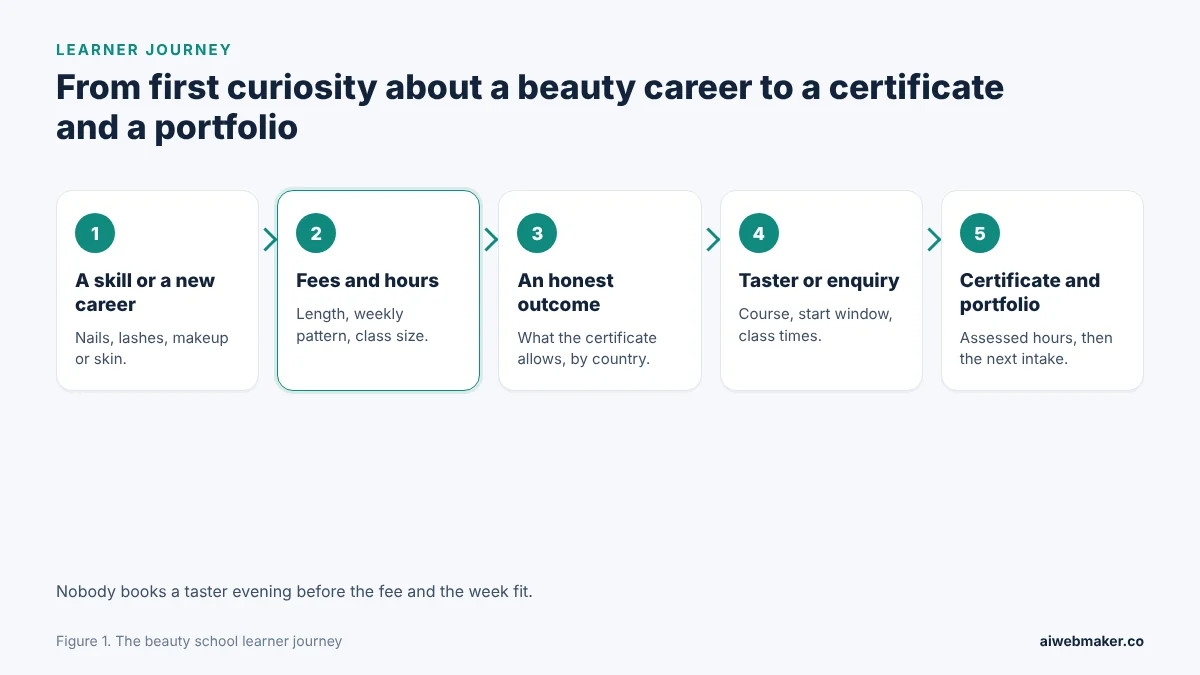
Fees and hours together form the highlighted step here, since nobody books a taster evening before knowing whether a course fits their budget and their week. Curiosity often begins with a treatment the learner already enjoys or a wish to change careers. A search for a course and a town turns up several schools, and the one that states length, fee and class size clearly gets the closer look. An honest note on licensing then decides whether the learner trusts the school with a larger commitment. An enquiry or a taster evening follows, and enrolment comes after that. The certificate and portfolio at the end become the proof that brings in the next intake.
Course pages, diploma pages and a student salon menu
A beauty school website needs pages for two audiences, future students and salon clients, and both must find their route quickly. Short courses each deserve a card with the length, the fee and whether a training kit is included. Diplomas need a page that shows the weekly pattern, the total fee, the assessed hours and the payment plan. The student salon needs its own menu with treatment times and prices, separate from the course pages. Intakes, the enquiry route and a visit page complete the set.
| Page | Who reads it | What it should hold |
|---|---|---|
| Short courses | Beginners and working therapists | Length, fee, kit, class size |
| Diplomas | Career changers | Weekly pattern, total fee, assessed hours |
| Licensing and outcomes | Anyone planning to work | What the certificate shows, rules by country |
| Student salon | Local clients | Treatments, time to allow, prices, patch tests |
| Intakes and fees | Applicants | Start dates, deposit, monthly payments |
| Enquiry and visit | Both audiences | Course or salon visit, start window, taster evenings |
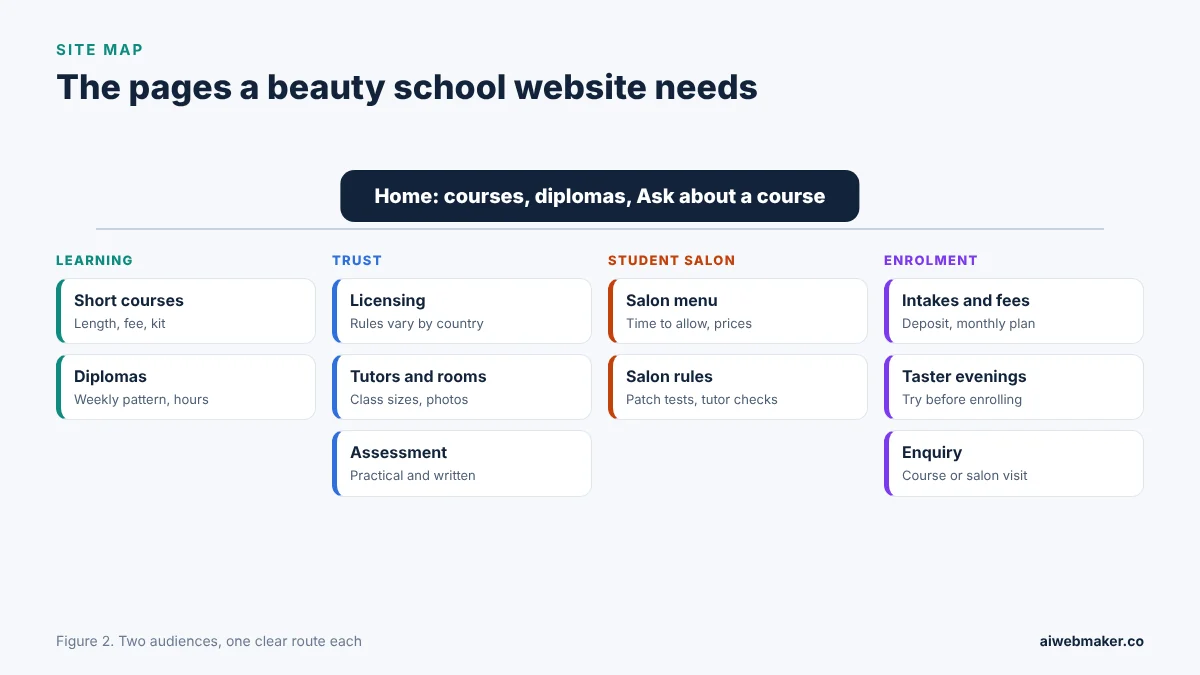
Each branch of this academy site map speaks to a different reader, which matters because a beauty school serves learners and salon clients at once. The learning branch holds the short courses and the diplomas. The trust branch explains licensing, tutors and assessment, and shows the training rooms. The salon branch carries the student salon menu and its rules, while the enrolment branch gathers intakes, fees, taster evenings and the enquiry. Our sample school, Lumen Academy of Beauty, teaches short courses in gel manicure and pedicure, acrylic and gel extensions, classic lash extensions, lash lift and brow lamination, bridal and occasion makeup and facial treatments, offers a Nail Technology Diploma, a Makeup Artistry Diploma and a Beauty Therapy Diploma, and runs a student salon with its own price list; the beauty school website example with courses, fees and a student salon also sets out five stages from a taster evening to a certificate.
Short courses or a full diploma: matching length to ambition
Learners choose between a short course and a diploma by asking what they want to do afterwards, so the website should frame each option around that goal. A one to five day course teaches a single skill to a beginner or adds a treatment to a working therapist's menu. A diploma runs for weeks or months, covers theory, hygiene and client care, and includes assessed hours on real clients. Fees, kit and the weekly pattern should sit on the same card, because time away from work is as important as money. Class sizes matter too, since a small group means more time with the tutor. A comparison table helps a reader see which route matches the career they have in mind.
| Route | Typical length | Suits | What the page should state |
|---|---|---|---|
| Short course | One to five days | A new skill or a first try | Fee, kit included or not, practice on a model |
| Evening diploma | Several weeks, part time | Learners keeping a day job | Evenings per week, total fee, assessment |
| Full diploma | Several months | A complete career change | Subjects, salon hours, payment plan |
| Taster evening | A couple of hours | The undecided | Fee, and whether it comes off a course |
Licences, awarding bodies and the honesty graduates need
Licensing is the question that most affects a learner's decision, and a careful academy answers it plainly rather than with a promise. Qualifications and licences for beauty work vary by country and often by state or region, and some places require a set number of training hours before a licence is granted. In the United States, for example, cosmetology and esthetics licences are issued at state level, while other countries rely on recognised awarding bodies or national qualifications. The page should say what the school's own certificate records, such as hours and assessments, and point readers to the licensing body where they plan to work. It should never suggest that a course alone guarantees the right to work or a job. Honest wording like this protects students and the academy's reputation when graduates start applying.
The student salon: slower treatments, supervised chairs, lower prices
A student salon brings in clients who would never enrol, and its page has to set their expectations carefully. Treatments take longer than in a busy salon, because a tutor checks each stage before the next one begins. Prices are lower to reflect that pace, and the page should explain the reason so clients do not feel misled. Tints and lash treatments usually need a patch test some time beforehand, and the tutor checks that a treatment suits the client before starting. Some treatments are unsuitable during pregnancy or with certain skin conditions, and clients with medical questions should ask their doctor. A clear, separate salon menu keeps paying clients happy and gives students the real practice their diplomas require.
| Salon detail | What the page should explain |
|---|---|
| Days and hours | When the training floor opens to the public |
| Time to allow | Treatments are slower because each stage is checked |
| Supervision | A qualified tutor signs off every treatment |
| Patch tests | Needed before tints, booked in advance |
| Suitability | The tutor checks health questions before starting |
Intakes, taster evenings, deposits and resits
Schools fill classes by intake, so the website should make the calendar and the money rules as clear as the courses themselves. Start dates for weekday, evening and weekend groups help learners plan around work and family. A deposit that holds a place, and a balance paid monthly and arranged directly with the academy office, makes a larger fee manageable. The page should also explain what happens if a class is missed, whether a resit is included and how cancellations work under local consumer rules, which differ from one country to the next. The AI website builder that drafts course, diploma and student salon pages produces this structure once the academy has summed itself up in a few sentences, and every line can then be rewritten. Clear terms written in advance prevent the disputes that damage a school's name.
Nail technician course, lash training, makeup diploma: how learners search
Learners search for a course and a place together, typing phrases such as nail technician course, lash extension training, makeup artist diploma or beauty therapy course with a town. Each course page should repeat those everyday words in its title and first sentence, so the match is exact. The map listing needs the academy category, accurate office hours and photos of the training rooms and the student salon. Reviews from graduates and from salon clients both strengthen the listing, because each speaks to one audience. Articles on choosing a first course, building a portfolio or what licensing involves attract readers months before an intake. Patient, useful writing turns the academy into the school learners already trust when they are ready to enrol.
What an academy pays to stay online through the intake calendar
An academy's website arithmetic is short: hosting, a domain and about $7.80 if twelve course guides are written with credits. A school with steady intakes pays least by clearing $119 once each year. A new academy still waiting on its first cohort may lean towards paying $19 a month. Adding a course, changing fees or posting a new intake date never adds to that sum. The $189 tier is shown purely so the routes can be compared.
| Item | Yearly | Monthly |
|---|---|---|
| Hosting the academy pages | $119 | $228 over twelve months |
| Domain | Depends on the ending | Depends on the ending |
| Higher plan, for comparison | $189 a year | Not needed |
| Twelve course guide articles at about $0.65 | About $7.80 | About $7.80 |
| New courses, fees and intake dates | No charge | No charge |
| Year before the domain | About $126.80 | About $235.80 |
Missing fees and vague outcomes: why applicants drift away
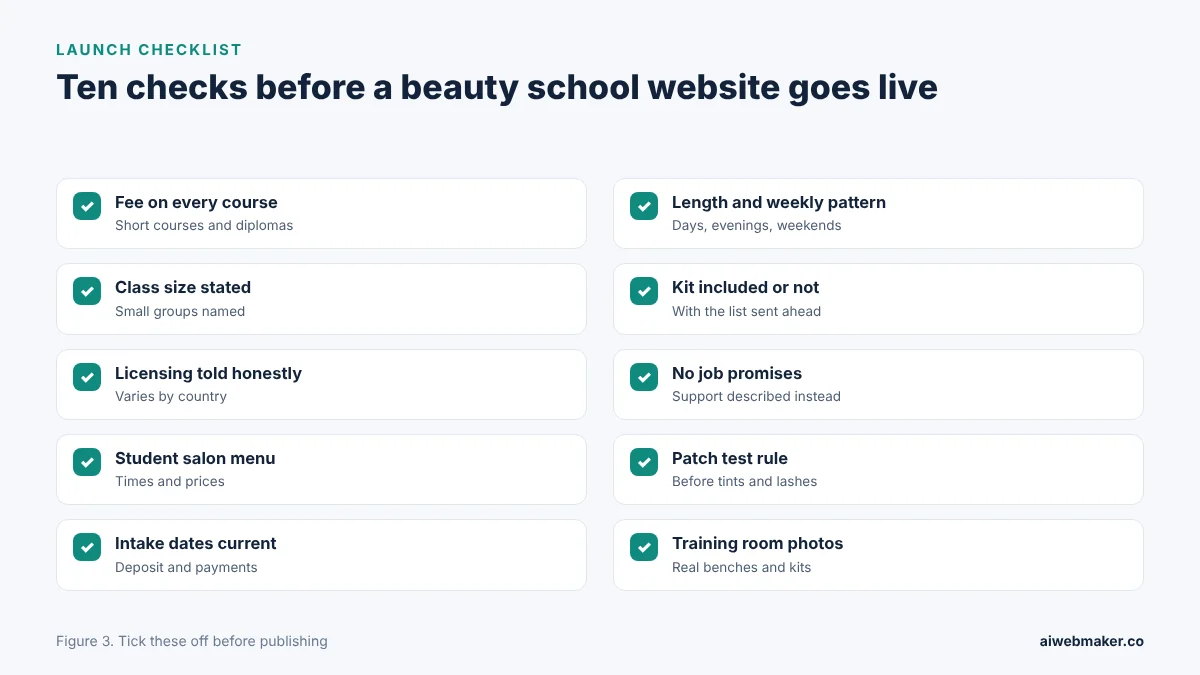
Applicants drift away from a beauty school website when fees appear only after an enquiry. A diploma page without the weekly pattern leaves working adults unable to judge whether they can attend. Vague promises about careers, with no word on licensing, make careful learners suspicious rather than excited. A student salon with no menu or prices loses local clients who would happily book. Photos of empty rooms tell visitors nothing about how teaching actually happens. An academy can fix all of this with the ten corrections drawn up for course sites.
Frequently asked questions
Will a beauty school certificate be enough to work?
Whether a certificate is enough depends on where the graduate plans to work, because licensing for beauty treatments varies by country and often by region. Some places require a licence or a recognised qualification with a set number of training hours, while others leave it to employers and insurers. A school's website should explain what its own certificate shows and point learners to the licensing body that applies to them. It should never suggest that a course guarantees the right to work. Learners who check first make better decisions and become better advocates for the school.
Can course fees be spread over several months?
Many academies accept a deposit to hold a place and spread the balance over monthly payments that end before the final assessment. Any plan like this is arranged directly between the learner and the academy office. The website should state the deposit, the number of payments and what happens if a learner withdraws. Clear terms help learners plan and reduce awkward conversations later. Being open about money tells a learner the school has nothing to hide.
Who can book a treatment in the student salon?
Most student salons welcome adult members of the public, and some accept older teenagers with a parent's consent. Treatments take longer and cost less because a tutor checks each stage. Clients booking tints or lash treatments usually need a patch test some time in advance. The salon menu page can list its opening days, any age limit and the checks made before a treatment. Clear rules keep the training floor calm for students and clients alike.
Does a school need to promise jobs to fill classes?
A school does not need to promise jobs, and doing so can mislead learners and break advertising rules in many places. What attracts careful students is a clear account of the skills taught, the assessed hours and the support offered after the course. Tutors can help with portfolios, salon trials and advice on routes such as employment, mobile work or renting a chair. The website should describe that support without implying any guaranteed outcome. Honest, specific support wins more enrolments than a vague promise ever could.
How few enrolments does it take to repay the hosting?
One learner on a one day lash lift course brings in more than the academy's $119 hosting bill for the whole year. A single student salon treatment can cover a month of hosting at $19 on its own. Every applicant who compares courses, reads the licensing note and sends an enquiry arrives better informed and more likely to stay the distance. Diploma students then bring income across many weeks, and graduates send friends to the next intake. Keeping fees, intake dates and the salon menu current also spares the office from repeating itself by phone. A full taster evening with names already on the next intake list is the plainest proof the site works.
Build your website in Minutes and get the AI Tools that work
Start Building Your Website →