Wedding Planner Website Cost and the Real Weddings That Win Couples
A wedding planner's hosting comes as one $119 yearly payment or a $19 charge every month, with a domain added. Next come service levels, planning stages, fees, galleries, first conversations, contracts, search and the annual figures.
- No coding required
- Live in minutes
- Blog, SEO and chatbot tools included
Hosting a wedding planner's website on AI Web Maker takes a single $119 payment for the year or a $19 charge every month, with a domain added to that. Services, real weddings and the team page can be drafted and reviewed in the preview long before any charge appears. Planning a single wedding earns many times that figure. The challenge is that couples take months to choose, compare planners on directories that list many rivals side by side, and cannot try the service before they buy it. The wedding planning business website sample shows how pages can stand in for that missing trial, following an imaginary planner's couples from the first call right through to the vows, all on pages AI Web Maker built. On a planner's own site, the couple meets just that planner, with time and space to picture their day. In turn, this guide covers who hires a planner, the pages to build, service levels, planning stages, fees and commissions, real weddings, the first conversation, contracts, search and the cost of a year online.
This article is part of our complete guide: Website Builder for Creative Businesses.
Who hires a planner, and what are couples really buying?
Couples who hire a planner are buying confidence that a complicated, emotional and expensive day will run as imagined. Many are busy professionals who lack the time to manage dozens of suppliers. Others are planning from another city or country and need someone on the ground. Some have already booked a venue and want help with everything that follows, while others want design and styling more than logistics. Parents who are paying often read the site as closely as the couple. A planner's website has to reassure every one of these readers that their day would be in safe hands.
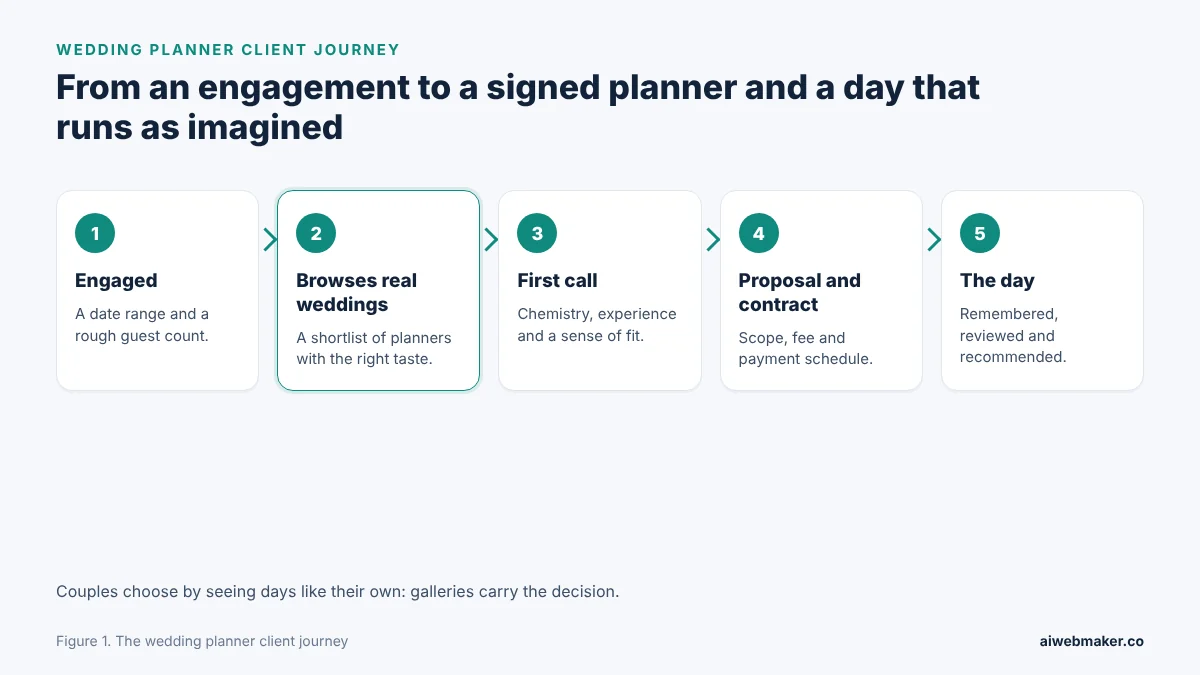
Real weddings form the highlighted step in this journey, because couples choose a planner by seeing days that resemble the one they imagine. The couple then browses galleries and real wedding stories, keeping a shortlist of planners whose taste matches their own. A first call or meeting follows, and chemistry with the planner matters as much as experience. The proposal, the contract and months of planning come next, ending with a day the couple remembers and a review that brings the next booking. Each page of the website should help one of these steps move forward without pressure.
The pages a planner's site needs to earn a first call
A planner's site needs fewer pages than a venue's, but each must carry real weight, because couples read slowly and compare carefully. The home page shows a striking real wedding, the areas served and a clear invitation to get in touch. The services page explains each level of help in plain language. A real weddings gallery proves the planner's taste and range, while a team page shows who the couple would actually work with. Pages on fees, the planning process and the contact step complete the set.
| Page | Couple's question | What it should hold |
|---|---|---|
| Home | Does this planner suit our style? | One real wedding, areas served, a clear next step |
| Services | What help is on offer? | Full, partial and coordination on the day, in plain words |
| Process | What happens and when? | Stages from first call to the day itself |
| Real weddings | Have they done a day like ours? | Galleries with venue, style and couple comments |
| Team | Who would we work with? | Faces, experience, languages spoken |
| Fees | Can we afford this? | How fees are set, starting points where sensible |
| Contact | How do we start? | What to share and what happens next |
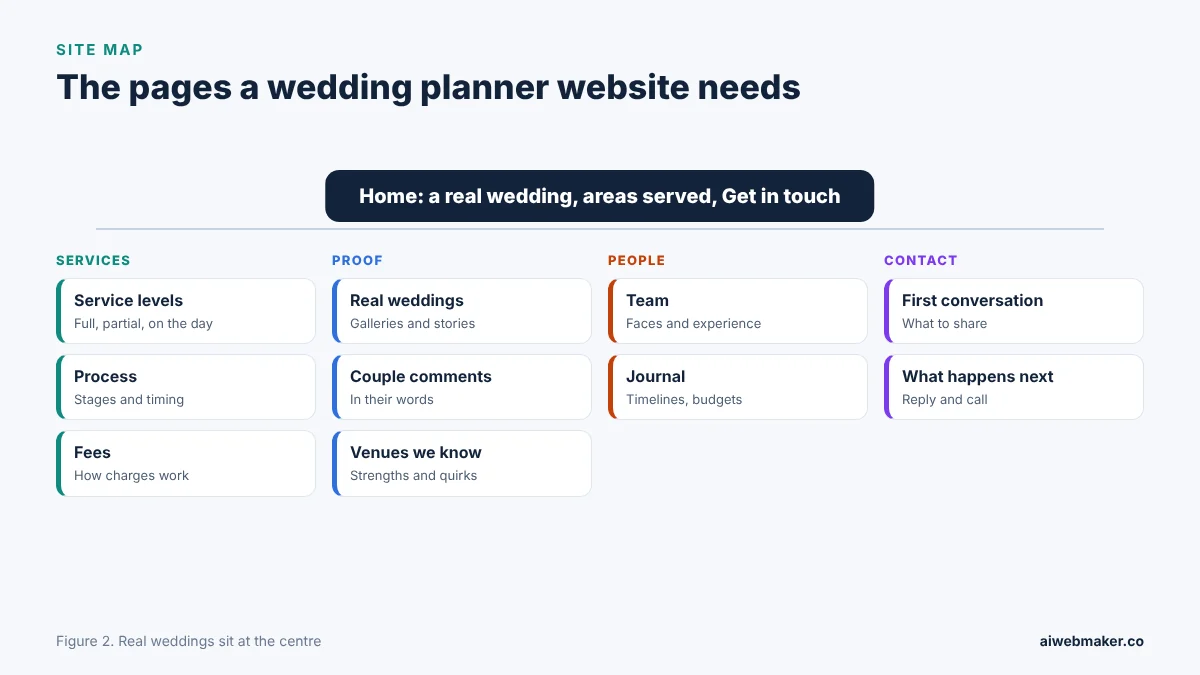
This site map places real weddings at the centre, because galleries are where couples spend most of their time. The services branch sets out each level of help and the process behind it. The proof branch holds the gallery and comments from couples, alongside venues the planner knows well. The people branch introduces the team, while the contact branch explains how a first conversation works. Our sample planner, Ivory and Vow Weddings, gives its weddings a gallery page with comments from couples, explains each stage of planning and how services can be combined on its services page, introduces the people on a team page and uses its contact page to explain what happens after an enquiry. The wedding planner website example with a gallery of real weddings came together in 45 seconds.
Three levels of help, and why their names confuse couples
Service levels confuse couples more than anything else on a planner's website, because the same names mean different things to different planners. Full planning usually covers the whole journey, from budget and venue search to every supplier and the day itself. Partial planning suits couples who have made some bookings and want help with the rest. Coordination on the day, which often starts several weeks before the wedding, hands the running of the day to a professional while the couple does the planning. Describing each level by what is included, rather than by its name alone, prevents misunderstandings that surface months later.
| Service | Suits | What it usually covers |
|---|---|---|
| Full planning | Busy couples, large or complex days | Budget, venue, every supplier, design, the day |
| Partial planning | Couples with some bookings made | Remaining suppliers, timeline, the day |
| Coordination on the day | Couples who planned it themselves | Final weeks, supplier checks, running the day |
| Destination planning | Couples marrying abroad | Local suppliers, legal steps, guest logistics |
| Design and styling | Couples focused on the look | Concept, colours, flowers, tables, decor |
From first call to the morning after: the stages of the work
Couples relax when they can see the shape of the months ahead, so a clear outline of the process is one of the most persuasive things a planner can publish. The first call explores the date, the guest count, the budget and the style. A proposal and contract follow, setting out the services, the fee and the payment schedule. Budget planning and the venue come next, then the suppliers, design decisions and the detailed timeline for the day. The final weeks gather numbers, seating plans and supplier confirmations, before the planner runs the day itself.
| Stage | What happens | What the couple receives |
|---|---|---|
| First call | Date, guests, budget, style | A sense of fit and next steps |
| Proposal and contract | Scope, fee, payment schedule | A written agreement |
| Budget and venue | Priorities set, venues compared | A working budget and a venue |
| Suppliers and design | Bookings, tastings, styling | A supplier list and a design plan |
| Final weeks | Numbers, seating, confirmations | A detailed timeline for the day |
| The day and after | Running the day, wrapping up | A day managed, loose ends tied |
Flat fees, percentages and supplier commissions
Couples want to know how a planner charges before they spend an hour on a call, so the fee model deserves a plain explanation. Some planners charge a flat fee for each service level, which gives couples certainty from the start. Others take a share of the overall wedding budget, which scales with the size of the day but can feel open ended. Coordination on the day is often priced as a fixed package, while consultations may be charged by the hour. Some planners also receive commissions from suppliers, and stating clearly whether that happens protects trust, since couples may otherwise suspect hidden incentives. Whatever the model, a starting figure or a range helps couples judge fit before the first conversation.
| Fee model | How it works | What to explain |
|---|---|---|
| Flat fee | One price per service level | What is included and what is extra |
| Percentage of budget | A share of total wedding spend | How the budget is defined |
| Fixed package | Set price for coordination on the day | When the work starts and ends |
| Hourly consultation | Time billed for advice sessions | Minimum session length |
| Supplier commissions | Payments from suppliers, where accepted | Whether they are taken and disclosed |
Real weddings, permissions and photographer credits
A gallery of real weddings persuades couples more than any description, because it shows the planner's taste, range and attention to detail. Each wedding can carry a short story with the venue, the size of the day and the brief the couple gave. Photographs belong to the photographer as well as the couple, so permission from both should be in place before anything is published. Crediting the photographer, the florist and the venue is generous to suppliers and shows couples a trusted network. A gallery built this way becomes the page that couples return to again and again while they decide.
A small first step for a long decision
Couples often take months to choose a planner, so the first step on the website should be small and carry no pressure. The contact page can invite the couple to share the date or season, the rough guest count, the area and the kind of help they want. Explaining what happens next, such as a reply within a stated time and an introductory call, removes any worry about a hard sell. Articles that answer common questions, such as how far ahead to book or how a planner works with a venue, keep the conversation going between contacts. The AI website builder that drafts services, gallery and contact pages for wedding planners creates these pages once the planner sums up the business in a few lines, leaving the photos and stories to be added. A gentle, clear first step suits a decision that couples rarely rush.
Contracts, postponements and supplier payments
Contracts are the part of wedding planning that couples think about least and need most, so the website should signal that they are handled properly. A good contract states the services, the fee, the payment schedule and what happens if the wedding is postponed or cancelled. Couples should also understand whether they pay suppliers directly or through the planner, since this affects their protection if a supplier fails. Liability insurance, and the rules on it, vary by country, so a planner should hold the cover that applies where it works. Destination weddings add legal steps for marriage that differ between countries, and the planner should point couples to official sources rather than give legal advice. A brief, calm note on these matters shows couples that they are dealing with a professional.
What engaged couples type, and where directories fit
Engaged couples tend to search by place and style, for instance a planner in their region or a coordinator for the day. Many add the name of a venue as well. A page for each service and each area the planner genuinely covers gives those searches a clear match. The map listing should show accurate hours, real wedding photos and the link to the site, even for planners who meet couples at venues. Reviews that mention calm, organisation and problems solved on the day carry great weight. Paid wedding directories can bring early attention, but they place a planner among many rivals, so they work best as a route to the planner's own site. Articles on timelines, venue choices and budgeting draw couples who are only starting to plan.
The planner's hosting bill for a year
Only hosting and an address recur on a planner's website, and neither changes however many couples sign. One yearly payment of $119 covers hosting, and a new planner still building a first season may prefer $19 monthly. Timeline and venue articles written through AI credits are roughly $0.65 each. Adding real weddings, updating fees or refreshing the team page is included at no cost. Yearly and monthly billing for a planner are listed together here, with the $189 tier present only as a yardstick.
| Item | Yearly | Monthly |
|---|---|---|
| Hosting the services, gallery and contact pages | $119 | $228 over twelve months |
| Domain | Depends on the ending | Depends on the ending |
| Higher plan, for comparison | $189 a year | Not needed |
| Twelve wedding timeline articles at about $0.65 | About $7.80 | About $7.80 |
| New real weddings and fee updates | No charge | No charge |
| Year before the domain | About $126.80 | About $235.80 |
Why do couples leave a planner's site without writing?
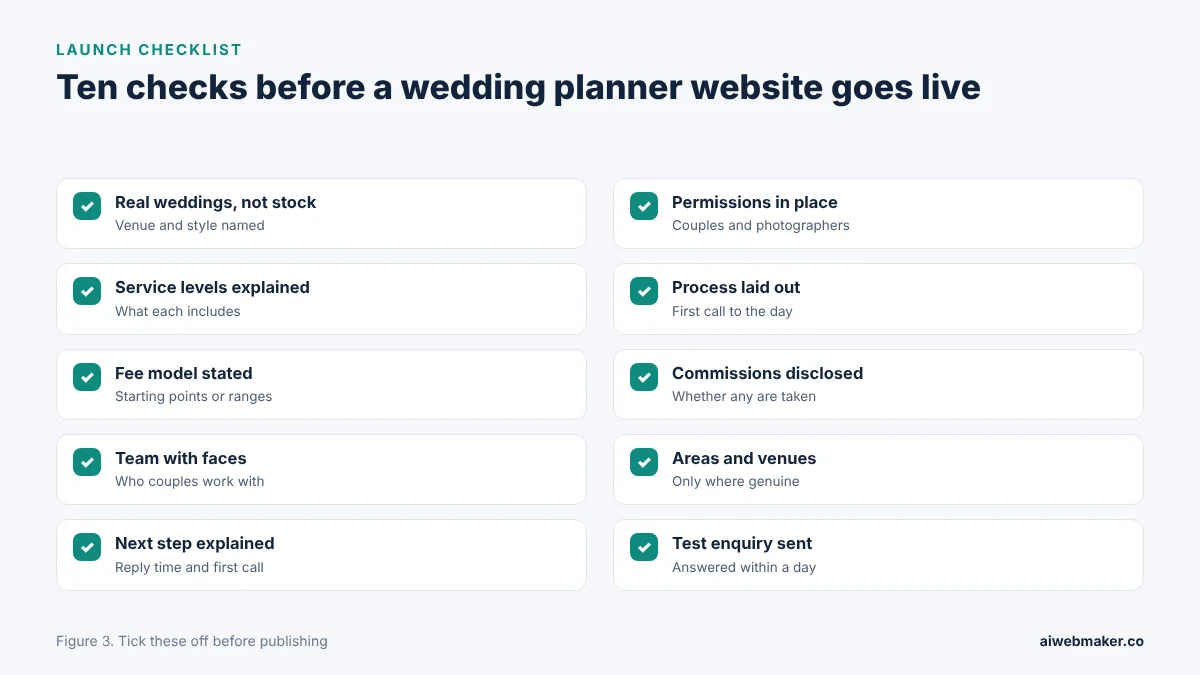
Couples leave without writing when the site gives them no picture of a day like theirs and no idea of the cost. A gallery of stock images, or of styled shoots with no real couples, raises doubts about experience. Service names without explanations leave couples guessing what they would receive. No faces on the team page make it hard to imagine a year of working together. A contact page with no hint of what happens next feels like the start of a hard sell. Set out in the image below are ten checks, one for every worry a couple brings.
Frequently asked questions
When do couples usually bring a planner on board?
Couples wanting full planning often sign a year or more before the wedding, and sooner for sought after venues. A partial service can begin later, once some suppliers are booked. Coordination on the day usually starts some weeks ahead of the date, depending on the planner. Peak season weekends fill first, so the website can encourage early contact for those dates. Honest timing advice helps couples act before their preferred date is taken.
Is coordination on the day worth it for couples who plan everything themselves?
Coordination on the day is often worth it for couples who have planned everything themselves, because it lets them enjoy the day rather than manage it. The coordinator confirms suppliers in the final weeks, builds a timeline and handles problems as they arise. Family members can then simply be guests rather than unpaid staff. The website should explain exactly when the coordinator's work starts and what it includes. Clear descriptions help couples see the value before they ask.
Can a planner publish photos from weddings it has planned?
A planner can publish photos from weddings it has planned once both the couple and the photographer agree. Many photographers are happy to share images in exchange for a credit and a link. Some couples prefer privacy, so asking each one matters. Captions naming the venue and the style add context without exposing personal details. Building the gallery with permission keeps it honest and generous to suppliers.
Should the site list venues the planner knows well?
Listing venues where the planner has genuinely worked is useful to couples with a venue already secured, and it shows real experience. The list should include only venues the planner knows, since couples may ask about them on the first call. A line about each venue's strengths and quirks adds useful detail. New venues can be added after each wedding. A growing venue list quietly proves long experience.
Recommendations, referrals and the couple that covers the year
One signed couple usually brings far more income than the year's $119 of hosting, or any single month at $19. Each later booking adds income the site played a part in winning. Referrals matter most, because couples recommend planners to friends who become engaged soon after them. Real weddings, plain service descriptions and an honest view of fees are what earn those recommendations. Enquiries from couples who already understand the services show that the site is preparing them well.
Build your website in Minutes and get the AI Tools that work
Start Building Your Website →