Wedding Florist Website Cost, Mood Boards, Seasons and the Set Up
A wedding florist's consultation pages stay live for $119 a year, well under half of a registry collection, or for $19 monthly through winter, plus a domain. Next: who books, the pages, seasons, proposals and deposits, pieces, set up and clear down, venue rules, search and the yearly figures.
- No coding required
- Live in minutes
- Blog, SEO and chatbot tools included
A wedding florist's consultation pages stay live for $119 a year, well under half of a registry collection, or for $19 monthly through the winter lull, plus a domain. Season tables, collection cards and the request form can be drafted and rearranged in the preview without AI Web Maker sending an invoice. One registry wedding covers the hosting several times over. The harder problem is that couples book flowers nine to twelve months ahead, often without knowing which stems will be at their best on the day. They also struggle to read prices that depend on stems, labour, set up and hired vases all at once. In the pages ahead: who books, the site, seasons, proposals and deposits, pieces, set up and clear down, venue rules, search and the year's figures.
This article is part of our complete guide: Website Builder for Creative Businesses.
Couples with a palette, planners with a timeline and venues with rules
Couples choose a wedding florist, but planners and venue coordinators often shape the shortlist and the final design. Couples arrive with a palette, a few photos and a budget they are unsure about. Planners want a florist who arrives on time, works neatly and moves ceremony pieces to the reception without fuss. Venue coordinators care about access times, open flames, petals and anything fixed to their walls. Parents helping with the budget tend to ask what one centrepiece really costs, which makes clear pricing a quiet advantage.
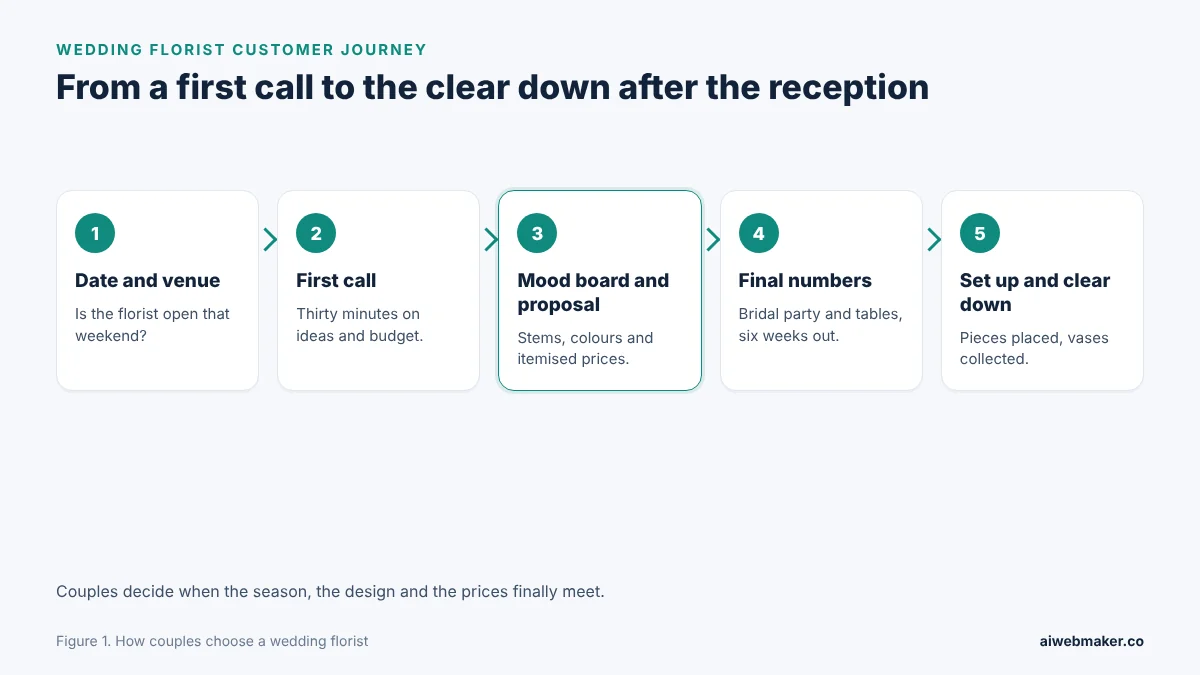
The date and the venue open this path, because a florist's availability is the first thing a couple checks. A short first call then confirms whether the date is open and what the couple has in mind. The highlighted third step is the mood board and itemised proposal, where flowers, colours and prices finally meet. Final numbers about six weeks before fix the bridal party, the tables and the ceremony pieces. Set up on the morning and clear down after the reception close the journey, and that tidy finish is what venues remember.
Collections, seasons, pieces and the first call: the site in outline
A wedding florist's website should guide couples from inspiration to a proposal without pretending that every price is fixed. Collections give starting points, while a page of individual pieces serves couples who prefer to build their own list. A season page shows which flowers are at their best in each month, which saves many disappointed conversations. A process page explains the first call, the consultation, the mood board, final numbers and set up. The request asks for the date, the venue, the guest count and a budget range, which is enough to arrange the first call.
| Page | What couples look for | Detail that matters |
|---|---|---|
| Process | How the planning works | First call, consultation, mood board, final numbers |
| Collections | Starting prices | What each collection includes, set up travel |
| Seasons | Which stems suit the month | Flowers and palettes by season |
| Pieces | Building a custom list | Bouquets, buttonholes, arches, centrepieces |
| Weddings dressed | The florist's style in real venues | Venue types, seasons, guest numbers |
| Questions | Substitutions, venue rules, vases | Plain answers |
| Ask about a date | Whether the florist is open | Date, venue, guests, budget range |
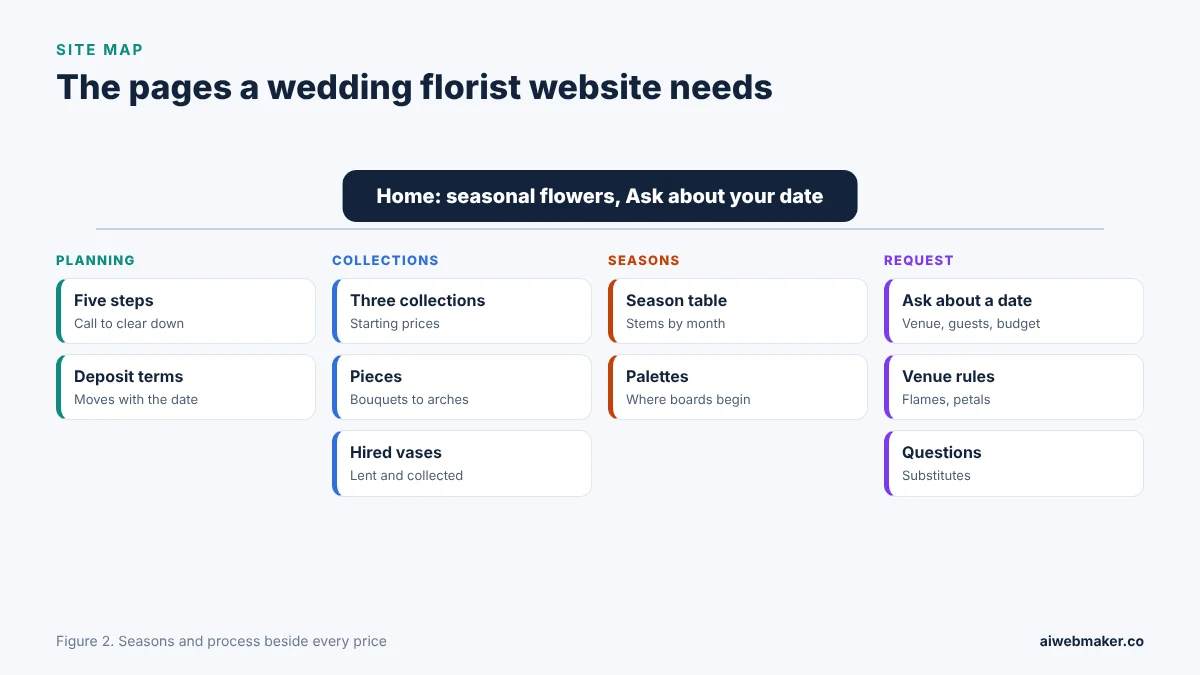
Planning, collections, seasons and the request form the four groups under this home card. Petal and Vow Wedding Flowers, the invented studio in the wedding florist website example with seasonal mood boards, opens with a thirty minute first call at no charge, two weddings a weekend at most and 80 km of set up travel included. Five steps follow, from the first call to a studio consultation, a mood board and proposal within ten days, final numbers six weeks before and set up on the morning. Three collections start the conversation: Registry and elopement at $320, Ceremony and bridal party at $1,150 and The whole day at $2,800. Below sit a section on designing with the season, a season table, four palettes, a list of pieces from the bridal bouquet to cake flowers and extras, recent weddings, questions and a date request with flower budget ranges.
The season sets the budget: designing with stems at their peak
Designing with the season is the biggest saving a florist can offer, since a flower at its peak costs less and lasts longer than an imported one. Peonies in early summer are generous and affordable, while the same request in autumn often means imported stems at a premium. A season table lets couples see which flowers suit their month before they fall in love with a photo from another time of year. Couples marrying in the southern hemisphere read the seasons the other way round, and climate changes the picture everywhere. Markets also shift from week to week, so every proposal should name a substitute for any stem that depends on the weather.
| Season | Flowers often at their best | Palettes that suit |
|---|---|---|
| Spring | Blossom, anemones, narcissus, ranunculus | Soft white, blush, pale green |
| Early summer | Peonies, sweet peas, garden roses | Blush, lilac, cream |
| Late summer | Dahlias, cosmos, scabious | Coral, burgundy, apricot |
| Autumn | Chrysanthemums, turning hydrangeas, rose hips | Rust, plum, copper |
| Winter | Anemones, paperwhites, berries, eucalyptus | Deep red, white, silver green |
Mood boards, itemised proposals and the deposit that holds a date
A wedding florist's proposal should be itemised piece by piece, because couples can only make sensible trade offs when they see what each bouquet, arch and centrepiece costs. A mood board of colours, shapes and stems shows the design, while the proposal beside it lists quantities and prices. Accepting the proposal with a deposit, such as a quarter of the total, secures the date, since a florist can only dress a limited number of weddings each weekend. Final numbers about six weeks before, and the balance about four weeks before, give time to order stems and hire stock. A postponement rule, such as the deposit moving to any open date within eighteen months, reassures couples who fear the unexpected.
| Stage | Usual timing | What the couple receives or pays |
|---|---|---|
| First call | Soon after the venue is booked | Date checked, ideas discussed |
| Studio consultation | Months ahead | Real stems in season, ribbons and vases |
| Mood board and proposal | Within about ten days | Design and itemised prices |
| Deposit | On accepting the proposal | A share of the total holds the date |
| Final numbers | About six weeks before | Bridal party, tables, ceremony pieces confirmed |
| Balance | About four weeks before | Remaining amount paid |
Piece by piece: bouquets, buttonholes, arches and centrepieces
Every wedding piece has its own price logic, and spelling it out lets couples trade an arch for more centrepieces or the reverse. A bridal bouquet depends on stem count, the flowers chosen and whether it is round and tight or loose and trailing. Buttonholes and corsages are small but labour heavy, since each is wired and pinned by hand on the morning. Ceremony arches and aisle meadows use many stems and need mechanics, transport and hours of set up. Centrepieces multiply quickly with table numbers, so the choice between low pieces and tall ones lifted above eye level shapes the whole budget.
| Piece | What drives the price | Planning note |
|---|---|---|
| Bridal bouquet | Stem count, flower choice, shape | Matched to the dress and ribbon |
| Bridesmaid bouquets | Size and number | Smaller echoes or contrasting posies |
| Buttonholes and corsages | Labour per piece | Pinned on the morning, a spare in the box |
| Ceremony arch or meadow | Stems, mechanics, set up hours | Venue rules on fixings |
| Table centrepieces | Number of tables, height | Low for talking, tall above eye level |
| Cake flowers and extras | Stems and coordination | Handed to the baker, petal cones |
Set up, the ceremony flip and the clear down after the reception
Set up decides a wedding florist's name with venues, because it happens against a fixed clock in a room full of other suppliers. Arriving at least three hours before the ceremony allows time to place every piece and pin the buttonholes. Moving ceremony arrangements to the reception while guests are at drinks, often called the flip, saves couples money but needs a plan with the venue. Hired vases, stands and arches must be collected after the reception or the next morning, with any missing or broken items charged at cost. The AI website builder that wedding florists use for collection and season pages drafts the process, collections, seasons and pieces pages once the florist describes its weddings in a few lines, and every price and stem can then be adjusted before publishing.
Venue rules on flames, petals and fixings
Venues set their own rules on open flames, petal confetti and fixing anything to walls or beams, and a florist who checks them early avoids awkward changes on the morning. Some venues allow candles only in enclosed glass, while others ban flames entirely. Petal confetti may be allowed outdoors but not inside, or only with dried petals that are easier to sweep. Many florists now avoid floral foam, since it can shed tiny plastic particles, and say so on their sites for couples who care. Because these rules differ by venue and by country, the florist's promise should be to ask each venue before the proposal is final.
Seasonal wedding flowers near a named region: the searches couples run
Wedding flower searches usually pair a style with a place, such as seasonal wedding flowers near a region or a bridal bouquet in a named town. Smaller ceremonies bring searches like flowers for a registry wedding or an elopement posy. Headings built from those exact pairings give each page a fair chance of being found. On the map listing, consultation times and photographs from dressed venues matter more than a shop window, because most couples look it up straight after a venue viewing. Reviews in which couples name the venue, the month and the calm of the set up persuade far better than a star rating alone. Monthly articles on what blooms when, how many buttonholes a bridal party needs or whether a sample centrepiece is worthwhile reach couples a year before their date.
A wholesale order of stems against twelve months of hosting
Set against the stems for one wedding, a florist's web year is small: twelve months of hosting, one domain and, if wanted, some articles bought with AI credits. A florist whose season is already booked keeps the total lowest with a single annual invoice. A newer studio can spread the hosting month by month until its first Saturdays fill. New collections, a fresh season table or a longer pieces list never change the bill. The grid gives yearly and monthly routes their own columns, while the $189 tier sits on one line as a point of comparison.
| Item | Yearly | Monthly |
|---|---|---|
| Hosting the wedding florist collection and season pages | $119 | $228 over twelve months |
| Domain | Depends on the ending | Depends on the ending |
| Higher plan, for comparison | $189 a year | Not needed |
| Twelve seasonal flower articles at about $0.65 | About $7.80 | About $7.80 |
| Collections, seasons and piece updates | No charge | No charge |
| Year before the domain | About $126.80 | About $235.80 |
Missing seasons and hidden set up fees: why couples look elsewhere
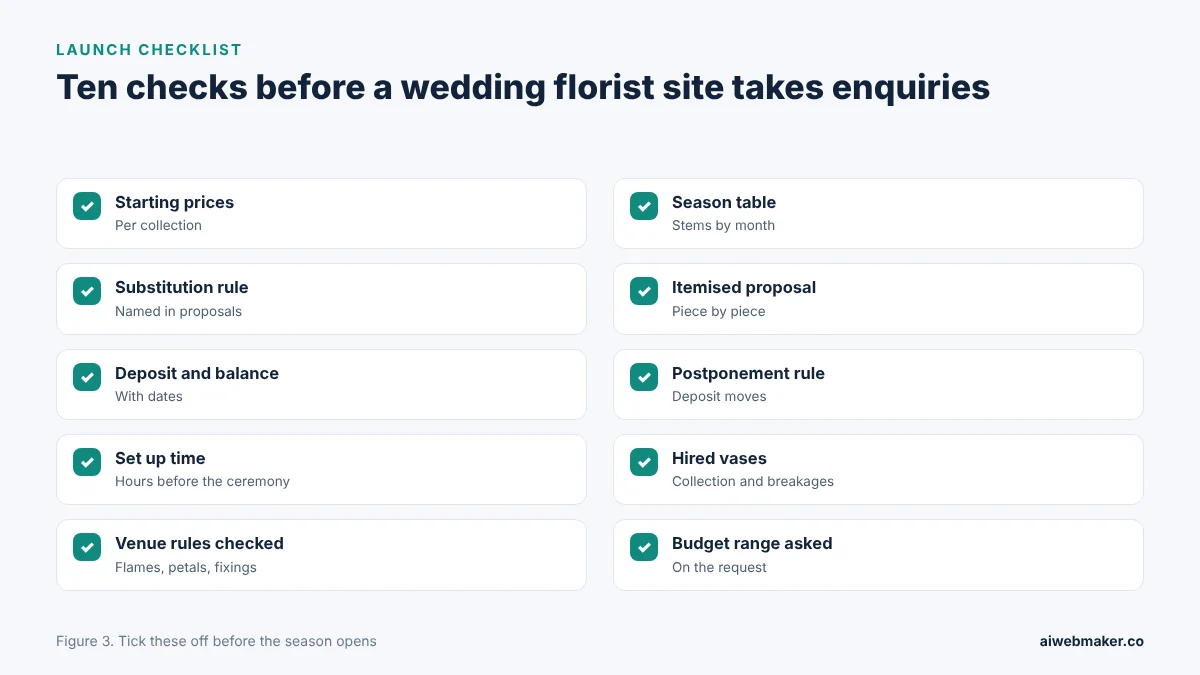
Couples leave a wedding florist's site when it shows beautiful bouquets but says nothing about the season, because they cannot tell whether their favourite flower is possible. Collections without starting prices leave couples guessing whether the florist suits their budget. No mention of set up, hired vases or the ceremony flip hides costs that appear later. Silence on venue rules worries planners who have seen arches refused on the morning. A request form that asks for no budget range invites mismatched first calls, and the card that follows ticks off a remedy for every one of these gaps.
Frequently asked questions
How many months ahead do couples book wedding flowers?
Many couples book nine to twelve months ahead, and spring and early summer Saturdays tend to go first. Shorter notice can still work when the date is open, with the design built around what the season offers by then. The deposit secures the date once the proposal is accepted. Florists who cap weddings per weekend fill popular dates early. Booking soon after the venue keeps the widest choice open.
Can a favourite flower be promised out of season?
Occasionally, though out of season stems are often imported, which raises the price and lowers the certainty. A good florist will suggest a flower of similar colour and shape that is at its best in the wedding month. The proposal should name a substitute for any stem that depends on the weather. Couples who trust the season usually get fuller, fresher designs for the same budget. Honest advice here prevents disappointment on the morning.
Who collects the vases and arches after the reception?
The florist usually collects hired vases, stands and arches at the end of the night or the next morning, depending on what the venue allows. The website should state the collection time and any charge for missing or broken items. Couples can then tell the venue team what to expect. Clear rules protect the florist's hire stock and the couple's budget. A tidy clear down is often what venues mention when recommending a florist.
May guests take the centrepieces home?
Many florists are happy for centrepiece flowers to be given away at the end of the night, while lent vases are returned. Leaving the stems wrapped in paper makes them easy for guests to carry. The couple should agree this with the florist and the venue in advance. It turns the last minutes of the reception into a kind gesture. Clear instructions stop vases from leaving with the flowers.
A registry posy and two buttonholes repay the year
A single Registry and elopement collection, at the sample's $320, would cover the hosting more than twice, while one booking of The whole day would cover it for over twenty years. Paid monthly, each $19 is a sliver of a typical wedding deposit. Guests at every wedding the florist dresses see the work up close, and some of them are planning weddings of their own. Seasonal designs, itemised proposals and plain rules on set up and venues win over couples and planners together. A weekend diary capped at two weddings and full a year ahead is the result worth working towards.
Build your website in Minutes and get the AI Tools that work
Start Building Your Website →