Photography Website Cost and a Portfolio That Wins Bookings
A photographer's portfolio site stays online for $119 a year, or a $19 charge each month, plus the domain. It walks through who hires photographers, curating the portfolio, packages and pricing, the client process, delivery and usage rights, consent, page speed, search and the yearly budget.
- No coding required
- Live in minutes
- Blog, SEO and chatbot tools included
A photographer's portfolio site stays online for $119 a year, while studios preferring smaller payments see a $19 charge each month, plus the domain. No charge applies while the portfolio and pages take shape inside AI Web Maker. A single portrait session usually covers the whole year, so cost is not what stands between a photographer and a busy calendar. The challenge is that clients decide within seconds whether a photographer's style is right for them, and then decide again when they see the price and the process. Seeing those two decisions handled on an actual page helps, and the photography website example, made for an invented photographer with AI Web Maker, pairs galleries with packages and booking dates. Couples planning a wedding, parents booking a newborn session and businesses needing product shots all arrive with different questions. The sections ahead cover portfolio curation, packages, the client process, usage rights and the yearly budget.
This article is part of our complete guide: Website Builder for Creative Businesses.
Who hires a photographer, and how do they decide?
People hire a photographer for very different reasons, and each group decides in its own way. Couples planning a wedding often book a year or more ahead, compare several photographers carefully and care deeply about style and personality. Families booking portraits or newborn sessions want warmth, patience and a relaxed experience. Businesses looking for headshots, product images or event coverage value reliability, turnaround time and clear usage terms. Event organisers need someone who can work quietly in a crowd and deliver quickly. A website that speaks to each of these groups separately wins more of each.
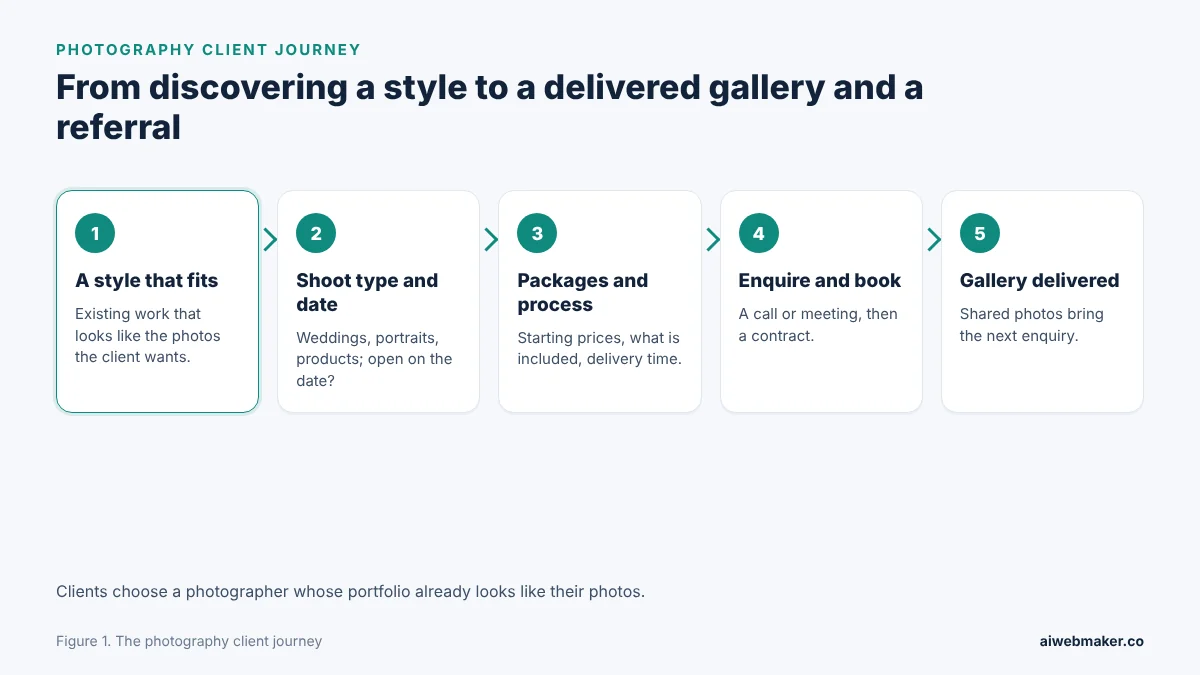
The journey in the figure begins with style, because almost every client chooses a photographer whose existing work already looks like the photos they want. Visitors then check whether the photographer covers their type of shoot and has availability on their date. Packages and starting prices come next, followed by an understanding of how the process works and when photos will arrive. An enquiry or a request for a session follows, and a call or meeting usually settles the booking. After delivery, a delighted client shares the photos, which brings the next enquiry. The website shapes every stage of that path.
How should a photography portfolio be curated?
A photography portfolio should be curated by shoot type, with a small number of the strongest images in each group rather than everything ever taken. A couple looking for a wedding photographer wants to see weddings, not product work, so separate galleries keep each visitor focused. Each gallery should show variety in light, setting and mood while staying true to one recognisable style. Complete sequences from a single wedding or event show that the photographer can tell a whole story, not only produce a few highlights. Images should be chosen for the clients the photographer wants more of, since the portfolio attracts similar work. Spending an evening on a ruthless selection is the most valuable thing a photographer can do for the website.
| Gallery | What clients look for | Suggested selection |
|---|---|---|
| Weddings | Emotion, candid moments, the whole day | Highlights plus one or two full stories |
| Portraits and families | Warmth, natural expressions | A short set showing different ages and settings |
| Newborn | Safety, softness, calm sessions | A few careful images with notes on safety |
| Headshots | Consistency and professionalism | Several examples on different backgrounds |
| Product and commercial | Accuracy, lighting, brand fit | Images grouped by type of product |
| Events | Coverage in real conditions | A sequence from one event |
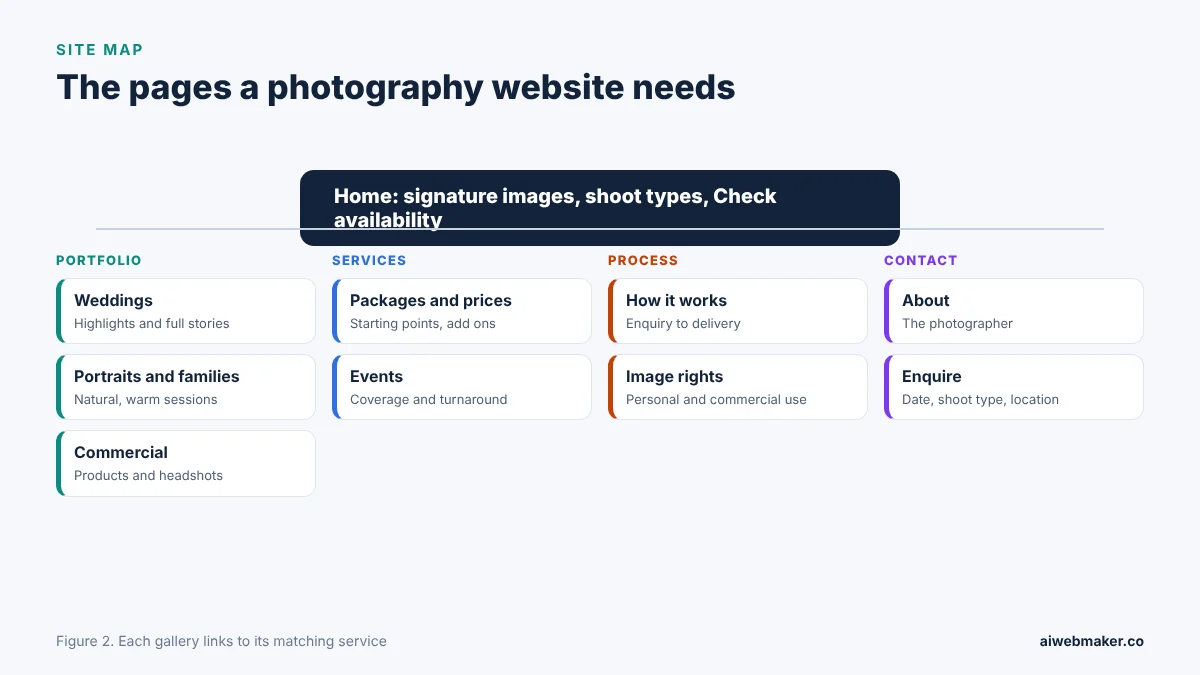
Mapped out, a photographer's website needs four groups of pages, with the galleries at the heart of the structure. Portfolio pages hold the galleries for each shoot type, each linking to the matching service page. Service pages describe weddings, portraits, commercial and event work, with starting prices and what each package includes. Process pages explain the client experience, delivery times and image rights. Contact pages carry the availability check or enquiry route and a short about page. Our sample studio, Clearframe Studios, groups its portfolio by type of shoot and explains its pricing on the services page, and the photography business website example with a portfolio and pricing guidance was generated in 38 seconds.
How should a photographer present packages and prices?
Packages work best with starting prices and a clear list of contents, because clients who see no figures often assume the work is out of reach. Wedding packages usually differ by hours of coverage, a second photographer, albums and engagement sessions. Portrait sessions can be priced by session length and the number of edited images included. Commercial work is often priced by day or half day, plus licensing for the intended use. Travel costs, extra hours and prints can be listed as add ons. Showing a starting point for each type of shoot filters out poor fits and invites serious enquiries.
| Pricing model | Common use | What the page should state |
|---|---|---|
| Wedding package | Full or partial day coverage | Hours, second shooter, album, number of images |
| Portrait session | Families, couples, individuals | Session length, location, edited images included |
| Day or half day rate | Commercial and product work | Hours, deliverables, licence for use |
| Per event coverage | Parties, conferences, launches | Hours, turnaround, number of images |
| Add ons | Any shoot | Albums, prints, extra hours, travel |
What should clients know about the process from enquiry to delivery?
Clients should know every step from their first enquiry to the final gallery, because a clear process reassures people spending significant money on something they cannot preview. The page can explain how availability is confirmed, when a call or meeting takes place and how a booking is secured with a contract and any retainer the photographer requires. Preparation guidance, such as what to wear for a portrait session or how to plan a wedding day timeline, helps clients feel supported. The page should state how long editing takes and how photos are delivered, such as through an online gallery. A note on how long galleries remain available prevents lost photos. The AI website builder that photographers use for enquiry and availability pages sets up this page beside the portfolio once the studio describes its services.
| Stage | What happens | Typical detail to state |
|---|---|---|
| Enquiry | Date, type of shoot, location | How soon replies arrive |
| Call or meeting | Plans, style and questions | Whether by video or in person |
| Booking | Contract and any retainer | What secures the date |
| Preparation | Timeline, outfits, locations | Guides the client receives |
| Shoot | The session or the day | Arrival time and coverage |
| Editing and delivery | Selection, editing, online gallery | Turnaround and gallery availability |
How should image rights and usage be explained?
Image rights deserve a plain explanation, because clients often assume they own every right to the photos they paid for. In many countries the photographer keeps the copyright unless a contract says otherwise, while the client receives a licence to use the images. A personal use licence usually covers sharing online and making prints, while commercial use, such as advertising, needs a broader licence. Businesses should know exactly where and for how long they may use product or headshot images. The photographer's own right to use images in the portfolio should be agreed with the client, especially for private sessions. Clear terms prevent disputes and help clients value the licence they receive.
| Usage | What the client can usually do | What the agreement should state |
|---|---|---|
| Personal use | Share online, print for home | That commercial use needs another licence |
| Commercial use | Advertising, packaging, websites | Media, territory and duration |
| Editorial use | Articles and press | Credits and any restrictions |
| Portfolio use by the photographer | Show selected images | Whether the client agrees, and any limits |
Why does consent matter for portfolio images?
Consent matters because the people in photographs have a right to decide where their images appear, and some situations call for extra care. Couples and families should agree in writing before their photos appear on the website or social media. Images of children deserve particular caution, and many photographers show them only with explicit parental permission. Commercial shoots involving models usually require a signed model release. Clients who prefer privacy can still be served well, with their images kept out of the public portfolio. Respecting consent builds a reputation for trustworthiness that brings in referrals.
How can a photographer keep large images from slowing the website?
A photographer can keep large images from slowing the website by exporting them at sensible sizes and in modern formats before uploading. Full resolution files from a camera are far larger than any screen needs, and they slow pages dramatically on phones. Exporting images at the width they will actually be shown, and in an efficient format such as WebP, keeps quality high and loading fast. Galleries with a reasonable number of images per page load better than endless scrolling pages. Fast pages keep impatient visitors browsing and also help search rankings. A few minutes spent on export settings pays off on every page view.
Which searches lead clients to a photographer?
Clients reach photographers through searches such as wedding photographer in a town, newborn photographer near me, corporate headshots or product photography studio. Naming the shoot type in each service heading, and again in the first paragraph, steers each search to the right gallery. Descriptive file names and alternative text for images help photos appear in image searches. Map listings with studio photos and accurate hours support local searches for portrait and headshot work. Articles on venues, locations and preparation tips, such as the best spots for engagement photos, attract couples early in their planning. Steady, useful writing builds visibility that a portfolio alone cannot.
How much does the portfolio site cost to keep online?
Hosting and a domain are the only recurring costs, since location articles drafted with credits barely move the total. Annual billing gives an established studio the lowest cost. A photographer just starting out may prefer monthly payments while bookings build. New galleries, packages and articles leave the bill unchanged. The $189 tier appears below next to both payment routes.
| Budget item | Billed yearly | Billed monthly |
|---|---|---|
| Hosting the portfolio and pages | $119 | $228 across twelve months |
| Domain | Set by the ending | Set by the ending |
| Higher plan, for comparison | $189 a year | Not needed |
| Twelve location and planning articles at about $0.65 | About $7.80 | About $7.80 |
| New galleries and packages | No charge | No charge |
| Year before the domain | About $126.80 | About $235.80 |
What makes a client close a photographer's website without enquiring?
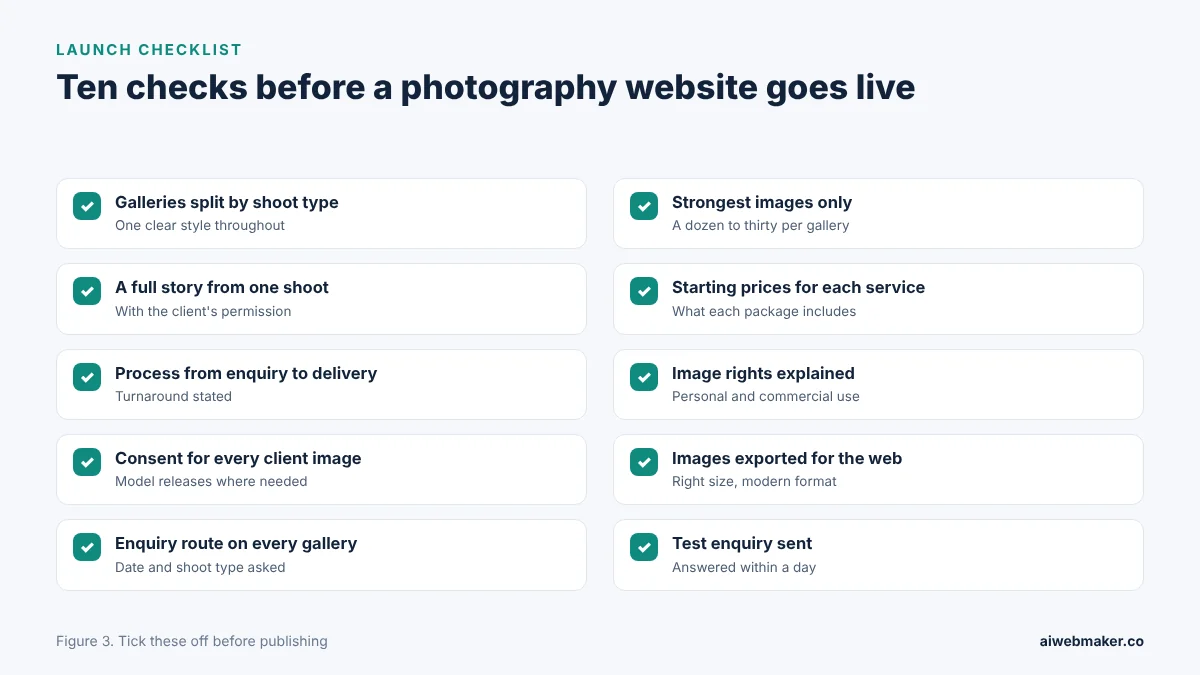
Clients close a photographer's website without enquiring when the portfolio mixes every kind of shoot and shows no clear style. No starting prices leaves visitors guessing and moving on. A slow site with huge images frustrates people browsing on a phone. A vague process with no delivery time worries couples planning carefully. A buried enquiry route loses visitors who were ready to ask about their date. The ten checks in this figure prevent each of these losses.
Frequently asked questions
How many images belong in a photography portfolio?
A focused portfolio usually works better than a huge one, with perhaps a dozen to thirty strong images per gallery depending on the shoot type. Every image should earn its place by showing style, skill or variety. Weak or repetitive images dilute the impression of the strong ones. Complete stories from one wedding or event can sit alongside the highlights. Reviewing the portfolio every few months keeps it current.
Should a photographer show full wedding galleries?
Showing one or two full wedding galleries, with the couple's permission, helps prospective clients see how the photographer covers a whole day. Highlights alone can hide gaps in coverage, such as speeches or family groups. A full gallery shows consistency across different light and moments. Some photographers share full galleries privately on request rather than publicly. Either approach reassures couples making a big decision.
Who owns the copyright in client photos?
In many countries the photographer owns the copyright in the images unless a contract transfers it, while the client receives a licence to use them. The scope of that licence should be set out in the contract and summarised on the website. Personal and commercial use are usually treated differently. Clients needing broader rights can usually buy an extended licence. Clear terms avoid disputes after delivery.
How soon after a shoot are photos delivered?
Delivery times vary by type of shoot, from a few days for headshots to several weeks for a full wedding. The website should state typical turnaround times for each service. Some photographers send a small preview soon after the shoot to share the excitement. Clients appreciate updates if editing takes longer than expected. Meeting stated timelines builds the reputation that brings referrals.
Does one portrait session cover the photography website?
One portrait session typically earns more than the $119 a photographer spends to host the website for a full year. On the monthly plan, one print order more than covers the $19. Each booking after that is income the portfolio helped to win, and each wedding covers many years of hosting. A curated portfolio, honest starting prices and a clear process persuade clients more than any slogan. Photographers who keep the site fresh and fast see enquiries arrive for the shoots they enjoy most. A calendar filled a season ahead is the surest sign the website is doing its job.
Build your website in Minutes and get the AI Tools that work
Start Building Your Website →