Kids Party Website Cost, Age Bands, Allergy Lists and Saturday Dates
Theme and booking pages for a children's party planner stay online on $119 of yearly hosting, under half an at home party, or $19 a month through quieter terms, and the domain comes extra. Inside: parents and guests, the pages, age bands, hosts and supervision, allergies and small parts, prices, weekends and deposits, the phrases parents search and a year of costs.
- No coding required
- Live in minutes
- Blog, SEO and chatbot tools included
Theme and booking pages for a children's party planner stay online for $119 across twelve months, or at $19 per month through the quieter terms, plus a domain. The age table, the safety section and the allergy page can be drafted and reworded in the preview as many times as needed, and AI Web Maker does not bill that work. A single party in a living room covers the hosting with money to spare. The real challenge is trust, because parents hand over their child's birthday and the care of other people's children for two loud hours. They want to know the games suit the age, that an adult is always watching and that the allergy list will be read before the first plate is served. Inside: parents and guests, the pages, age bands, hosts and supervision, allergies and small parts, prices, weekends and deposits, the phrases parents search and a year of costs.
This article is part of our complete guide: Website Builder for Creative Businesses.
Parents of the birthday child, and the parents of every guest
A children's party has two kinds of parent, and the planner's site has to reassure both before the invitations go out. The parent booking the party wants the theme, the price and an open weekend date to line up, usually four to eight weeks ahead. Parents of the guests rarely see the website, yet their questions about allergies, collection and supervision arrive through the host family. Grandparents sometimes pay and read the prices closely. Every one of them wants evidence that the planner has thought about safety as carefully as the fun.
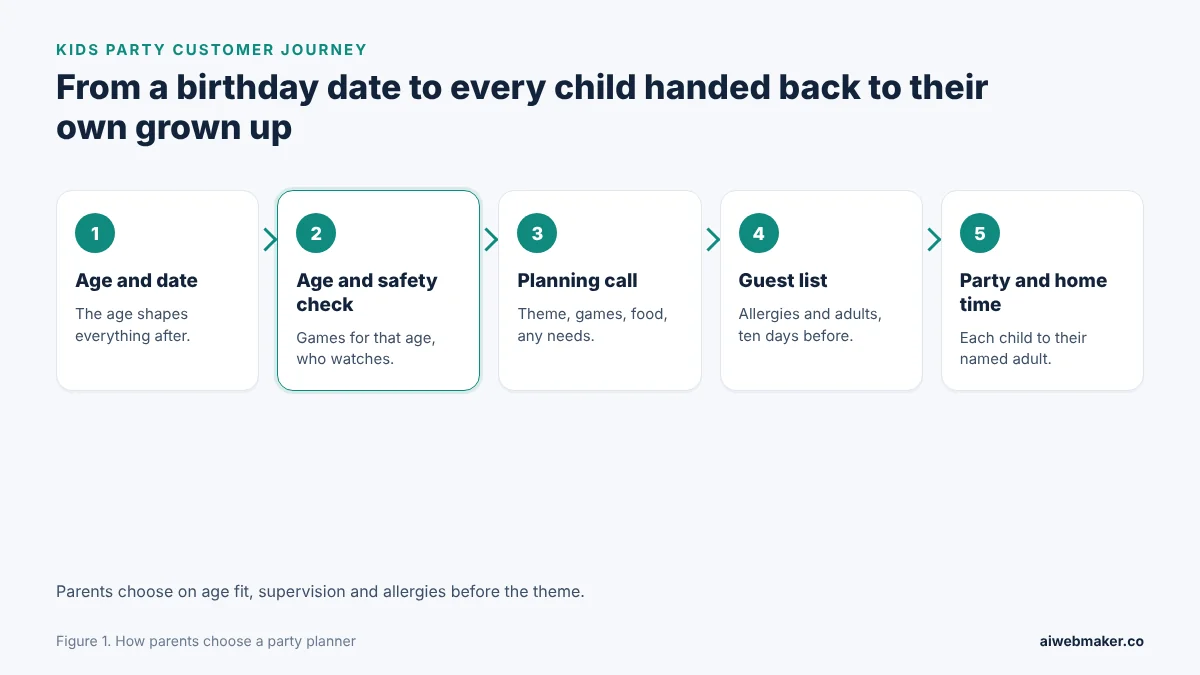
A birthday date and an age start this path, since the age shapes everything that follows. The highlighted second step is the age and safety check, when the parent reads what a party looks like for that age and how children are supervised. A short planning call settles the theme, the games, the food and any needs among the guests. Ten days before, the guest list arrives with allergies and the names of the adults staying. The party day ends with every child handed back to their own grown up, which is the moment parents remember.
Themes, ages, parties and safety: the pages parents read first
A children's party planner's site should be organised around the questions parents ask, which begin with the age of the child rather than the theme. Themes catch the eye, but an age table tells a parent whether the games will suit a three year old or bore a ten year old. Party types and prices let parents compare an at home party with a hall party. Safety, food and allergy pages answer the questions that guests' parents will send. A planning request completes the set, asking for the age, the date, the place and the number of children.
| Page | What parents look for | Detail that matters |
|---|---|---|
| Themes | Something the child will love | Own themes, gentler versions for the youngest |
| Ages | Games that suit the age | Activities, length, adults needed |
| Parties | What each price includes | Hosts, games, food, decorations, travel |
| Safety | Who watches the children | Checks, first aid, counting in and out |
| Food and allergies | How allergies are handled | List ten days before, labelled plates |
| Plan a party | Whether the date is open | Age, date, place, children, theme idea |
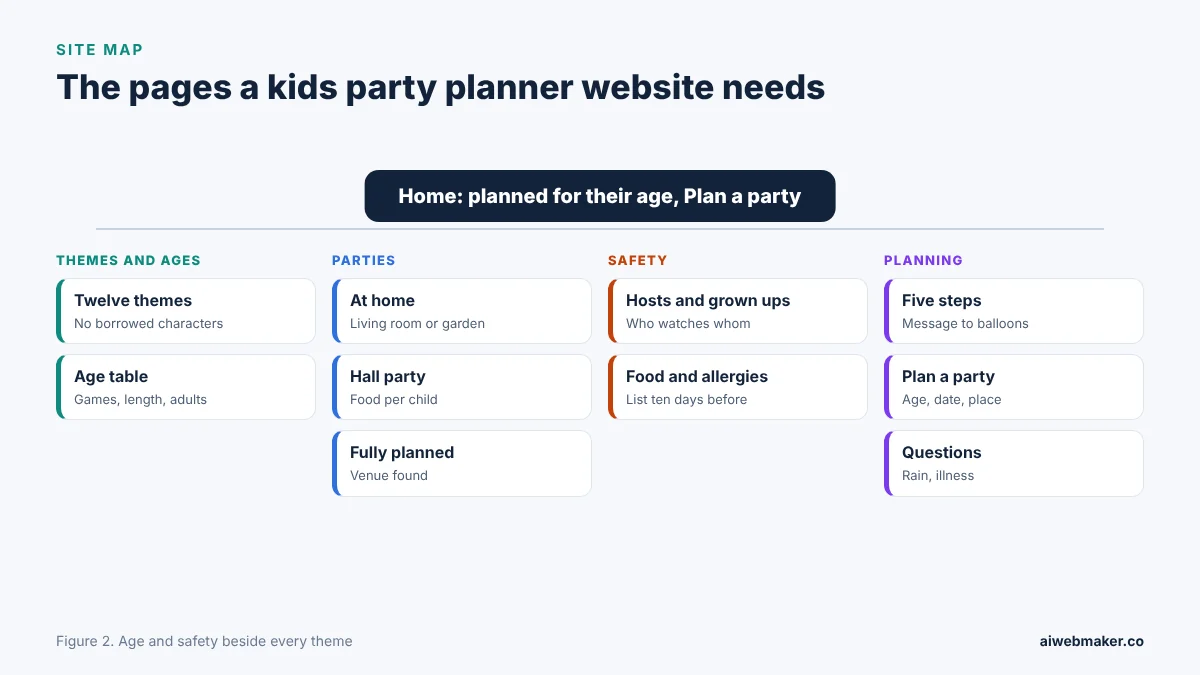
Themes, the parties on offer, safety and planning form the four groups under the home page in this drawing. Party Pals Kids Events, the invented planner in the kids party planner website example with age bands and allergy lists, runs themed parties for children aged 3 to 11, with one host for every ten children and most parties lasting two hours. Twelve themes of its own, from a space mission to a sports day, come with no film characters or toy brands. An age table follows, then three party types: At home at $295, a Hall party at $480 and Fully planned at $850, with an $80 deposit holding the date. Sections on safety, food and allergies, five planning steps, parent questions and a "Plan a party" form complete the page.
Planning by age band, not by theme
A party for a three year old and one for a ten year old share a cake and very little else, so the website should plan by age before theme. The youngest guests need short activities, songs and bubbles, with nothing small enough to swallow. Five and six year olds enjoy simple team games and a craft to take home. Seven and eight year olds like challenges with points and a themed quest, while older children prefer workshops, a disco or a sports day they help to run. Any theme can be made gentler for younger guests, which keeps the theme page simple and the age page honest.
| Age | What the party looks like | Length | Adults asked to stay |
|---|---|---|---|
| 3 to 4 | Bubbles, parachute games, songs, a short story | About 90 minutes | One per child |
| 5 to 6 | Team games, a treasure trail, a craft | About two hours | One for every six children |
| 7 to 8 | Points challenges, a quest, a short show | About two hours | Two from the family |
| 9 to 11 | Science or art workshops, a disco, sports | Two to two and a half hours | Two from the family |
Hosts, grown ups and who is responsible for whom
The safety page should say plainly who is responsible for each child, because parents worry most about the gaps between the party host and the family. Hosts lead the games, while a parent or carer of the birthday child stays for the whole party and the family stays responsible for its guests. Background check rules for people working with children differ between countries; British planners, for example, commonly use checks through a national disclosure service, so each planner should follow the local rule and say so. Hosts trained in first aid, never alone with a child out of sight of others, reassure parents without overpromising. Counting children in at the door and out again, and handing each child only to the adult the parent has named, closes the most important gap of all.
Allergy lists, labelled plates and the limits of a party kitchen
Food is where most worries sit, so the allergy process should be written out step by step rather than summed up as careful catering. A guest list with each child's allergies and dietary needs, sent ten days before, gives the planner time to plan the food. Every plate can carry a name, and food for a child with an allergy can be served first, on its own tray. No party can promise that any food is entirely without allergens, so a parent of a child with a severe allergy should stay with any prescribed medicine. Choking risks deserve the same care, since burst balloons and small craft pieces are a known danger for the youngest children.
| Risk | What the planner does | What the family does |
|---|---|---|
| Food allergies | Collects the list, labels plates, serves allergy plates first | Sends every guest's needs ten days before |
| Severe allergy | Plans around it, cannot promise no traces | A parent stays with prescribed medicine |
| Small pieces | Keeps crafts and balloons away from under fours | Tells the planner the youngest guest's age |
| Collection | Hands each child to the named adult | Names who collects each guest |
| Emergency | Calls the local emergency number, then the parents | Shares contact numbers for every guest |
Prices per party, food per child and the travel radius
Party prices should be set out by type, because parents compare an at home party with a hall party before they think about themes. An at home party needs fewer decorations and no hall, but space for games in a living room or garden limits the number of children. A hall party adds decorations, a themed table and often an entertainer slot, while food can be priced per child so the parent controls the total. A fully planned party adds the search for a venue, the cake, invitations and a photo corner. Travel within a stated radius should be included in the price, with longer journeys quoted before the date is held.
| Party type | Usually includes | Priced by |
|---|---|---|
| At home | Two hosts, games, music, party bags, tidy up | The party, up to a set number of children |
| Hall party | Decorations, themed table, entertainer slot | The party, plus food per child |
| Fully planned | Venue found, food, cake, invitations | The party, up to a larger group |
| Extras | Magic, puppets, science show, photo corner | Each extra |
Saturday afternoons, an $80 deposit and a poorly birthday child
Weekend afternoons are the only stock a party planner really has, so the deposit and illness rules need to be fair to both sides. A modest deposit, such as $80, holds the date rather than the enquiry, which stops parents reserving three planners for one party. Children fall ill without warning, and a rule that moves the party to another date within a few months, with the deposit carried over, earns enormous goodwill. Garden parties need an indoor version of every game, or a hall the planner knows, in case of rain. The AI website builder that children's party planners use for age and safety pages drafts the themes, ages, parties, safety and planning pages once the planner sums up its parties in a few plain sentences, ready to adjust before going live.
Party planner searches with an age and a theme in them
Parents usually search for a party by age, theme and town together, so pages titled with those words meet them directly. Typical phrases include kids party entertainer near a named town, dinosaur party at home, science party for an eight year old and children's party planner for a hall. Weekday call hours, party photos with no identifiable children's faces and the website belong on the map listing. Reviews from parents that mention the age, the calm handling of allergies and children handed back safely are the most persuasive. Articles on games by age, how many guests suit each age or planning party food around allergies bring parents weeks before the date.
The yearly figures for a children's party planner
A party planner's fixed web bill stops at hosting and the domain, while a party games article drafted with AI credits costs around sixty five cents. Paying yearly costs least for a planner with a full season of weekends. Monthly billing suits a new planner who prefers costs to follow bookings through the first school year. Adding a theme, changing prices or updating the safety page is part of the hosting. Yearly and monthly payments get a column each in the grid, and one row shows the $189 tier simply for scale.
| Item | Yearly | Monthly |
|---|---|---|
| Hosting the kids party theme and planning pages | $119 | $228 over twelve months |
| Domain | Depends on the ending | Depends on the ending |
| Higher plan, for comparison | $189 a year | Not needed |
| Twelve party game and allergy planning articles at about $0.65 | About $7.80 | About $7.80 |
| Themes, prices and safety page updates | No charge | No charge |
| Year before the domain | About $126.80 | About $235.80 |
Bright themes, no ages: why parents ask the class chat instead
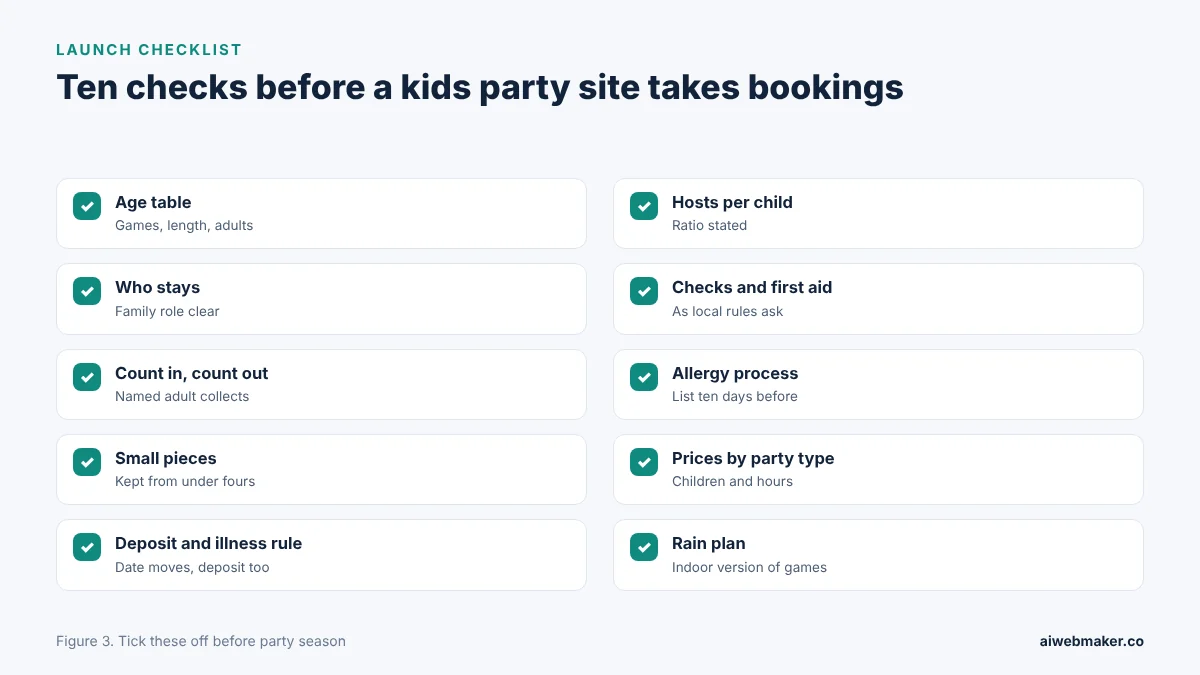
Parents leave a party planner's site when it shows bright themes but no ages, because a party for a ten year old can overwhelm a three year old. Prices without the number of children or hosts make comparison impossible. No word on who stays, who supervises and how children are collected worries every parent of a guest. A vague promise about food, without a step by step allergy process, sends careful families elsewhere. Missing deposit and illness rules make booking feel risky, so the card of ten checks below speaks to every one of those fears.
Frequently asked questions
Do parents need to stay for the whole party?
Many planners ask a parent or carer of the birthday child to stay throughout, and younger guests often need their own adult. The hosts lead the games, while the family stays responsible for its guests. Ratios differ by age and by planner, and local rules on supervision may also apply. The website should state the ratios clearly for each age band. Clear expectations prevent awkward moments at the door.
What is the youngest age a themed party suits?
Many planners start from the third birthday, when children can follow simple games and songs. Younger children often enjoy a short session of bubbles and music at home more than a full party. The site can suggest a gentler format for the very young. Small pieces, balloons and long games should be kept away from the youngest guests. Matching the party to the age keeps it happy for everyone.
How are guests with food allergies looked after?
Good planners collect every guest's allergies and dietary needs well before the party, often ten days ahead. Plates can be labelled with names, and allergy plates served first on their own tray. No planner can promise that food is completely without allergens, so the parent of a child with a severe allergy should stay with the child's medicine. Party planners are not a medical service, and in an emergency the local emergency number comes first. Honest wording here earns more trust than any promise.
Is there a plan for a rainy garden party?
Every garden game should have an indoor version, so the party can move inside if the weather turns. If there is no room indoors, some planners can move the party to a hall they know, at the hall's own price. The site should explain this before the date is booked. Parents appreciate a plan they do not have to invent on the morning. A clear rain rule removes one of the biggest worries about summer parties.
One living room party and the year is covered
At the sample's illustrative prices, a single At home party at $295 pays for more than two years of hosting, and a Fully planned party for about seven. Paid monthly, each $19 is less than party food for three guests at a hall party. Every parent who books through the site brings a room of guests whose parents see the planner at work. An honest age table, a clear safety page and a careful allergy process persuade the families who are trusting someone with their child's day. A diary of weekend afternoons filled through the school year is the outcome to look for.
Build your website in Minutes and get the AI Tools that work
Start Building Your Website →