Interior Stylist Website Cost, Styling Days and Honest Shopping Lists
An interior stylist's styling pages stay online for twelve months at a hosting price of $119, or $19 when paid monthly, and the stylist adds a domain. Topics: who books, pages, three ways to charge, commission and markups, where styling stops, renters, a styling day, search and the budget.
- No coding required
- Live in minutes
- Blog, SEO and chatbot tools included
Keeping an interior stylist's rooms and prices online costs $119 in annual AI Web Maker hosting, or $19 at the start of every month, with a domain as the lone extra. Nobody bills the stylist for writing the ways to work, the room gallery and the enquiry, or for testing them on a phone screen in the preview. One styling day pays for the year's hosting several times over, so the bill is not the question. The question is how to show that a stylist differs from an interior designer, why advice is worth paying for when shops offer it at the till, and how money spent on furniture stays the client's own. Clients also need to know where styling stops, because nobody wants to learn halfway through a day that the lighting plan needs an electrician. Below, in turn: who books, pages, three ways to charge, commission and markups, where styling stops, renters, a styling day, search and the budget.
This article is part of our complete guide: Website Builder for Creative Businesses.
New homeowners, tired renters and the room that never felt finished
Interior stylists are booked by people who like their home's structure but not how it feels, and who want neither builders nor drawings. A couple with boxes still in the spare room a year after moving, a renter who cannot paint and a homeowner whose living room looks bare despite new furniture are all typical. Some are preparing to host a family event or to sell, and want the room photographed at its best. They compare stylists by the rooms shown, the clarity of prices and whether the stylist respects what they already own. Most of all, they want a result they can afford, with no surprise markup on the shopping.
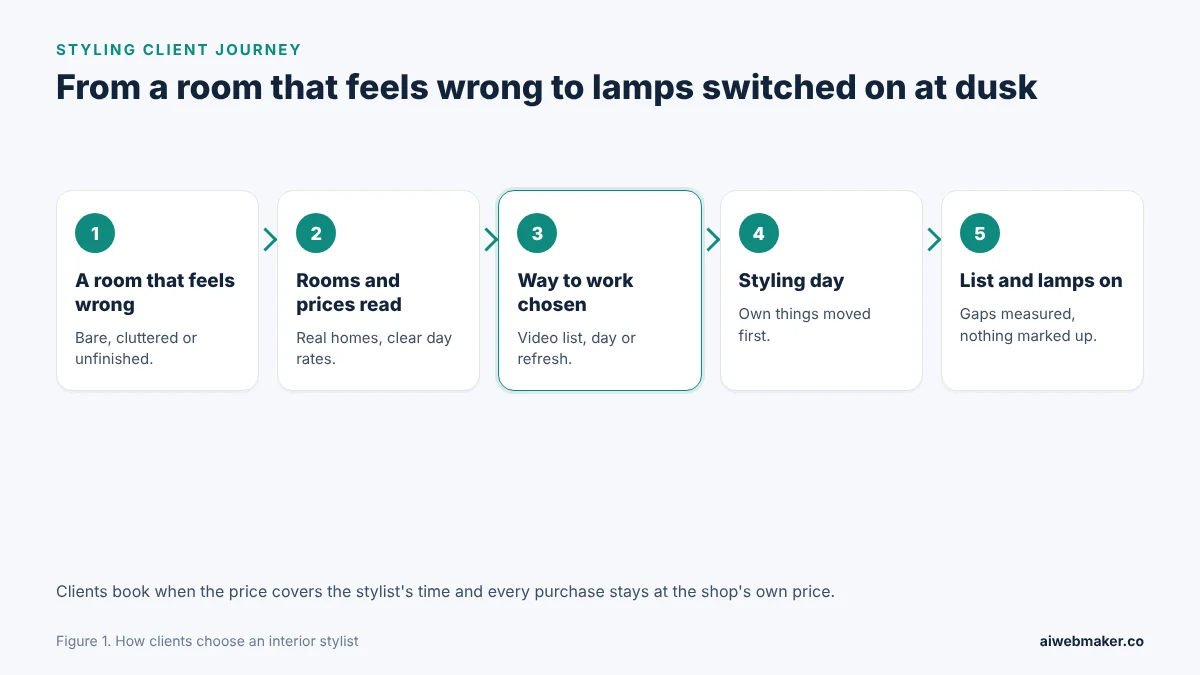
Choosing a way to work is the highlighted step, because clients pick a price shape before they pick a date. The trigger is a room that has never felt right, whether too empty, too full or a mix of styles from different moves. Clients then look for real rooms, preferably lived in, and a price they can understand. The styling day itself usually starts with what is already in the home, moved and reused, before anything new is suggested. A measured shopping list and lamps switched on at the end of the day turn a visit into a recommendation.
Ways to work, restyled rooms, small jobs, limits and the room enquiry
An interior stylist's site should feel like a well styled room, calm and edited, with nothing that makes the visitor work. The home page shows one finished room and names the ways to work, from a video shopping list to a full room refresh. A ways to work page prices each option, says what is included and states that clients buy from shops of their choice. A gallery of lived in rooms, a page of small jobs and a page explaining where styling stops answer the rest. A room enquiry that asks for words rather than photos at first keeps the start easy.
| Page | Client's question | What it should show |
|---|---|---|
| Home | Is this the look we want? | One finished room, ways to work, a calm enquiry button |
| Ways to work | What will it cost? | Video list, styling day, room refresh, travel |
| Restyled rooms | Has this stylist done rooms like ours? | Lived in homes, before and after, owners' permission |
| Small jobs | Can one thing be booked alone? | Lamps, shelves, gallery walls, colour, rugs and curtains |
| Where styling stops | Will a builder be needed? | What a stylist does and what other trades do |
| Room enquiry | How do we start? | The room, what would help, budget for new pieces |
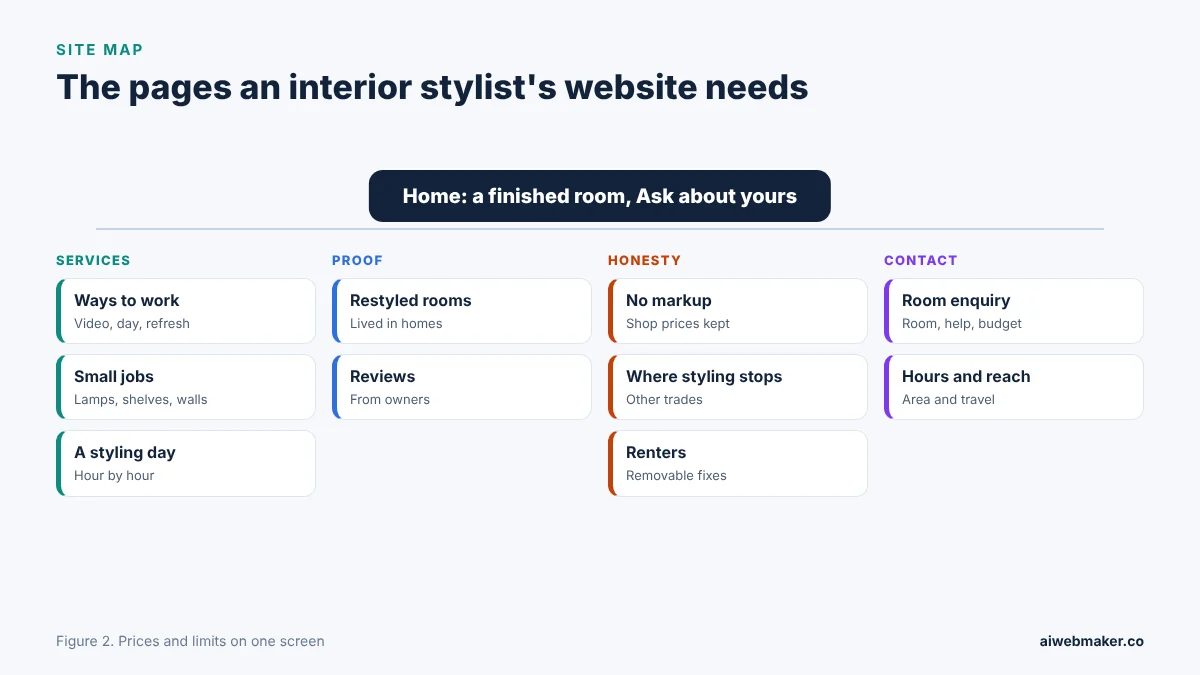
Prices and limits sit together in this plan, so a client sees what a day costs and what it will not include on the same screen. The services group holds the three ways to work and the small jobs, the proof group shows restyled rooms and reviews, and the honesty group explains commission, renters and the point where other trades take over. Lamplight Room Styling, the made up stylist behind our sample, offers a Shopping list by video, a Styling day and a Room refresh. Its small jobs are a Lamp plan, Shelf and mantel styling, a Gallery wall, a Colour consultation, Rug and curtain sizing and a Rental friendly refresh, and the page explains where styling stops before showing a styling day hour by hour. The interior stylist website example with styling days and a room enquiry ends with the questions clients ask before a stylist steps inside.
Day rates, video lists and room refreshes: three ways to charge
Stylists usually charge for time in one of three shapes, and each suits a different client and budget. A shopping list by video suits confident clients who want a plan they can carry out themselves, priced per room. A styling day suits rooms that need moving, editing and layering more than buying, at a day rate that covers the stylist's hours on site. A room refresh adds measured shopping, a return visit and final styling, priced as a project. Invoicing half to hold the date and half on the day, with travel beyond a stated distance added at cost, keeps the money simple.
| Way to work | How it is usually priced | Suits | What the page should state |
|---|---|---|---|
| Shopping list by video | A fixed fee per room | Confident clients on a budget | Call length, list format, number of rooms |
| Styling day | A day rate | One or two rooms, own things reused | Hours, travel, what happens on the day |
| Room refresh | A project fee | A room that needs new pieces | Visits, the shopping list, final styling |
| Small jobs | A set fee each | One specific problem | Time needed, what to buy beforehand |
| Travel | Added beyond a set distance | Homes further away | The distance and how it is charged |
Commission, trade discounts and the price on the tag
How a stylist earns money from the shopping is the question clients rarely ask and often wonder about. Some stylists and designers take commission from shops or keep part of a trade discount, which can be fair when disclosed but leaves clients unsure whether each suggestion suits them or the margin. Others charge only for their time and let clients buy at the price on the tag from shops they choose, which is simpler to explain. Either model can work, but the page must say which applies, since consumer and advertising rules on disclosing paid links and commissions vary by country. A sentence on the ways to work page answers it before suspicion sets in.
Where styling stops and another trade begins
A stylist works with what can be moved, hung, layered or bought, and the site should draw that boundary clearly. Anything that changes the structure, wiring or plumbing of a home belongs to a designer, a builder or a qualified tradesperson, and electrical work in particular is restricted to qualified people in many countries. Who may do which job is decided country by country, sometimes town by town, so the page can state the principle and leave the detail to local regulations. Naming the kinds of trade a stylist can recommend, without promising their work, helps clients who discover a bigger job during the day. Clear limits protect the client, the stylist and the home.
| Task | A stylist can | Needs another trade |
|---|---|---|
| Furniture layout | Move, edit and arrange | Removing a wall or a built in unit |
| Colour | Choose paint, test samples, plan accents | Plastering or damp repairs |
| Lighting | Plan lamps, bulbs and plug in fittings | New sockets, wiring or ceiling points |
| Art and mirrors | Plan and hang them | Fixings into fragile or unusual walls |
| Curtains and blinds | Measure, choose and dress them | Fitting on difficult windows |
| The shape of the room | Suggest zones and flow | Any structural or plumbing change |
Renters, landlords and fixes that come off cleanly
Renters are a large and often overlooked group of styling clients, because they cannot paint, drill wherever they like or replace fittings. A rental friendly refresh relies on removable hooks, plug in lamps, rugs, curtains on tension rods and furniture that moves with the tenant. The page should advise renters to check their tenancy agreement and ask the landlord before any change that could leave a mark, since rules on alterations differ between countries and contracts. Pieces chosen for a rental can be listed with the next home in mind, which makes the spend feel less temporary. Speaking directly to renters wins clients that many interior sites ignore.
A styling day by the hour, and the enquiry that books it
Describing a styling day hour by hour turns an abstract service into something a client can picture and plan around. A typical day starts with a walk round and a talk about how the room is used, then clears surfaces, moves the large pieces and tries the client's own things in new places. The afternoon fills gaps, layers textiles, hangs art and ends with the lamps switched on, followed by a measured list of anything still missing. The AI website builder for interior stylists and their styling day pages drafts the ways to work, the gallery and the room enquiry once the stylist describes the services, the area and the fees. Every price and caption can then be adjusted in the preview until the page matches how the stylist actually works.
Interior stylist near me and the phrases homeowners type
Homeowners type phrases such as interior stylist near me, home styling service, help styling a living room, rental friendly decorating or gallery wall help, usually with a town. Many search for a specific problem first, such as how to light a dark room or what size rug suits a sofa. Pages for each small job, with a heading in the client's own words, catch these searches. Photos of finished rooms on a map listing, along with the districts served, help local clients check the stylist is nearby. Articles on lamp placement, styling shelves or choosing curtain lengths bring readers who later book a day.
Bulbs, picture hooks and the website: a stylist's yearly costs
Picture hooks, warm white bulbs, felt pads, a laser level and the car that carries them cost an interior stylist more over a year than the website. Hosting from AI Web Maker stands at $119 for the year, or $19 paid in each month for a stylist starting out, while the domain's price is fixed by its ending. Twelve articles on lamps, shelves and rugs use roughly 65 cents of AI credit each, around $7.80 for the dozen. Adding a restyled room or changing a day rate costs nothing. A $189 tier joins the table as a contrast, not a recommendation.
| Item | Yearly | Monthly |
|---|---|---|
| Hosting the styling pages | $119 | $228 over twelve months |
| Domain | Depends on the ending | Depends on the ending |
| Higher plan, for comparison | $189 a year | Not needed |
| Twelve lamp, shelf and rug articles at about $0.65 | About $7.80 | About $7.80 |
| New rooms and day rate changes | No charge | No charge |
| Year before the domain | About $126.80 | About $235.80 |
Stock photos, hidden markups and other reasons clients keep scrolling
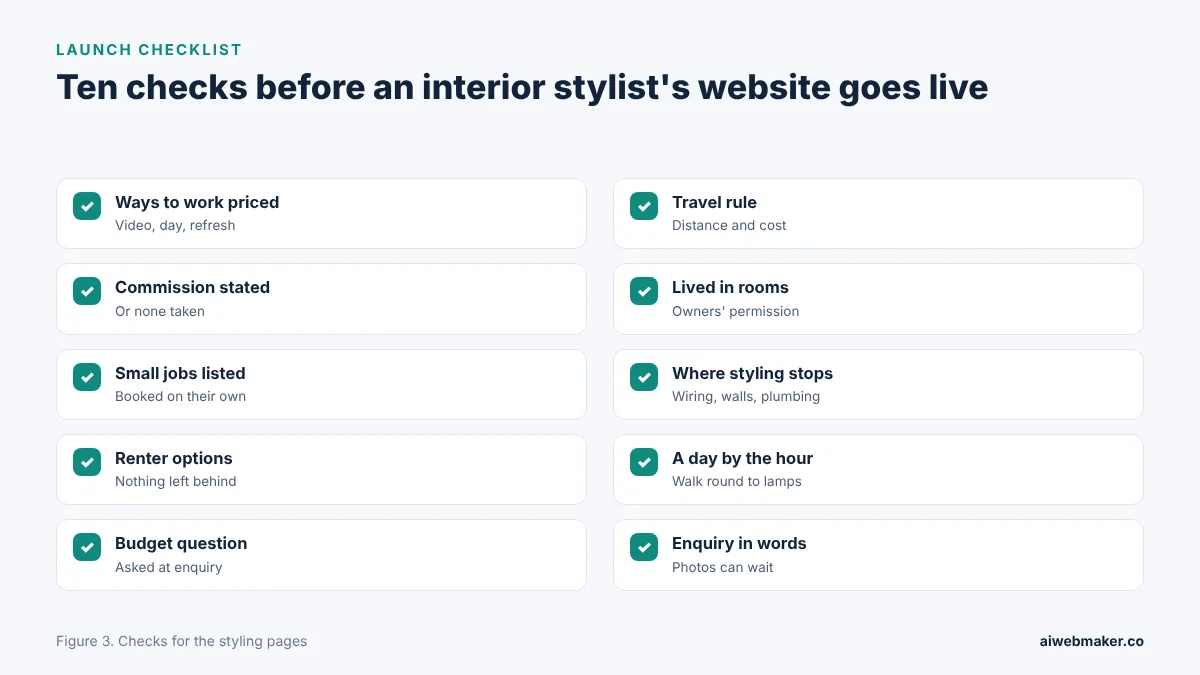
Clients leave a stylist's site when the rooms look like catalogue shoots rather than homes people live in. A missing day rate makes them assume a service they cannot afford. Silence about commission leaves them wondering whether every suggested lamp carries a hidden cut. No word on what styling cannot do worries anyone whose room might need an electrician. The image that follows lists ten checks that answer those worries.
Frequently asked questions
Is an interior stylist the same as an interior designer?
A stylist usually works with the room as it is, while an interior designer may also plan layouts, specify built in work and manage trades. Styling covers furniture, colour, lighting, textiles and accessories. Titles are used loosely in many countries, and in some places the title interior designer is protected or regulated for certain kinds of work. The site should explain which work the stylist does and which needs a designer or a builder. Clients who want walls moved or kitchens replaced are better served elsewhere, and saying so builds trust. Clear definitions help each client book the right kind of help.
Can a client keep their own furniture?
Most styling starts with the client's own furniture, because reusing what is loved costs less and makes the room feel personal. A stylist moves pieces between rooms, edits what crowds the space and suggests where one new item would change the most. Some pieces may be recommended for storage, sale or donation, but the decision always stays with the client. The shopping list then fills only the real gaps. Saying this on the site reassures clients who fear being told to start again.
How much should a client budget for new pieces?
The right budget depends on the room, the client's taste and how much existing furniture can be reused, which is why stylists ask for a rough figure early. A modest budget can still change a room through lamps, cushions, a rug and rehung art. Larger budgets may stretch to a sofa, curtains or a statement light. The list should show each item with its measurements and the shop's price, so the client can buy in stages. A realistic figure lets the stylist plan a list the client can actually buy.
Does a stylist help with homes about to be sold?
Some stylists prepare homes for sale or for photographs, which is usually called home staging and has different aims from styling a home for its owners. Staging tends to remove personal items and make rooms feel larger and neutral, while styling for owners makes the room feel more like them. The page should say whether the stylist offers staging, and whether furniture hire is included or arranged separately. Agents and sellers will want to know how quickly a room can be ready for photographs. Clarity here prevents a mismatch between the client's goal and the stylist's approach.
One styling day and the hosting year it covers
One styling day earns an interior stylist several times the $119 annual hosting charge. Billed monthly instead, $19 is a sliver of what even a lamp plan brings in. Each client who arrives having read the ways to work and the commission note books faster and argues less over the shopping. Rooms photographed after each job feed the gallery that wins the next booking. Enquiries describing the light, the problem and a rough budget in the first message show the pages are guiding clients well.
Build your website in Minutes and get the AI Tools that work
Start Building Your Website →