Hair Salon Website Cost and a Booking Path That Keeps Chairs Busy
Hosting a salon's website runs to $119 a year, or $19 a month on monthly billing, with the domain purchased separately. Inside: how clients pick a salon, price lists, stylist levels, colour consultations, booking policies, galleries, reviews, search and the yearly budget.
- No coding required
- Live in minutes
- Blog, SEO and chatbot tools included
Hosting the salon's website runs to $119 a year, and salons that prefer monthly billing are charged $19 every month, while the domain is purchased separately. AI Web Maker bills nothing while the salon assembles its pages and checks how they look. To picture those pages once assembled, open the hair salon website example, a whole site for an invented salon, produced in AI Web Maker, with colour, cuts and braids. A couple of colour appointments cover the whole year, so the money is not where the real decision lies. The decision that matters is whether the website fills the gaps in the column and brings in clients who return every six weeks. People choosing a salon judge the stylists' work, the prices, the atmosphere and how easy it is to grab a slot that fits their week. The sections below cover every page that shapes those judgements, from the price list to the booking policies and the yearly budget.
This article is part of our complete guide: Website Builder for Creative Businesses.
How do clients pick a hair salon?
Clients usually pick a hair salon by looking at the work first and the practical details second. Many discover a salon through photos shared by friends or on social media, then visit the website to check whether the style matches what they want. Prices come next, and a visitor who cannot find them often assumes the salon is beyond their budget. Availability matters, especially for people who can only come in the evening or at weekends. Location, parking and reviews from clients with similar hair complete the picture. A website that answers these questions quickly turns a casual browser into a booked client.
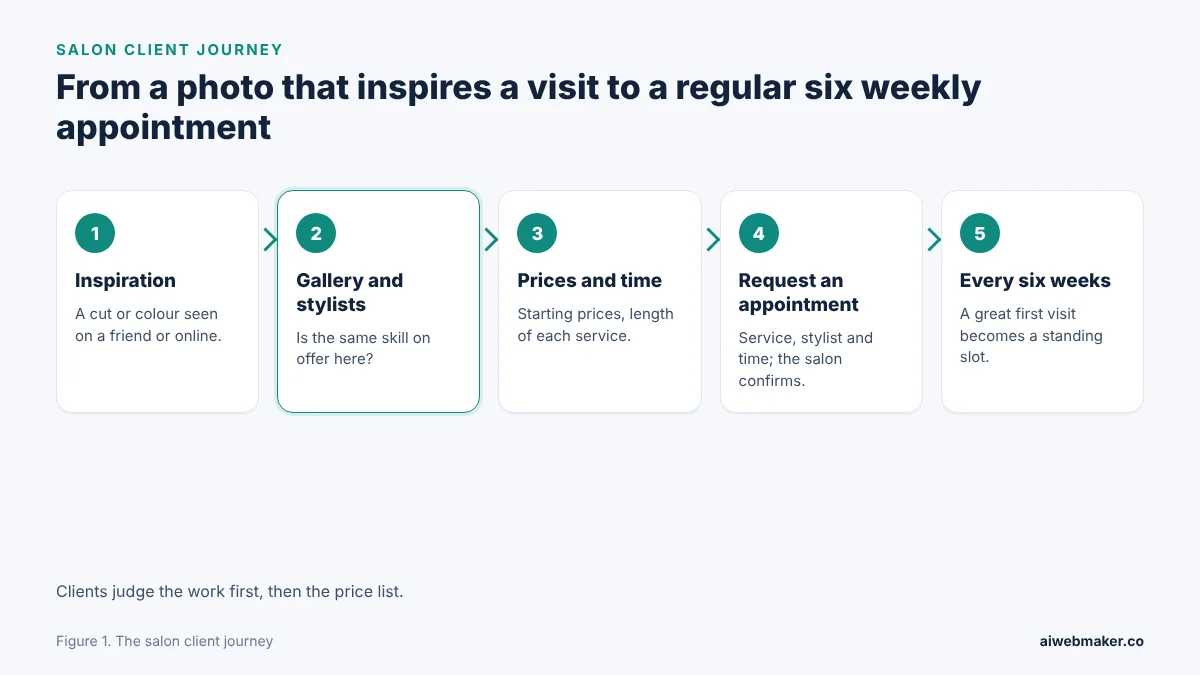
The figure tracks a new client from the photo that caught their eye to a regular place in the diary. Inspiration comes first, often from a cut or colour seen online. The visitor then checks the salon's own gallery and stylists to see whether the same skill is on offer. Prices and the time each service takes follow, because clients plan around both. The appointment request is the moment of commitment, after which a great first visit turns into a six weekly habit. The website supports each of these steps and gives the salon a steady stream of returning clients.
How should a salon price list be organised?
A salon price list should be organised by service, with clear starting prices, typical appointment lengths and notes on what changes the price. Cuts and blow dries sit together, followed by colour services, treatments and occasion styling. Colour prices often depend on hair length and thickness, so the list should explain this rather than hide it. Appointment lengths help clients plan, especially for colour, which can take several hours. Many salons price by stylist level, and showing this lets clients choose between budget and experience. A clear price list removes the most common reason people hesitate before booking.
| Service | Typical length to state | What changes the price |
|---|---|---|
| Cut and finish | Under an hour | Hair length, stylist level |
| Blow dry | Short | Hair length and style |
| Root colour | One to two hours | Product used, coverage |
| Full head colour | Two hours or more | Length, thickness, colour change |
| Highlights or balayage | Two to four hours | Technique, length, toner needed |
| Treatments | Short add on | Type of treatment |
| Occasion styling | About an hour | Complexity, trial needed |
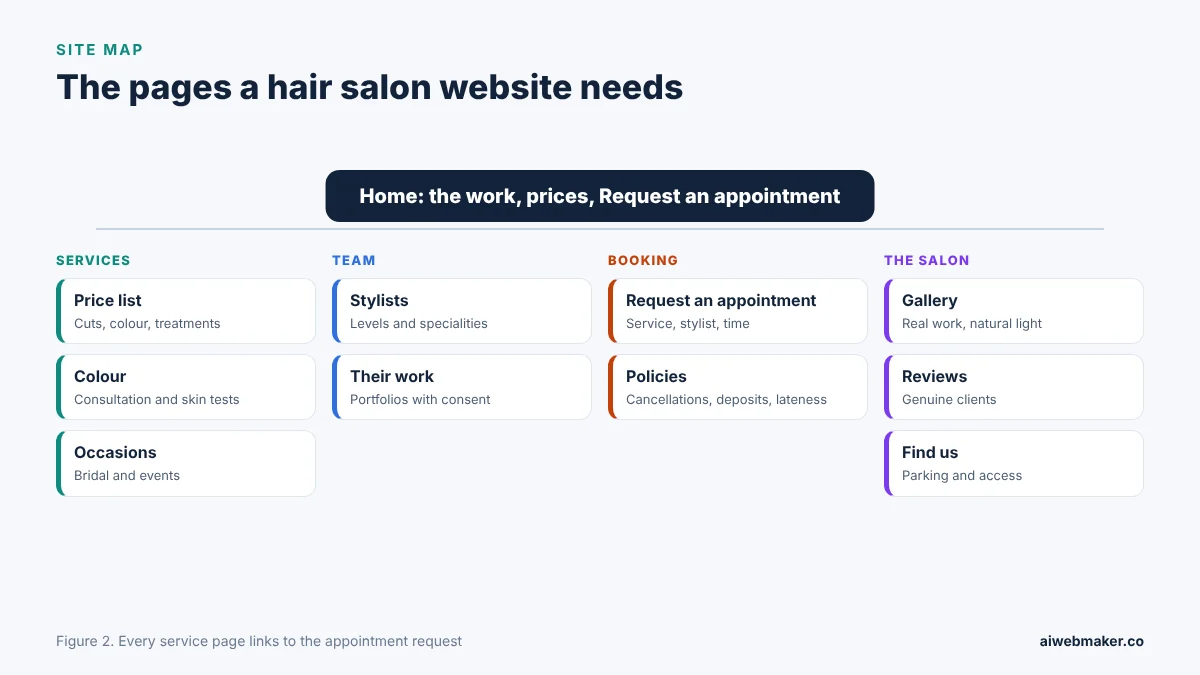
The salon site map in this figure splits the pages into services, team, booking and the salon itself. Service pages hold the price list, colour details and treatments, each linking to the booking request. Team pages introduce each stylist, their level and their specialities. The booking group pairs the appointment request with house rules on deposits, lateness and cancellations. Salon pages cover the gallery, products used, reviews and directions. Our sample salon, Velvet Touch Beauty Salon, takes requests for four services, namely facial care, nail care, relaxing body care, and hair and styling; its hair salon website example where clients request appointments online took 45 seconds to generate.
How should stylist levels and specialities be presented?
Stylist levels and specialities should be presented on a team page that helps clients match their hair and budget to the right person. Many salons use levels such as junior stylist, stylist, senior stylist and director, each with a different price. A short profile for each stylist, with a photo, years of experience and favourite techniques, makes the choice personal. Specialities, such as curly hair, blonde colour, men's cuts or bridal styling, help clients with specific needs. Photos of each stylist's own work, used with clients' consent, prove the skill behind the profile. A team page that feels human often decides which salon a newcomer chooses.
| Stylist level | Who it suits | What the profile should show |
|---|---|---|
| Junior stylist | Simple cuts, budget conscious clients | Training stage, supervised services |
| Stylist | Most cuts and colours | Experience, favourite techniques |
| Senior stylist | Complex colour and corrective work | Specialities, portfolio |
| Director or salon owner | Clients wanting the most experience | Background, signature work |
| Colour specialist | Blonde, balayage, colour changes | Technique, before and after photos |
What should colour clients know before their first appointment?
Colour clients need a consultation and often a skin test because results depend on the starting hair, and hair dye can cause allergic reactions. Most dye manufacturers instruct salons to carry out a skin allergy test at least 48 hours before a colour service, and many salons repeat it for returning clients at set intervals. The website should explain this clearly, so new colour clients book the test before their appointment. A consultation, in person or by video, lets the stylist assess the hair and agree a realistic result and price. Clients wanting a dramatic change, such as dark to blonde, should know it may take more than one visit. Explaining these steps prevents disappointment and protects the salon.
Which booking policies should a salon publish?
A salon should publish booking policies that protect the column while staying friendly, because missed appointments cost real money. The appointment request itself lets clients choose a service, a stylist and a time, and the salon accepts it, suggests another slot or declines it. Deposits for long colour appointments, where the salon takes them, are arranged directly by the salon and never pass through the platform. Clear rules on cancellation notice and late arrivals reduce empty chairs. Information about children, accessibility and the skin test requirement belongs in the same place. The AI website builder that hair salons use for appointment requests sets up the request page with the price list and team pages once the salon describes its services.
| Policy | What the website should state |
|---|---|
| Cancellation notice | How much notice is needed, and what happens without it |
| Late arrival | How lateness affects the service or the booking |
| Deposits | Whether long services need one, and how it is arranged |
| Skin tests | When a test is needed and how to book it |
| Children | Age guidelines and children's prices |
| Accessibility | Step access, seating, quiet appointments |
What should a salon gallery show?
A salon gallery should show real work by the salon's own stylists, photographed consistently and honestly. Natural light and plain backgrounds show colour accurately, while heavy filters create expectations the salon cannot meet. Grouping photos by service, such as cuts, blonde, brunette, curly hair and bridal, helps clients find relevant examples. Before and after pairs are especially persuasive for colour correction and big changes. Every photo should be used with the client's permission, and the website can say so. A trustworthy gallery reduces consultations that start with unrealistic photos from elsewhere.
How should a salon handle reviews and recommendations?
A salon should collect reviews honestly from real clients and display them without editing their meaning. In the United States, the Federal Trade Commission has adopted a rule banning fake reviews and testimonials, and many other countries have similar consumer protection rules. Buying reviews, writing them for clients or hiding negative ones can lead to penalties and lost trust. Asking happy clients for a review after their appointment is entirely acceptable. Reviews that mention a stylist's name and a specific service help other clients choose. Honest reviews are one of the most persuasive parts of any salon website.
Which phrases bring local clients to a salon's pages?
Clients searching locally find a hair salon with phrases such as hair salon near me, balayage specialist, curly hair salon or men's haircut with a town name. Service pages that name these services in their headings help the right searches reach the right page. Map listings with accurate hours, salon photos and the website address bring in much of the local traffic. Reviews that mention specific services strengthen these listings further. Articles on topics such as caring for coloured hair or choosing a style for thick hair attract readers who later book. A salon that publishes steadily becomes a familiar name before clients ever walk in.
How much does a salon pay to keep its website running?
To keep its website running a salon pays the hosting fee and a domain, while hair care articles drafted with credits cost little more. A salon with a loyal client base gets the lower total through annual billing. A newly opened salon may start monthly while it builds its client list. Updating prices, stylists or the gallery adds nothing to the bill. The $189 tier sits in the table alongside both routes.
| Expense | Yearly payment | Monthly payments |
|---|---|---|
| Hosting the salon pages | $119 | $228 over twelve months |
| Domain for the salon | Varies by ending | Varies by ending |
| Higher plan, for comparison | $189 a year | Not needed |
| Twelve hair care articles at about $0.65 | About $7.80 | About $7.80 |
| Price, team and gallery updates | No charge | No charge |
| Year before the domain | About $126.80 | About $235.80 |
Which gaps send salon clients to a competitor?
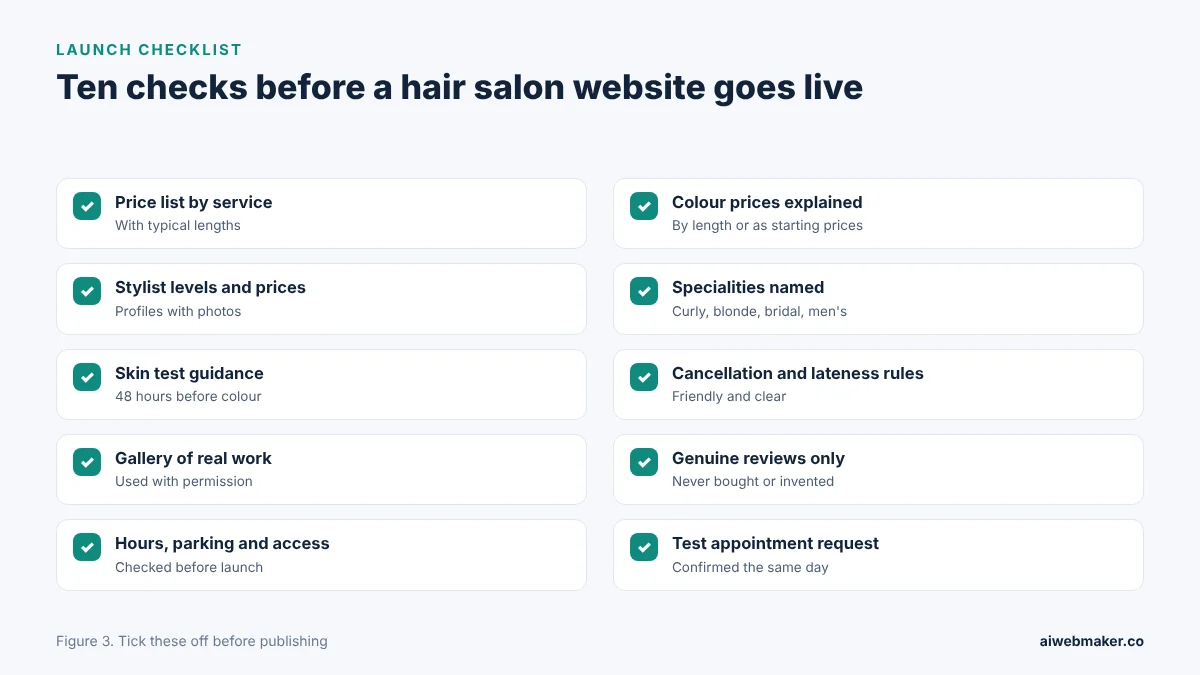
Salon clients drift to a competitor when the price list is missing or vague about colour. A team page without photos makes the salon feel anonymous. No mention of skin tests leaves new colour clients surprised and disappointed at the door. A gallery full of filtered or borrowed images undermines trust. Hidden cancellation rules lead to disputes and empty chairs. Every one of these gaps is covered in the checklist that follows.
Frequently asked questions
Should a salon list colour prices by hair length?
Listing colour prices by hair length, or as starting prices with a note that length and thickness affect the final cost, helps clients budget accurately. Long, thick hair needs more product and time, so a single price can mislead. Some salons show short, medium and long prices for each colour service. A consultation can confirm the final price before work starts. Clear guidance prevents awkward conversations at the till.
How far ahead can clients request appointments?
Clients can usually request appointments weeks ahead, and many like to book their next visit before leaving the salon. The website should show how far ahead requests can be made and how quickly they are confirmed. Busy periods, such as before holidays, may need earlier booking. Regular clients often prefer a standing slot every six weeks. Clear guidance helps clients plan and keeps the diary full.
How far in advance is a skin allergy test done?
New colour clients usually need a skin allergy test before their first colour appointment, because most dye manufacturers instruct salons to carry one out at least 48 hours beforehand. The website should explain how to book the test and how long before the appointment it is needed. Some salons also repeat the test for returning clients after a set period. Clients with known allergies should mention them when they book. Clear guidance protects clients and the salon alike.
Can a salon show each stylist's own work?
A salon can show each stylist's own work on their profile, provided clients give permission for their photos to be used. Linking photos to stylists helps clients find the right person for the look they want. Consistent photography across the team keeps the gallery looking professional. Stylists can add new work regularly to keep their profiles fresh. Personal portfolios often become the main reason clients ask for a particular stylist.
Do two colour appointments pay for the salon website?
Revenue from two colour appointments usually exceeds the $119 annual hosting fee. Salons billed monthly earn back the $19 from a single blow dry. Each new client who becomes a regular adds years of appointments that began with a visit to the website. Most of the persuading is done by a clear price list, warm stylist profiles and honest photos. Keeping those pages current helps a salon fill quiet weekday afternoons, not only Saturdays. A column full of returning names is the best evidence the site is working.
Build your website in Minutes and get the AI Tools that work
Start Building Your Website →