Corporate Event Planner Website Cost, Budgets Shown Line by Line
A corporate planner's format and brief pages need $119 in yearly hosting, a sliver of one team day fee, or $19 monthly until accounts land, with a domain on top. Topics: who briefs and who signs, the pages, fees, budget lines, room blocks and contracts, run sheets and risk, briefs and confidentiality, search and the annual numbers.
- No coding required
- Live in minutes
- Blog, SEO and chatbot tools included
Twelve months of hosting for a corporate planner's format and brief pages come to $119, or $19 monthly until the first accounts land, with the domain billed beside the hosting. Nobody at AI Web Maker bills the planner for drafting format pages, a budget table and a brief form, or for testing them in the preview. The planning fee for one team day dwarfs that hosting. What complicates matters is that companies buy events through several hands, and each pair of hands opens the website looking for something else. An assistant wants a planner who replies quickly, a finance team wants a budget it can audit and a director wants the day to run without embarrassment. Inside: who briefs and who signs, the pages, fees, budget lines, room blocks and contracts, run sheets and risk, briefs and confidentiality, search and the annual numbers.
This article is part of our complete guide: Website Builder for Creative Businesses.
Office managers, marketing leads and the procurement inbox
A corporate event is usually briefed by one person and approved by several, so the planner's site must work for readers who never meet. Executive assistants and office managers often send the first message, especially for team days, dinners and client evenings. Marketing teams brief product launches and care about the reveal, the press list and the photographs. Sales and operations teams run conferences, while finance and procurement check fees, contracts and supplier costs before anything is signed. Every one of these readers wants evidence that the planner controls money and risk as carefully as the creative side.
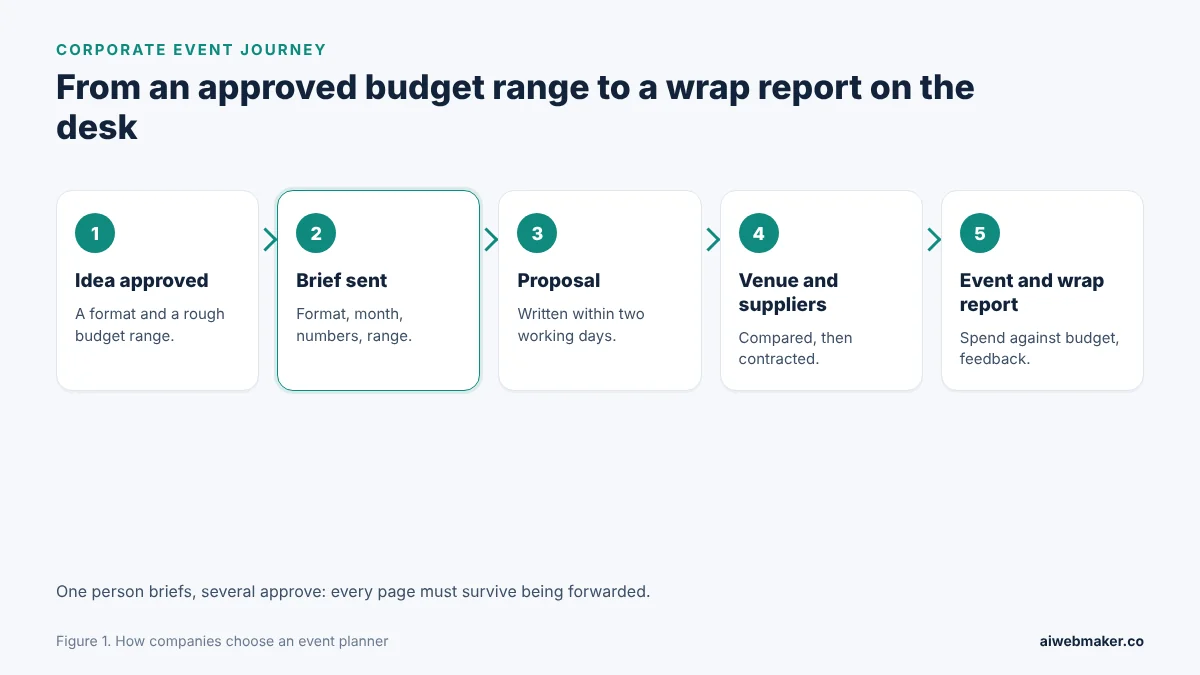
An approved idea with a rough budget range starts the path, often months before anyone thinks about venues. The highlighted second step is the brief, when the company sends the format, the month, the numbers and the range. A written proposal follows quickly, and its speed often decides which planner wins the work. Venues and suppliers are then shortlisted, compared and contracted in the agreed name. The event day and the wrap report finish the journey, and that report is what persuades the company to brief the same planner again.
Formats, budgets, process and fees: the planner's page set
A corporate planner's website needs fewer pages than a wedding planner's, but each one must survive being forwarded to a finance director. Format pages show what the planner runs, from a conference for hundreds to a dinner for twelve clients. A budget page explains where money goes and how it is controlled. The process page sets out the stages and who is responsible at each, while the fees page separates the planner's charge from the event budget. A brief form closes the set, asking enough to write a proposal without demanding a full specification.
| Page | Who reads it | What it must show |
|---|---|---|
| Formats | The person briefing | Conferences, launches, team days, dinners, hybrid sessions |
| Budgets | Finance and procurement | Lines, what pushes each up, contingency |
| Process | Everyone involved | Stages from brief to wrap report |
| Fees | Procurement | Planning fee apart from the budget, invoicing stages |
| Run sheet and risk | Directors and venue teams | Cues, owners, fallbacks, access needs |
| Recent events | Everyone | Formats and numbers, client names only with consent |
| Brief form | The person briefing | Format, month, numbers, budget range, goals |
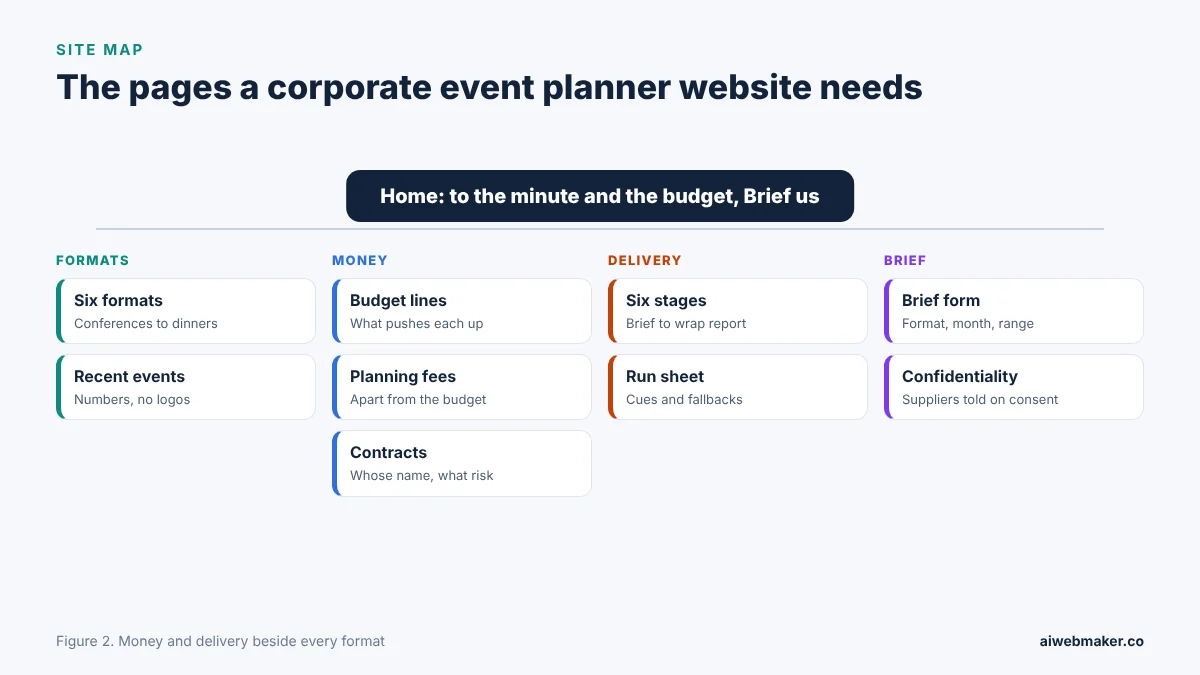
Formats, money, delivery and the brief are the four branches under this drawing's home card. Agenda Corporate Events, the invented firm in the corporate event planner website example with budgets and run sheets, plans for 30 to 1,500 attendees with one producer from brief to wrap report and a first written proposal within two days. Six formats come first: conferences and summits, product launches, team days and offsites, awards and gala dinners, client hospitality, and hybrid and streamed sessions. A budget table follows, running from venue and rooms through food and drink, audio visual and staging, travel, print and a contingency line. Six stages, a section on the run sheet and three fee options (On the day at $1,800, Team day at $3,200 and Conference at $7,500) lead to questions and a brief form with budget ranges.
Planning fees kept apart from the event budget
Companies trust a planner whose own fee sits on a separate line from the money spent on the event, because procurement teams look for hidden margins first. Charging models vary: a fixed sum per format, a share of the total budget or an hourly rate for advisory work. Supplier markups and commissions are where trust is most easily lost, so passing supplier invoices on at cost, with the original quotes attached, is a strong position to state openly. Invoicing in stages, such as a third when the proposal is signed, a third when the venue is contracted and the rest after the wrap report, spreads the risk on both sides. Whatever the model, procurement should be able to see from the fees page what the planner earns and who pays it.
| Fee model | How it works | What a client should ask |
|---|---|---|
| Flat fee per format | A fixed charge for a defined scope | What happens if the scope grows |
| Percentage of budget | A share of total event spend | Whether the share rises as costs rise |
| Hourly advisory | Time billed for advice or reviews | How hours are recorded and capped |
| Supplier commission | Payments from venues or suppliers | Whether commissions are disclosed |
| Pass through at cost | Supplier invoices passed on unchanged | Whether original quotes are attached |
Where a conference budget goes, line by line
A conference budget is easiest to approve when every line is shown with what drives it, since finance teams question totals that arrive as a single figure. The venue often carries a minimum spend on food and drink, which can shape the menu more than taste does. Audio visual, staging and streaming can rival the venue cost for a large plenary, especially with cameras and remote speakers. Travel and rooms grow quickly with speaker flights and attendee accommodation, while print and signage shrink when digital agendas work. Service charges and sales taxes are not uniform across borders, so each belongs on its own budget line wherever it applies.
| Budget line | What it covers | What pushes it up |
|---|---|---|
| Venue and rooms | Plenary, breakouts, storage | Minimum spend, peak season dates |
| Food and drink | Coffee, lunch, breaks, receptions | Late number changes, premium menus |
| Audio visual and staging | Screens, sound, lighting, set | Cameras, streaming, extra rehearsals |
| Travel and rooms | Speaker travel, attendee rooms | Late booking, unused room blocks |
| Print and signage | Badges, signs, agendas | Last minute changes, many languages |
| Contingency | Late changes and surprises | Returned if unused |
Room blocks, attrition and the cancellation clauses
Hotel room blocks and venue contracts hide most of the financial risk in corporate events, and a planner who explains them earns the trust of finance teams. A room block reserves bedrooms for attendees at an agreed rate until a release date, after which unclaimed rooms return to the hotel. Many contracts include an attrition clause that charges for rooms or meals below an agreed share of the original numbers. Venue cancellation charges usually rise as the date approaches, sometimes reaching the full hire fee close to the event. The website can explain these terms in plain language and promise to read every clause before the client signs.
The run sheet, rehearsals and a risk plan
A run sheet is the document the whole event hangs on, listing every cue from the moment the screens power on to the time the last coach leaves. Each line names the person responsible and the fallback if it slips, such as a spare presenter laptop or a second microphone on stage. Rehearsals with speakers the day before, or that morning, catch problems with slides, timings and nerves. Risk assessments, venue rules and permits are required in different forms in different countries, so the planner should check what applies locally rather than assume. The AI website builder that corporate event planners use for format and brief pages drafts the format, budget, process and brief pages once the planner has summed up its events in a few sentences, and the run sheet wording can then be polished in the preview.
Briefs, proposals and the confidentiality companies expect
A brief form needs only the format, the month, the expected numbers, the city and a budget range to support a first proposal. A range is better than a fixed figure at this stage, since the planner can show what each level buys. Product launches and leadership offsites are often confidential, so the site should promise that briefs reach suppliers only with the client's agreement. Where a non disclosure agreement is expected, the planner can say it is happy to sign one before details are shared. Speed matters too, and a proposal within two working days signals that the firm can work at corporate pace.
Conference organiser near a named city: the searches companies run
Companies searching for a planner usually combine the format with the place, so format pages titled that way meet them halfway. Typical phrases include conference organiser in a named city, corporate event management company, team building day near a region, product launch event agency and awards dinner planner. The map listing should show weekday office hours and a phone number, because assistants often call before they write. Reviews from clients who describe the format and the numbers, even without naming the company, carry real weight. Articles on conference lead times, budgeting a team day or choosing a hybrid format bring readers who are only starting to plan.
Against a conference fee, the planner's hosting line
Set against even one conference fee, a corporate planner's website costs almost nothing: hosting, a domain and perhaps a few articles drafted with AI credits. Settling the hosting annually gives the lowest figure for a firm with steady clients. A new planning firm may keep to monthly billing while it wins its first accounts. Adding formats, updating fee options or posting recent events never alters the bill. The yearly and monthly routes share the table below, with the $189 plan listed only as a benchmark.
| Item | Yearly | Monthly |
|---|---|---|
| Hosting the corporate events and brief pages | $119 | $228 over twelve months |
| Domain | Depends on the ending | Depends on the ending |
| Higher plan, for comparison | $189 a year | Not needed |
| Twelve budgeting and lead time articles at about $0.65 | About $7.80 | About $7.80 |
| Formats, fees and recent events | No charge | No charge |
| Year before the domain | About $126.80 | About $235.80 |
Why a busy assistant forwards a rival planner's link instead
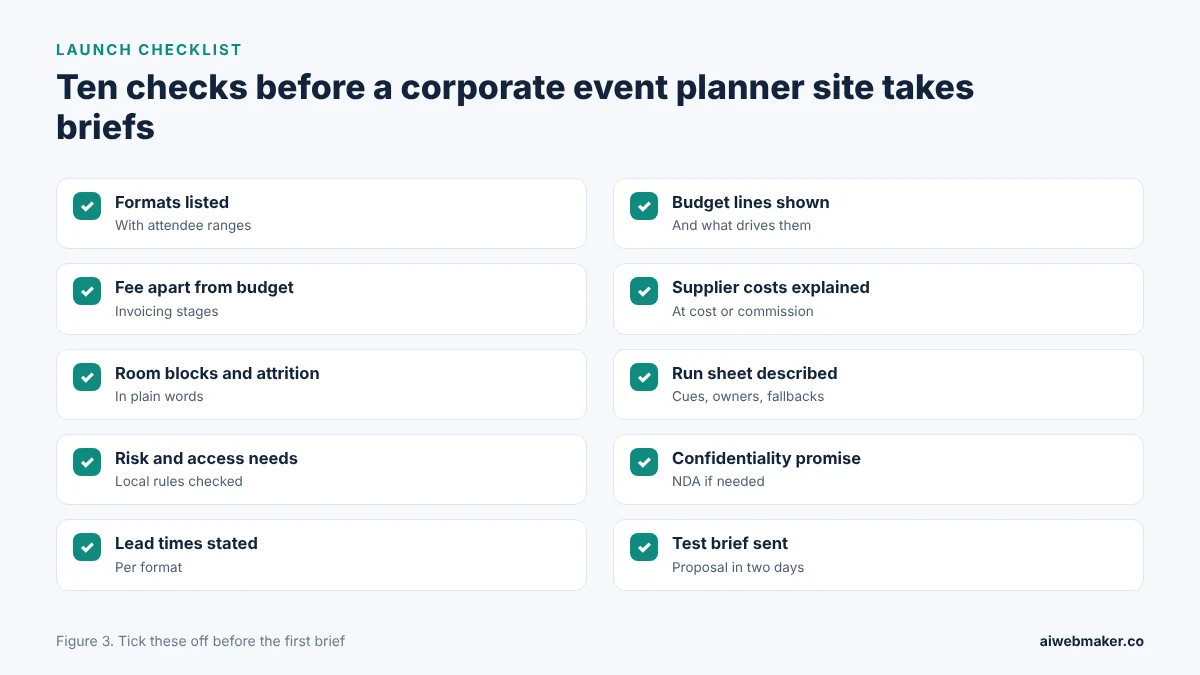
Assistants forward a rival planner's link when a site shows glossy photos but no budget lines, because they cannot send a picture to finance. A fee page that blurs the planner's charge into the event total raises procurement's suspicion at once. No mention of run sheets, rehearsals or risk plans leaves directors wondering who handles a failed microphone. A brief form that demands a full specification before any conversation feels like hard work. Silence on confidentiality worries anyone planning a launch, and the ten points on the card below answer every one of those doubts.
Frequently asked questions
What lead time does a conference really need?
Larger conferences often need four to nine months, so the venue, the speakers and the hotel rooms can be secured. Team days and dinners can often be arranged in six to ten weeks if the dates are flexible. Popular cities and peak seasons push lead times further out. An honest planner says when a date is too tight rather than accepting it and hoping. Clear lead times help companies brief early enough to keep choices open.
Is a budget range enough to start a brief?
A range is usually enough, because the first proposal can show what different levels buy in the chosen city. A fixed figure at the start can force decisions before the options are understood. The planner then sets out each line, so the company decides where to spend and where to save. Finance teams generally prefer this to a single number that later grows. Starting with a range leads to fewer surprises later.
Whose name goes on the venue contract?
A venue contract may be signed by the client, with the planner managing it, or by the planner, who then passes every cost through. Each choice changes who carries the risk if the event is cancelled or numbers fall. Many companies prefer contracts in their own name for control and audit trails. The planner's site should explain both options and let the client choose. Clarity here prevents disputes when a clause is tested.
Can a planner run an event in another country?
Many planners do, using local suppliers they have vetted or worked with before. Permits, taxes on services, venue rules and employment rules for event staff differ from country to country. The proposal should set out which local rules apply and who handles them. Travel, currency and time differences also need their own budget lines. Careful planning turns an overseas event into a familiar process.
One team day and the hosting is a footnote
At the sample's illustrative fees, the $119 yearly hosting is well under a tenth of a single On the day fee, and a fraction of a conference fee. On monthly billing, each $19 is smaller than a single line in any event budget. Every company that briefs through the site and receives a clear proposal often comes back for its next event. Budgets shown line by line, fees kept apart and run sheets described in detail persuade the people who sign. A brief that arrives already complete, with format, month, numbers and range, is the sign the pages are doing their job.
Build your website in Minutes and get the AI Tools that work
Start Building Your Website →