Solar Company Website Cost and Honest Pages That Outlast Lead Sellers
Solar installers see one hosting line, $119 annually or $19 if billed by the month, and a domain to match. Topics: who researches solar, core pages, the kit, honest estimates, installation stages, certification and warranties, search and the yearly budget.
- No coding required
- Live in minutes
- Blog, SEO and chatbot tools included
Solar installers using AI Web Maker see one hosting line in the accounts, $119 annually or $19 on each monthly bill, and a domain bought to match the company name. The service pages, the installation stages and the project gallery can all be shaped and checked in the preview before a single invoice exists. One residential installation is worth many times that yearly figure, so hosting is the smallest number in the business plan. Seeing a finished build first helps, and the solar energy company website of an invented installer, put together in AI Web Maker, covers the stages from roof survey to the day the system is switched on. The real obstacle in solar is suspicion, because homeowners are targeted by comparison sites that sell their details to several installers at once and by sales calls that promise savings nobody can guarantee. Incentives, tariffs and grid rules also differ between countries and change over time, which leaves buyers unsure whom to believe. This article covers who researches solar, the core pages, the equipment, honest estimates, installation stages, certification and warranties, search and the yearly budget.
This article is part of our complete guide: Home Services Website Builder.
Rising bills, outages and electric cars: who researches solar
Solar buyers arrive with different motives, and the website should recognise each of them in plain language. Homeowners facing higher electricity bills want to understand whether panels make sense for their roof and their usage. Families in regions with frequent power cuts care most about batteries and backup, often more than about export payments. Owners of electric cars want to charge from their own roof, while rural properties may want systems that work away from the grid. Businesses with large daytime loads, such as cold stores, workshops and offices, look at return on investment and disruption. Each group researches for weeks, and each is wary of pressure.
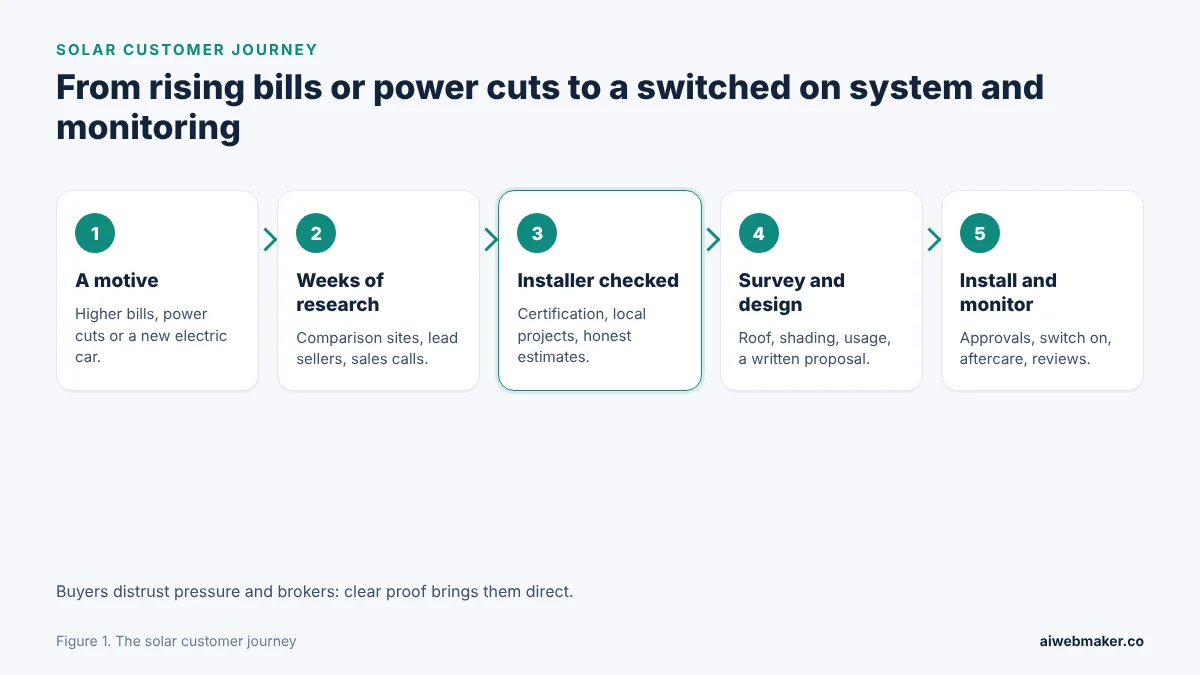
The journey opens with a motive, such as a painful bill, a run of power cuts or a new electric car in the driveway. Research comes next, and it is here that many homeowners first meet lead sellers and comparison sites. The heaviest step is checking the installer, when buyers look for certification, real projects nearby and estimates that explain their assumptions. A survey and a written design follow, then approvals, installation and switch on. Monitoring and aftercare close the loop and produce the reviews that reassure the next buyer. An installer whose website wins the third step rarely needs to buy the first.
Home systems, business arrays and batteries: the installer's core pages
A solar website needs separate pages for homes, businesses and batteries, because each audience reads with different priorities. The home installation page should explain the survey, the typical system and what affects the outcome. Business installation pages need to address daytime demand, roof space, approvals and disruption to operations. Battery storage deserves its own page, since many buyers want to add a battery later or need backup during outages. Related services, such as electric car chargers, monitoring and maintenance, can sit alongside. A process page, a projects page and an about page with certifications complete the structure.
| Page | Who reads it | What it should show |
|---|---|---|
| Home solar installation | Homeowners comparing installers | Survey, typical systems, honest estimates |
| Business solar installation | Owners and facility managers | Daytime demand, approvals, disruption |
| Battery storage | Buyers wanting backup or more self use | What backup covers, adding a battery later |
| Equipment | Researchers comparing brands | Panels, inverters, batteries, monitoring |
| Installation process | Anyone nervous about the work | Stages from survey to switch on |
| Projects | Neighbours and cautious buyers | Property type, system size, photos |
| About and certification | Everyone, especially cautious buyers | Certification, insurance, team, area |
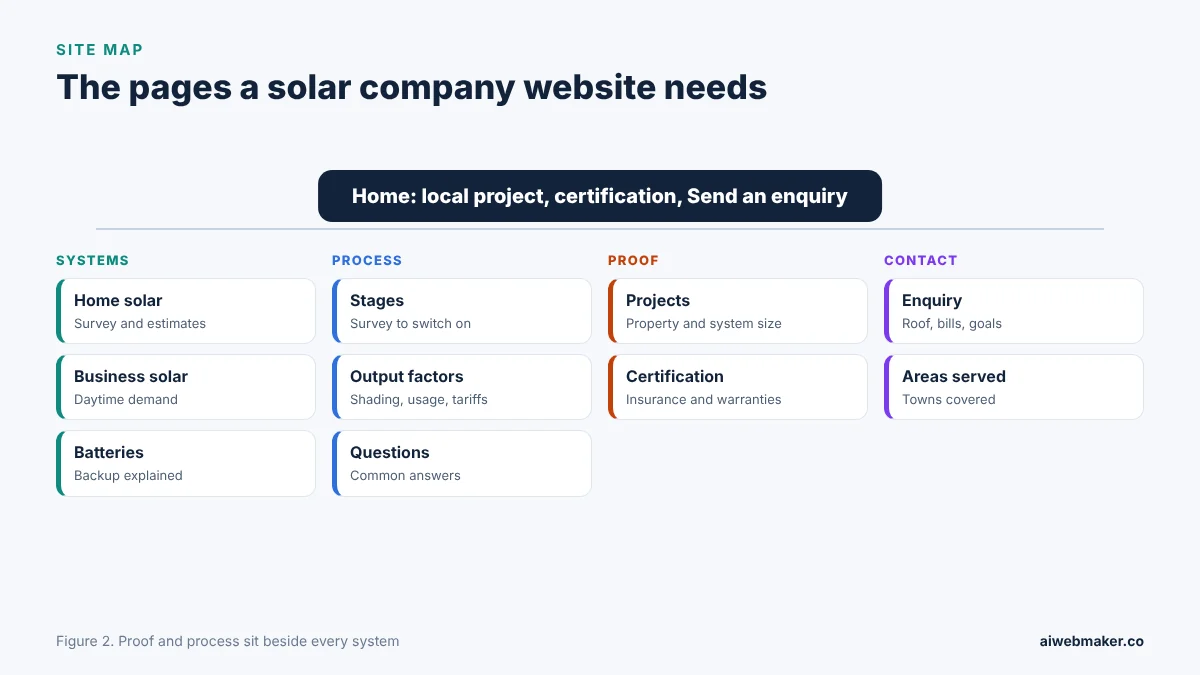
An installer's site branches into systems, process, proof and contact, while its home page opens on a real local project with an enquiry button beside it. System pages cover homes, businesses, batteries and equipment. Process pages explain the stages, what affects output and the most common questions. Proof pages hold projects and reviews, while the contact branch carries the enquiry form and the areas served. Brightfield Solar, the sample installer, features a family home rooftop array with battery on its home page, lists home solar installation and business solar installation as separate sections of its services page, and describes the stages of an installation on its process page together with typical considerations. The solar installer website example with an installation process page and project gallery also includes an about page covering the team, accreditations and insurance, and all five pages were built in 60 seconds.
Panels, inverters and batteries explained without the hype
Equipment should be explained in terms of what each part does and what a buyer should ask, because brand names and efficiency figures mean little without context. Panels turn sunlight into electricity, and most residential systems now use monocrystalline modules. The inverter converts that power into the form a home uses, and it may be a single string inverter, microinverters on each panel or a hybrid unit that also manages a battery. Batteries store surplus energy for the evening or for outages, with lithium iron phosphate now common in homes. Mounting, cabling, isolators and monitoring complete the system and decide how neat and safe it is. A table helps buyers compare quotes on more than headline panel wattage.
| Component | What it does | What buyers should ask |
|---|---|---|
| Panels | Turn sunlight into electricity | Make, wattage, warranty terms |
| Inverter | Converts power for home use | String, micro or hybrid, and why |
| Optimisers | Reduce losses from partial shading | Whether the roof needs them |
| Battery | Stores surplus energy | Usable capacity, backup ability |
| Mounting | Fixes panels to roof or ground | Roof type, weatherproofing method |
| Monitoring | Shows production and use | App or display, who watches faults |
Orientation, shading and tariffs: estimating output without promises
Any estimate of output or savings should be presented as an estimate, with its assumptions shown, because results depend on factors no installer controls. Roof orientation, pitch and shading from trees, chimneys or neighbouring buildings change how much electricity a system produces. Household usage matters just as much, since power used during the day is worth more to most homeowners than power exported. Tariffs, export payments, net metering rules and incentives are set nationally or regionally and revised from time to time, so an installer should describe them only as they apply locally and at the time of writing. Advertising rules in many countries treat exaggerated savings claims seriously, and a site that avoids headline payback figures keeps both buyer and installer out of trouble. A personalised estimate after a survey, with the assumptions listed, is both safer and more persuasive.
Survey, design, grid approval, install: the stages of a solar project
The stages of an installation should be explained in order, because homeowners fear roof damage, electrical work and a long wait for approvals. A survey checks the roof, its condition and structure, the electrical supply and recent energy bills. Design and a written quote follow, setting out the equipment, the layout and the expected output range. Grid connection approval, building notices or planning consent may be needed, depending on the system size and local rules. Installation itself often takes a day or a few days for a typical home, with scaffolding where required. Commissioning, a handover of documents and monitoring set up close the project.
| Stage | What happens | What the buyer receives |
|---|---|---|
| Survey | Roof, shading, electrics, bills reviewed | A clear view of suitability |
| Design and quote | Layout, equipment, estimate with assumptions | A written proposal |
| Approvals | Grid connection, permits where required | Confirmation before work starts |
| Installation | Scaffolding, mounting, panels, inverter | A tidy, safe site |
| Commissioning | Testing, certificates, switch on | Documents and warranty details |
| Monitoring | App or display set up | A way to see production |
Certification, warranties and the lead seller problem
Certification and warranties are where an installer separates itself from lead sellers and pressure sales, so the details deserve prominent space. Installer certification schemes vary by country, such as MCS in the United Kingdom, and access to some incentives or export payments may depend on using a certified installer. Electrical work is usually regulated separately, and the site should name the relevant registrations held. Warranties come in layers, covering panel products, panel performance, inverters, batteries and the installer's own workmanship, and buyers should see each one explained. The AI website builder for solar installers and battery specialists lays out the services, the installation stages, the project gallery and an enquiry form after the installer outlines its systems and area in a short note. A site this clear lets homeowners contact the installer directly instead of handing their details to a broker.
| Warranty | What it covers | Often quoted length |
|---|---|---|
| Panel product | Defects in manufacture | Often 10 to 25 years |
| Panel performance | Output above a stated level | Often around 25 years |
| Inverter | Faults in the inverter | Often 5 to 12 years, sometimes extendable |
| Battery | Capacity over time or energy throughput | Often around 10 years |
| Workmanship | The installer's own work | Set by the installer, should be stated |
Solar panels near me: what buyers search and where reviews count
Buyers researching solar type phrases like solar panels near me, solar installers in a town, home battery storage, solar for business or solar panel cleaning. Each system page should use those words in its heading and opening lines. A map listing with the address, the areas served and photos of real installations helps the installer appear in local searches. Reviews that mention a tidy installation, accurate estimates and helpful aftercare carry particular weight in an industry where buyers fear pressure. Articles explaining how a survey works, what affects output or how batteries handle power cuts answer questions buyers search during their long research. Patient, accurate content earns the trust that lead sellers cannot buy.
The hosting year beside a single rooftop installation
Solar websites carry a very small bill, hosting plus the domain, and each explainer drafted through credits adds about $0.65. Installers with a steady pipeline keep the total lowest by settling the year upfront. A newer installer may prefer monthly billing while the projects page fills. Adding projects, updating equipment and refreshing certification details are covered by the hosting. Yearly and monthly billing are compared next, and the $189 tier appears for reference rather than as a recommendation.
| Item | Yearly | Monthly |
|---|---|---|
| Hosting the solar pages | $119 | $228 over twelve months |
| Domain | Depends on the ending | Depends on the ending |
| Higher plan, for comparison | $189 a year | Not needed |
| Twelve solar explainer articles at about $0.65 | About $7.80 | About $7.80 |
| New projects, equipment and certificates | No charge | No charge |
| Year before the domain | About $126.80 | About $235.80 |
Payback promises and hidden certifications: why homeowners close the tab
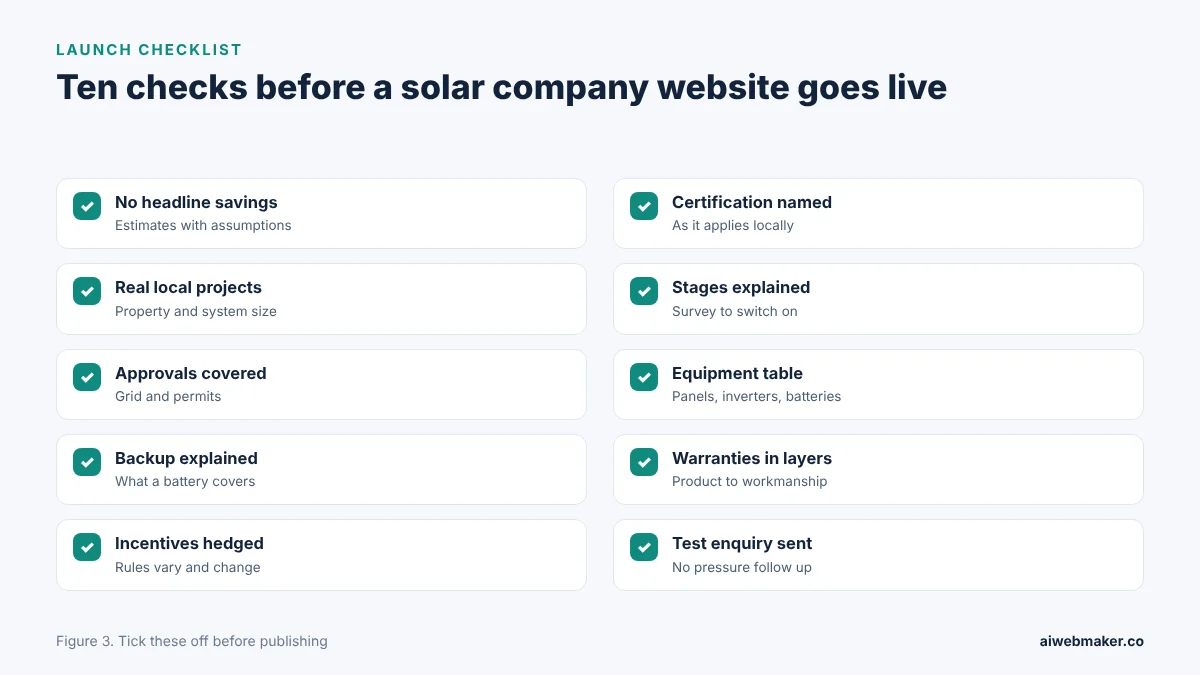
Homeowners close a solar site quickly when it opens with a bold savings figure and no explanation of where it came from. Missing certification details make the installer look like one more broker. Stock images of panels on unfamiliar roofs, rather than real local projects, weaken trust further. Pages that never mention the survey, shading or approvals suggest a sales process rather than an engineering one. A pushy enquiry form demanding a phone number before any information is given reminds visitors of the calls they want to avoid. Running through the ten checks pictured here keeps a new installer's site clear of those faults.
Frequently asked questions
Will panels keep the lights on during a power cut?
A standard grid connected system usually shuts down during a power cut, for the safety of people working on the network. Keeping some power on requires a battery and an inverter set up for backup, and even then the circuits covered depend on the design. Some systems back up only essential circuits, while others can run more of the home. The website should explain this clearly, because many buyers assume panels alone provide backup. Clear answers prevent disappointment the first time the grid goes down.
How long do solar panels last?
Solar panels typically last for decades, and many manufacturers offer performance warranties of around 25 years. Output declines slowly over that period, and the warranty usually states the minimum level expected. Inverters normally need replacing sooner than panels, and batteries have their own warranty terms. The website can explain these lifespans without promising exact figures for any particular product. Honest expectations help buyers compare quotes on more than price.
Is every roof suitable for solar?
Not every roof suits solar, because orientation, shading, structure, condition and available space all matter. A roof nearing the end of its life may need replacing before panels are fitted. Flat roofs, ground mounts or carports can be options where the main roof is unsuitable. Some buildings, such as listed or protected properties, may face extra approval rules depending on the country. A survey gives the real answer, and the website should say so.
Are incentives and export payments guaranteed?
Incentives and export payments are not guaranteed, because governments, regulators and energy suppliers set them and can change them. Rules differ widely between countries and regions, and eligibility may depend on the equipment, the installer or the date of connection. An installer can describe the schemes that currently apply locally but should avoid promising amounts. Buyers should check the latest terms with the relevant authority or supplier. Careful wording here protects buyers and keeps the installer on the right side of advertising rules.
Every direct enquiry is a lead nobody had to buy
Set beside one residential installation, the $119 that keeps a solar site online for the year looks trivial. Paid monthly, the $19 is a small sum next to what a single purchased lead often costs an installer. Each homeowner who contacts the company directly after reading the process page is a lead that never passed through a broker. Real local projects, clear certification and estimates with honest assumptions persuade where pressure sales fail. Installers who add every finished system to the projects page build a record that neighbours recognise. When enquiries start mentioning a nearby project seen on the site, the hosting has paid for itself many times over.
Build your website in Minutes and get the AI Tools that work
Start Building Your Website →