Wedding Cake Website Cost, Counted in Portions and Lead Times
For wedding cake makers, hosting means one $119 charge yearly, or $19 charged monthly, and the domain is added on top. Inside: how couples choose, the pages, portions, the tasting box, lead times, delivery and set up, allergens, search and the budget.
- No coding required
- Live in minutes
- Blog, SEO and chatbot tools included
A wedding cake maker's tiers, flavours and tasting box pages stay online on $119 of yearly hosting, or $19 billed monthly, with a domain added. Every page is drafted and tested in AI Web Maker before any money changes hands. A single two tier cake at the sample's $420 covers more than three years of that hosting. The difficulty is time and distance, because couples book a year ahead, pay a deposit for a cake that will not exist for months and need confidence that it will arrive upright at a venue the maker may never have seen. They also want to taste before they commit and to know how many guests each size really feeds. How couples choose, the pages, portions, the tasting box, lead times, delivery and set up, allergens, search and the yearly sums are worked through below.
This article is part of our complete guide: Food Business Website Builder.
Couples, planners and parents: who chooses the wedding cake
Wedding cakes are usually chosen by a couple, though planners, venue coordinators and paying parents often join the conversation. Most start looking once the date and venue are fixed, sometimes more than a year ahead. They shortlist makers by style first, then check whether the date is likely to be open and whether the maker delivers to their venue. Prices and portions come next, because a guest list of 120 changes the size and the budget. Flavours, allergens and a chance to taste decide which maker wins the booking. A website that answers those questions in that order turns a shortlist into a tasting box order.
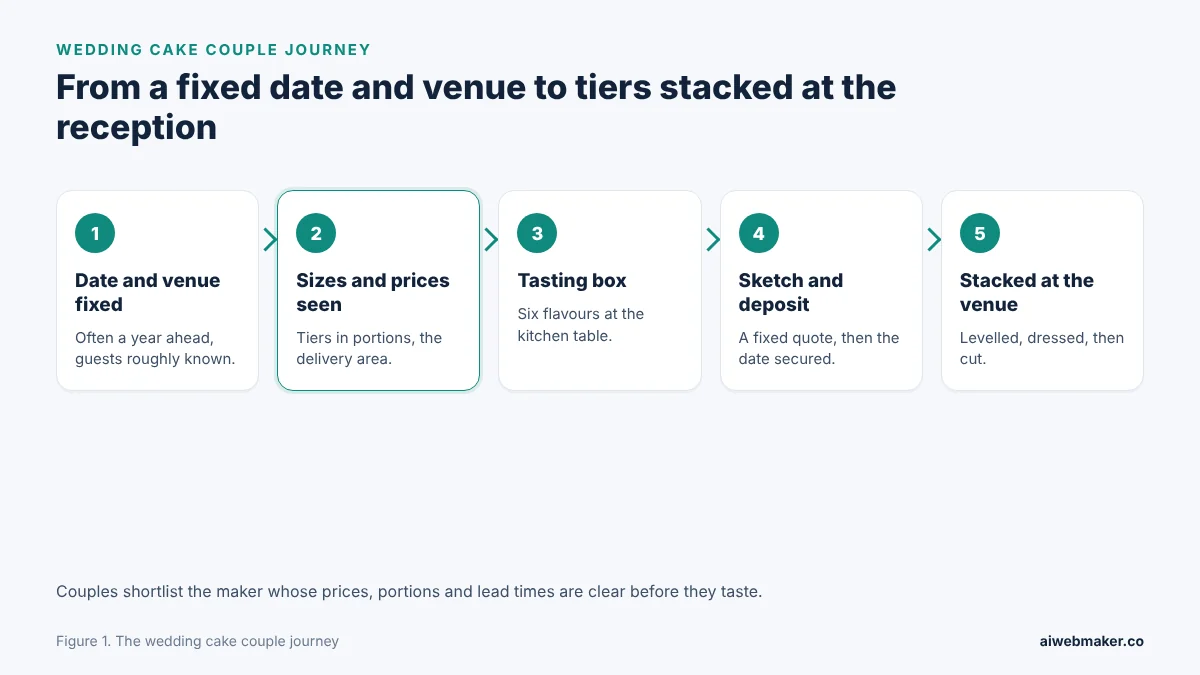
The second step of this journey settles the shortlist, because couples rarely order a tasting box from a maker whose sizes and prices they cannot see. Tiers counted in wedding portions, starting prices and the delivery area let a couple judge fit in minutes. The tasting box then moves the decision to the kitchen table, where flavours are argued over happily. A sketch, a fixed quote and a deposit secure the date. The morning the tiers are stacked, levelled and dressed at the venue is what the couple, the planner and the photographer remember.
Pages a wedding cake maker needs, from first look to cake table
A wedding cake maker needs pages that move a couple from browsing to tasting to booking without a phone call. The home page should show a cake on its table at a real venue, state the lead times and the delivery area, and invite couples to ask about their date. A sizes and prices page counts tiers in wedding portions, and a flavour page lists every recipe with its allergens. The tasting box deserves its own page, as do the lead times and the delivery and set up details. Galleries of cakes on their tables complete the set with the proof couples look for.
| Page | Couple's question | What it should show |
|---|---|---|
| Home | Is our date likely to be open? | Lead times, delivery area, ask about a date |
| Sizes and prices | How big, and how much? | Tiers counted in wedding portions, starting prices |
| Flavours | What can each tier be? | Flavour menu with allergens in words |
| Tasting box | Can we taste first? | Box contents, price, credit when booking |
| Lead times | When must we decide? | Months ahead, shortest notice, final details |
| Delivery and set up | Will it arrive safely? | Cooled van, stacking on site, venue needs |
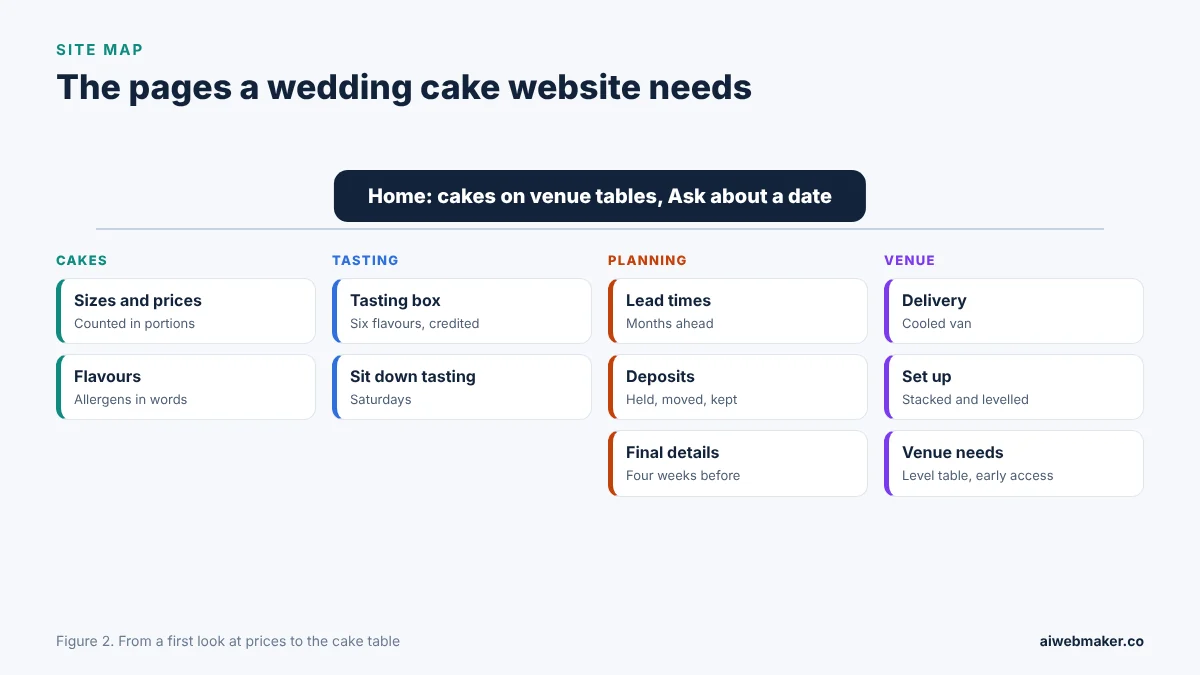
A couple planning a year ahead can follow this plan from a first look at prices to the morning the cake is stacked. Cake pages hold the sizes and flavours, tasting pages hold the box and sit down tastings, planning pages hold lead times and deposits, and venue pages hold delivery, set up and what the room must provide. Our sample, Tiered and True Wedding Cakes, prices two tiers from $420, three tiers from $680 and four tiers with a sugar flower cascade from $1,150. It sells a $40 tasting box of six flavours, drives every cake in a cooled van, stacks and levels it on site, and asks venues for a level table out of the sun and access two hours early. The wedding cake website example with a tasting box and venue set up is a layout written by hand, and no real studio bakes its sponges. Its habit of counting every size in wedding portions is the detail most worth copying.
Tiers priced in wedding portions, not party slices
Wedding cakes are best priced by tier and counted in wedding portions, because couples otherwise compare prices that feed very different numbers of guests. A wedding portion is usually a narrow finger slice, much smaller than a party slice, and the website should give its size. Each size can then show roughly how many guests it serves and its starting price with a simple finish. Extra portions for large guest lists can come from a plain kitchen cake sliced out of sight, which saves on display tiers. Advising couples to tell their caterer which portion to cut prevents running short on the day. Clear portion maths stops couples paying for tiers they do not need.
| Size | Tiers | Often suits | From |
|---|---|---|---|
| Two tiers | 15 cm on 23 cm | Smaller weddings or a shared dessert table | $420 |
| Three tiers | 10, 15 and 23 cm | Receptions of about 80 to 100 guests | $680 |
| Four tiers | With a sugar flower cascade | Long guest lists and high ceilings | $1,150 |
| Kitchen tray | Plain iced, sliced out of sight | About 40 extra portions | $95 |
The tasting box, sold before the sketch
A tasting box turns a browsing couple into a paying one, so it deserves its own page and a clear price. Six slices, one of each flavour, with a card naming every filling and allergen, give a couple an evening at the kitchen table to decide. Crediting the box price against the cake when the couple books within a set period, as the sample does with its $40 box and 30 days, makes that first payment feel safe. Collection days, ordering deadlines and whether boxes can travel by post should be stated, since fresh fillings rarely survive a parcel van. The AI website builder for wedding cake makers who sell tasting boxes drafts the sizes, flavours, tasting and delivery pages once the maker describes its studio and delivery area in a few lines, and everything stays open to revision in the preview before any payment. A well explained tasting box is often the step at which a shortlist of three becomes a single booking.
Lead times, date holds and deposits
Popular wedding dates fill early, so lead times and date holds belong near the top of the website rather than in small print. Saturdays in the busiest season may be booked a year or more ahead, while weekdays and quieter months often have room closer in. A short hold on a date while the couple orders a tasting box, followed by a sketch and a fixed quote, gives a fair sequence. A deposit paid directly to the maker then secures the date, with the balance and final details due some weeks before the wedding. The shortest notice the maker accepts for tiered cakes, and the longer notice for sugar flowers, should be stated plainly. Couples who can see the whole timeline plan their decisions without chasing the maker.
| When | What happens in the sample |
|---|---|
| 12 to 14 months before | The date is asked about and held for 14 days |
| After the tasting | A sketch and fixed quote within a week, then a 30% deposit |
| 8 weeks before | The latest new tiered order, or 12 weeks with sugar flowers |
| 4 weeks before | Final guest count, flavours, access times and the balance |
| Wedding week | Sponges baked, filled and iced over three days |
| On the day | Driven upright, stacked, levelled and dressed |
Delivery, set up and what the venue must provide
Tiered cakes travel in pieces and are built on the cake table, so delivery and set up are part of what a couple buys. The website should explain how tiers travel, for example boxed on a flat floor in a cooled van, and how long stacking, levelling and dressing take on site. Venues need to provide a sturdy, level table away from windows, heaters and the dance floor, with access before the room fills. Heat matters, because buttercream softens in warm rooms and summer marquees, and a maker that suggests a firmer finish for hot venues sounds experienced. Flowers from the florist should be unsprayed and safe near food, with stems wrapped rather than pushed into the sponge, because some popular blooms are not safe to eat. Many makers also state that responsibility passes to the venue once the cake is set up and photographed, which keeps everyone clear about who guards it afterwards.
Nut traces, sealed desserts and cottage food laws
Wedding cakes raise allergen questions from guests the couple may barely know, so every flavour should list its allergens in plain words. A kitchen that uses wheat flour, nuts, soya and sesame should say traces are possible in any cake, even a tier made without wheat. A guest with a serious allergy is better served by a sealed dessert from a specialist kitchen, placed beside the cake. Rules for cake kitchens vary widely, since many states of the United States let home bakers sell under cottage food laws that often exclude cakes needing refrigeration, while the United Kingdom requires every food business to register. Labelling law also changes between countries, and the maker answers to whichever version governs its own kitchen. A flavour menu with honest allergen notes reassures couples planning for every guest at the table.
Searches couples make once the venue is booked
Couples searching for a cake maker usually name a style, a place or a step in the process. Typical phrases include wedding cake maker near me, buttercream wedding cake, wedding cake tasting, sugar flower wedding cake and wedding cakes delivered to a named venue or county. Each size, flavour and tasting page should carry its matching phrase in a heading, so the tasting page answers the couple who typed tasting. On maps, a studio listing with tasting hours and photos of cakes on real venue tables catches couples nearby. Reviews that mention a cake stacked before the guests arrived, or a kind answer about an allergy, carry weight with the next couple. Articles on how many portions a guest list needs or buttercream in summer reach couples early in their planning.
The cake studio's hosting sums for a wedding year
Next to the price of a single tiered cake, a year of hosting is a minor expense. A busy studio keeps it lowest with one $119 payment, while a maker taking its first wedding bookings may prefer the $19 monthly route. A dozen articles on portions, flavours and summer weddings need about $7.80 in AI credits. New cakes in the gallery, revised prices and a wider delivery area are added at no further cost. Totals for each route appear below, the $189 tier included purely so the figures can be compared.
| Item | Yearly | Monthly |
|---|---|---|
| Hosting the sizes, flavours and tasting pages | $119 | $228 over twelve months |
| Domain | Depends on the ending | Depends on the ending |
| Higher plan, for comparison | $189 a year | Not needed |
| Twelve portion and flavour articles at about $0.65 | About $7.80 | About $7.80 |
| Gallery cakes, prices and delivery area | No charge | No charge |
| Year before the domain | About $126.80 | About $235.80 |
Gaps that make couples cross a cake maker off the list
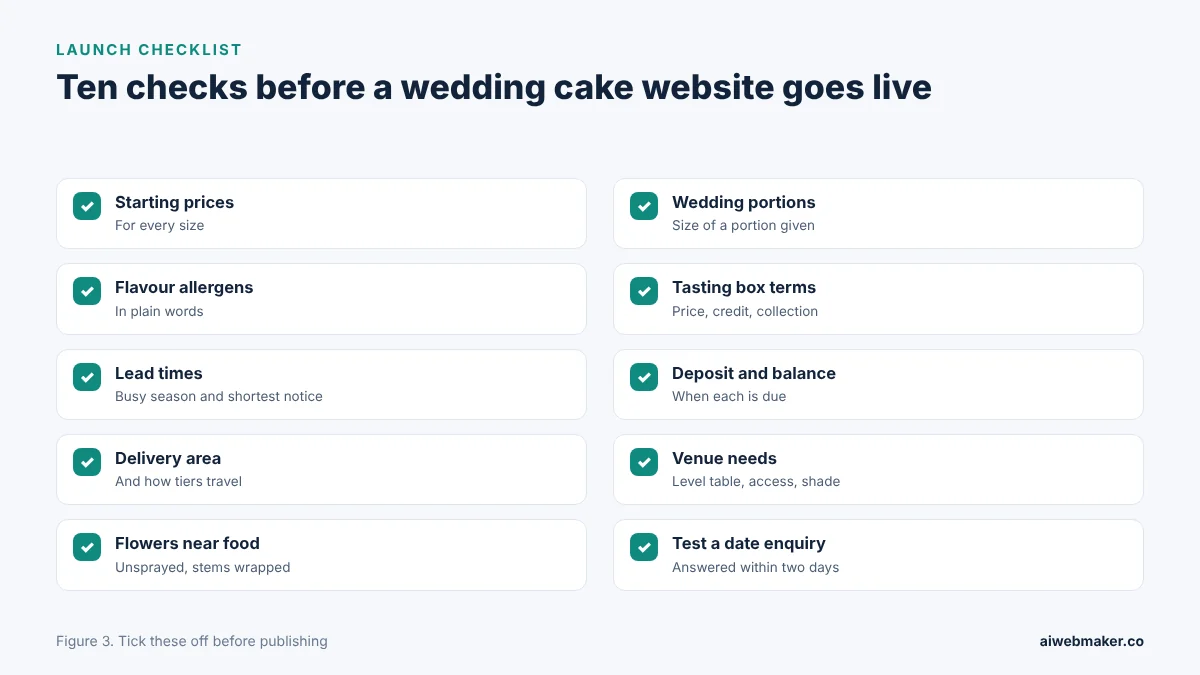
Couples cross a maker off quickly when the website shows beautiful cakes but no starting prices at all. Prices without portions leave them unable to tell whether three tiers will feed 120 guests. Missing lead times make them fear the date has gone, so they move on without asking. Silence on delivery and set up raises the worst wedding day worry, a cake that never arrives or arrives leaning. No allergen information leaves a couple planning for a guest with a nut allergy no choice but to look elsewhere. Ten cake studio checks, pictured next, keep a couple from ever meeting those gaps.
Frequently asked questions
How many guests does each tier size feed?
Guest numbers depend on the portion cut, so a maker should count every size in wedding portions and give the portion's dimensions. A wedding portion is a finger slice, roughly half a party slice, which means the same cake feeds about twice as many guests when cut that way. The sample's three tiers give about 90 wedding portions or about 45 party slices. Leaving a cutting guide with the cake helps the caterer cut the right size. Clear numbers prevent both shortages and oversized cakes.
What if the venue is hot or the cake stands in a marquee?
Warm rooms and marquees soften buttercream, and couples booking summer dates deserve to know how the maker copes. The sample warns that buttercream softens above about 24 °C and suggests a fondant finish or keeping the cake indoors until the cutting. A maker can also ask about the planned position of the cake table and raise concerns in advance. Honest advice about weather protects the couple's photographs. Clear guidance shows that the maker has delivered to hot venues before.
Can the tasting box be posted?
Tasting boxes filled with fresh buttercream and curd rarely travel well, so many makers ask couples to collect them. The website should say which days boxes are ready and when they must be ordered. Couples who live further away can be offered a sit down tasting instead. Stating the rule saves disappointed messages from couples hoping for a parcel. A clear answer also signals that the maker cares about freshness.
Can a booked cake follow a postponed wedding?
Postponed weddings are common enough that the deposit's fate deserves a sentence before anyone pays one. The sample lets a deposit move once to a new date within twelve months, if that day is still open. Cancellation terms, such as which payments are kept and when the full price falls due, should be stated just as clearly. These are the maker's own terms, settled directly with the couple. Fair, visible rules make a large deposit easier to pay.
How many tiers pay for the cake studio's year online?
Three tasting boxes at the sample's $40 already cover the $119 hosting fee between them. One two tier cake pays for more than three years, and a four tier cascade for many more. What earns those bookings is clarity on portions, prices, lead times and set up, all visible before a couple sends a message. A tasting box then brings the decision to the kitchen table, where the maker's flavours do the talking. Makers who add each season's cakes to the gallery give couples fresh proof every spring. Counted in tiers, a year online costs less than one layer of sponge.
Build your website in Minutes and get the AI Tools that work
Start Building Your Website →